Why Cooling Is a System-Level Engineering Decision
author: HT infinitepower
2026-07-28
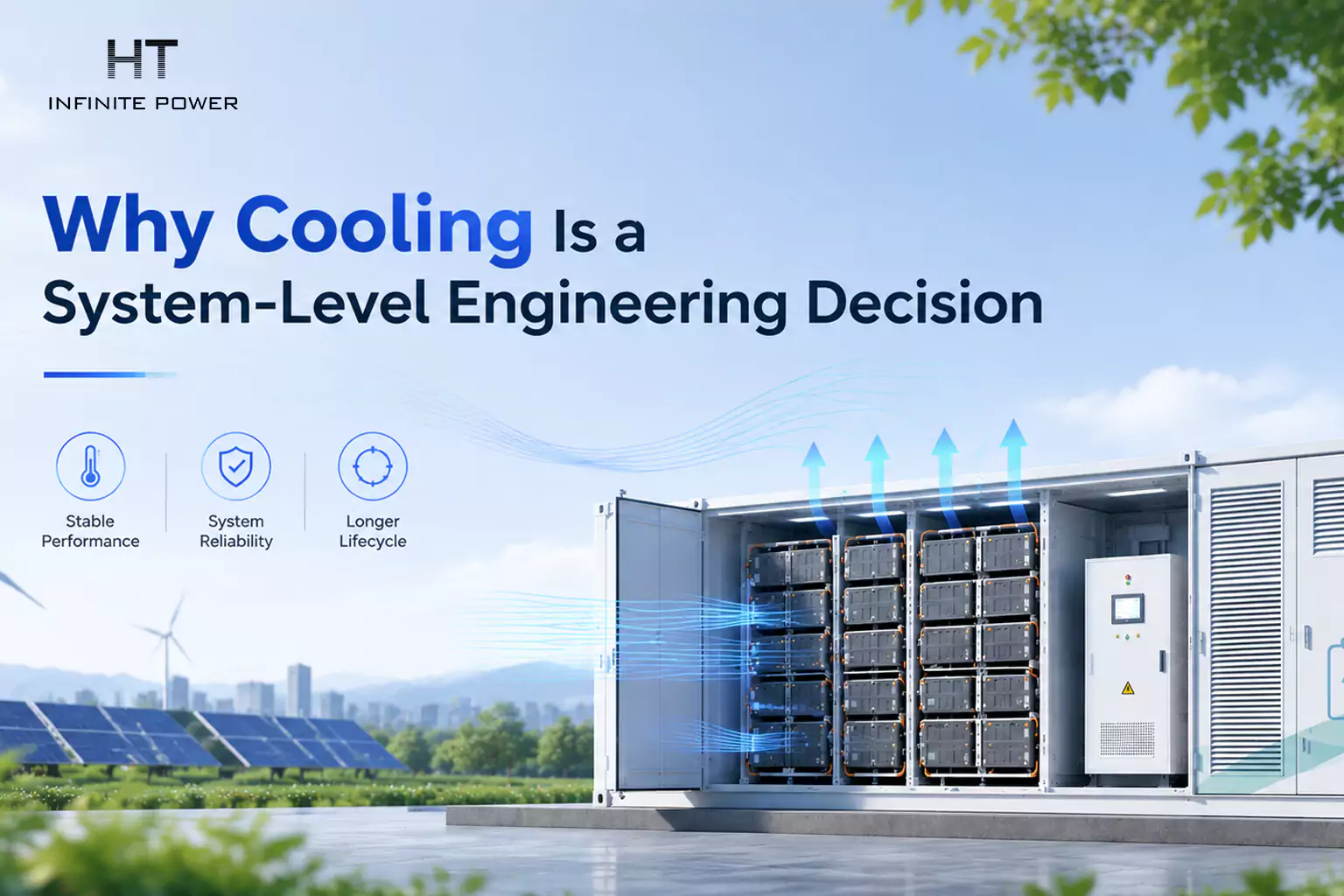
Thermal management is sometimes considered a supporting subsystem of BESS design.
In real engineering evaluations, it is treated as a factor that directly influences battery performance, reliability, and lifecycle behavior.
The purpose of thermal management is not simply to remove heat.
It is to maintain stable operating conditions across the entire battery system.
Battery Efficiency and Thermal Uniformity
Battery performance is affected not only by operating temperature but also by temperature distribution.
Engineers typically evaluate:
- Average battery temperature
- Maximum temperature points
- Cell-to-cell temperature difference
- Module-to-module temperature difference
- Rack-level thermal uniformity
Even when the average battery temperature remains within the recommended operating range, large temperature differences between cells can create uneven operating conditions.
For example:
A warmer module may experience faster aging compared with cooler modules operating under the same charging and discharging schedule.
Over thousands of cycles, this difference can affect:
- Available capacity
- System balancing performance
- Battery lifetime prediction
During commercial BESS design reviews, thermal uniformity is often considered a key indicator of long-term system consistency.
A cooling system with better temperature distribution can help the battery operate closer to its expected lifecycle performance.
Battery Degradation and Thermal Stress
Battery degradation is influenced by multiple factors, including:
- Operating temperature
- Charging and discharging rate
- Cycling frequency
- Depth of discharge
Thermal stress becomes more significant when a BESS operates frequently at high power.
For example, industrial peak shaving projects may require daily charging and discharging cycles.
Under these conditions, repeated heat generation can create cumulative thermal stress.
For example, industrial peak shaving projects may require daily charging and discharging cycles.
Under these conditions, repeated heat generation can create cumulative thermal stress.
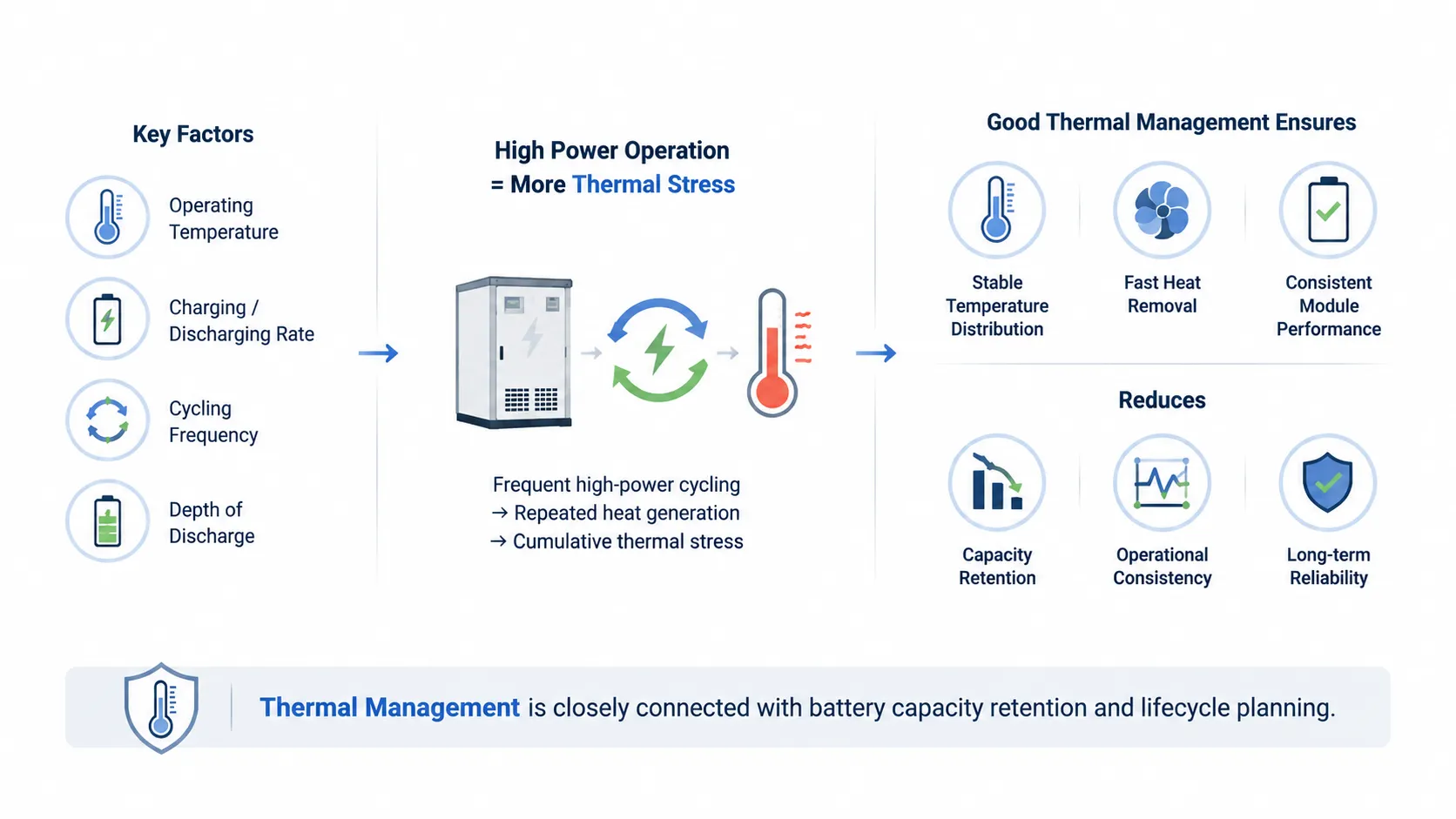
Engineers evaluate whether the cooling system can maintain:
- Stable temperature distribution
- Fast heat removal
- Consistent module performance
A system that experiences repeated thermal imbalance may show uneven degradation among battery modules.
This can reduce:
- Available capacity retention
- Operational consistency
- Long-term reliability
For this reason, thermal management is closely connected with battery capacity retention and lifecycle planning.
Safety and Operating Reliability
Thermal management contributes to BESS safety by controlling operating conditions and reducing excessive heat accumulation.
A properly designed cooling system helps manage:
- Localized heat generation
- Thermal imbalance
- High-power operating stress
- Abnormal temperature increases
However, cooling is only one part of the complete safety architecture.
Thermal management does not replace:
- Battery Management System (BMS)
- Electrical protection systems
- Fire suppression systems
- Thermal runaway mitigation strategies
A complete commercial BESS design requires coordination between electrical protection, battery monitoring, thermal management, and safety systems.
Cooling supports safe operation by maintaining controlled battery conditions, while other protection systems address abnormal operating events.
2. Air Cooling Characteristics: Advantages and Engineering Limitations
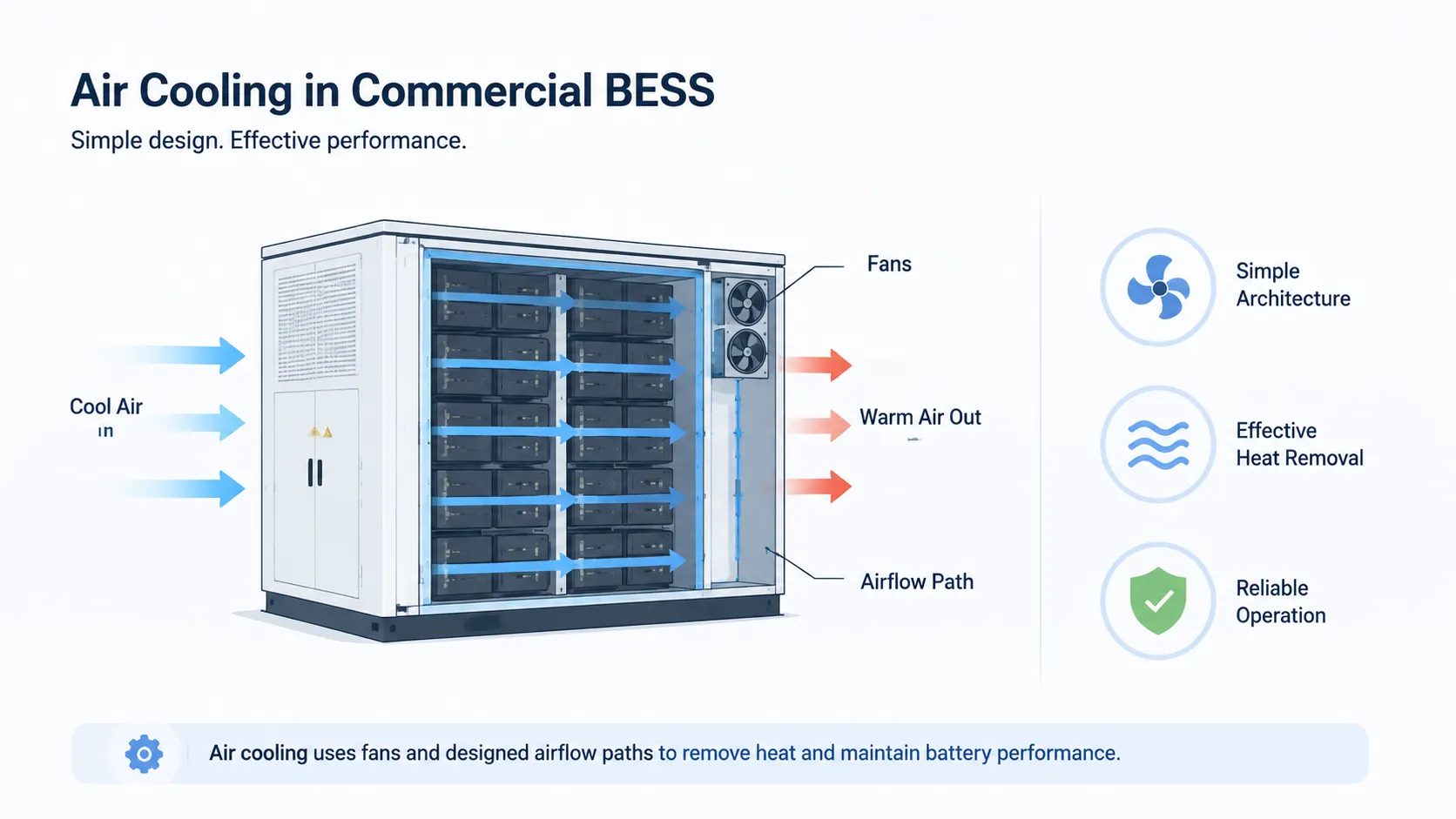
Air cooling remains widely used in commercial BESS applications because of its relatively simple architecture.
From an engineering perspective, air cooling removes heat by circulating air through battery modules using fans and designed airflow paths.
Its main advantage is system simplicity.
From an engineering perspective, air cooling removes heat by circulating air through battery modules using fans and designed airflow paths.
Its main advantage is system simplicity.
Simpler System Structure
Air cooled BESS systems generally contain fewer mechanical components compared with liquid cooling systems.
Typical components include:
- Fans
- Air ducts
- Filters
- Temperature sensors
- Control systems
This simpler structure provides advantages in:
- Installation
- Maintenance
- Troubleshooting
- Initial investment
For smaller commercial storage projects, air cooling can provide a practical balance between thermal performance and system complexity.
During early-stage project evaluation, engineers often consider whether the thermal requirements justify additional cooling complexity.
For systems with moderate power requirements and limited cycling frequency, a simpler air cooling architecture may provide sufficient performance.
Easier Maintenance and Lower System Complexity
Maintenance requirements are an important consideration in commercial BESS projects.
Air cooling typically provides:
- Easier inspection procedures
- Fewer mechanical components
- Simpler service requirements
This can be valuable for facilities where operational simplicity is a priority.
However, simplicity does not automatically mean suitability for every application.
As battery systems become larger and more compact, maintaining thermal uniformity becomes increasingly challenging.
However, simplicity does not automatically mean suitability for every application.
As battery systems become larger and more compact, maintaining thermal uniformity becomes increasingly challenging.
Heat Dissipation Limitations at Higher Energy Density
The main limitation of air cooling appears when battery energy density increases.
The engineering relationship is:
Higher energy density
↓
Higher heat generation within limited space
↓
Greater thermal load
↓
More difficult airflow management
Higher energy density
↓
Higher heat generation within limited space
↓
Greater thermal load
↓
More difficult airflow management
As battery modules become more densely arranged, airflow must remove heat across a larger number of cells through limited air channels.
This creates challenges in:
- Heat dissipation capability
- Airflow distribution
- Temperature consistency
For large-scale BESS projects, the challenge is not only removing heat.
It is ensuring that every battery module receives sufficient and balanced cooling.
It is ensuring that every battery module receives sufficient and balanced cooling.
3. Liquid Cooling Characteristics: Advantages and Engineering Considerations
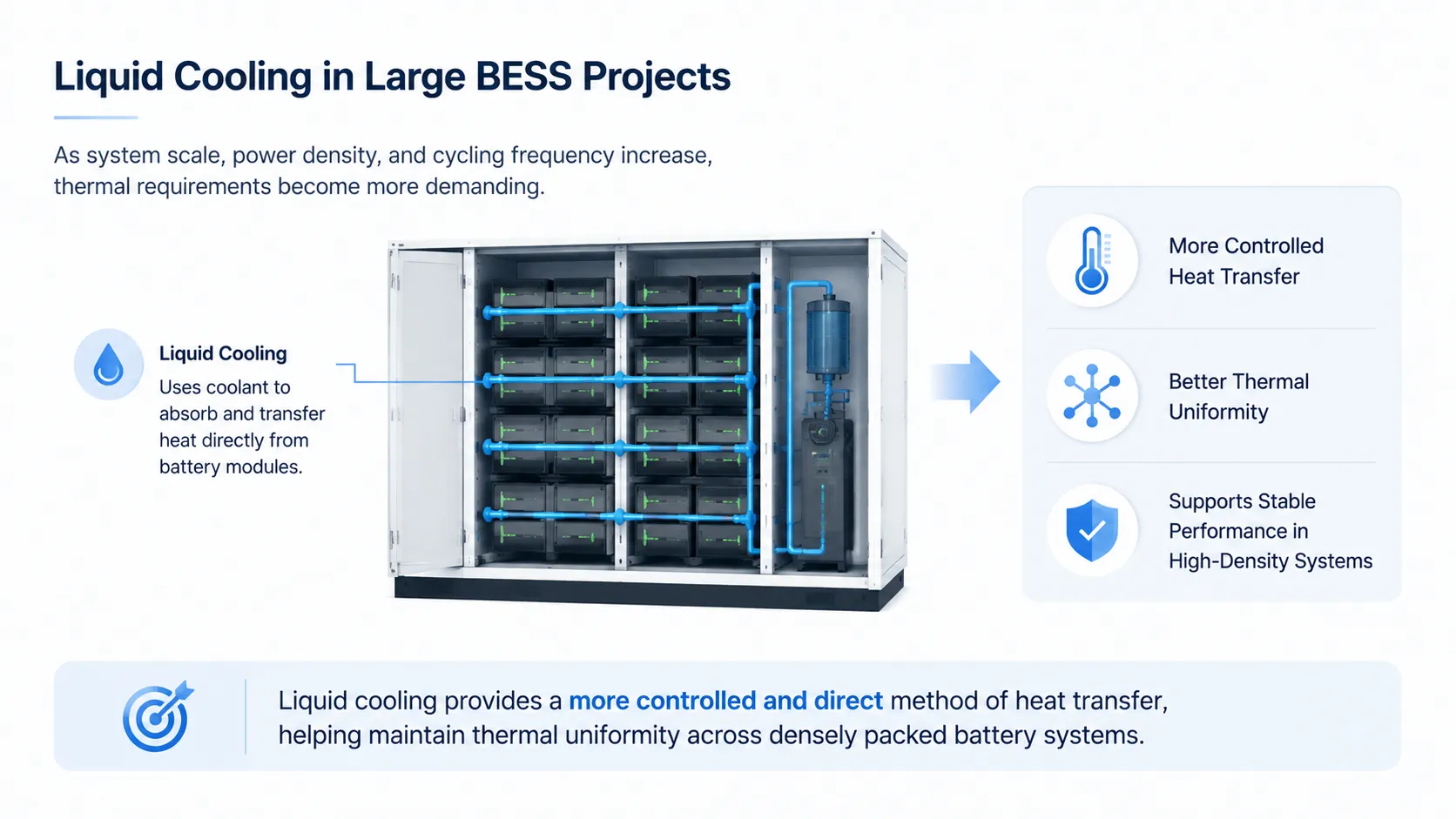
Liquid cooling has become increasingly considered in larger Battery Energy Storage System (BESS) projects because thermal requirements become more demanding as system scale, power density, and cycling frequency increase.
The engineering advantage of liquid cooling is not simply that it can achieve lower temperatures.
The more important factor is that it provides a more controlled and direct method of heat transfer, which helps maintain thermal uniformity across densely packed battery systems.
Better Thermal Uniformity and Heat Dissipation Capability
In high-energy-density BESS designs, battery modules are arranged closer together to achieve higher capacity within a limited footprint.
As the system becomes more compact, heat generated during operation must be removed more efficiently.
Liquid cooling provides a direct heat transfer path between:
- Battery cells
- Cooling plates or thermal interfaces
- Liquid circulation system
Compared with airflow-based cooling, this approach can provide stronger control over:
- Cell temperature difference
- Module temperature difference
- Rack-level thermal distribution
For EPC contractors and system integrators, this thermal consistency is often one of the key evaluation factors when selecting a cooling strategy.
The question is not only:“How much heat can the system remove?”
It is also:“How evenly can the system maintain temperature across all battery units?”
It is also:“How evenly can the system maintain temperature across all battery units?”
A smaller temperature difference between cells and modules helps reduce uneven aging and supports more predictable battery performance.
Stronger Cooling Response During High-Power Operation
High-power charging and discharging create higher instantaneous heat generation.
This is especially relevant for applications such as:
- Industrial peak shaving
- Frequent energy shifting
- High-cycle commercial BESS
- Grid-support applications
During these operating conditions, engineers evaluate the cooling system’s response capability.
Important considerations include:
- Heat generation rate
- Cooling response speed
- Temperature recovery after high-power events
- Thermal stress during repeated cycles
A battery system operating at high power every day creates a different thermal challenge compared with a system used occasionally.
Liquid cooling becomes more valuable when the operating profile creates continuous thermal demand.
Why Liquid Cooling Becomes More Important in High-Density BESS
The increasing adoption of larger battery systems creates a direct relationship between energy density and thermal management requirements.
The engineering relationship can be summarized as:
Higher energy density
↓
Higher power intensity
↓
More frequent cycling
↓
Higher heat generation rate
↓
Greater thermal management requirement
As battery systems become larger, airflow limitations become more noticeable.
Air cooling depends on distributing air evenly through battery modules. However, in compact systems:
- Air paths become longer
- Cooling effectiveness can vary between modules
- Temperature differences may increase
Liquid cooling provides a more direct heat transfer path, making it better suited for applications requiring stronger thermal control.
This does not mean liquid cooling is always the preferred option.
The decision depends on whether the project’s thermal requirements justify the additional system complexity.
Suitable for Large-Scale and High-Cycle Applications
Liquid cooling is commonly evaluated for:
- Large commercial BESS
- MWh containerized energy storage systems
- Industrial facilities with frequent cycling
- High-power energy storage applications
These applications typically have:
- Higher battery capacity
- Greater operating intensity
- More demanding lifecycle expectations
For example, a factory using a BESS every day for demand management may place significantly higher thermal demands on the battery system than a commercial building using storage occasionally.
In these cases, stronger thermal control may provide additional lifecycle value.
In these cases, stronger thermal control may provide additional lifecycle value.
Higher System Complexity and Engineering Requirements
The improved thermal performance of liquid cooling comes with additional design requirements.
A liquid cooling system typically includes:
- Cooling plates
- Pumps
- Liquid circulation loops
- Heat exchangers
- Control components
- Monitoring systems
This increases:
- System complexity
- Commissioning requirements
- Maintenance considerations
During project evaluation, engineers must consider whether the operational requirements justify this additional complexity.
Maintenance Considerations
Liquid cooling introduces additional maintenance factors compared with air cooling.
Engineers typically evaluate:
- Leakage prevention
- Cooling circuit reliability
- Pump operation
- Fluid monitoring
- Long-term maintenance requirements
For commercial BESS projects, maintenance planning is an important part of lifecycle evaluation.
A technically advanced cooling system still needs to provide reliable operation throughout the project lifetime.
A technically advanced cooling system still needs to provide reliable operation throughout the project lifetime.
4. Air Cooling vs Liquid Cooling: Cost and Lifecycle Considerations
Cooling selection should not be determined only by initial equipment cost.
During commercial BESS design, engineers evaluate the complete lifecycle impact.
During commercial BESS design, engineers evaluate the complete lifecycle impact.
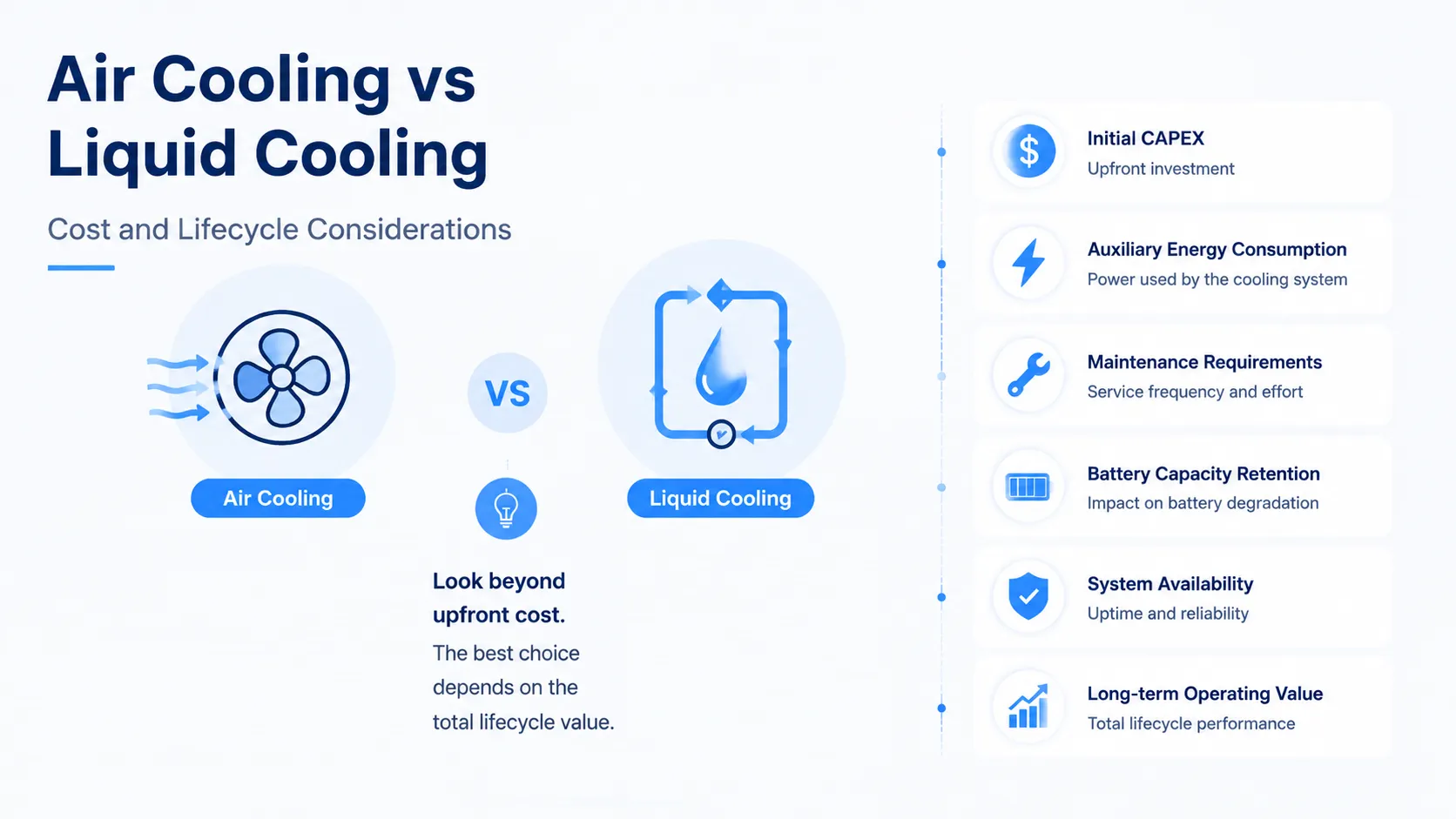
The evaluation typically includes:
- Initial CAPEX
- Auxiliary energy consumption
- Maintenance requirements
- Battery capacity retention
- System availability
- Long-term operating value
A cooling solution with lower initial cost may not always provide the lowest total lifecycle cost.
Air Cooling vs Liquid Cooling Comparison
| Parameter | Air Cooling | Liquid Cooling |
|---|---|---|
| System complexity | Simpler architecture with fewer mechanical components | More complex system requiring pumps, liquid circuits, and thermal controls |
| Initial CAPEX | Generally lower upfront investment | Higher initial investment due to additional thermal components |
| Temperature uniformity | Depends strongly on airflow design and module arrangement | Generally provides better temperature consistency across cells and modules |
| Heat dissipation capability | Suitable for moderate thermal loads | Better suited for high heat generation and dense battery configurations |
| Cooling response during high-power operation | Limited by airflow distribution and heat transfer path | Faster and more direct thermal response |
| Maintenance requirements | Simpler inspection and service procedures | Requires monitoring of pumps, cooling circuits, and leakage risks |
| Auxiliary energy consumption | Usually lower due to simpler cooling equipment | Higher due to pumps and additional thermal components |
| Suitable application scale | Small to medium commercial BESS | Medium to large commercial and containerized BESS |
| High-cycle performance | Suitable for moderate cycling requirements | Better suited for frequent charge/discharge operation |
| Energy density suitability | More challenging as system density increases | Better suited for compact high-density battery systems |
This comparison does not indicate that one technology is universally superior.
The engineering decision depends on the relationship between:
- Thermal requirements
- Operating conditions
- Project economics
- Lifecycle expectations
Auxiliary Energy Consumption Considerations
Cooling systems consume energy during operation, which affects overall BESS efficiency.
Air cooling generally has lower auxiliary consumption because the system mainly relies on fans and airflow management.
Air cooling generally has lower auxiliary consumption because the system mainly relies on fans and airflow management.
Liquid cooling requires additional components, including:
- Pumps
- Cooling units
- Thermal control systems
These components increase parasitic energy consumption.
However, auxiliary consumption cannot be evaluated separately from thermal performance.
However, auxiliary consumption cannot be evaluated separately from thermal performance.
For example, a liquid cooling system may consume more energy but provide:
- Better temperature consistency
- Lower thermal stress
- Improved battery capacity retention
In high-cycle applications, these benefits may offset the additional cooling energy consumption.
Engineers therefore evaluate both:
Thermal performance and Cooling system energy demand
when selecting the appropriate solution.
Thermal performance and Cooling system energy demand
when selecting the appropriate solution.
Lifecycle Cost Beyond Initial Investment
A complete lifecycle evaluation considers more than equipment price.
Important factors include:
Battery Capacity Retention
Better thermal uniformity can help reduce uneven aging between cells and modules.
This may support:
This may support:
- More predictable degradation
- Better available capacity over time
- Improved long-term performance
Maintenance Requirements
Air cooling generally has simpler maintenance requirements.
Liquid cooling requires additional monitoring of:
- Pumps
- Cooling circuits
- Thermal components
The maintenance strategy should match the operational capability of the project owner.
System Availability
For industrial applications, system availability can directly affect project value.
Engineers evaluate:
Engineers evaluate:
- Downtime risks
- Maintenance intervals
- Cooling system reliability
A cooling method that improves long-term operational stability may provide additional value despite higher initial cost.
The correct comparison is therefore not:
“Which cooling method has the lowest purchase cost?”
The more complete engineering question is:
“Which cooling strategy provides the required thermal performance and lifecycle value under actual operating conditions?”
“Which cooling method has the lowest purchase cost?”
The more complete engineering question is:
“Which cooling strategy provides the required thermal performance and lifecycle value under actual operating conditions?”
5. Application Scenarios: When to Choose Air Cooling or Liquid Cooling
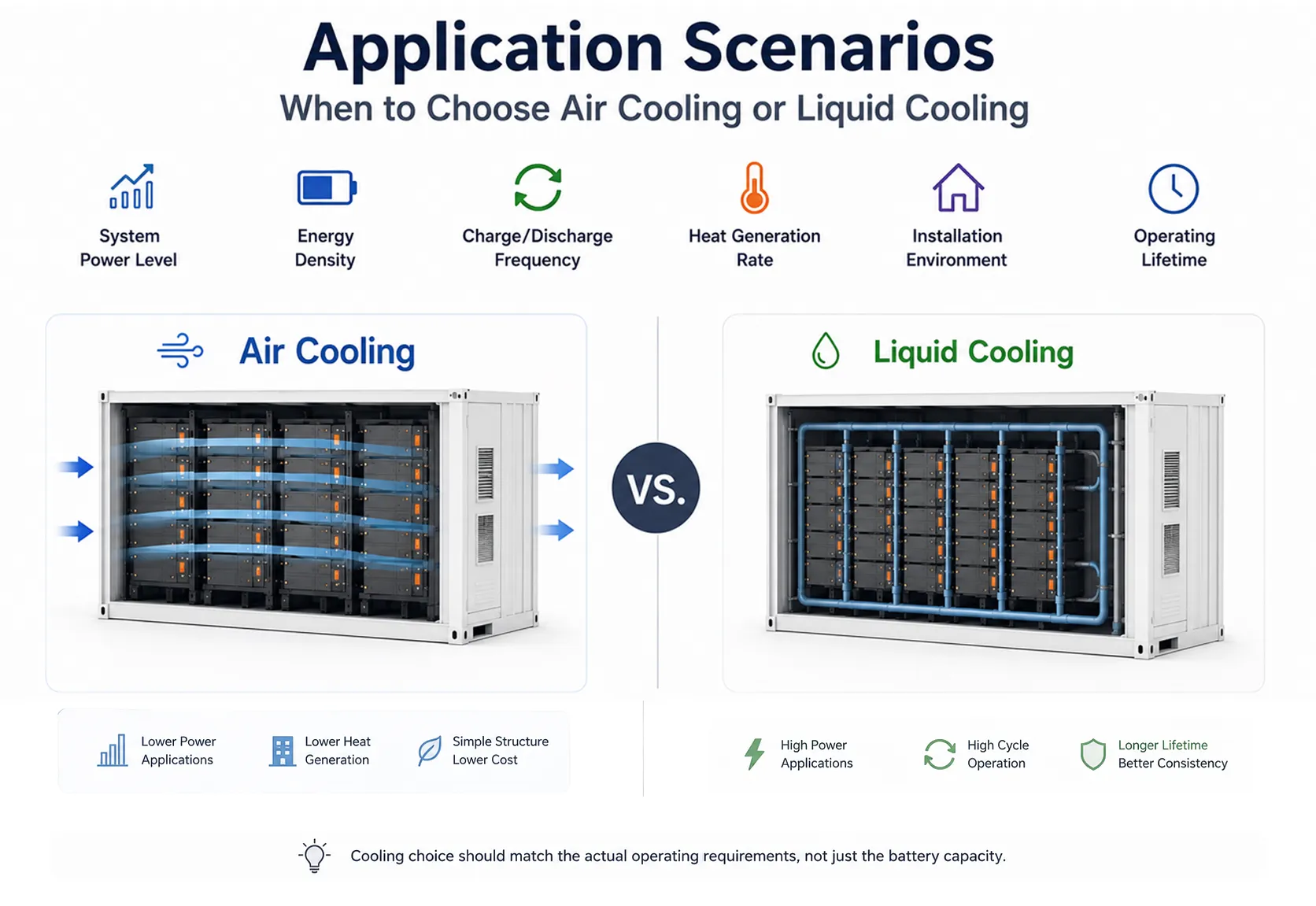
Cooling selection depends on the actual operating requirements of the BESS project.
In practical commercial BESS evaluations, engineers do not select cooling technology based only on battery capacity.
In practical commercial BESS evaluations, engineers do not select cooling technology based only on battery capacity.
They consider:
- System power level
- Energy density
- Charging and discharging frequency
- Heat generation rate
- Installation environment
- Expected operating lifetime
Different applications create different thermal challenges.
A cooling approach suitable for a small commercial storage system may not be appropriate for a high-cycle industrial BESS.
Cooling Considerations for Different BESS Applications
| BESS Application | Typical Characteristics | Cooling Considerations |
|---|---|---|
| Small commercial storage | Lower capacity, moderate power demand, occasional operation | Air cooling can often provide sufficient thermal performance with lower complexity and cost |
| Commercial and industrial (C&I) BESS | Demand management, peak shaving, moderate to frequent cycling | Cooling selection depends on power intensity, battery density, and operating frequency |
| MWh containerized BESS | Large battery capacity, compact system design, higher energy density | Liquid cooling is often considered due to stronger thermal uniformity requirements |
| High-cycle peak shaving systems | Daily charging/discharging, continuous thermal stress | Strong thermal management capability becomes more important to maintain lifecycle performance |
This table does not represent a fixed selection rule.
The final cooling decision depends on the specific system design and operating conditions.
The final cooling decision depends on the specific system design and operating conditions.
Smaller Commercial BESS Applications
For smaller commercial storage projects, air cooling can often provide a practical balance between performance and system simplicity.
Typical applications include:
- Commercial buildings
- Small industrial facilities
- Lower-frequency peak demand management
These systems may have:
- Lower thermal load
- Moderate cycling frequency
- Less demanding power operation
In these cases, air cooling advantages include:
- Lower initial investment
- Simpler maintenance
- Lower auxiliary energy consumption
- Reduced system complexity
However, engineers still need to verify that airflow design can maintain acceptable temperature differences between modules.
Even smaller systems require sufficient thermal uniformity to avoid uneven battery aging.
Commercial and Industrial BESS Applications
C&I BESS projects often require more detailed thermal evaluation because operating conditions vary significantly.
For example:
A warehouse using storage occasionally for demand management may have moderate cooling requirements.
A manufacturing facility using a BESS every working day for peak shaving may experience:
- More frequent cycling
- Higher charging/discharging power
- Greater cumulative thermal stress
In these applications, cooling selection becomes closely connected with:
- Battery capacity sizing
- PCS power requirements
- Operating strategy
For example, a peak shaving project designed through the How to Size Battery Capacity for Peak Shaving Projects methodology must consider not only energy requirements but also the thermal impact of repeated power operation.
MWh Containerized BESS Applications
Large containerized BESS systems create additional thermal challenges because battery capacity is concentrated within a limited physical area.
Key engineering concerns include:
- Higher energy density
- Larger heat generation volume
- More complex airflow distribution
- Greater requirement for temperature consistency
For these systems, liquid cooling is often evaluated because it provides a more direct and controllable heat transfer method.
The decision is driven by system requirements rather than the assumption that larger systems always require liquid cooling.
High-Cycle Peak Shaving Systems
Some industrial BESS projects operate almost every day.
Examples include facilities with:
- Significant demand charges
- Predictable daily load patterns
- Frequent charge/discharge operation
These projects create higher thermal stress because the battery experiences repeated:
- Power changes
- Heat generation events
- Cooling recovery cycles
Under these conditions, engineers pay more attention to:
- Cooling response speed
- Thermal uniformity
- Long-term degradation impact
6. Engineering Factors That Determine Cooling Selection
Cooling selection is not an independent decision.
It is part of the overall commercial BESS design process, where engineers evaluate how different subsystems interact.
It is part of the overall commercial BESS design process, where engineers evaluate how different subsystems interact.
The main factors include:
Battery Chemistry and Thermal Characteristics
Different battery technologies and cell formats have different thermal behaviors.
Engineers consider:
- Heat generation characteristics
- Operating temperature range
- Thermal sensitivity
- Expected cycle performance
Even when two systems use the same battery chemistry, differences in:
- Cell design
- Module structure
- System arrangement
can influence cooling requirements.
The thermal management system must match the actual battery architecture.
The thermal management system must match the actual battery architecture.
System Size and Energy Density
System size directly affects thermal requirements.
As battery capacity increases:
- Total heat generation increases
- Thermal management becomes more complex
- Temperature control becomes more important
Higher energy density creates additional challenges because more cells operate in a smaller physical volume. This is closely related to battery capacity sizing considerations in commercial BESS projects.
The engineering relationship is:
Higher energy density
↓
Higher heat concentration
↓
Greater cooling demand
↓
Need for improved thermal management capability
Higher energy density
↓
Higher heat concentration
↓
Greater cooling demand
↓
Need for improved thermal management capability
This is one reason liquid cooling is increasingly considered for large-scale BESS projects.
Operating Profile and Cycling Frequency
The operating profile has a direct impact on thermal stress.
A BESS that operates occasionally will experience different thermal conditions compared with a system cycling multiple times per day.
Engineers evaluate:
- Charging duration
- Discharging duration
- Power intensity
- Cycling frequency
For example:
A system designed for occasional backup operation may have limited thermal demand.
A system designed for daily peak shaving requires stronger thermal management because repeated operation increases cumulative heat generation.
A system designed for occasional backup operation may have limited thermal demand.
A system designed for daily peak shaving requires stronger thermal management because repeated operation increases cumulative heat generation.
This is also why cooling evaluation should be connected with previous engineering stages such as:
- Load profile analysis
- Battery capacity sizing
- PCS selection
Load behavior determines how frequently and how intensely the battery operates.
Installation Environment
The installation location affects cooling requirements.
Engineers consider:
- Ambient temperature range
- Outdoor exposure
- Seasonal variation
- Dust conditions
- Space limitations
Outdoor BESS systems may require different thermal strategies compared with indoor installations.
The cooling system must maintain stable operation across expected environmental conditions.
The cooling system must maintain stable operation across expected environmental conditions.
Lifecycle Expectations
Projects with longer operating requirements usually require deeper thermal analysis.
Engineers evaluate:
- Expected cycle count
- Battery degradation expectations
- Availability requirements
- Maintenance strategy
A cooling system that provides better thermal consistency may support better long-term battery performance.
However, the additional complexity and cost must also be justified by the project requirements.
However, the additional complexity and cost must also be justified by the project requirements.
7. Engineering Recommendation Logic: Not Which Cooling Is Better, But Which Fits the Project
The correct cooling selection process follows system requirements.
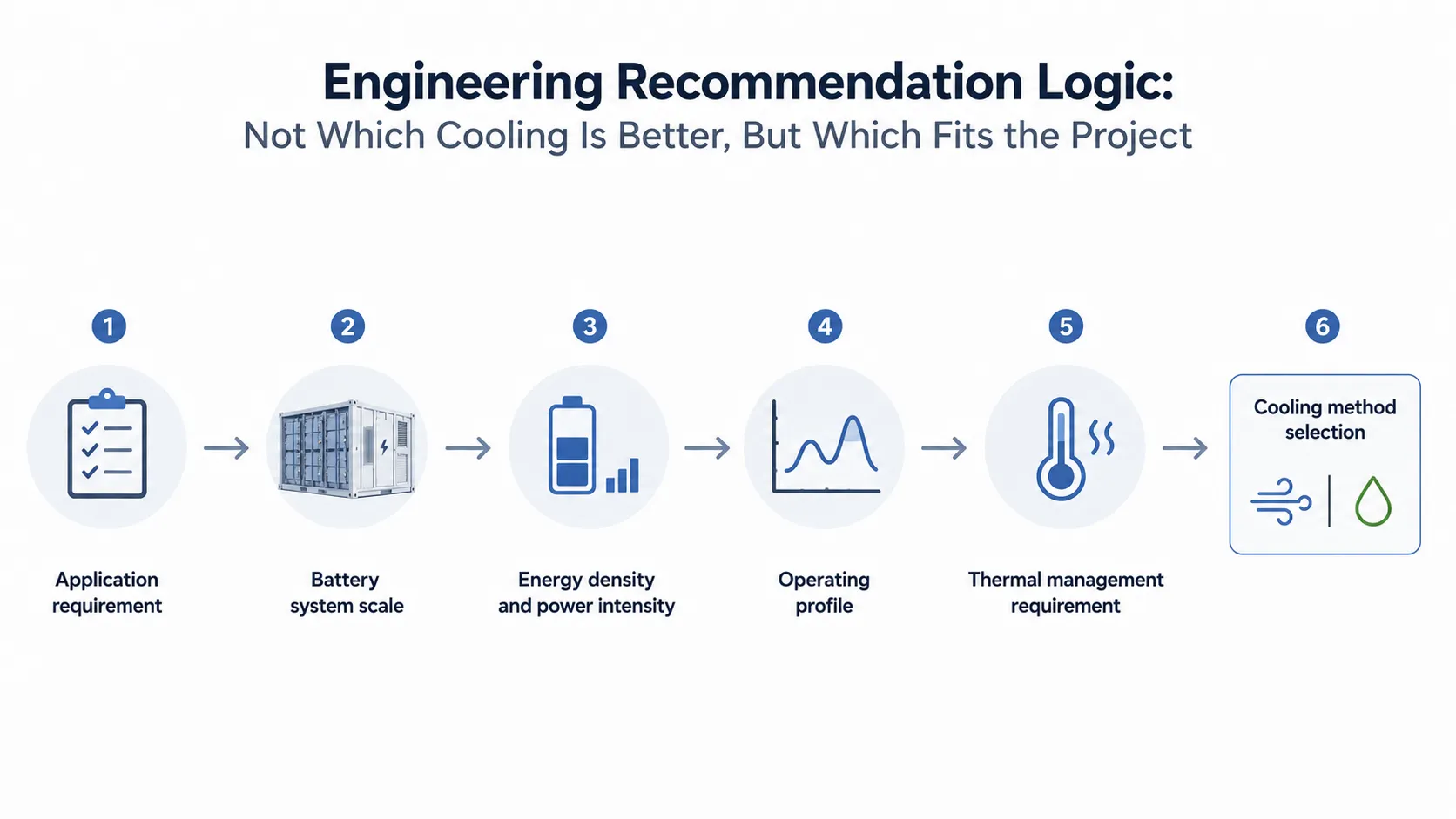
A typical engineering evaluation sequence is:
Application requirement
↓
Battery system scale
↓
Energy density and power intensity
↓
Operating profile
↓
Thermal management requirement
↓
Cooling method selection
Application requirement
↓
Battery system scale
↓
Energy density and power intensity
↓
Operating profile
↓
Thermal management requirement
↓
Cooling method selection
This approach avoids a common design mistake:
Selecting a cooling technology first and forcing the rest of the system to match.
In real BESS projects, engineers evaluate cooling together with:
- Battery configuration
- PCS capability
- Operating strategy
- Installation conditions
- Lifecycle objectives
For example, a high-power commercial BESS requires coordination between thermal design and electrical design.
The PCS determines how much power the battery exchanges with the grid, while the cooling system ensures that the battery can operate under the resulting thermal conditions.
A detailed understanding of How to Select the Right PCS for Commercial Battery Storage is therefore also important when evaluating thermal requirements for high-power applications.
Air cooling is not an outdated approach.
For appropriate applications, it can provide reliable thermal management with lower complexity.
Liquid cooling is not automatically the correct choice.
It becomes more valuable when project requirements demand:
- Higher thermal uniformity
- Greater heat dissipation capability
- More frequent cycling
- Higher energy density operation
The best engineering decision is the cooling solution that matches the actual project conditions.
Conclusion: Cooling Design Is a System Engineering Decision
Cooling selection in commercial BESS projects is not simply a comparison between air cooling and liquid cooling technologies.
Thermal management affects:
- Temperature uniformity
- Battery degradation
- Energy efficiency
- Safety margin
- Operational reliability
- Lifecycle economics
A well-designed BESS does not select cooling technology based on one specification.
It evaluates the complete relationship between:
- Application requirements
- Battery capacity
- PCS power capability
- Operating profile
- Thermal conditions
- Lifecycle expectations
Cooling design is one part of the broader battery energy storage system design process.
Other engineering stages, including:
- Load profile analysis
- Battery capacity sizing
- PCS selection
- EMS strategy
- Safety engineering
must work together to achieve reliable system performance.
The correct cooling solution is not necessarily the technology with the highest performance specification.
It is the thermal management approach that provides the required balance between:
- Technical performance
- Energy consumption
- Maintenance requirements
- Battery lifetime
- Project economics
FAQ
1. What is the difference between air cooling and liquid cooling in BESS?
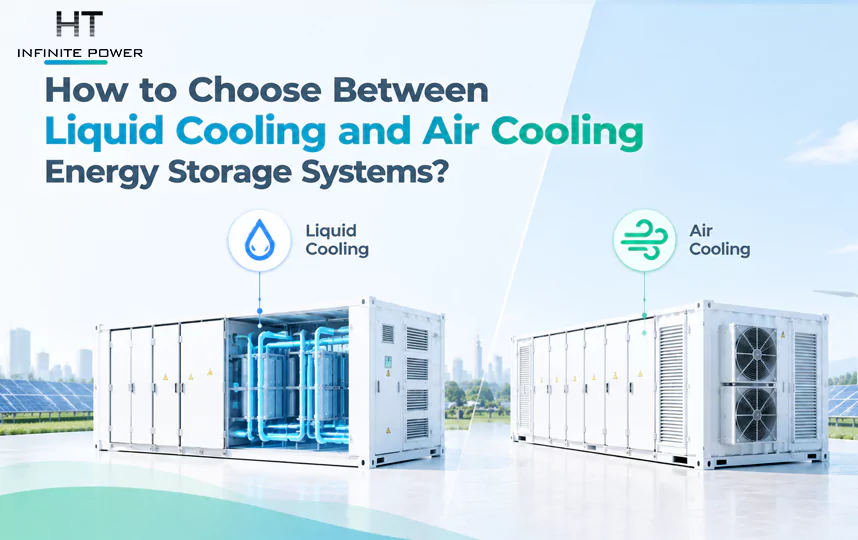
Air cooling uses fans and airflow channels to remove heat from battery modules, while liquid cooling transfers heat through liquid circulation systems and thermal components.
The main engineering difference is the level of thermal control. Liquid cooling generally provides stronger temperature uniformity for high-density and high-power BESS applications, while air cooling offers simpler system architecture.
The main engineering difference is the level of thermal control. Liquid cooling generally provides stronger temperature uniformity for high-density and high-power BESS applications, while air cooling offers simpler system architecture.
2. Is liquid cooling always better than air cooling for battery storage systems?
No.
Liquid cooling provides advantages when projects require stronger thermal management, such as:
Liquid cooling provides advantages when projects require stronger thermal management, such as:
- Higher energy density
- Frequent cycling
- High-power operation
However, air cooling may be more suitable for smaller systems where thermal requirements are moderate and simplicity is important.
3. When should commercial BESS projects consider liquid cooling?
Liquid cooling is commonly evaluated for projects with:
- Large battery capacity
- High energy density
- Frequent charging and discharging
- Strict temperature uniformity requirements
Examples include MWh containerized systems and high-cycle industrial BESS applications.
4. How does cooling method affect battery lifetime?
Cooling affects battery lifetime by influencing temperature consistency and thermal stress.
A system with better thermal uniformity can reduce uneven aging between cells and modules, helping maintain more predictable capacity retention over time.
A system with better thermal uniformity can reduce uneven aging between cells and modules, helping maintain more predictable capacity retention over time.
5. How do engineers choose between air cooling and liquid cooling?
Engineers evaluate:
- Battery system size
- Energy density
- Power requirements
- Cycling frequency
- Installation conditions
- Lifecycle objectives
The decision is not based on which cooling method is universally better.
It depends on which thermal management strategy best matches the actual BESS project requirements.
It depends on which thermal management strategy best matches the actual BESS project requirements.
Five Common Design Mistakes in Commercial BESS Projects
How to Select the Right PCS for Commercial Battery Storage