Amps to Volts Calculator: Understanding Voltage Requirements in Battery Systems
author: HT Infinite Power
2026-10-29
⚡
Amps to Volts Calculator
Enter values to calculate
Quick Answer
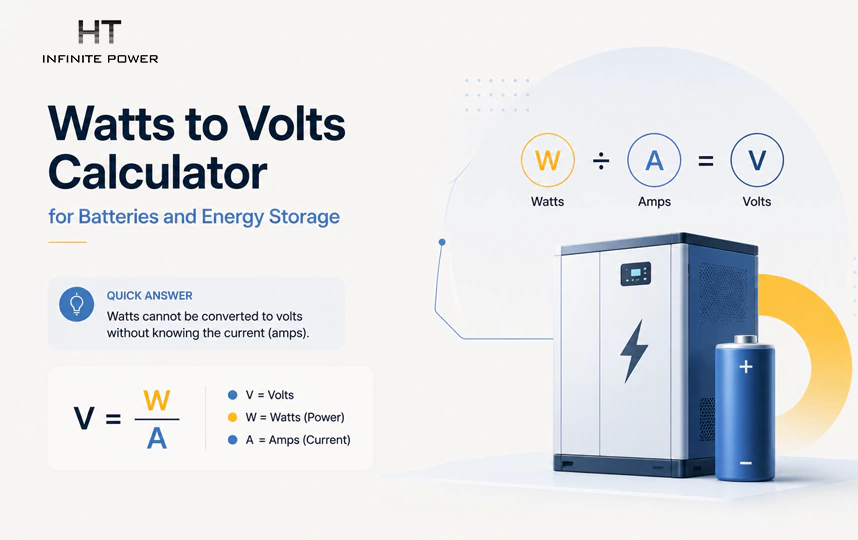
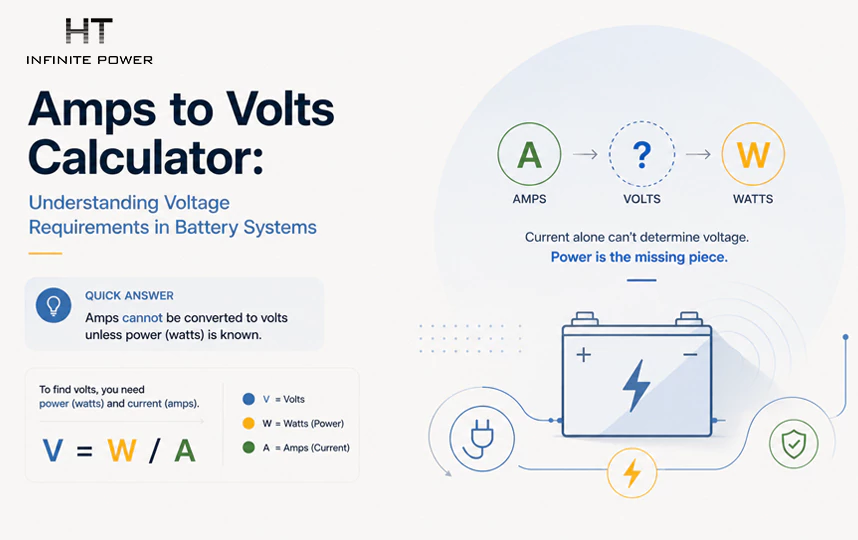
Amps cannot be converted to volts unless power (watts) is known.
The formula is:
The formula is:
V=W÷A
Where:
- V = Volts
- W = Watts (Power)
- A = Amps (Current)
Quick Examples
| Power | Current | Voltage |
| 1200W | 100A | 12V |
| 2400W | 100A | 24V |
| 4800W | 100A | 48V |
| 5120W | 100A | 51.2V |
| 40000W | 100A | 400V |
The same current can correspond to very different voltages depending on the amount of power being delivered.
Why Amps Cannot Be Converted to Volts Without Power
Many people assume there is a direct conversion between amps and volts.
There is not.
Current alone cannot determine voltage.
For example:
Current alone cannot determine voltage.
For example:
100A at 1200W
1200÷100=12V
100A at 4800W
4800÷100=48V
100A at 40000W
40000÷100=400V
The current remains exactly the same in all three examples.
Only the power changes.
Yet the voltage increases from 12V to 400V.
This is why every accurate amps-to-volts calculation requires both current and power.
Only the power changes.
Yet the voltage increases from 12V to 400V.
This is why every accurate amps-to-volts calculation requires both current and power.
Understanding Amps, Volts, and Power
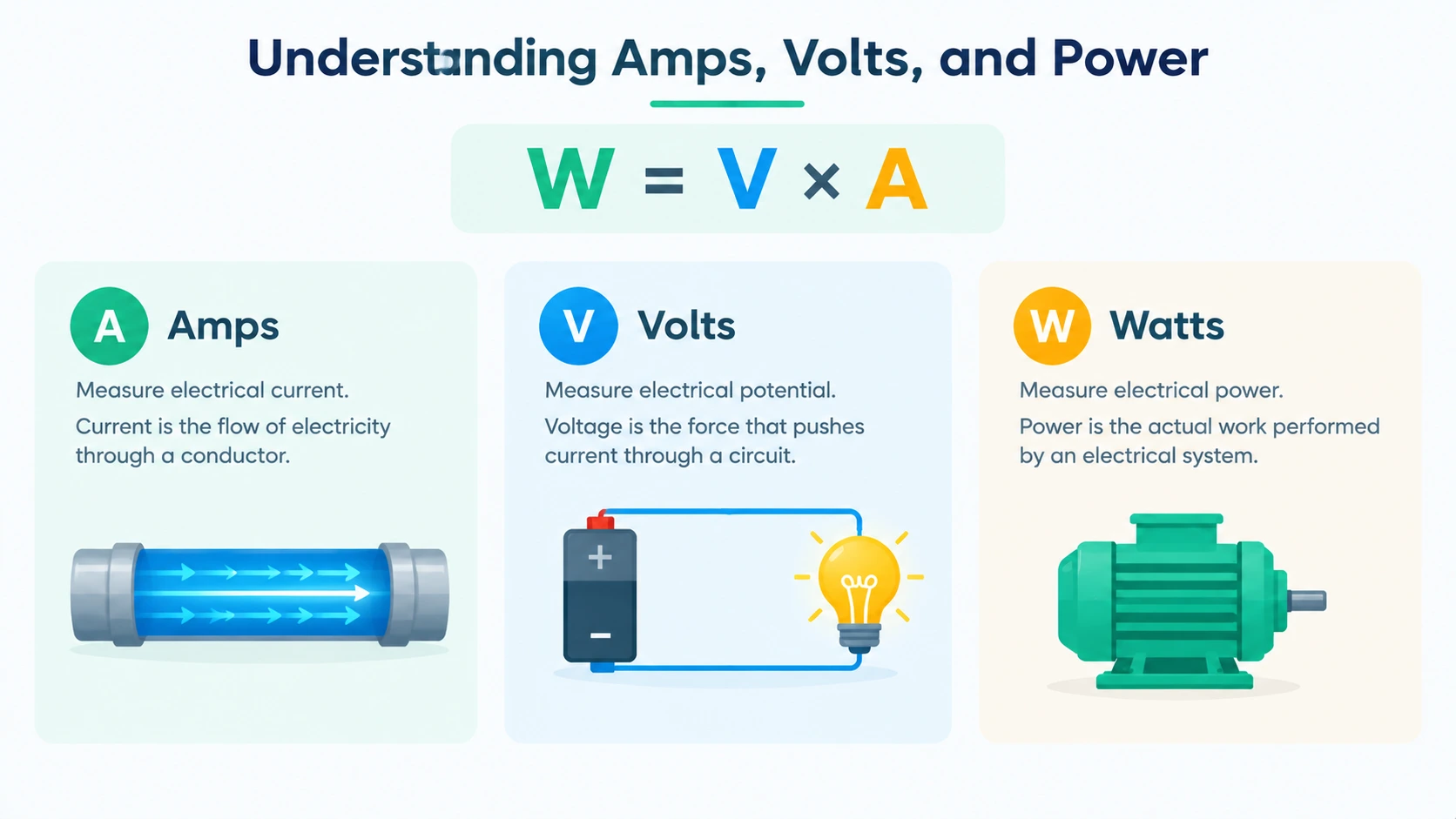
Electrical systems are built around three closely related values:
W=V×A
Understanding this relationship makes it easier to design, size, and evaluate battery systems.
What Are Amps?
Amps measure electrical current.
Current represents the flow of electricity through a conductor.
Examples include:
Current represents the flow of electricity through a conductor.
Examples include:
- Battery discharge current
- Inverter output current
- Charger current
- Motor current
Higher current means more electricity is moving through the circuit.
What Are Volts?
Volts measure electrical potential.
Voltage is often described as the force that pushes current through a circuit.
Higher voltage allows the same amount of power to be delivered with lower current.
Voltage is often described as the force that pushes current through a circuit.
Higher voltage allows the same amount of power to be delivered with lower current.
What Are Watts?
Watts measure electrical power.
Power represents the actual work performed by an electrical system.
Examples include:
Power represents the actual work performed by an electrical system.
Examples include:
- Battery output
- Inverter power
- Appliance consumption
- EV charging power
- ESS discharge power
Amps to Volts Formula
The standard formula is:
V=W÷A
It is derived from:
W=V×A
Once power and current are known, calculating voltage is straightforward.
V=W÷A
It is derived from:
W=V×A
Once power and current are known, calculating voltage is straightforward.
Example 1
1200W at 100A:
1200÷100=12V
1200÷100=12V
Example 2
5000W at 100A:
5000÷100=50V
5000÷100=50V
Example 3
10000W at 200A:
10000÷200=50V
10000÷200=50V
How to Convert Amps to Volts
To convert amps to volts:
Step 1
Determine power in watts.
Step 2
Determine current in amps.
Step 3
Divide power by current.
Example
Power:
5120W
5120W
Current:
100A
100A
Calculation:
5120÷100=51.2V
The required voltage is 51.2V.
5120÷100=51.2V
The required voltage is 51.2V.
How Many Volts Is 10A, 20A, 50A, and 100A?
The answer depends on power.
The table below assumes a power level of 1000W.
The table below assumes a power level of 1000W.
| Current | Voltage |
| 10A | 100V |
| 20A | 50V |
| 50A | 20V |
| 100A | 10V |
For a fixed power level, increasing current reduces the required voltage.
Amps to Volts Conversion Chart
| Power | 10A | 20A | 50A | 100A |
| 500W | 50V | 25V | 10V | 5V |
| 1000W | 100V | 50V | 20V | 10V |
| 2500W | 250V | 125V | 50V | 25V |
| 5000W | 500V | 250V | 100V | 50V |
| 10000W | 1000V | 500V | 200V | 100V |
This chart demonstrates why neither amps nor volts can be analyzed independently.
Why Voltage Requirements Matter in Battery Systems
When people compare batteries, they often focus on:
- Capacity
- Runtime
- Power output
However, operating voltage may be one of the most important design parameters.
Voltage directly affects:
Voltage directly affects:
- Current requirements
- Cable sizing
- Inverter compatibility
- PCS design
- Heat generation
- System efficiency
As battery systems become larger, voltage becomes increasingly important.
Why Battery Systems Use Different Voltage Architectures
Different battery applications require different voltage levels.
A battery voltage is not chosen randomly. It is determined by how many cells are connected in series.
A typical lithium iron phosphate (LFP) cell has a nominal voltage of approximately:
3.2V
A battery voltage is not chosen randomly. It is determined by how many cells are connected in series.
A typical lithium iron phosphate (LFP) cell has a nominal voltage of approximately:
3.2V
By combining multiple cells in series, manufacturers create higher-voltage systems.
| Configuration | Approximate Voltage |
|---|---|
| 4 Cells | 12.8V |
| 8 Cells | 25.6V |
| 16 Cells | 51.2V |
| 128 Cells | 409.6V |
| Hundreds of Cells | 800V–1500V |
This is why residential, commercial, and utility-scale battery systems operate at very different voltages.
Common Battery Voltage Examples
12V Battery Systems
Common in:
- RV systems
- Marine batteries
- Portable backup power
These systems are simple but require relatively high current for larger loads.
24V Battery Systems
Often used in:
- Telecom backup systems
- Small solar installations
- Industrial backup power
Twenty-four volts reduces current compared with 12V systems.
48V Battery Systems
Widely used in:
- Residential ESS
- Off-grid installations
- Hybrid solar systems
48V has become a standard voltage in home energy storage.
51.2V Battery Systems
Popular in:
- LFP batteries
- Rack batteries
- Residential storage systems
A 51.2V battery normally consists of sixteen LFP cells connected in series.
High-Voltage Battery Systems
Commercial and utility-scale projects often use:
- 400V
- 600V
- 800V
- 1000V
- 1500V
These systems can deliver large amounts of power without excessive current.
From Battery Cells to Utility-Scale ESS
Battery voltage increases as systems become larger.
A typical energy storage architecture follows this progression:
A typical energy storage architecture follows this progression:
Battery Cell→Battery Module→Battery Pack→Battery Rack→Battery Cluster→ESS Container

As batteries move from individual cells to utility-scale installations, voltage increases significantly.
Higher voltage helps reduce current, simplify wiring, improve efficiency, and lower installation costs.
This is one reason utility-scale ESS projects commonly exceed 1000V.
Why Most Residential Energy Storage Systems Use 48V or 51.2V
Home battery systems need to balance:
- Safety
- Efficiency
- Cost
- Compatibility
Consider a battery delivering:
5120W
5120W
at:
100A
Required voltage:
5120÷100=51.2V
100A
Required voltage:
5120÷100=51.2V
This voltage is high enough to keep current manageable while remaining practical for residential installations.
Many home ESS products are built around:
Many home ESS products are built around:
- 100Ah batteries
- 200Ah batteries
- 280Ah cells
- 314Ah cells
combined with 48V or 51.2V architectures.
Why Commercial ESS Systems Use Higher Voltages
Commercial energy storage systems deliver far more power than residential systems.
Consider a 100kW battery system.
At 48V
100000÷48≈2083A
At 800V
100000÷800 =125A
The difference is dramatic.
By increasing voltage, engineers can significantly reduce current.
Benefits include:
- Smaller conductors
- Lower cable costs
- Reduced heat generation
- Easier installation
Why Utility-Scale Energy Storage Is Moving Toward 1500V
As projects become larger, the industry continues moving toward higher voltages.
Consider delivering:
1MW
At 1000V
1000000÷1000=1000A
At 1500V
1000000÷1500≈667A
The higher-voltage design requires substantially less current.
Advantages include:
- Lower conductor costs
- Lower electrical losses
- Reduced cooling requirements
- Improved project economics
This is why many utility-scale ESS projects now use 1500V battery architectures.
Why Voltage Requirements Influence Every Major ESS Component
Voltage affects more than just the battery.
It influences nearly every major component within an energy storage system.
Higher voltage impacts:
- Battery design
- PCS design
- Inverter selection
- Breaker sizing
- Cable sizing
- Thermal management
- Protection systems
For engineers, voltage is one of the first decisions made during system design because it affects the entire ESS architecture.
How Voltage Affects PCS and Inverter Design
Consider a 100kW PCS
48V System
100000÷48≈2083A
800V System
100000÷800=125A
Both systems deliver 100kW.
However, the lower-voltage design must handle over sixteen times more current.
Higher current increases:
- Busbar size
- Semiconductor stress
- Cooling requirements
- Cable complexity
This is one reason why commercial ESS projects increasingly favor high-voltage systems.
Real Home Energy Storage Example
Suppose a homeowner installs:
- 10kWh battery system
- 51.2V architecture
The system supplies:
100A
Power delivered:
51.2×100=5120W =5.12kW
This power level is sufficient for many essential household loads.
Real Commercial Energy Storage Example
Consider a commercial ESS designed to provide:
100kW
using an:
using an:
800V
battery architecture.
Current required:
100000÷800=125A
Compared with lower-voltage designs, this architecture reduces:
- Cable size
- Heat losses
- Installation complexity
while improving overall system efficiency.
Why Higher Voltage Reduces Current
For any power level:
A=W÷V
As voltage increases, current decreases.
Lower current provides several advantages:
- Smaller conductors
- Lower voltage drop
- Less heating
- Better efficiency
- Lower installation costs
This simple relationship influences every modern battery and energy storage system.
Common Mistakes
Ignoring Power
Current alone cannot determine voltage.
Confusing Amps and Volts
Amps measure current.
Volts measure electrical potential.
Using the Wrong Formula
Always use:
V=W÷A
for amps-to-volts calculations.
Mixing AC and DC Systems
Some AC calculations require additional factors such as power factor.
Ignoring Voltage Architecture
Voltage selection significantly affects system performance and cost.
Conclusion
An amps-to-volts calculator helps determine voltage when power and current are known. While the mathematical conversion is simple, voltage plays a critical role in battery architecture and energy storage system design. From 12V backup batteries and 51.2V residential ESS products to 800V commercial systems and 1500V utility-scale installations, voltage directly affects current requirements, efficiency, thermal performance, cable sizing, PCS design, and overall project economics. Understanding voltage requirements is therefore essential for designing and evaluating modern battery and energy storage systems.
FAQ
How do I convert amps to volts?
Use:
V=W÷A
You must know both power and current.
Can amps be converted directly to volts?
No. Power information is required.
How many volts is 100 amps?
There is no single answer. Voltage depends on the power involved.
Why do home batteries use 48V or 51.2V?
These voltages balance efficiency, safety, and current requirements.
Why do commercial ESS systems use 400V to 800V?
Higher voltage reduces current and improves system efficiency.
Why are utility-scale ESS projects adopting 1500V?
Higher voltage reduces losses, conductor costs, and infrastructure requirements.
What is the relationship between amps and volts?
Amps measure current, volts measure electrical potential, and both are linked by:
W=V×A
Watts to Volts Calculator for Batteries and Energy Storage
Related Article