How to Size Battery Capacity for Peak Shaving Projects
author: HT infinitepower
2026-07-17

Introduction: Battery Capacity Sizing Starts With Peak Reduction Requirements
In commercial and industrial BESS projects, one of the first questions customers often ask is:
“How many kWh of battery storage do we need?”
“How many kWh of battery storage do we need?”
Although battery capacity is an important design parameter, engineers do not usually begin the sizing process by selecting a battery energy value.
For peak shaving applications, the starting point is defining the actual demand reduction requirement:
- How much grid demand needs to be reduced?
- How long must the reduction be maintained?
- How frequently will the system operate?
A peak shaving BESS is designed around a specific power management objective. The battery must provide enough power to reduce the demand peak and enough energy to maintain that reduction for the required duration.
Therefore, battery capacity sizing for peak shaving is not only an energy calculation. It is a power and energy matching process.
The basic engineering logic is:
Peak reduction requirement
+
Required discharge duration
+
System efficiency
+
Battery degradation considerations
↓
Required battery capacity
Peak reduction requirement
+
Required discharge duration
+
System efficiency
+
Battery degradation considerations
↓
Required battery capacity
In commercial BESS engineering projects, load profile analysis provides the operating data needed to identify the peak shaving target. However, once the target is defined, the sizing process focuses on translating that requirement into technical parameters.
A properly designed peak shaving battery system is not based on a customer preference such as “we need 500 kWh.”
It is calculated from the actual performance requirement the system must deliver.
1. Define the Peak Shaving Target Before Battery Sizing
Before calculating battery capacity, engineers first define what the BESS is expected to achieve.
The key question is:
What demand reduction must the battery provide?
In commercial and industrial applications, engineers typically determine:
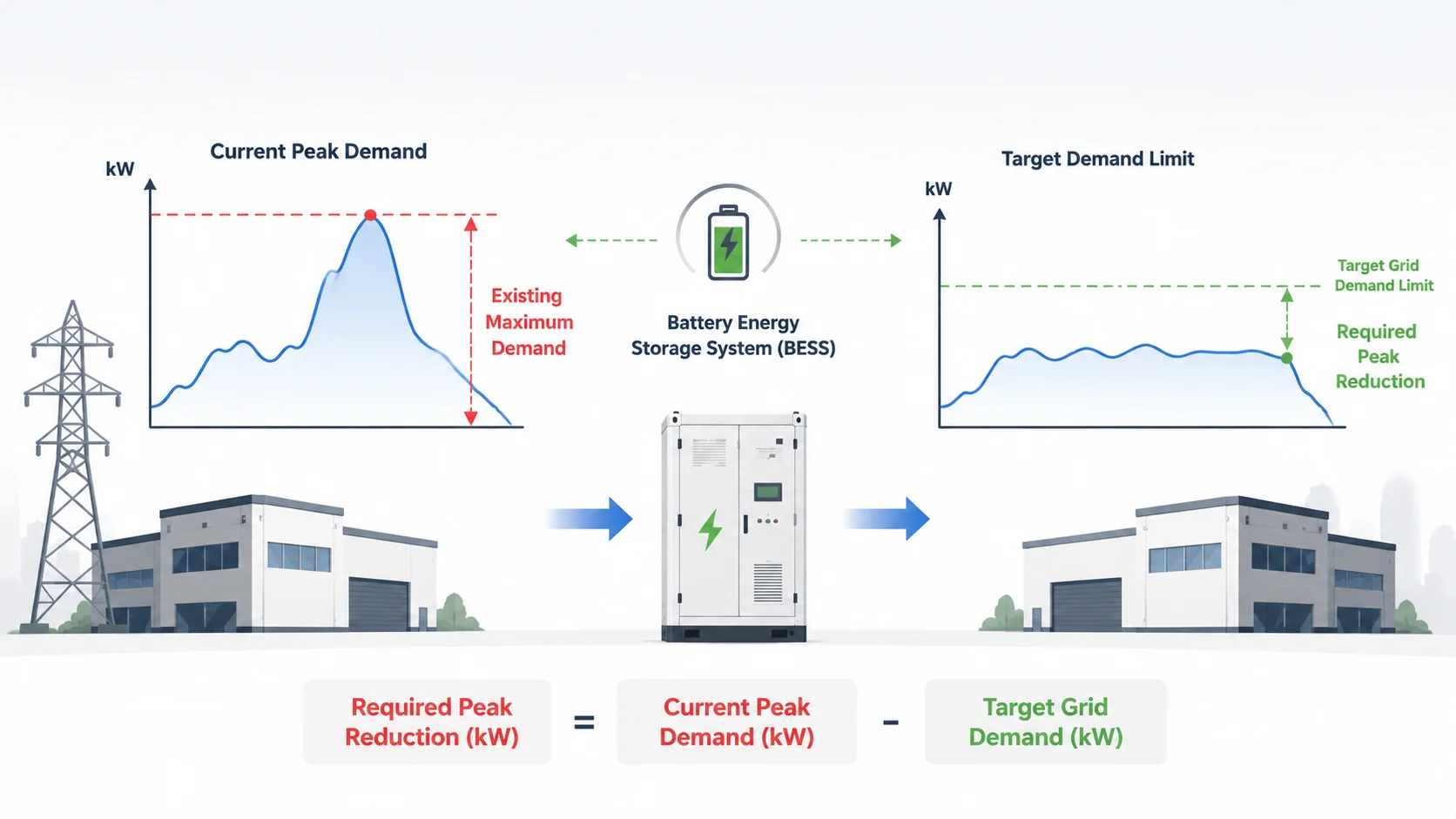
- Existing maximum grid demand
- Target demand limit
- Required peak reduction
The basic calculation is:
Required Peak Reduction (kW) = Current Peak Demand (kW) - Target Grid Demand (kW)
Required Peak Reduction (kW) = Current Peak Demand (kW) - Target Grid Demand (kW)
Example: Industrial Factory Peak Reduction Target
Consider an industrial facility:
Maximum demand:1,500 kW
Target grid demand:1,250 kW
The required reduction is:1,500 kW - 1,250 kW = 250 kW
Target grid demand:1,250 kW
The required reduction is:1,500 kW - 1,250 kW = 250 kW
The result means the BESS must be capable of reducing approximately 250 kW of grid demand during peak events.
At this stage, engineers have only defined the required power reduction.
Battery capacity has not yet been determined.
The 250 kW value primarily establishes the required system power capability. The next step is determining how long this power reduction must be maintained.
This distinction is important because a peak shaving system is limited by both:
- How much power it can deliver
- How long it can continue delivering that power
2. Determine Required Battery Power: Understanding kW Requirement
One of the most common mistakes in peak shaving projects is focusing only on battery capacity while overlooking power capability.
A BESS has two fundamental parameters:
Power (kW) and Energy (kWh)
Power (kW) and Energy (kWh)
Power determines how much electricity the system can deliver at a specific moment.
Energy determines how long that output can continue.
For peak shaving applications, the required power level is usually defined first because the BESS must immediately respond when the demand peak occurs.
Energy determines how long that output can continue.
For peak shaving applications, the required power level is usually defined first because the BESS must immediately respond when the demand peak occurs.
Why PCS Power Rating Matters
The PCS determines the maximum power output available from the BESS.
A battery with a large energy capacity but insufficient PCS power cannot achieve the required peak reduction.
A battery with a large energy capacity but insufficient PCS power cannot achieve the required peak reduction.
For example:
System A
Battery capacity:500 kWh
PCS rating:100 kW
PCS rating:100 kW
System B
Battery capacity:500 kWh
PCS rating:250 kW
PCS rating:250 kW
Although both systems contain the same stored energy, their peak shaving performance is different.
If the facility requires a 250 kW demand reduction:
- System A cannot provide sufficient output power
- System B can meet the required power target
The additional battery energy in System A does not solve the problem because the limitation is power capability.
In peak shaving applications, PCS sizing and battery sizing must be considered together because insufficient power capability cannot be compensated by simply increasing battery energy capacity.
During engineering evaluation, BESS designers therefore determine the required PCS power and battery energy capacity as interconnected design parameters rather than separate selections.
(PCS selection and detailed power conversion design are discussed in our guide on how to select the right PCS for commercial battery storage systems.)
3. Convert Peak Reduction Requirement Into Battery Energy Requirement
After defining the required power output, engineers calculate the required battery energy.
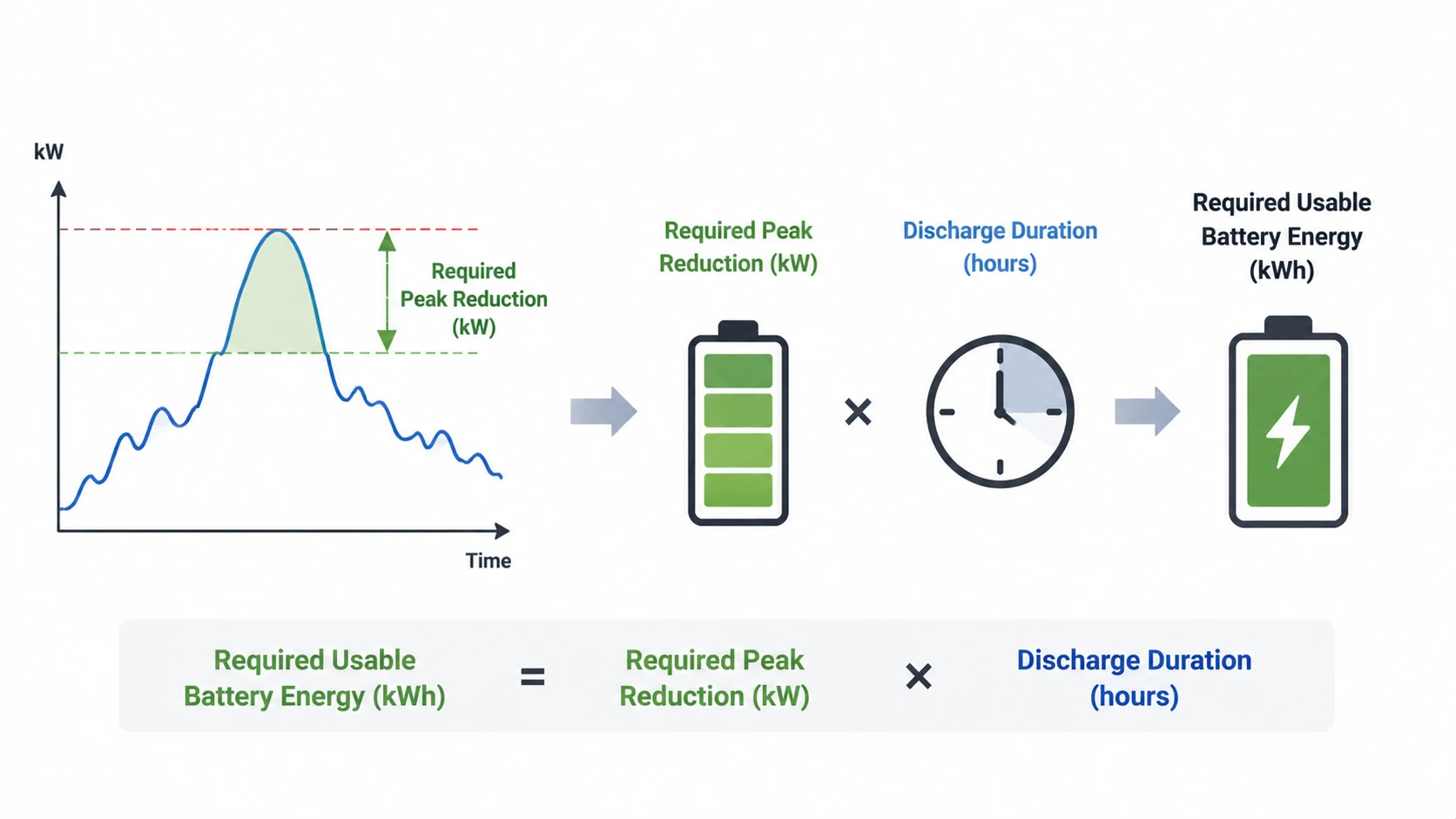
The basic relationship is:
Required Usable Battery Energy (kWh) = Required Power (kW) × Discharge Duration (hours)
Required Usable Battery Energy (kWh) = Required Power (kW) × Discharge Duration (hours)
This calculation determines the usable energy required to maintain the peak shaving function.
Example: 250 kW Peak Shaving Requirement
Assume:
Required peak reduction:250 kW
Required discharge duration:2 hours
The usable energy requirement is:250 kW × 2 hours = 500 kWh usable energy
Required peak reduction:250 kW
Required discharge duration:2 hours
The usable energy requirement is:250 kW × 2 hours = 500 kWh usable energy
This means the system needs approximately 500 kWh of usable energy to maintain a 250 kW reduction for two hours.
Why Discharge Duration Changes Battery Capacity
The same peak reduction target can require very different battery capacities depending on duration.
Example:
Scenario A
Peak reduction:250 kW
Duration:30 minutes
Energy requirement:250 kW × 0.5 hours = 125 kWh usable energy
Duration:30 minutes
Energy requirement:250 kW × 0.5 hours = 125 kWh usable energy
Scenario B
Peak reduction:250 kW
Duration:4 hours
Energy requirement:250 kW × 4 hours = 1,000 kWh usable energy
Duration:4 hours
Energy requirement:250 kW × 4 hours = 1,000 kWh usable energy
The power requirement is identical, but the battery energy requirement changes significantly.
This is why battery capacity is calculated after defining the required operating duration.
For commercial BESS design, engineers size storage based on the specific demand event the system must manage rather than selecting a standard battery capacity.
This is why battery capacity is calculated after defining the required operating duration.
For commercial BESS design, engineers size storage based on the specific demand event the system must manage rather than selecting a standard battery capacity.
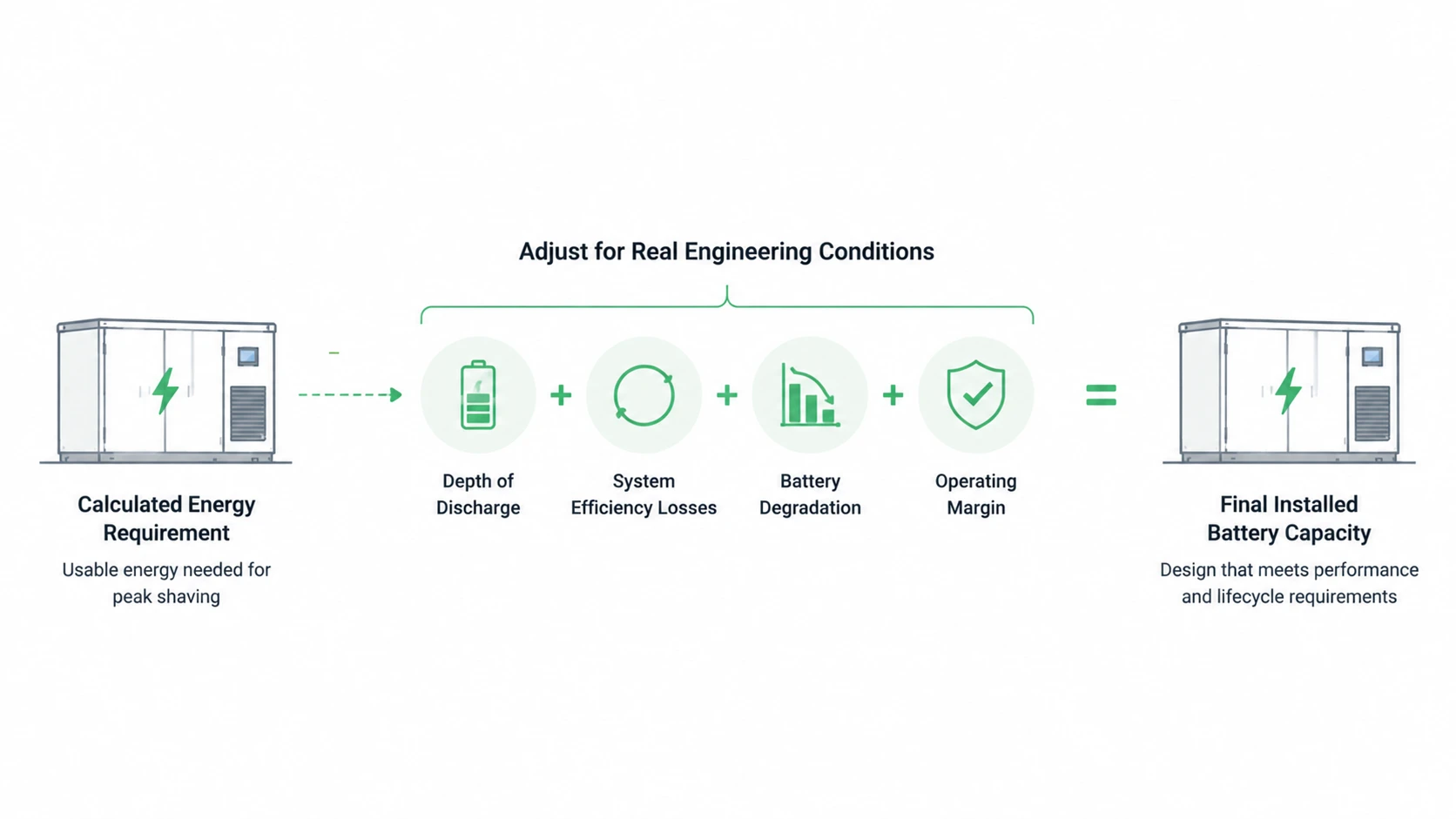
4. Adjust Battery Capacity for Real Engineering Conditions
The calculated energy requirement represents the usable energy needed for the peak shaving function.
However, it is not always the final installed battery capacity.
In real commercial projects, engineers adjust the design based on operating limitations and lifecycle requirements.
However, it is not always the final installed battery capacity.
In real commercial projects, engineers adjust the design based on operating limitations and lifecycle requirements.
The final installed capacity must account for:
- Depth of discharge
- System efficiency losses
- Battery degradation
- Operating margin
Depth of Discharge (DoD)
The usable energy available from a battery depends on the allowed operating range.
For example, if a project requires:500 kWh usable energy
the installed battery capacity may need to be higher depending on the selected operating DoD.
A battery designed with additional capacity margin can provide the required usable energy while operating within recommended limits.
the installed battery capacity may need to be higher depending on the selected operating DoD.
A battery designed with additional capacity margin can provide the required usable energy while operating within recommended limits.
System Efficiency Losses
Energy is lost during charging and discharging because of:
- Battery internal losses
- Power conversion losses
- Auxiliary consumption
Therefore, the installed battery capacity must consider efficiency losses.
A system requiring 500 kWh delivered energy will generally require more installed capacity than the theoretical calculation.
A system requiring 500 kWh delivered energy will generally require more installed capacity than the theoretical calculation.
Battery Degradation
Battery capacity decreases gradually during operation.
For commercial peak shaving projects, engineers consider:
For commercial peak shaving projects, engineers consider:
- Expected cycling frequency
- Project operating years
- Required end-of-life performance
A system designed only for first-year performance may not maintain the required peak reduction capability later in its operating life.
Operating Margin
Engineering teams may also include additional margin for:
- Load variation
- Future operational changes
- Unexpected operating conditions
The objective is not simply achieving the minimum calculated battery size.
The objective is ensuring the BESS continues delivering the required peak shaving function throughout the project lifecycle.
5. Engineering Constraints Affecting Battery Capacity Selection
The battery energy calculation provides the theoretical sizing basis, but commercial BESS projects must consider additional engineering constraints before finalizing the system configuration.
During practical project development, engineers evaluate whether the selected battery capacity can work together with the required power output, operating pattern, and long-term performance expectations.
PCS Limitation: Energy Capacity Cannot Replace Power Capability
A common misunderstanding in peak shaving projects is assuming that increasing battery capacity can compensate for insufficient power output.
However, battery energy and power capability solve different problems.
However, battery energy and power capability solve different problems.
For example:
A 1 MWh battery paired with a 100 kW PCS still cannot provide a 250 kW demand reduction.
The system has sufficient stored energy, but it cannot deliver enough instantaneous power.
A 1 MWh battery paired with a 100 kW PCS still cannot provide a 250 kW demand reduction.
The system has sufficient stored energy, but it cannot deliver enough instantaneous power.
This is why engineers evaluate:
- Required peak reduction (kW)
- PCS output capability (kW)
- Battery energy capacity (kWh)
together during the design process.
A correctly sized battery with insufficient power capability will not achieve the intended peak shaving result.
A correctly sized battery with insufficient power capability will not achieve the intended peak shaving result.
Battery C-Rate Considerations
The C-rate represents the relationship between battery capacity and discharge power.
A higher discharge requirement means the battery must deliver more power relative to its available energy.
A higher discharge requirement means the battery must deliver more power relative to its available energy.
For peak shaving applications, engineers consider whether the battery configuration can support:
- Required discharge power
- Expected operating frequency
- Project lifetime requirements
For example, a battery system that performs short-duration high-power events may operate differently from a system designed for longer daily energy shifting.
The selected battery capacity must therefore match the expected operating profile rather than only the initial power requirement.
The selected battery capacity must therefore match the expected operating profile rather than only the initial power requirement.
Thermal Management Considerations
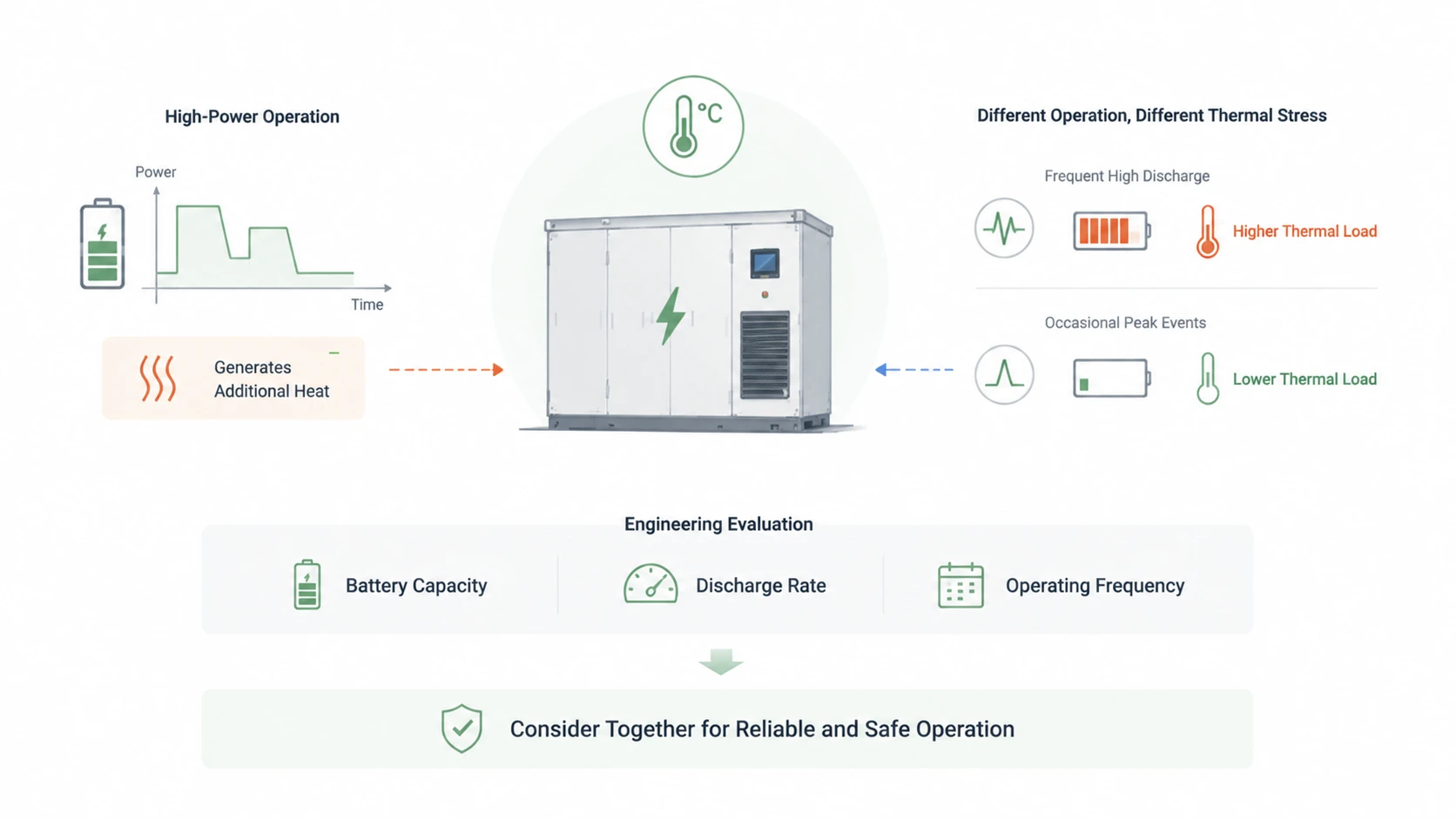
High-power charging and discharging generate additional heat.
Although cooling system design is a separate engineering topic, battery sizing decisions cannot be completely separated from thermal considerations.
Although cooling system design is a separate engineering topic, battery sizing decisions cannot be completely separated from thermal considerations.
(For more information about battery thermal management decisions, see our article on air cooling vs liquid cooling for commercial BESS applications.)
A system operating frequently at high discharge rates may experience different thermal conditions compared with a system used only for occasional peak events.
During engineering evaluation, battery capacity, discharge rate, and operating frequency are considered together to ensure reliable operation.
Operating Frequency and Battery Lifetime
Peak shaving projects vary significantly in how often the battery operates.
Some facilities may require daily demand reduction.
Others may only experience occasional demand peaks.
Some facilities may require daily demand reduction.
Others may only experience occasional demand peaks.
The expected operating frequency affects:
- Battery cycle life
- Capacity degradation
- Maintenance expectations
- Long-term system performance
A battery system designed for occasional operation may require a different capacity strategy compared with a system expected to cycle every day.
6. Oversizing vs Undersizing Battery Capacity
Selecting the right battery capacity requires balancing technical performance and investment efficiency.
Both oversized and undersized systems can create engineering problems.
Both oversized and undersized systems can create engineering problems.
Oversizing Battery Capacity
A larger battery provides some advantages:
- Longer discharge duration
- Greater operational flexibility
- Potential support for additional applications
However, oversizing can also create disadvantages:
- Higher CAPEX
- Larger installation footprint
- Lower utilization rate
- Additional unused energy capacity
For example, if a facility only requires two hours of peak shaving support, installing significantly more capacity may not provide proportional benefits.
The additional stored energy may remain unused for most operating cycles.
The additional stored energy may remain unused for most operating cycles.
Undersizing Battery Capacity
An undersized battery may reduce project performance.
Potential problems include:
- Inability to maintain the required demand reduction
- Reaching the energy limit before the peak period ends
- Increased battery stress from excessive operation
For example, a facility requiring two hours of peak shaving may not achieve the expected result if the battery only provides one hour of usable energy.
The system may successfully reduce demand at the beginning of the event but fail before the peak period is complete.
The system may successfully reduce demand at the beginning of the event but fail before the peak period is complete.
Finding the Correct Balance
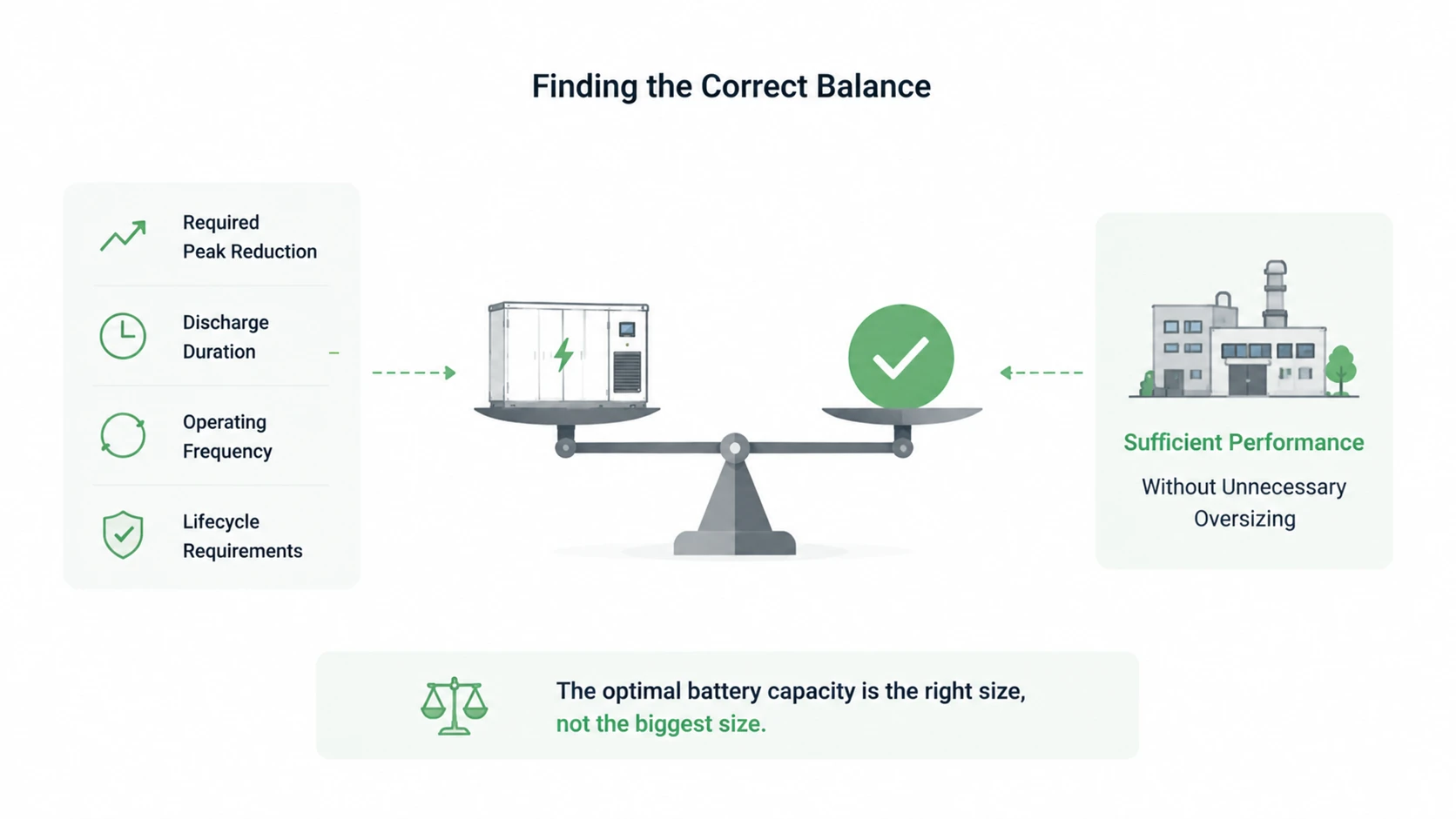
The optimal battery capacity is not the largest available system.
It is the capacity that matches:
- Required peak reduction
- Discharge duration
- Operating frequency
- Lifecycle requirements
A well-designed peak shaving system provides sufficient performance without unnecessary oversizing.
7. Practical Example: 250kW / 500kWh Peak Shaving Capacity Sizing
Consider a commercial manufacturing facility evaluating a peak shaving BESS project.
The facility characteristics are:
Peak grid demand:1.5 MW
Target demand reduction:250 kW
Required peak shaving duration:2 hours
Based on the engineering requirement, the BESS must reduce grid demand by approximately 250 kW during the identified peak period.
The facility characteristics are:
Peak grid demand:1.5 MW
Target demand reduction:250 kW
Required peak shaving duration:2 hours
Based on the engineering requirement, the BESS must reduce grid demand by approximately 250 kW during the identified peak period.
Step 1: Determine Required Power Output
Required peak reduction:250 kW
Therefore, the system requires approximately:250 kW power capability
The selected PCS power rating would need to support this demand reduction target.
Therefore, the system requires approximately:250 kW power capability
The selected PCS power rating would need to support this demand reduction target.
Step 2: Calculate Required Usable Energy
Required duration:2 hours
Calculation:250 kW × 2 hours = 500 kWh usable energy requirement
At this stage, engineers have calculated the required usable energy.
However, this does not necessarily represent the final installed battery capacity.
Calculation:250 kW × 2 hours = 500 kWh usable energy requirement
At this stage, engineers have calculated the required usable energy.
However, this does not necessarily represent the final installed battery capacity.
The actual battery capacity may be higher depending on:
- Operating DoD
- System efficiency
- Battery degradation allowance
- Supplier battery configuration
For example, a commercial system may require additional installed capacity to ensure that 500 kWh of usable energy remains available throughout the project lifetime.
Why Not Select a 1 MWh Battery?
A 1 MWh battery could provide longer discharge duration.
However, if the facility’s primary objective is reducing a 250 kW peak for approximately two hours, the additional capacity may not be fully utilized.
However, if the facility’s primary objective is reducing a 250 kW peak for approximately two hours, the additional capacity may not be fully utilized.
The larger system may result in:
- Higher initial investment
- Larger physical footprint
- Lower utilization efficiency
Additional capacity should be justified by a clear operational requirement.
Why Not Select a 250 kWh Battery?
A 250 kWh battery may provide:
250 kW × 1 hour = 250 kWh usable energy
250 kW × 1 hour = 250 kWh usable energy
However, if the demand peak lasts two hours, the system would not maintain the required reduction throughout the complete event.
The battery would reach its usable energy limit too early.
The battery would reach its usable energy limit too early.
Engineering Decision
For this scenario, the sizing logic indicates:
Required power:Approximately 250 kW
Required usable energy:Approximately 500 kWh
Final installed battery capacity:
Determined after considering DoD, efficiency, degradation, and project requirements
Required power:Approximately 250 kW
Required usable energy:Approximately 500 kWh
Final installed battery capacity:
Determined after considering DoD, efficiency, degradation, and project requirements
This configuration matches the facility’s peak shaving objective rather than simply selecting a larger storage system.
8. Engineering Rule for Peak Shaving Battery Sizing
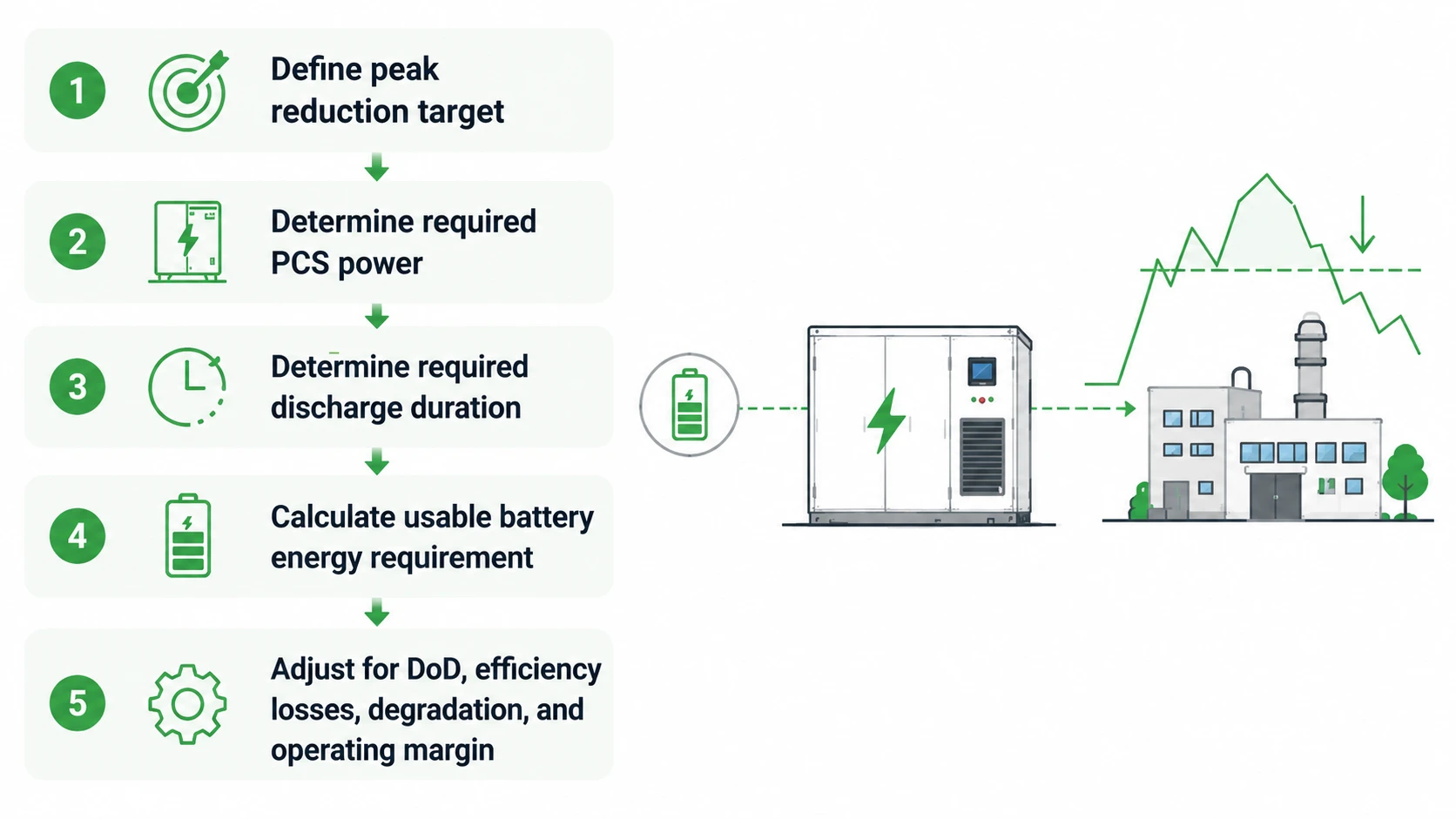
The engineering process for peak shaving battery sizing can be summarized as:
Define peak reduction target
↓
Determine required PCS power
↓
Determine required discharge duration
↓
Calculate usable battery energy requirement
↓
Adjust for DoD, efficiency losses, degradation, and operating margin
Define peak reduction target
↓
Determine required PCS power
↓
Determine required discharge duration
↓
Calculate usable battery energy requirement
↓
Adjust for DoD, efficiency losses, degradation, and operating margin
This approach ensures that battery capacity is calculated from the actual application requirement.
Battery capacity is not selected because a customer requests a specific kWh value.
It is determined by the performance the system must deliver.
Battery capacity is not selected because a customer requests a specific kWh value.
It is determined by the performance the system must deliver.
A complete commercial battery storage system design process also includes other engineering stages, including PCS selection, EMS strategy development, cooling system design, and safety engineering.
Battery sizing is one part of the overall BESS design process, but it is one of the most important steps because it directly affects system performance, investment level, and lifecycle value.
The fundamental engineering principle is:
Battery capacity is the result of understanding the peak shaving requirement, not the starting assumption.
Battery capacity is the result of understanding the peak shaving requirement, not the starting assumption.
FAQ
1. How do engineers calculate battery capacity for peak shaving?
Engineers first determine the required peak reduction in kW. They then calculate the required usable battery energy based on discharge duration:
Battery Energy (kWh) = Required Power (kW) × Duration (hours)
The final installed capacity is adjusted based on DoD, efficiency losses, degradation, and operating requirements.
Battery Energy (kWh) = Required Power (kW) × Duration (hours)
The final installed capacity is adjusted based on DoD, efficiency losses, degradation, and operating requirements.
2. What is more important for peak shaving, kW or kWh?
Both are necessary, but they represent different design requirements.
kW determines whether the BESS can provide enough power to reduce the demand peak.
kWh determines how long the system can maintain that reduction.
A successful peak shaving system requires both parameters to be correctly matched.
kW determines whether the BESS can provide enough power to reduce the demand peak.
kWh determines how long the system can maintain that reduction.
A successful peak shaving system requires both parameters to be correctly matched.
3. Can a larger battery always reduce demand charges?
No.
A larger battery can provide longer operating duration, but it does not automatically create additional savings.
If the additional capacity is rarely used, it may increase investment without improving peak shaving performance.
A larger battery can provide longer operating duration, but it does not automatically create additional savings.
If the additional capacity is rarely used, it may increase investment without improving peak shaving performance.
4. How does PCS rating affect peak shaving performance?
The PCS rating determines the maximum power output available from the BESS.
If the PCS cannot deliver the required peak reduction power, increasing battery capacity alone will not solve the problem.
Battery energy and PCS power must be designed together.
If the PCS cannot deliver the required peak reduction power, increasing battery capacity alone will not solve the problem.
Battery energy and PCS power must be designed together.
5. Why should battery degradation be considered during sizing?
Battery capacity decreases gradually over time due to cycling and aging.
Including degradation considerations during the initial design ensures that the system can continue meeting peak shaving requirements throughout its expected operating life.
Including degradation considerations during the initial design ensures that the system can continue meeting peak shaving requirements throughout its expected operating life.
How to Select the Right PCS for Commercial Battery Storage
Why Load Profiles Matter More Than Battery Capacity in Commercial Battery Storage Design