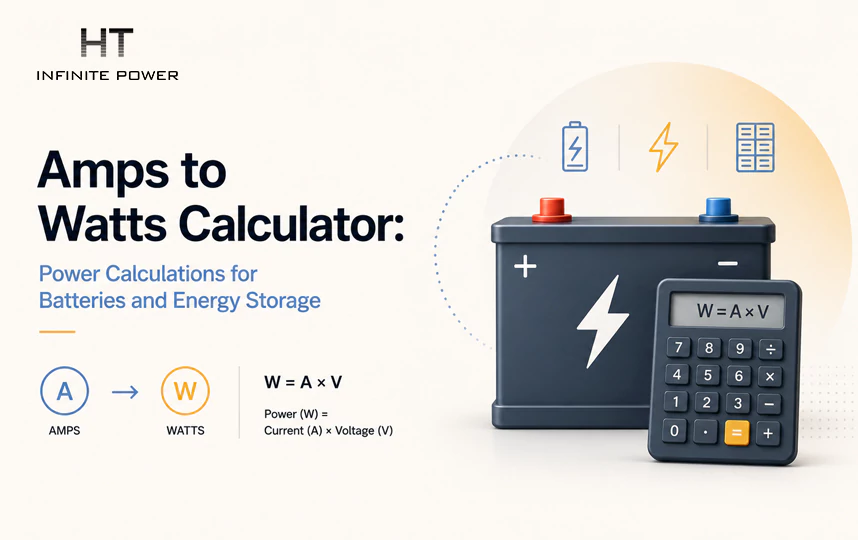
Watts to Volts Calculator for Batteries and Energy Storage
author: HT Infinite Power
2026-10-28
⚡
Watts ↔ Volts Calculator
Enter values to calculate
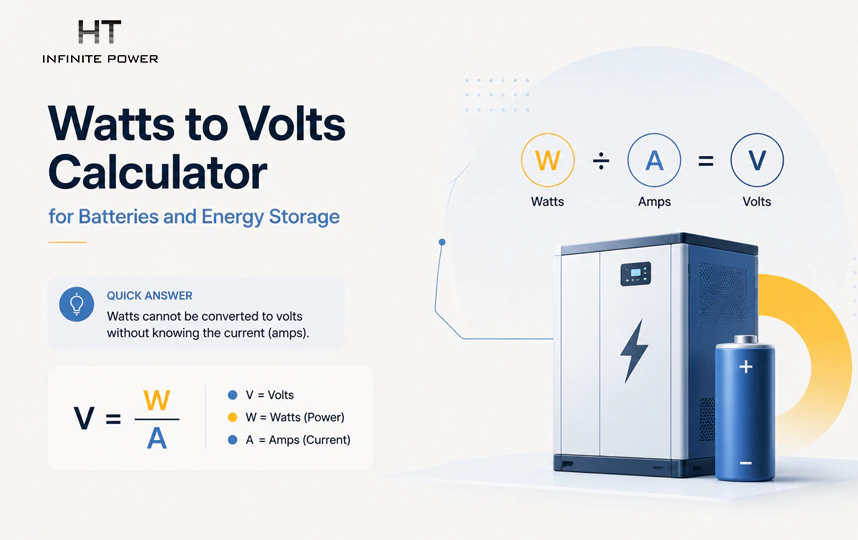
Quick Answer
Watts cannot be converted to volts without knowing the current (amps).
The conversion formula is:
The conversion formula is:
V=W/A
Where:
- V = Volts
- W = Watts (Power)
- A = Amps (Current)
Quick Examples
| Power | Current | Voltage |
| 1200w | 100A | 12V |
| 2400w | 100A | 24V |
| 4800w | 100A | 48V |
| 5120w | 100A | 51.2V |
| 40000w | 100A |
400V
|
The same power rating can operate at very different voltages depending on the current flowing through the system.
Why Watts Cannot Be Converted to Volts Without Current
Many people assume that watts and volts can be directly converted.
In reality, voltage depends on both power and current.
For example:
1000W at 10A
1000÷10=100V
1000W at 20A
1000÷20=50V
1000W at 50A
1000÷50=20V
The power never changes.
Only the current changes.
Yet the voltage changes dramatically.
This is why every accurate watts-to-volts calculation requires the current value.
Only the current changes.
Yet the voltage changes dramatically.
This is why every accurate watts-to-volts calculation requires the current value.
Understanding Watts, Volts and Amps
Before converting watts to volts, it helps to understand how these electrical values work together.
What Are Watts?
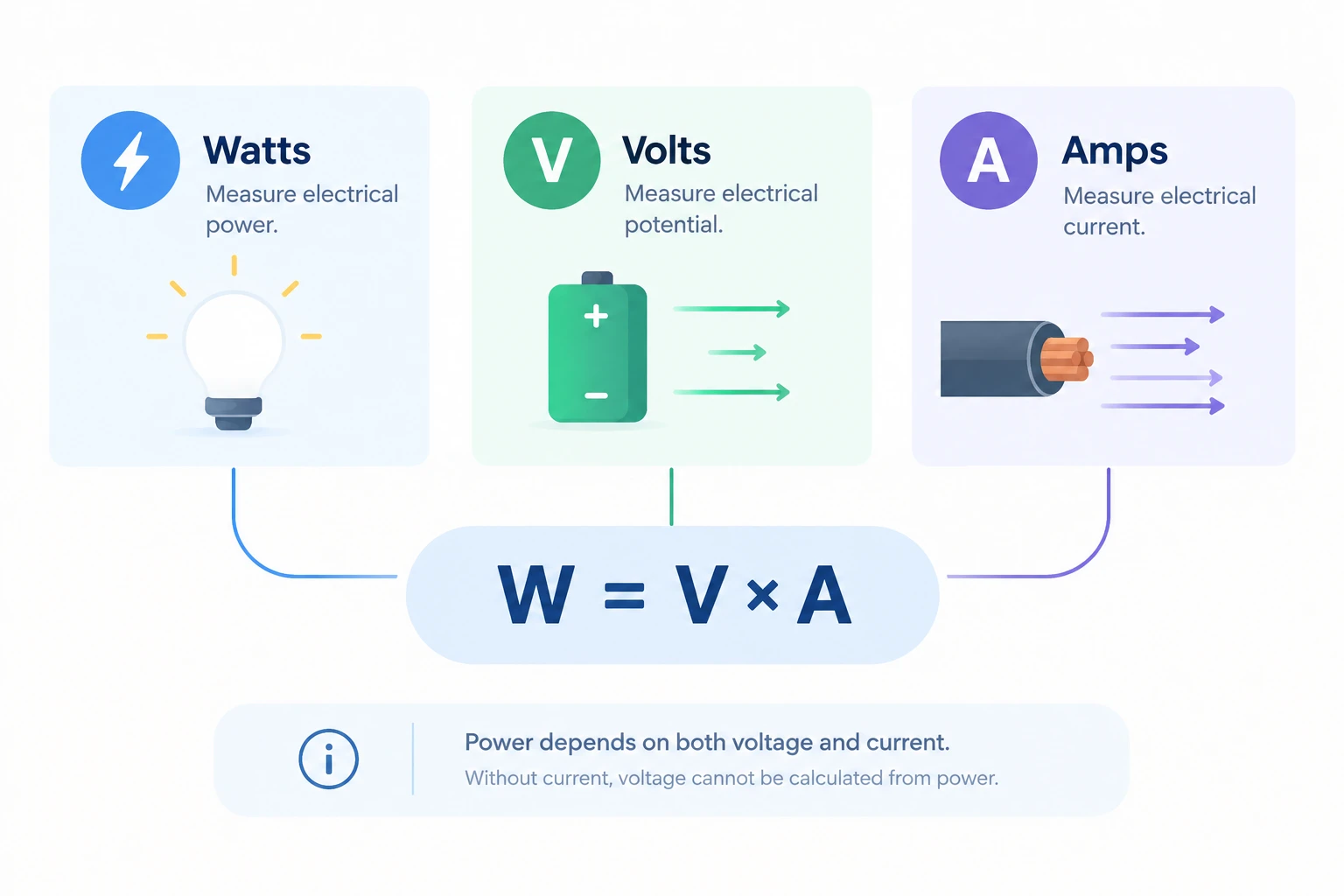
Watts measure electrical power.
Power represents the rate at which electrical energy is consumed or delivered.
Common examples include:
Power represents the rate at which electrical energy is consumed or delivered.
Common examples include:
- Battery output power
- Inverter power ratings
- Appliance power consumption
- EV charger output
- ESS discharge power
When a system is described as 5kW, 50kW, or 100kW, that figure represents its power output.
What Are Volts?
Volts measure electrical potential.
Voltage is often described as the electrical pressure that pushes current through a circuit.
Higher voltage allows the same power to be delivered with less current.
This principle is one of the most important concepts in modern energy storage systems.
Voltage is often described as the electrical pressure that pushes current through a circuit.
Higher voltage allows the same power to be delivered with less current.
This principle is one of the most important concepts in modern energy storage systems.
What Are Amps?
Amps measure electrical current.
Current is the flow of electricity through wires, cables, batteries, inverters, and electrical equipment.
Power depends on both voltage and current:
Current is the flow of electricity through wires, cables, batteries, inverters, and electrical equipment.
Power depends on both voltage and current:
W=V×A
Without current, voltage cannot be calculated from power.
Without current, voltage cannot be calculated from power.
Watts to Volts Formula
The standard formula is:
V=W/A
V=W/A
This formula is derived from:
W=V×A
W=V×A
By rearranging the equation, voltage can be determined when power and current are known.
Example 1
1200W at 100A:
1200/100=12V
Example 2
5000W at 100A:
Example 3
10000W at 200A:
1000/200=50V
How to Convert Watts to Volts
Converting watts to volts involves three simple steps.
Step 1
Determine the power rating in watts.
Step 2
Determine the current in amps.
Step 3
Divide watts by amps.
Example
Power: 5120W
Current: 100A
Current: 100A
Calculation: 5120/100=51.2V
The operating voltage is 51.2 volts.
How Many Volts Is 100W, 500W, 1000W, 5000W and 10000W?
The following table assumes a current of 10A.
| Power | Current | Voltage |
| 100W | 10A | 10V |
| 500W | 10A | 50V |
| 1000W | 10A | 100V |
| 5000W | 10A | 500V |
| 10000W | 10A | 1000V |
Changing the current changes the voltage immediately.
Watts to Volts Conversion Chart
| Watts | 5A | 10A | 20A | 50A | 100A |
| 500W | 100V | 50V | 25V | 10V | 5V |
| 1000W | 200V | 100V | 50V | 20V | 10V |
| 2500W | 500V | 250V | 125V | 50V | 25V |
| 5000W | 1000V | 500V | 250V | 100V | 50V |
| 10000W | 2000V | 1000V | 500V | 200V | 100V |
This chart highlights how strongly current influences voltage calculations.
Why Voltage Matters More Than Most People Realize
Many users focus on power ratings and assume voltage is a secondary detail.
However, voltage has a major impact on system design, efficiency, installation costs, and current requirements.
Consider a 5kW system.
However, voltage has a major impact on system design, efficiency, installation costs, and current requirements.
Consider a 5kW system.
At 12V
5000÷12≈417A
At 48V
5000÷12≈104A
At 400V
5000÷14=12.5A
All three systems deliver the same amount of power.
The difference lies in the current required.
This simple relationship explains why modern energy storage systems continue moving toward higher operating voltages.
Common Battery Voltage Examples
Different battery applications use different voltage architectures.
12V Batteries
Common in:
- RV systems
- Marine batteries
- Portable backup power
These systems are simple but often require high current to deliver significant power.
24V Batteries
Often found in:
- Telecom backup systems
- Small solar installations
- Remote monitoring systems
24V reduces current requirements compared to 12V designs.
48V Batteries
Widely used in:
- Residential energy storage
- Hybrid solar systems
- Off-grid installations
48V has become one of the most common voltages in home battery storage.
51.2V Batteries
Popular in:
- LFP batteries
- Rack batteries
- Residential ESS systems
A 51.2V battery is typically built from sixteen lithium iron phosphate cells connected in series.
High-Voltage Battery Systems
Commercial and utility-scale systems often operate at:
- 400V
- 600V
- 800V
- 1000V+
- 1500V
These higher voltages dramatically reduce current requirements.
Voltage Selection in Residential, Commercial and Utility ESS
Different storage applications use different voltage levels for different reasons.
| Application | Typical Voltage |
| RV Battery Systems | 12V |
| Small Off-Grid Solar | 24V |
| Residential ESS | 48V–51.2V |
| Commercial ESS | 400V–800V |
| Utility-Scale ESS | 1000V–1500V |
Residential systems prioritize safety, simplicity, and compatibility with residential inverters.
Commercial systems focus on efficiency, cable sizing, and installation cost.
Utility-scale projects prioritize maximum power transfer and minimum infrastructure cost.
Commercial systems focus on efficiency, cable sizing, and installation cost.
Utility-scale projects prioritize maximum power transfer and minimum infrastructure cost.
Why Modern Home Batteries Use 48V and 51.2V
Residential energy storage systems require a practical balance between safety, current, efficiency, and cost.
For example:
For example:
51.2V at 100A
51.2×100=5120W=5.12kW
This power level is sufficient for many household loads while keeping current at manageable levels.
Modern residential battery systems frequently use:
- 100Ah modules
- 200Ah modules
- 280Ah cells
- 314Ah cells
combined with 48V or 51.2V architectures.
This combination has become an industry standard for home ESS installations.
Why Commercial Energy Storage Uses High Voltage
Commercial systems face different challenges.
They must deliver large amounts of power while controlling costs and improving efficiency.
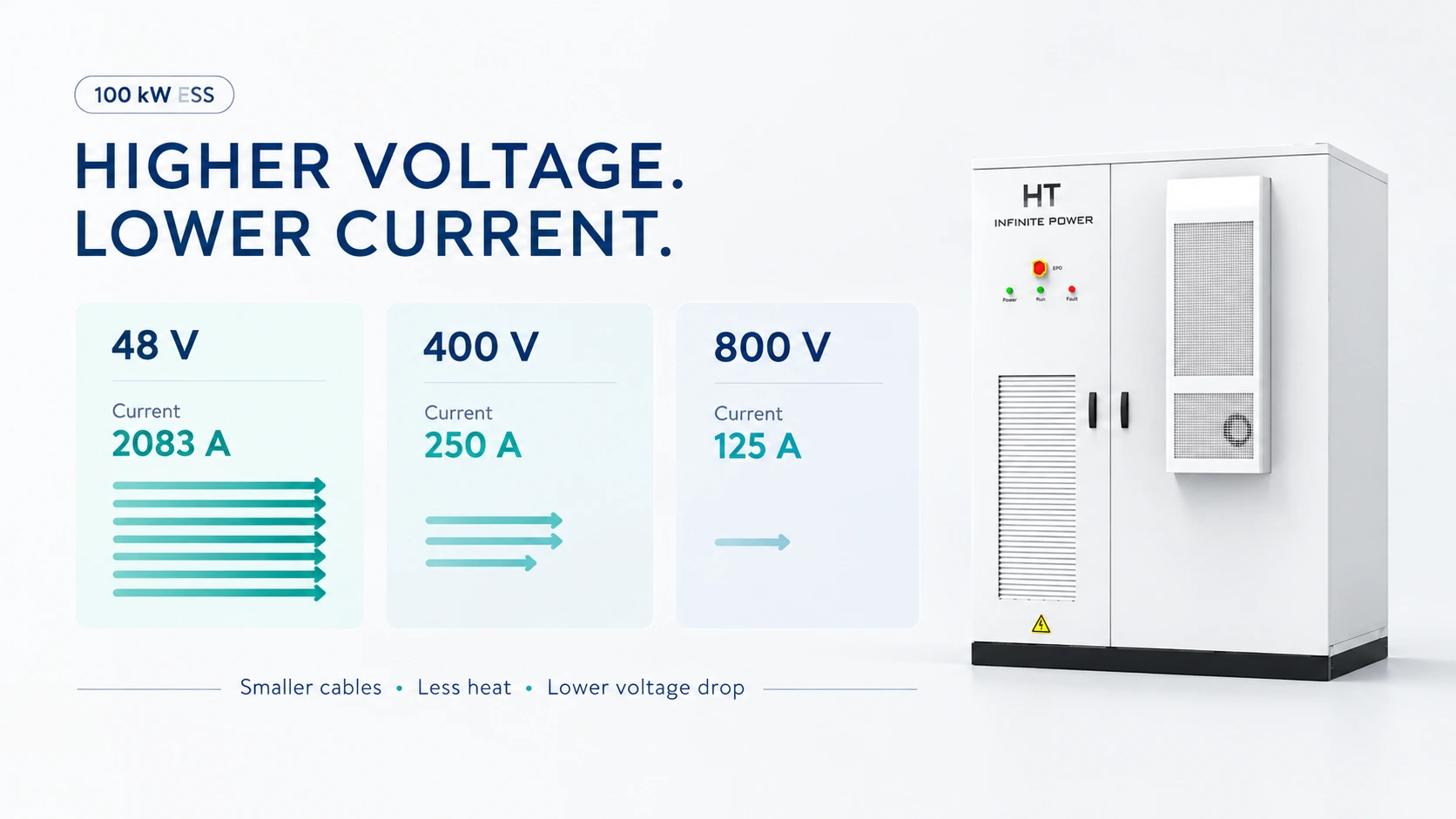
Consider a 100kW ESS.
They must deliver large amounts of power while controlling costs and improving efficiency.
Consider a 100kW ESS.
At 48V
100000/48≈2083A
At 400V
100000/400=250A
At 800V
100000/800=125A
The current reduction is substantial.
Lower current means:
- Smaller cables
- Lower heat generation
- Reduced voltage drop
- Lower installation cost
This is why high-voltage architectures dominate commercial ESS deployments.
Why 1500V Is Becoming the New Standard for Utility-Scale Energy Storage
Large energy storage projects continue to increase in size, often reaching hundreds of megawatts or more.
To improve efficiency and reduce infrastructure costs, many developers are adopting 1500V battery platforms.
Consider a 1MW power output.
To improve efficiency and reduce infrastructure costs, many developers are adopting 1500V battery platforms.
Consider a 1MW power output.
At 1000V
1000000/1000=1000A
At 1500V
1000000/150≈667A
The higher-voltage system requires significantly less current.
Benefits include:
Benefits include:
- Smaller conductors
- Lower electrical losses
- Reduced heat generation
- Lower BOS (Balance of System) costs
- Higher system efficiency
For these reasons, 1500V architectures are increasingly common in utility-scale ESS projects.
How Voltage Affects PCS and Inverter Design
Voltage selection directly impacts PCS and inverter engineering.
Consider a 100kW PCS.
Consider a 100kW PCS.
48V Architecture
100000÷48≈2083A
800V Architecture
100000÷800=125A
Both systems provide identical power.
However, the low-voltage design must handle more than sixteen times the current.
However, the low-voltage design must handle more than sixteen times the current.
Higher current increases:
- Busbar size
- Cooling requirements
- Semiconductor stress
- Cable requirements
- Overall system complexity
This is one of the primary reasons why commercial and utility-scale energy storage systems use high-voltage battery platforms.
Real Home Energy Storage Example
Suppose a homeowner installs a 10kWh battery system operating at 51.2V.
The battery provides:
The battery provides:
100A
The power output is:
51.2×100=5120w=5.12kW
51.2×100=5120w=5.12kW
This power level can support many essential household loads, including refrigerators, lighting, networking equipment, computers, and other critical appliances.
Real Commercial ESS Example
Consider a commercial ESS designed to deliver:
100kW
using an 800V battery architecture.
using an 800V battery architecture.
Current required:
100000÷800=125A
Compared with low-voltage systems, the higher-voltage design benefits from:
- Lower conductor requirements
- Reduced thermal losses
- Simpler installation
- Improved efficiency
This is one reason why high-voltage architectures dominate modern commercial energy storage projects.
Why Higher Voltage Reduces Current
For any power level:
A=W÷V
A=W÷V
As voltage increases, current decreases.
This brings several advantages:
- Smaller cables
- Lower voltage drop
- Reduced heating
- Improved efficiency
- Lower infrastructure costs
The relationship affects everything from residential batteries to utility-scale storage plants.
Why Higher Voltage Improves System Efficiency
The benefits of higher voltage go beyond reducing current.
Electrical losses in conductors are commonly represented by:
Electrical losses in conductors are commonly represented by:
Loss = I²R
Because current is squared, relatively small reductions in current can significantly reduce system losses.
For example, reducing current by 50% reduces conductor losses by approximately 75%.
This can lead to:
- Higher round-trip efficiency
- Lower operating temperatures
- Reduced cooling requirements
- Longer equipment life
These efficiency gains are a major reason why modern ESS, EV charging infrastructure, and PCS designs continue moving toward higher operating voltages.
Common Mistakes
Ignoring Current
Watts alone cannot determine voltage.
Confusing Watts and Volts
Watts measure power.
Volts measure electrical potential.
Using the Wrong Formula
Voltage calculations always require current.
Mixing AC and DC Systems
AC applications may require additional considerations such as power factor.
Ignoring Voltage Architecture
Voltage selection has a major impact on efficiency, costs, and overall system design.
Conclusion
A watts-to-volts calculator helps determine voltage when power and current are known. While the mathematical conversion is simple, the relationship between watts, volts, and amps plays a critical role in battery design, inverter operation, PCS engineering, and energy storage system architecture. From 12V backup batteries to 1500V utility-scale ESS projects, voltage directly impacts current requirements, system efficiency, thermal performance, and project economics. Understanding these relationships helps engineers, system designers, and energy storage users make better decisions when selecting batteries, inverters, and ESS equipment.
FAQ
How do I convert watts to volts?
Use:
V=W/A
You must know the current.
Can watts be converted to volts without amps?
No. Current is required.
How many volts is 1000 watts?
It depends on current.
1000W at 10A = 100V
1000W at 20A = 50V
1000W at 20A = 50V
Why does current affect voltage calculations?
Because power depends on both voltage and current.
Why do home batteries use 48V or 51.2V?
These voltages offer a practical balance between safety, efficiency, and power delivery.
Why do commercial ESS systems use 400V or 800V?
Higher voltages reduce current requirements and improve system efficiency.
Why are utility-scale ESS projects moving toward 1500V?
Higher voltage reduces current, lowering cable requirements, losses, and overall project costs.
What is the difference between watts and volts?
Watts measure power output, while volts measure electrical potential.
Amps to Watts Calculator: Power Calculations for Batteries and Energy Storage
Related Article