How to Design a Commercial Battery Energy Storage System: A Step-by-Step Engineering Guide
author: HT infinitepower
2026-07-08

Commercial Battery Energy Storage System (BESS) projects are often introduced as battery installation projects. However, from a system engineering perspective, the battery is only one part of a much larger decision framework.
In many commercial BESS projects, the final performance is not determined by the battery cell technology alone. It depends on whether the system architecture matches the customer’s operating conditions, electrical infrastructure, tariff structure, and long-term business objectives.
During engineering evaluations, one of the most common questions from facility owners is:
“How many kilowatt-hours of storage do we need?”
Although this appears to be a straightforward sizing question, experienced BESS engineers usually start somewhere else.
The first question is:
“What operational problem is the energy storage system expected to solve?”
A manufacturing plant trying to reduce demand charges, a logistics warehouse trying to maximize solar self-consumption, and a commercial building requiring backup capability may all need BESS solutions. However, their system designs can be completely different.
A larger battery is not automatically a better solution.
A higher PCS rating does not always create higher value.
A more advanced cooling system does not always improve project economics.
The final design must balance:
- Electrical performance
- Operating strategy
- Safety requirements
- Lifecycle degradation
- Investment return
From a system integrator perspective, commercial BESS design is the process of finding the most suitable configuration under real-world constraints.
Engineering Perspective: How Experienced Teams Approach BESS Design
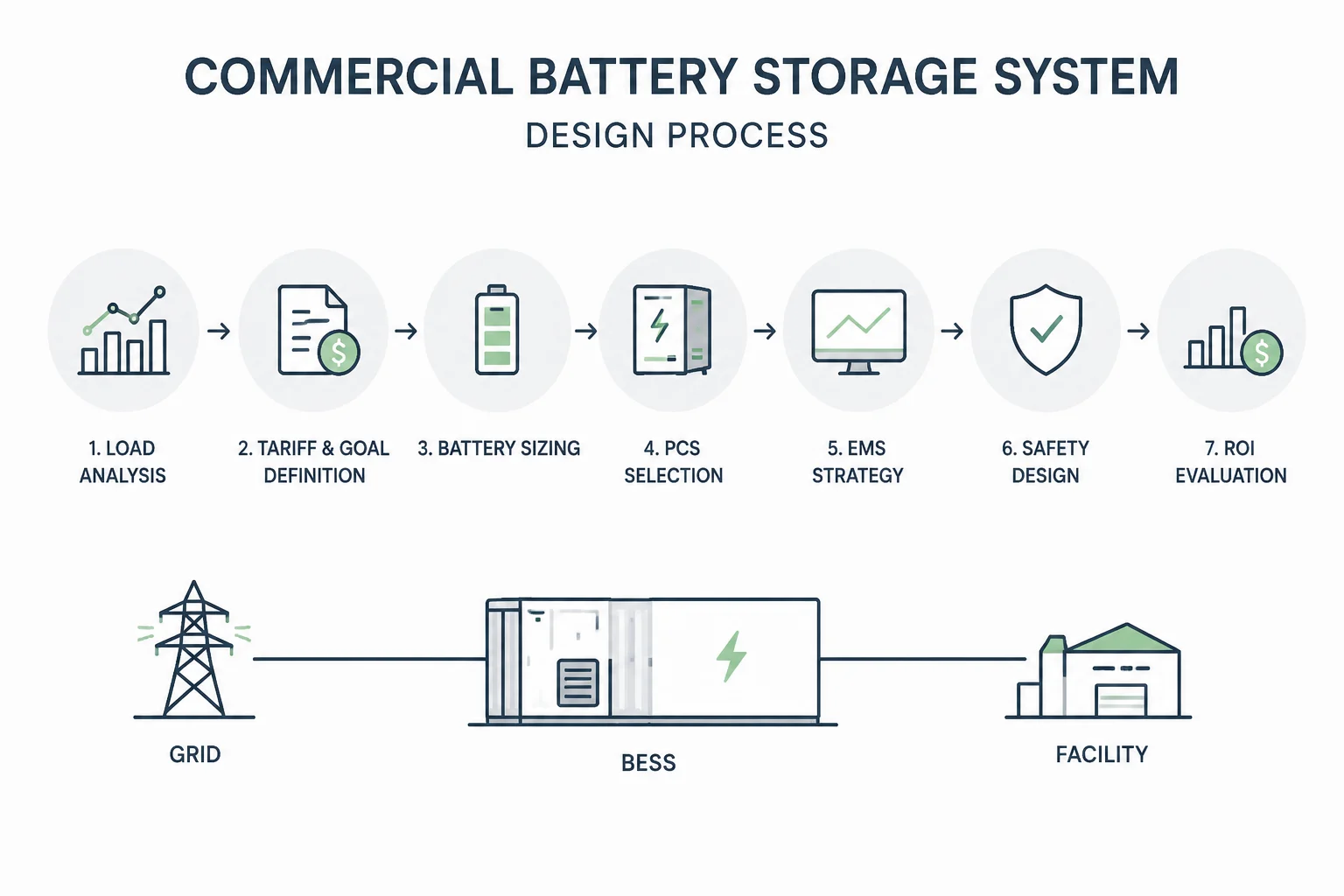
During engineering evaluations, our team typically does not begin with equipment selection.
The design process usually starts with understanding four fundamental constraints:
Electrical Constraint
The electrical system determines:
- required power output
- grid connection limitations
- transformer capacity
- protection requirements
Operational Constraint
The operating profile determines:
- charging and discharging frequency
- expected daily cycles
- required response time
- application priority
Economic Constraint
The business model determines:
- acceptable investment level
- expected payback period
- revenue sources
- degradation tolerance
Physical Constraint
The installation environment determines:
- cooling requirements
- safety design
- equipment layout
- maintenance accessibility
These constraints are interconnected.
For example, during many commercial projects, we observe that customers initially focus on increasing battery capacity because it appears to provide more flexibility. However, after analyzing actual load behavior, engineers often find that the limiting factor is not stored energy but insufficient discharge power during critical periods.
In those cases, adding more batteries increases project cost without solving the original problem.
This is why professional BESS design is not simply a calculation exercise. It requires understanding how each component affects the complete system.
1. Why Every Project Starts with Load Analysis
Load analysis is the foundation of commercial BESS design because it defines how the system interacts with the facility.
A common mistake during early project discussions is focusing only on annual electricity consumption.
Annual energy consumption helps estimate overall electricity demand, but it does not tell engineers when and why the facility requires power.
A BESS responds to operational patterns, not annual averages.
What Engineers Analyze During Load Evaluation
During engineering assessments, teams usually review:
- 15-minute interval demand data
- hourly load profiles
- seasonal changes
- production schedules
- equipment operating patterns
For industrial customers, engineers pay particular attention to:
- sudden demand increases
- production startup events
- HVAC-related peaks
- charging infrastructure loads
A short but expensive peak event may create more economic value for BESS than several hours of normal consumption.
Real Project Observation: Similar Loads Can Require Different BESS Designs
Consider two facilities with similar annual electricity consumption.
Case A: Manufacturing Facility
Electrical characteristics:
- Average load: 700 kW
- Peak demand: 1.5 MW
- Peak duration: 20 minutes
The primary issue:
Demand charges caused by simultaneous operation of production equipment.
Demand charges caused by simultaneous operation of production equipment.
Engineering approach:
A higher-power PCS with moderate battery duration may provide the best return.
A higher-power PCS with moderate battery duration may provide the best return.
Case B: Cold Storage Warehouse
Electrical characteristics:
- Average load: 700 kW
- Peak demand: 1 MW
- Peak duration: 4 hours
The primary issue:
Long-duration energy consumption during expensive tariff periods.
Long-duration energy consumption during expensive tariff periods.
Engineering approach:
A larger energy capacity system may be more appropriate.
Although both facilities consume similar electricity annually, the required BESS architecture is different.
This is one of the reasons experienced integrators request detailed load data before providing final system recommendations.
This is one of the reasons experienced integrators request detailed load data before providing final system recommendations.
Decision Guidance for EPC Contractors
Before approving a BESS design, EPC teams should confirm:
- Is the project solving a power problem or an energy problem?
- Is the peak demand event short or continuous?
- Is the economic value created by reducing kW demand or shifting kWh consumption?
- Does the proposed battery capacity match actual operating requirements?
A technically impressive system can still produce weak financial results if the design objective is unclear.
2. Understanding the Customer's Energy Goals
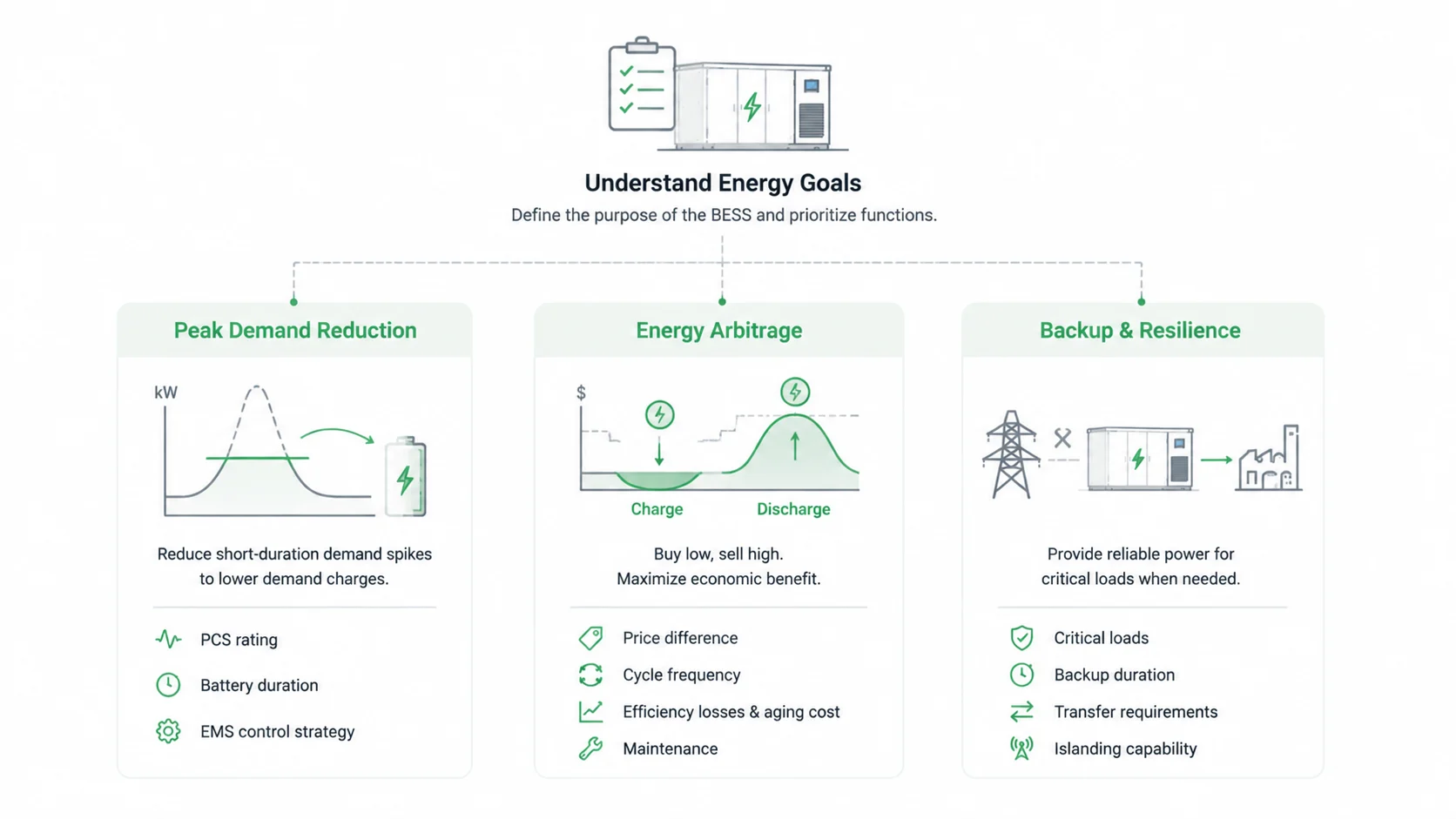
After understanding the load profile, engineers define the actual purpose of the BESS.
Commercial customers often have multiple expectations:
- lower electricity costs
- renewable energy integration
- backup capability
- grid flexibility
However, these goals may conflict.
A system optimized for maximum daily energy arbitrage may not be ideal for emergency backup.
A system reserved for backup may not achieve maximum economic utilization.
Therefore, engineering teams usually establish the priority of each function before selecting system parameters.
A system reserved for backup may not achieve maximum economic utilization.
Therefore, engineering teams usually establish the priority of each function before selecting system parameters.
Peak Demand Reduction
For industrial facilities, demand charge reduction is one of the most common BESS applications.
The objective is not to power the entire facility.
Instead, the BESS reduces short-duration demand spikes.
For example:
A factory may normally operate at 900 kW but occasionally reach 1.4 MW when multiple production lines start.
The BESS does not need to replace the entire 1.4 MW load.
It only needs to reduce the portion creating additional demand charges.
The BESS does not need to replace the entire 1.4 MW load.
It only needs to reduce the portion creating additional demand charges.
This decision directly influences:
- PCS rating
- battery duration
- EMS control strategy
Energy Arbitrage
Energy arbitrage applications require careful financial analysis.
Engineers consider:
- peak/off-peak price difference
- charging opportunities
- expected cycle frequency
- battery degradation impact
A common mistake is evaluating arbitrage only from electricity price differences.
In practice, the calculation must also include:
- round-trip efficiency losses
- battery aging cost
- maintenance requirements
Backup and Resilience Applications
Backup applications require different design considerations.
During engineering reviews, teams usually define:
- critical loads
- backup duration
- transfer requirements
- islanding capability
A peak shaving system and a backup power system may use similar batteries, but their electrical architecture and operating logic are often different.
3. Collecting Site Information: Turning the Installation Environment Into Design Inputs
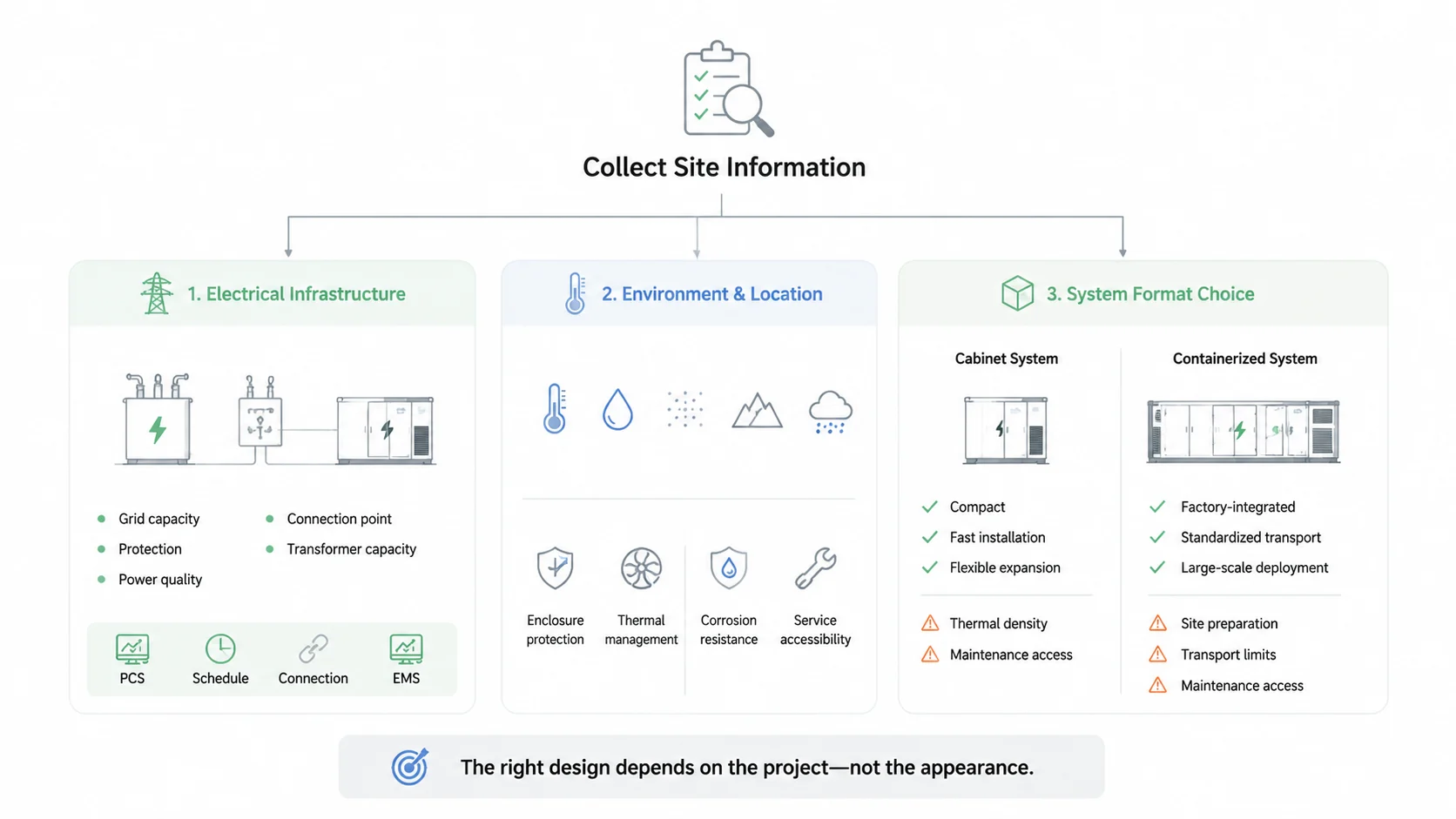
After defining the customer’s energy objectives, the next step is evaluating whether the site conditions support the proposed BESS architecture.
In commercial projects, many design challenges appear not because the battery system is technically incapable, but because the original site assumptions were incomplete.
During engineering evaluations, a BESS team typically reviews the site from three perspectives:
- Electrical compatibility
- Environmental suitability
- Installation and maintenance practicality
A successful system must work not only on a specification sheet but also inside the customer’s actual facility.
Electrical Infrastructure Assessment
The existing electrical infrastructure often becomes the hidden constraint in commercial BESS projects.
Engineers typically evaluate:
- Transformer capacity
- Medium-voltage or low-voltage connection point
- Available grid capacity
- Protection coordination
- Power quality requirements
For example, an industrial customer may request a 500 kW BESS to reduce peak demand.
However, during detailed engineering review, the transformer may already operate close to its rated capacity during production hours.
However, during detailed engineering review, the transformer may already operate close to its rated capacity during production hours.
In this situation, the question is no longer:
“How large should the battery be?”
The more important question becomes:
“How can the BESS operate without creating additional stress on the existing electrical system?”
This may influence:
- PCS selection
- charging schedule
- grid connection design
- EMS operating limits
Environmental Conditions and Installation Location
Battery performance is directly influenced by the operating environment.
Engineering teams usually evaluate:
- Ambient temperature range
- Humidity
- Dust exposure
- Altitude
- Outdoor weather conditions
A system installed inside a controlled industrial room and a system installed outdoors in a high-temperature environment should not be designed the same way.
For outdoor installations, additional considerations may include:
- enclosure protection rating
- thermal management strategy
- corrosion resistance
- service accessibility
Choosing Between Cabinet and Containerized Systems
From a supplier and system integration perspective, there is no universal “best” BESS format.
The correct architecture depends on project requirements.
The correct architecture depends on project requirements.
Integrated Outdoor Cabinet Systems
Often selected when:
- installation space is limited
- deployment speed is important
- capacity requirements are moderate
Advantages:
- compact footprint
- simplified installation
- easier expansion for certain applications
Limitations:
- thermal density can become challenging
- maintenance access requires careful planning
Containerized BESS
Often selected for larger commercial and industrial projects.
Advantages:
Advantages:
- factory-integrated design
- standardized transportation
- easier large-scale deployment
However, containerization also introduces considerations:
- site preparation requirements
- transportation limitations
- access for maintenance
During project reviews, engineers often find that customers initially prefer containers because they appear more industrial. However, for some commercial facilities, a modular cabinet solution may provide better lifecycle value.
The correct decision depends on the project, not the appearance of the system.
4. Electricity Tariff Analysis: Connecting Engineering Design With Business Value
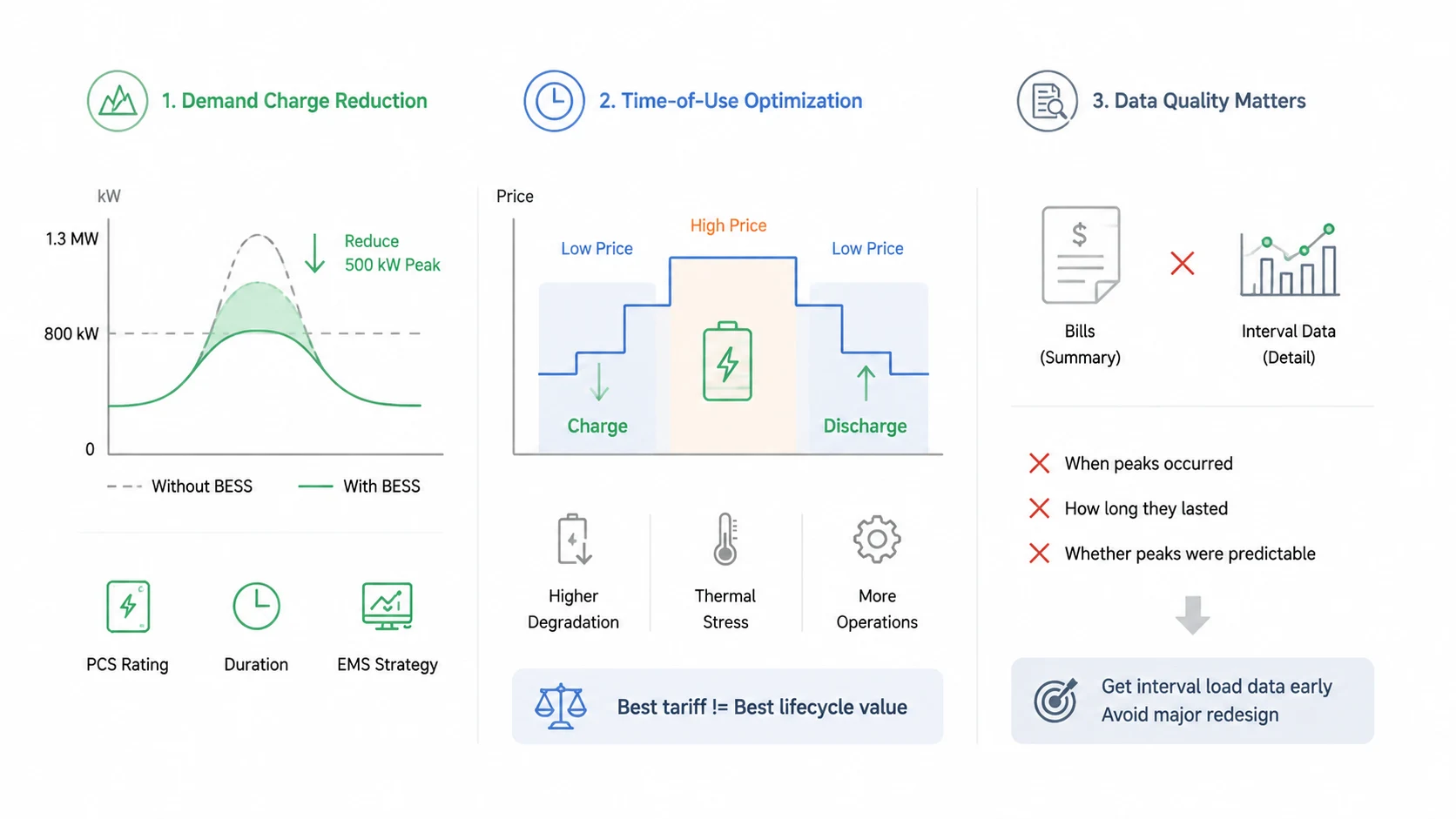
A commercial BESS does not create economic value simply because it stores energy.
It creates value by changing when and how electricity is consumed.
This is why tariff analysis is a core engineering input rather than only a financial exercise.
It creates value by changing when and how electricity is consumed.
This is why tariff analysis is a core engineering input rather than only a financial exercise.
Demand Charge Reduction
Many industrial customers pay based on their highest recorded power demand during a billing period.
A BESS can reduce these peaks by supplying part of the facility demand during critical periods.
A BESS can reduce these peaks by supplying part of the facility demand during critical periods.
Example:
A factory operates normally at 800 kW but reaches 1.3 MW during several production events.
The economic opportunity is not necessarily storing enough energy to operate the entire factory.
The opportunity is reducing the additional 500 kW demand peak.
A factory operates normally at 800 kW but reaches 1.3 MW during several production events.
The economic opportunity is not necessarily storing enough energy to operate the entire factory.
The opportunity is reducing the additional 500 kW demand peak.
This directly affects:
- PCS power rating
- discharge duration
- EMS strategy
Time-of-Use Optimization
For customers with significant electricity price differences, the BESS may charge during low-cost periods and discharge during expensive periods.
However, engineering teams must evaluate whether the tariff difference supports the additional cycling.
A project with frequent daily cycling may generate more revenue but also experience:
- higher degradation
- increased thermal stress
- more intensive operating requirements
The most attractive tariff strategy is not always the most profitable lifecycle strategy.
Supplier-Side Insight: Why Tariff Data Quality Matters
During commercial BESS evaluations, one issue frequently appears:
The customer provides electricity bills but not detailed interval data.
Bills show how much electricity was consumed.
The customer provides electricity bills but not detailed interval data.
Bills show how much electricity was consumed.
They usually do not show:
- when peaks occurred
- how long they lasted
- whether peaks were predictable
Without this information, system sizing becomes an estimation rather than an engineering design.
For serious EPC projects, obtaining interval load data early can prevent major redesign later.
For serious EPC projects, obtaining interval load data early can prevent major redesign later.
5. Load Profile Analysis: Converting Data Into System Behavior
Load profile analysis is where raw electrical data becomes a practical operating strategy.
The objective is not only identifying maximum demand.
Engineers need to understand the behavior behind the demand.
The objective is not only identifying maximum demand.
Engineers need to understand the behavior behind the demand.
Peak Power and Peak Duration Must Be Evaluated Together
A common design mistake is focusing only on peak demand value.
For example:
A 1 MW peak lasting 10 minutes and a 1 MW peak lasting 4 hours require completely different solutions.
The first is primarily a power requirement.
The second is primarily an energy requirement.
A 1 MW peak lasting 10 minutes and a 1 MW peak lasting 4 hours require completely different solutions.
The first is primarily a power requirement.
The second is primarily an energy requirement.
Engineering Calculation Example
Assume a facility requires:
- Peak reduction target: 250 kW
- Required support duration: 2 hours
Basic energy requirement:
250 kW × 2 hours = 500 kWh
250 kW × 2 hours = 500 kWh
However, engineers must consider:
- usable depth of discharge
- inverter efficiency
- battery aging margin
- environmental conditions
Assuming:
- 90% usable energy window
- 95% round-trip efficiency
Required installed capacity:
500 ÷ (0.90 × 0.95)
≈ 585 kWh
500 ÷ (0.90 × 0.95)
≈ 585 kWh
Additional margin may be considered depending on the project lifetime requirement.
This is why commercial systems are usually specified above the simple load calculation.
Engineering Perspective: Design Around Real Operating Events
In many projects, the highest-value information is not the average load.
It is the abnormal but expensive event.
It is the abnormal but expensive event.
Examples include:
- production line startup
- compressor operation
- refrigeration cycles
- EV charging peaks
Experienced engineers focus on understanding these events because they often define the economic case for BESS.
6. Battery Capacity Calculation: Designing for Lifetime Operation
Battery sizing is not simply selecting a kWh number.
A commercial BESS must deliver expected performance not only on day one but throughout years of operation.
A commercial BESS must deliver expected performance not only on day one but throughout years of operation.
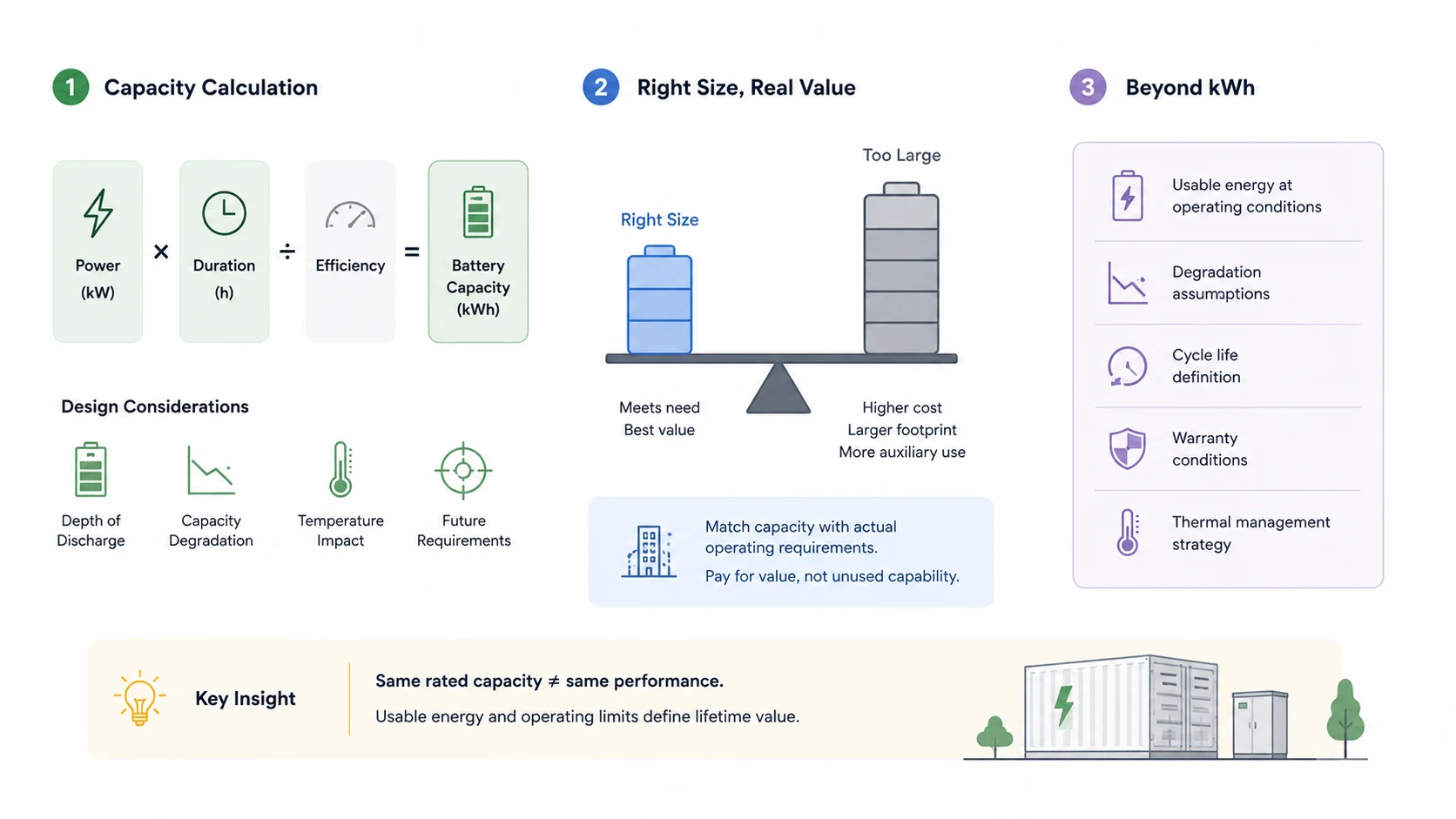
Basic Energy Sizing Formula
A simplified calculation:
Required Battery Capacity = Required Output Power × Discharge Duration ÷ System Efficiency
Required Battery Capacity = Required Output Power × Discharge Duration ÷ System Efficiency
However, professional design includes additional factors:
- Depth of Discharge limitation
- Capacity degradation
- Temperature impact
- Future performance requirements
Why Larger Battery Capacity Is Not Always Better
During customer discussions, larger capacity often appears attractive.
However, additional capacity increases:
- capital investment
- footprint
- auxiliary consumption
If the additional stored energy is rarely used, the customer may pay for capability that does not generate value.
For example:
A commercial building that only needs 30 minutes of demand reduction may not benefit economically from a multi-hour battery system.
The correct design matches capacity with actual operating requirements.
Supplier-Side Engineering Insight: Battery Specification Is More Than kWh
When evaluating suppliers, EPC contractors should look beyond nominal battery capacity.
Important considerations include:
- usable energy at operating conditions
- degradation assumptions
- cycle life definition
- warranty conditions
- thermal management strategy
Two systems with the same rated capacity may provide different lifecycle performance depending on how the supplier defines usable energy and operating limits.
7. PCS Selection: Matching Power Conversion Capability With Project Objectives
The Power Conversion System (PCS) is often one of the most misunderstood parts of a commercial BESS design.
Many project discussions focus heavily on battery capacity, while the PCS determines whether that stored energy can actually be delivered in the way the application requires.
Many project discussions focus heavily on battery capacity, while the PCS determines whether that stored energy can actually be delivered in the way the application requires.
From a system integration perspective, engineers usually evaluate PCS selection based on three questions:
- How much power does the facility actually need?
- How quickly must the system respond?
- How often will the PCS operate at high output?
The correct PCS rating is not necessarily the largest available.
It is the rating that matches the operational objective.
It is the rating that matches the operational objective.
Power Rating and Energy Capacity Solve Different Problems
Battery capacity determines how much energy can be stored.
PCS rating determines how much power can be exchanged with the grid.
These two parameters must be designed together but should not be confused.
PCS rating determines how much power can be exchanged with the grid.
These two parameters must be designed together but should not be confused.
For example:
A manufacturing facility may have:
A manufacturing facility may have:
- Peak demand: 2 MW
- Target peak reduction: 300 kW
- Peak duration: 30 minutes
In this case, installing a 2 MW PCS would technically provide more capability, but it may not create sufficient economic benefit to justify the additional investment.
A properly sized 300–500 kW PCS may achieve the actual objective more efficiently.
A properly sized 300–500 kW PCS may achieve the actual objective more efficiently.
Oversizing vs. Undersizing the PCS
Oversized PCS
Advantages:
- Higher flexibility
- Faster response capability
- More future expansion potential
Limitations:
- Higher capital cost
- Additional conversion losses
- Lower utilization rate in normal operation
Undersized PCS
Advantages:
- Lower initial investment
Limitations:
- Limited peak shaving capability
- Longer time required to discharge energy
- Potential mismatch with customer expectations
Engineering Evaluation: PCS Selection Should Consider Future Operation
During EPC reviews, engineers often examine not only current load conditions but also future operating changes.
Examples:
- planned production expansion
- additional EV charging loads
- future solar integration
However, oversizing only for possible future needs can also reduce project economics.
The best approach is usually a balanced design with realistic expansion consideration.
The best approach is usually a balanced design with realistic expansion consideration.
8. Cooling Method Selection: Managing Temperature for Reliability and Lifetime
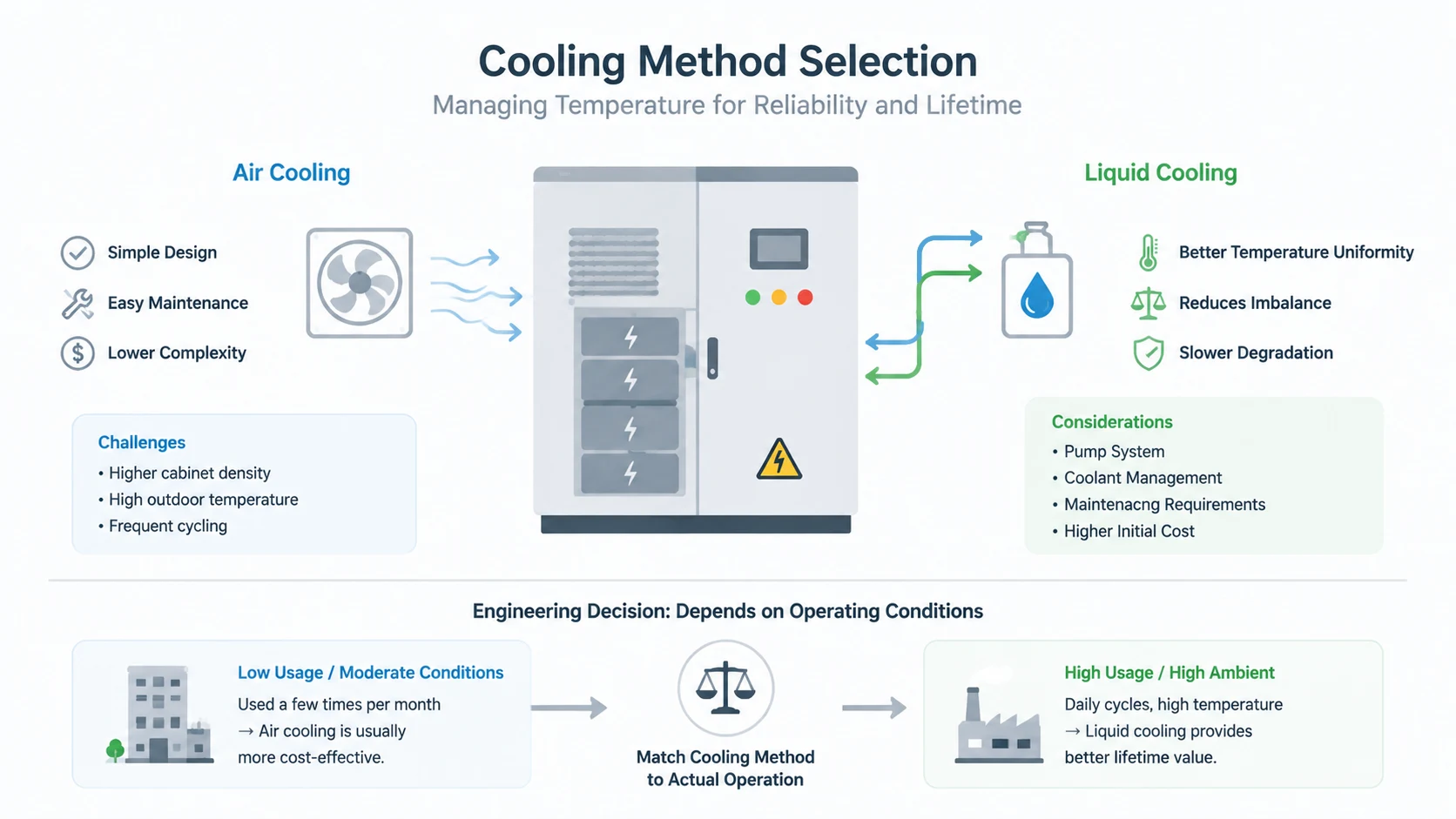
Thermal management is one of the areas where commercial BESS design has evolved significantly.
Early projects often treated cooling as a secondary consideration.
Early projects often treated cooling as a secondary consideration.
Today, engineers recognize that thermal performance directly influences:
- battery degradation
- available capacity
- system reliability
Air Cooling: Suitable for Specific Applications
Air cooling remains a practical option for many commercial systems.
It may be suitable when:
- cycling frequency is moderate
- ambient conditions are controlled
- system energy density is not extremely high
Advantages:
- simpler design
- easier maintenance
- lower auxiliary complexity
However, air cooling can become challenging when:
- cabinet density increases
- outdoor temperature rises
- charging and discharging cycles become frequent
Liquid Cooling: Designed for Higher Thermal Control Requirements
Liquid cooling provides better temperature uniformity across battery modules.
This can help reduce:
- cell temperature differences
- imbalance between battery units
- accelerated aging
However, liquid cooling introduces additional engineering considerations:
- pump systems
- coolant management
- maintenance requirements
- higher initial cost
Engineering Decision: When Not to Choose Liquid Cooling
Liquid cooling is not automatically the best option.
For example:
A small commercial building using BESS only a few times per month for demand management may not achieve enough additional value to justify a more complex thermal system.
A small commercial building using BESS only a few times per month for demand management may not achieve enough additional value to justify a more complex thermal system.
For an industrial facility operating daily cycles under high ambient temperature, the lifecycle benefit may justify the investment.
The correct cooling choice depends on operating conditions, not simply system size.
The correct cooling choice depends on operating conditions, not simply system size.
9. EMS Requirements: Turning Hardware Into an Operating Strategy
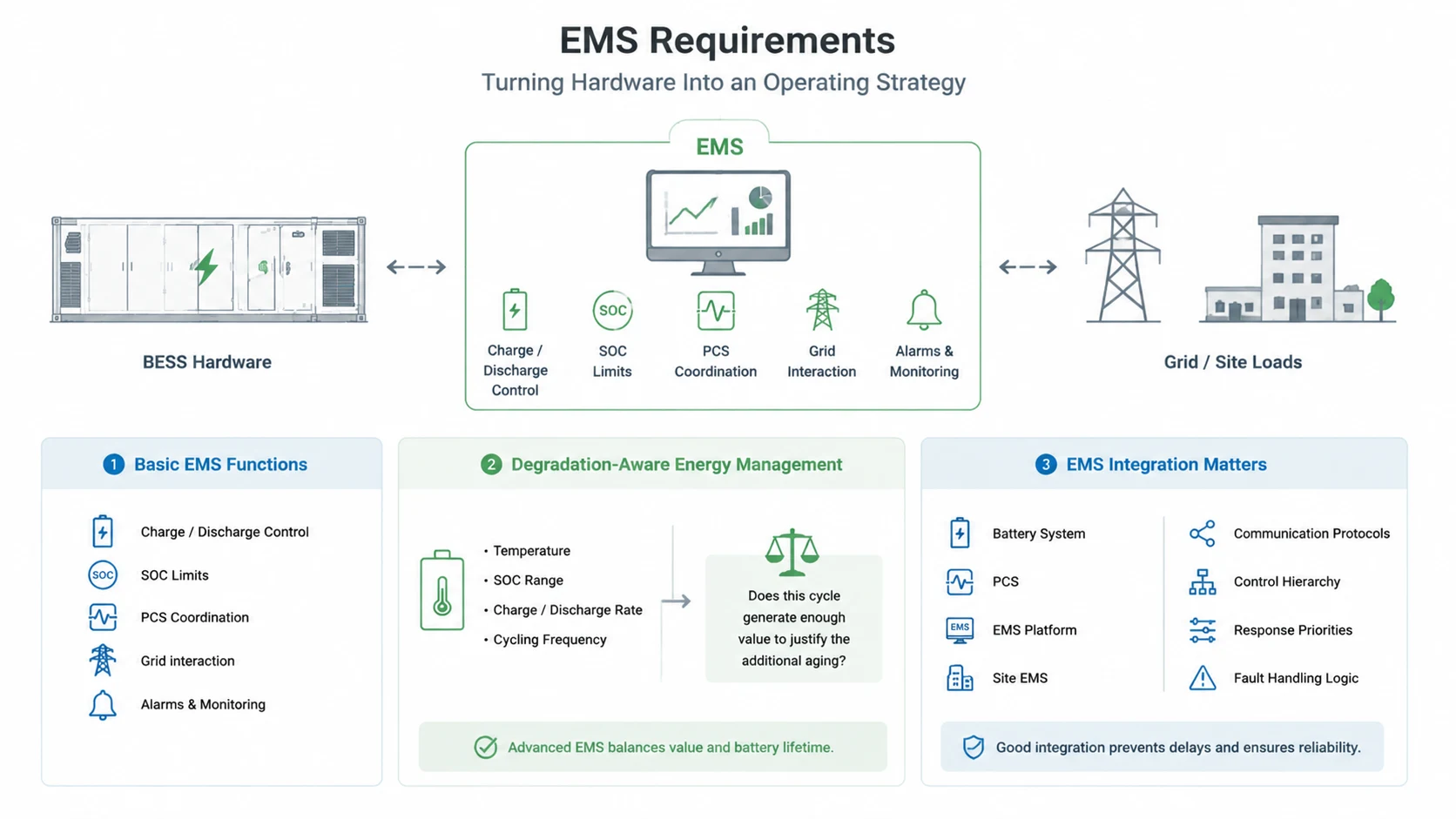
The Energy Management System (EMS) determines how the BESS behaves after installation.
A battery system can have excellent hardware specifications and still underperform if the operating strategy is poorly designed.
A battery system can have excellent hardware specifications and still underperform if the operating strategy is poorly designed.
During engineering evaluations, EMS functionality is often reviewed from the perspective of:
- economic optimization
- battery protection
- operational flexibility
Basic EMS Functions
A commercial EMS typically manages:
- charging and discharging commands
- SOC limits
- PCS coordination
- grid interaction
- alarms and monitoring
However, commercial applications increasingly require more advanced control.
Degradation-Aware Energy Management
Battery degradation depends on:
- operating temperature
- SOC range
- charge/discharge rate
- cycling frequency
A simple EMS may maximize daily savings by cycling aggressively.
A more advanced EMS evaluates:
“Does this additional cycle create enough revenue to justify the additional battery aging?”
This is an important difference between basic control and commercial optimization.
“Does this additional cycle create enough revenue to justify the additional battery aging?”
This is an important difference between basic control and commercial optimization.
Supplier-Side Insight: EMS Integration Matters
In multi-vendor projects, one common challenge is communication compatibility.
A BESS may include:
- battery system
- PCS
- EMS platform
- site energy management system
If communication interfaces are not carefully coordinated, commissioning delays can occur.
Experienced system integrators typically evaluate:
- communication protocols
- control hierarchy
- response priorities
- fault handling logic
before installation begins.
10. Safety Design: Integrating Protection Into the System Architecture
Safety is not a single component.
A reliable BESS safety strategy combines multiple protection layers.
A reliable BESS safety strategy combines multiple protection layers.
These typically include:
- cell monitoring
- battery management system (BMS)
- thermal control
- electrical protection
- fire detection
- emergency shutdown
The Role of Standards
Commercial BESS projects often reference standards including:
- UL 9540
- UL 9540A
- NFPA 855
- IEC 62619
These standards influence:
- system testing requirements
- installation practices
- safety validation
However, certification alone does not guarantee good system design.
Engineers must still consider:
- installation environment
- maintenance access
- emergency response procedures
- system layout
Engineering Observation: Safety and Serviceability Are Connected
During project design reviews, safety discussions often focus on preventing failures.
However, maintenance access is equally important.
A system that is difficult to inspect or service may create operational risks over time.
However, maintenance access is equally important.
A system that is difficult to inspect or service may create operational risks over time.
Therefore, experienced engineering teams consider:
- component accessibility
- replacement procedures
- monitoring capability
as part of safety planning.
11. ROI Evaluation: Measuring Lifecycle Value Instead of Initial Savings

A commercial BESS project should be evaluated across its operating lifetime.
Initial cost is important, but it is only one part of the decision.
Initial cost is important, but it is only one part of the decision.
Main Economic Factors
A complete evaluation usually includes:
Benefits
- demand charge reduction
- energy arbitrage
- renewable energy utilization
- resilience value
Costs
- equipment investment
- installation
- maintenance
- efficiency losses
- degradation impact
Why Simple Payback Is Not Enough
A basic calculation:
Payback Period = Initial Investment ÷ Annual Savings
can provide a quick estimate.
Payback Period = Initial Investment ÷ Annual Savings
can provide a quick estimate.
However, professional evaluations also consider:
- battery capacity loss
- changing electricity prices
- operational changes
- replacement assumptions
Engineering Decision: Lowest CAPEX Is Not Always Best
During procurement discussions, buyers often compare systems mainly by initial price.
However, a lower-cost system may have:
- reduced usable capacity
- lower thermal performance
- weaker integration capability
- limited future expansion
A slightly higher initial investment may provide better lifecycle value.
The correct comparison should be based on total cost of ownership.
The correct comparison should be based on total cost of ownership.
12. Typical Configuration Example: 250kW / 522kWh Industrial BESS Scenario
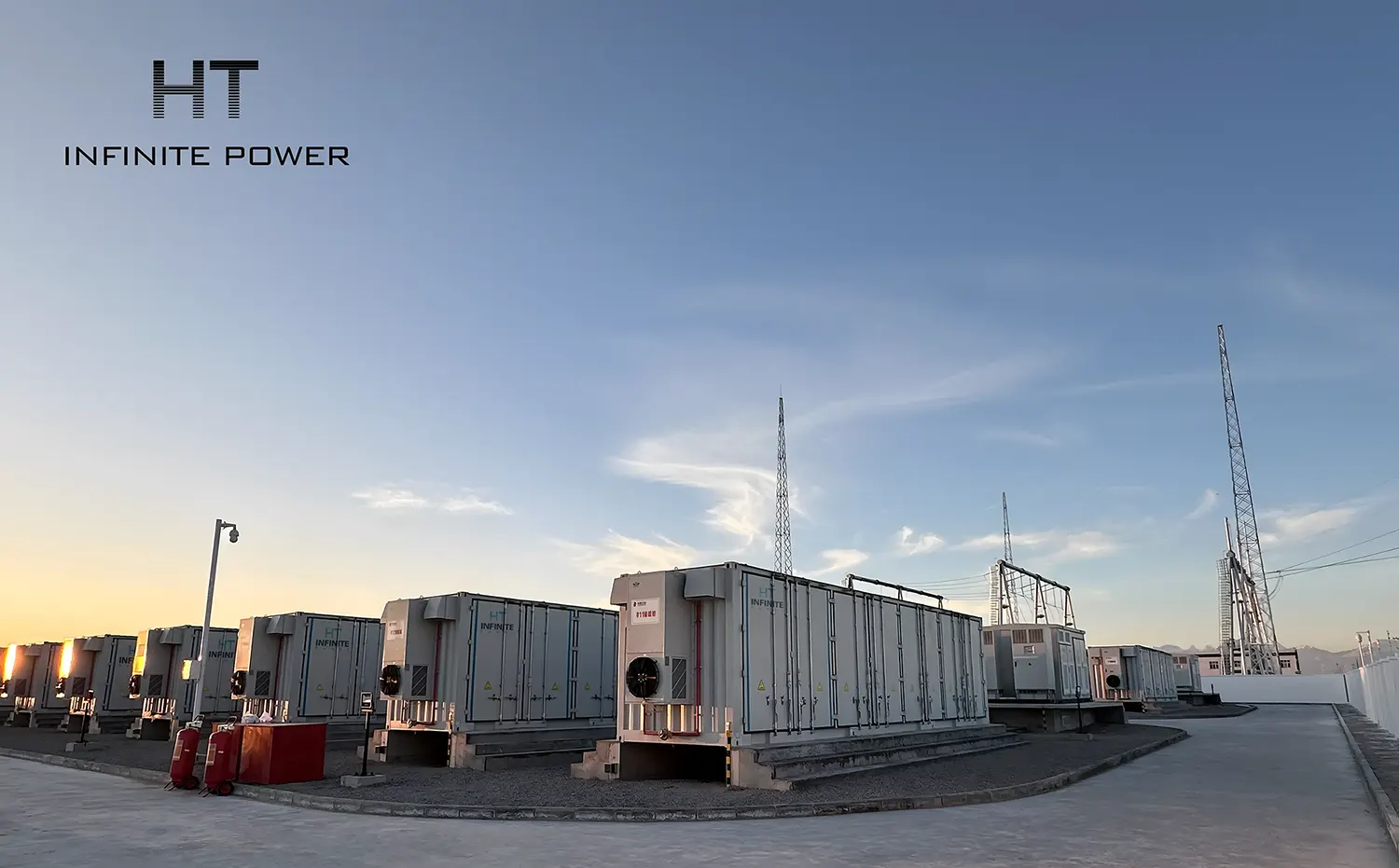
The following example represents a typical commercial industrial application.
Project Background
Customer:
Automotive component manufacturing facility
Automotive component manufacturing facility
Operating conditions:
- Two-shift production schedule
- High daytime electricity consumption
- Significant demand peaks during production changes
Electrical characteristics:
- Peak demand: approximately 1.5 MW
- Average demand: approximately 700–900 kW
Main challenge:
Reducing demand charges without affecting production operation.
Reducing demand charges without affecting production operation.
Engineering Assessment
Initial customer request:
“Install enough storage to reduce electricity costs.”
“Install enough storage to reduce electricity costs.”
During engineering evaluation, the actual requirement was refined:
- Reduce short-duration demand peaks
- Avoid unnecessary battery oversizing
- Maintain operational flexibility
Selected Configuration
System:
- Battery capacity: 522 kWh
- PCS rating: 250 kW
- Battery chemistry: Lithium iron phosphate (LFP)
- Application: Peak shaving + tariff optimization
Why This Configuration Was Selected
Why 250 kW PCS?
Load analysis showed that reducing approximately 250 kW of peak demand delivered the strongest economic return.
A larger PCS would provide additional capability but would not generate proportional financial benefit.
A larger PCS would provide additional capability but would not generate proportional financial benefit.
Why 522 kWh Battery Capacity?
The expected discharge window required approximately two hours of operation.
Additional capacity would increase investment without significantly improving savings.
Additional capacity would increase investment without significantly improving savings.
Why LFP Battery Chemistry?
For commercial and industrial projects, priorities typically include:
- cycle life
- thermal stability
- safety characteristics
- predictable lifecycle performance
rather than maximum energy density.
Expected Operating Strategy
Typical operation:
Off-peak period:
Off-peak period:
- Charge battery
Peak tariff period:
- Discharge to reduce grid demand
Normal operation:
- Maintain SOC reserve according to EMS strategy
This example demonstrates an important principle:
The optimal BESS is designed around the customer’s operating pattern, not maximum technical capacity.
The optimal BESS is designed around the customer’s operating pattern, not maximum technical capacity.
13. Common Design Mistakes in Commercial BESS Projects
Based on commercial project evaluations, many design issues come from incorrect assumptions rather than technology limitations.
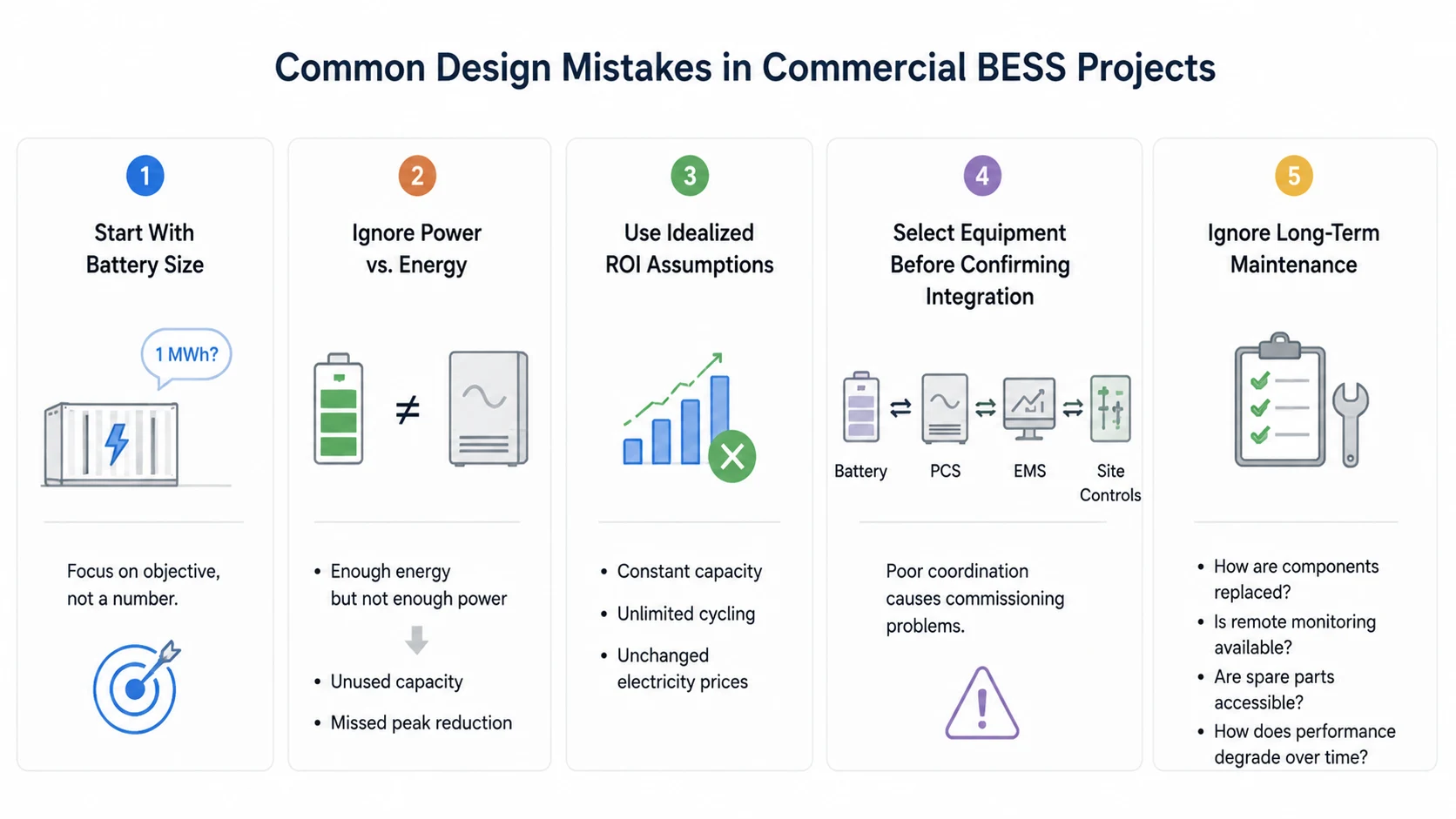
Mistake 1: Starting With Battery Size Instead of Project Objective
A common request is:
“We need a 1 MWh battery.”
“We need a 1 MWh battery.”
However, the real question should be:
“What problem requires 1 MWh of storage?”
Without defining the objective, sizing decisions become arbitrary.
“What problem requires 1 MWh of storage?”
Without defining the objective, sizing decisions become arbitrary.
Mistake 2: Ignoring Power and Energy Differences
A system may have enough battery energy but insufficient PCS power.
This results in:
This results in:
- unused battery capacity
- missed peak reduction opportunities
Mistake 3: Using Idealized ROI Assumptions
Some financial models assume:
- constant battery capacity
- unlimited cycling
- unchanged electricity prices
Real systems operate under changing conditions.
Mistake 4: Selecting Equipment Before Confirming Integration Capability
A commercial BESS includes multiple subsystems.
Poor coordination between:
- battery
- PCS
- EMS
- site controls
can create commissioning problems.
Mistake 5: Ignoring Long-Term Maintenance Requirements
A system should be evaluated beyond installation.
Important questions include:
- How are components replaced?
- Is remote monitoring available?
- Are spare parts accessible?
- How does performance degrade over time?
14. FAQ: Commercial BESS Engineering and Procurement Questions
How should EPC contractors compare different BESS suppliers?
EPC contractors should compare more than battery capacity and price.
Important evaluation points include:
- system architecture
- PCS compatibility
- EMS capability
- safety testing
- warranty conditions
- lifecycle assumptions
- commissioning support
A lower initial price does not always represent lower total project cost.
What technical documents should buyers request before purchasing a BESS?
Typical documents include:
- system datasheet
- battery performance specifications
- PCS specifications
- efficiency curves
- thermal design information
- safety certifications
- warranty terms
- installation requirements
These documents help confirm whether the proposed system matches the project requirements.
Should buyers prioritize battery capacity or PCS power rating?
Neither should be considered separately.
Battery capacity determines energy availability.
PCS rating determines power delivery capability.
The correct balance depends on the application.
Battery capacity determines energy availability.
PCS rating determines power delivery capability.
The correct balance depends on the application.
How can buyers evaluate battery lifecycle claims?
Buyers should review:
- cycle life conditions
- depth of discharge assumptions
- operating temperature conditions
- warranty degradation limits
Cycle numbers alone do not provide complete lifecycle information.
Is the lowest-cost BESS usually the best choice?
Not necessarily.
Commercial projects should consider total lifecycle value, including:
Commercial projects should consider total lifecycle value, including:
- reliability
- efficiency
- maintenance
- degradation
- integration capability
Final Thoughts: Designing BESS Around Engineering Reality
Commercial Battery Energy Storage System design is not simply a process of selecting batteries and inverters.
It is the process of balancing electrical requirements, economic objectives, operational constraints, and long-term reliability.
From engineering evaluations, one principle appears repeatedly:
The most successful BESS projects are not always the largest or most advanced systems.
They are the systems where every design decision supports the actual purpose of the installation.
It is the process of balancing electrical requirements, economic objectives, operational constraints, and long-term reliability.
From engineering evaluations, one principle appears repeatedly:
The most successful BESS projects are not always the largest or most advanced systems.
They are the systems where every design decision supports the actual purpose of the installation.
For EPC contractors, integrators, and energy buyers, the key question is not:
“How much storage can we install?”
“How much storage can we install?”
The better question is:
“How should the storage system be designed so that it creates measurable value throughout its operating life?”
“How should the storage system be designed so that it creates measurable value throughout its operating life?”
That question defines professional BESS engineering.
Why Load Profiles Matter More Than Battery Capacity in Commercial Battery Storage Design
Beyond Energy Storage: How New-Generation Storage Is Reshaping the Energy Landscape