Amps to Watts Calculator: Power Calculations for Batteries and Energy Storage
author: HT Infinite Power
2026-10-23
⚡
Amps ↔ Watts Calculator
Enter values to calculate
Quick Answer
Amps cannot be converted to watts without knowing the voltage.
The basic formula is:
The basic formula is:
W=A×V
Where:
- W = Watts (Power)
- A = Amps (Current)
- V = Volts (Voltage)
Quick Examples
| Current | Voltage | Power |
| 10A | 12V | 120W |
| 10A | 48V | 480W |
| 10A | 51.2V | 512W |
| 10A | 230V | 2300W |
The same current can produce very different power outputs because power depends on both current and voltage.
Why Amps Cannot Be Converted to Watts Without Voltage
One of the biggest mistakes people make when using an amps-to-watts calculator is assuming that amps alone determine power.
They do not.
Current is only one part of the equation.
For example:
100A at 12V
100×12=1200W
100A at 48V
100×48=4800W
100A at 51.2V
100×51.2=5120W
100A at 400V
100×400=40000W
The current never changes.
Only the voltage changes.
Yet the power output increases from 1.2kW to 40kW.
This is why voltage must always be known before converting amps to watts.
Only the voltage changes.
Yet the power output increases from 1.2kW to 40kW.
This is why voltage must always be known before converting amps to watts.
Understanding Current, Voltage and Power
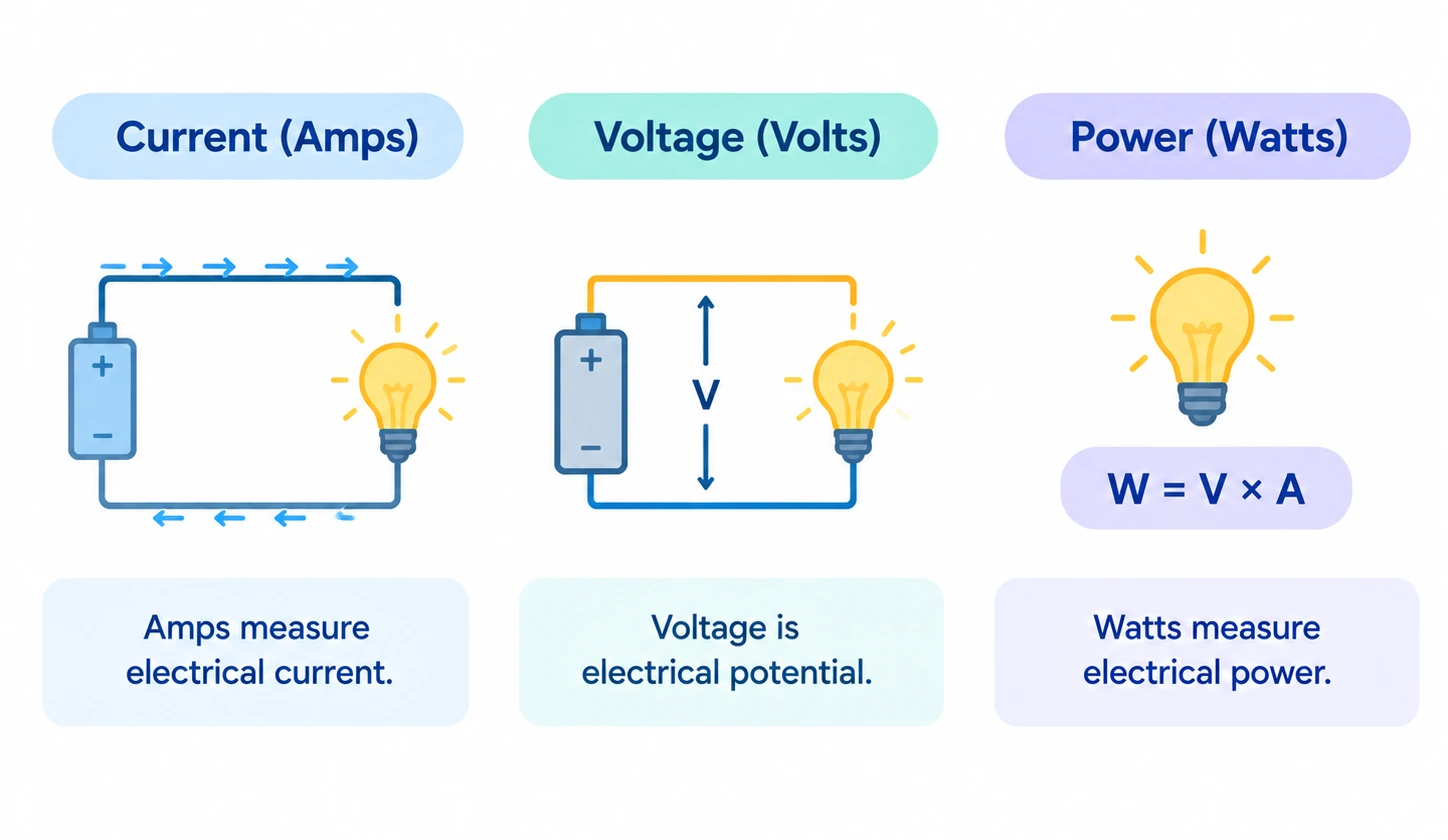
To understand amps-to-watts conversion, it helps to understand how these three values work together.
What Are Amps?
Amps measure electrical current.
Current is the flow of electricity through a wire, cable, battery, inverter, or electrical device.
Examples:
Current is the flow of electricity through a wire, cable, battery, inverter, or electrical device.
Examples:
- A battery may discharge at 100A.
- A charger may draw 20A.
- An inverter may supply 150A.
Current tells you how much electricity is moving.
What Are Volts?
Voltage is electrical potential.
You can think of voltage as the force that pushes current through a circuit.
Higher voltage allows more power to be delivered with the same current.
You can think of voltage as the force that pushes current through a circuit.
Higher voltage allows more power to be delivered with the same current.
What Are Watts?
Watts measure electrical power.
Power represents useful electrical output.
For example:
Power represents useful electrical output.
For example:
- Running appliances
- Operating motors
- Charging EVs
- Supplying homes with battery power
- Supporting commercial energy storage systems
Most system sizing decisions ultimately depend on watts and kilowatts, not amps alone.
Amps to Watts Formula
The standard formula is:
W=A×V
Once current and voltage are known, calculating power is straightforward.
Example 1
5A at 12V:
5×12=60W
Example 2
20A at 48V:
20×48=960W
20×48=960W
Example 3
100A at 51.2V:
100×51.2=5120W
How to Convert Amps to Watts
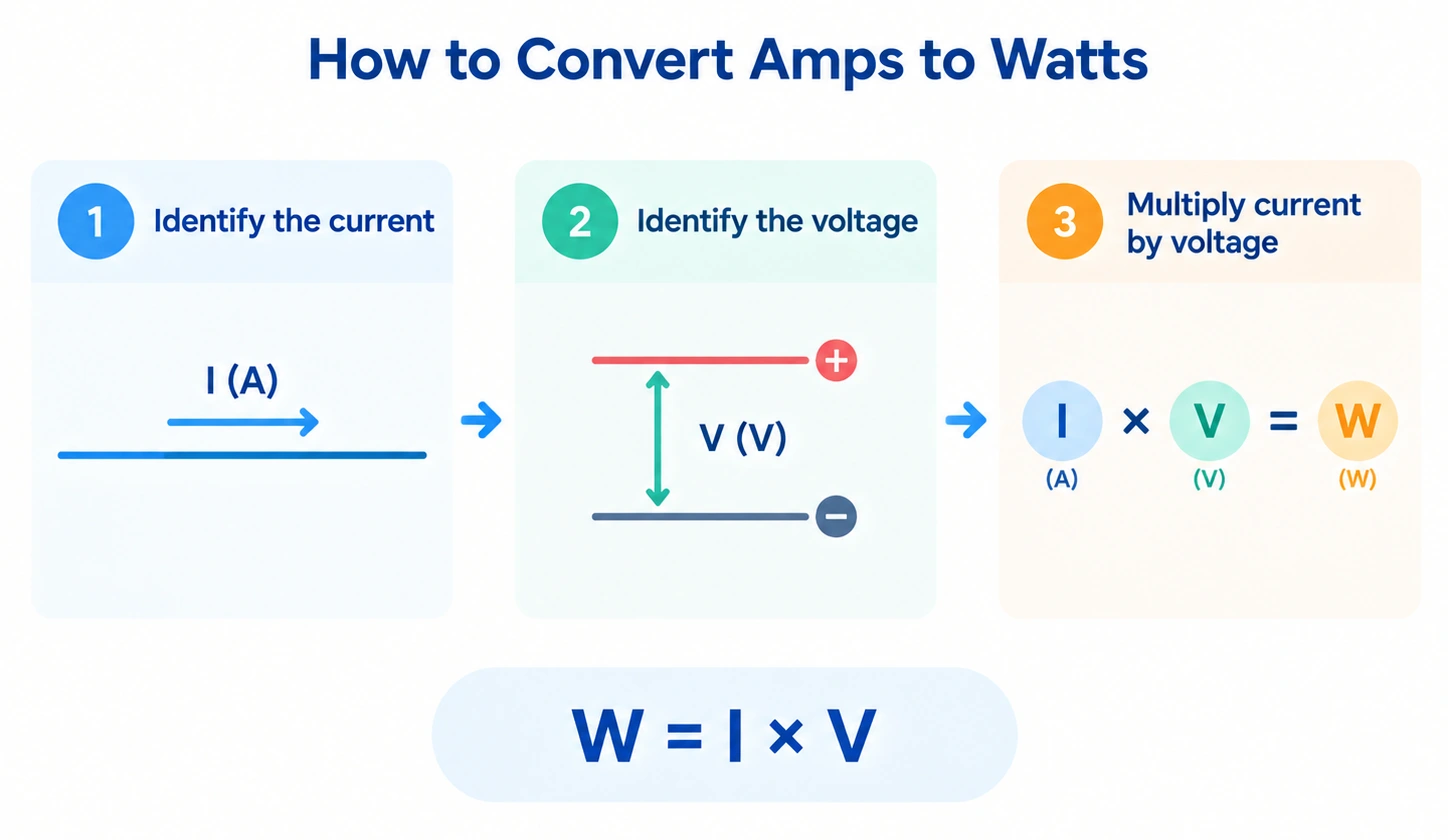
Converting amps to watts requires only three steps.
Step 1
Identify the current.
Step 2
Identify the voltage.
Step 3
Multiply current by voltage.
Example
Battery current:
100A
Battery voltage:
51.2V
Calculation:
100A
Battery voltage:
51.2V
Calculation:
100×51.2 =5120W
The battery is capable of delivering approximately 5.12kW of power.
How Many Watts Is 1, 5, 10, 20 and 50 Amps?
| Amps | 12V | 24V | 48V | 51.2V | 230V |
| 1A | 12W | 24W | 48W | 51W | 230W |
| 5A | 60W | 120W | 240W | 256W | 1150W |
| 10A | 120W | 240W | 480W | 512W | 2300W |
| 20A | 240W | 480W | 960W | 1024W | 4600W |
| 50A | 600W | 1200W | 2400W | 2560W | 11500W |
This table clearly shows why voltage matters just as much as current.
Why the Same Current Produces Different Power
This is the most important concept in amps-to-watts conversion.
Consider a system carrying 100A.
Consider a system carrying 100A.
| Voltage | Power |
| 12V | 1.2kW |
| 24V | 2.4kW |
| 48V | 4.8kW |
| 51.2V | 5.12kW |
| 400V | 40kW |
| 800V | 80kW |
Although every system carries the same current, the available power differs dramatically.
This explains why engineers cannot evaluate an electrical system by amps alone.
Power capability depends on both current and voltage.
This explains why engineers cannot evaluate an electrical system by amps alone.
Power capability depends on both current and voltage.
Why Current Is One of the Most Important Battery Specifications
When evaluating batteries, many people focus on capacity and ignore current ratings.
However, maximum current often determines how much power a battery can actually deliver.
However, maximum current often determines how much power a battery can actually deliver.
For example:
A 51.2V battery rated for 100A continuous discharge can provide:
51.2×100 =5120W
or approximately:
5.12kW
A similar battery capable of 200A discharge can deliver:
10240W
or:
or:
10.24kW
Even if both batteries store the same amount of energy, the higher-current battery can support larger loads.
Even if both batteries store the same amount of energy, the higher-current battery can support larger loads.
Continuous Current vs Peak Current
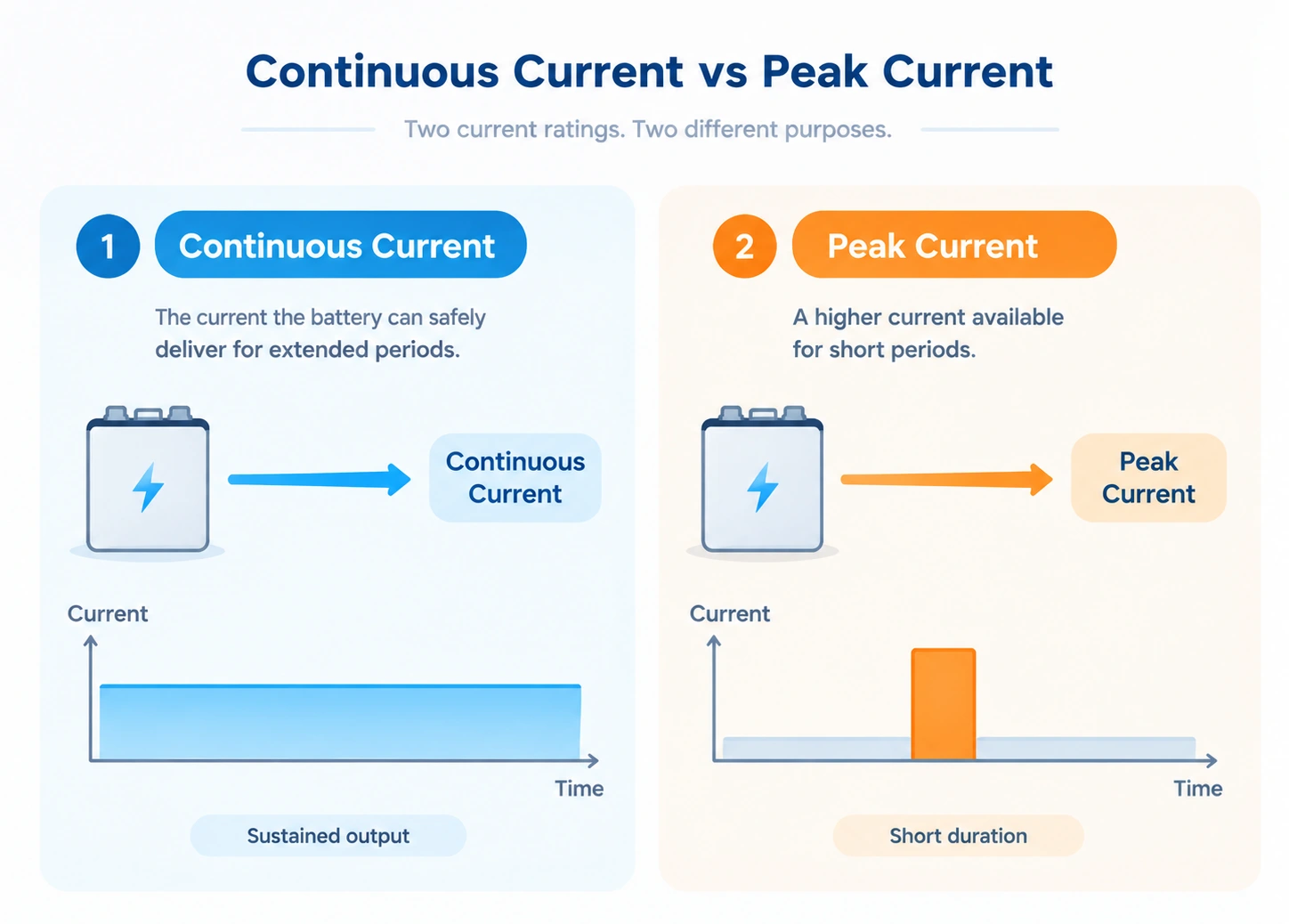
Battery manufacturers often specify two current ratings.
Continuous Current
The current the battery can safely deliver for extended periods.
Example:
100A continuous.
Example:
100A continuous.
Peak Current
A higher current available for short periods.
Example:
200A peak for 10 seconds.
Peak current helps support:
- Motor startup
- Pump startup
- Compressor startup
- Surge loads
Understanding the difference is important when selecting batteries and inverters.
How Current Affects Battery Heating
Electrical current directly affects heat generation.
Heat loss in conductors follows:
Heat loss in conductors follows:
P = I²R
Where:
- P = heat loss
- I = current
- R = resistance
This means heat increases with the square of current.
For example:
Doubling current does not double heating.
It increases heating by four times.
This is one reason why high-current battery systems require careful thermal management.
Why High Current Requires Larger Cables
Large currents create several design challenges.
Higher current leads to:
- Larger cables
- Greater voltage drop
- More heat generation
- Increased installation costs
For example:
Supplying: 5kW
Supplying: 5kW
at:
48V
requires approximately: 104A
Supplying the same power at: 400V
requires only: 12.5A
The 400V system can use much smaller conductors and experiences lower losses.
Why Battery Systems Are Usually Rated in kWh Instead of Amps
Many people ask:
Why don't manufacturers simply advertise battery current?
The answer is that current alone tells very little about actual system capability.
Consider two batteries:
Battery A
12V 100A 1200W
Battery B
51.2V 100A 5120W
Both batteries provide 100A.
Yet one delivers over four times more power.
For this reason, modern battery systems are increasingly marketed using:
- kW
- kWh
rather than current alone.
These measurements better represent real-world performance.
Common Battery Voltage Examples
Different battery systems use different voltages depending on the application.
12V Batteries
Used in:
- RV systems
- Marine batteries
- Small backup systems
24V Batteries
Used in:
- Telecommunications
- Small solar systems
- Backup power installations
48V Batteries
Common in:
- Residential ESS
- Off-grid solar systems
- Hybrid inverter systems
51.2V Batteries
Popular in:
- LFP batteries
- Rack batteries
- Home energy storage
A 51.2V system typically uses sixteen lithium iron phosphate cells connected in series.
High-Voltage Batteries
Common in:
- Commercial ESS
- Utility-scale storage
- EV charging infrastructure
Typical voltages include:
- 400V
- 600V
- 800V+
Why Modern Energy Storage Systems Use Higher Voltages
This is where amps-to-watts calculations become especially important.
Imagine a system must deliver: 100kW
Imagine a system must deliver: 100kW
At 48V
100000÷48≈2083A
At 400V
100000÷400=250A
At 800V
100000÷800=125A
The difference is enormous.
Higher voltages allow engineers to reduce:
- Cable size
- Heat generation
- Electrical losses
- Installation costs
This is one reason modern ESS, EVs, and PCS systems increasingly use high-voltage architectures.
Home Energy Storage Design Example
Imagine a homeowner installs a:
- 10kWh battery
- 51.2V system
The battery supplies:
100A
Power output:
100×51.2=5120W=5.12kW
This means the system can comfortably support a typical household load of approximately 5kW while operating within its current limits.
Commercial ESS Design Example

Consider a commercial ESS project delivering: 100kW
using an:800V battery system.
Required current:100000÷800=125A
This relatively low current simplifies:
- Cable design
- PCS integration
- Thermal management
- System efficiency
This is one reason why commercial battery storage systems increasingly rely on high-voltage battery platforms.
Why Current Alone Does Not Define System Size
Two systems may have identical current ratings.
System A
48V 100A =4.8kW
System B
400V 100A =40kW
Although both systems carry the same current, System B can deliver more than eight times the power.
This demonstrates why engineers evaluate current, voltage, power, and energy together rather than relying on amps alone.
Common Mistakes
Ignoring Voltage
Amps cannot be converted to watts without voltage.
Confusing Amps and Power
Current and power are not the same thing.
Ignoring Continuous Current Limits
Always distinguish between continuous and peak current ratings.
Using Undersized Cables
Higher currents require larger conductors.
Mixing AC and DC Calculations
AC systems may also require power factor considerations.
Conclusion
An amps-to-watts calculator does more than convert one electrical unit into another. It helps explain the relationship between current, voltage, and power in real-world battery and energy storage systems. While the conversion formula is simple, understanding how current affects heating, cable sizing, battery performance, and ESS design is essential for selecting and operating modern power systems. Whether you are designing a home battery backup system or evaluating a commercial ESS project, understanding amps, volts, and watts will help you make more informed decisions about system performance and scalability.
FAQ
How do I convert amps to watts?
Use:
W=A×V
Voltage is required.
Voltage is required.
Can amps be converted to watts without voltage?
No. Voltage must be known.
How many watts is 100 amps at 51.2V?
100×51.2 =5120W
Why does voltage affect wattage?
Because electrical power depends on both current and voltage.
Why do battery systems use higher voltages?
Higher voltages reduce current requirements and improve efficiency.
What is the difference between amps and watts?
Amps measure current flow, while watts measure power output.
Why is current important in battery systems?
Current affects power delivery, heating, cable sizing, and inverter compatibility.
Peak Sun Hours: How to Calculate Solar Energy Potential
Related Article