Volts to Watts Calculator: Real Power for Home and Commercial Energy Storage
Volts ↔ Watts Calculator
Quick Answer
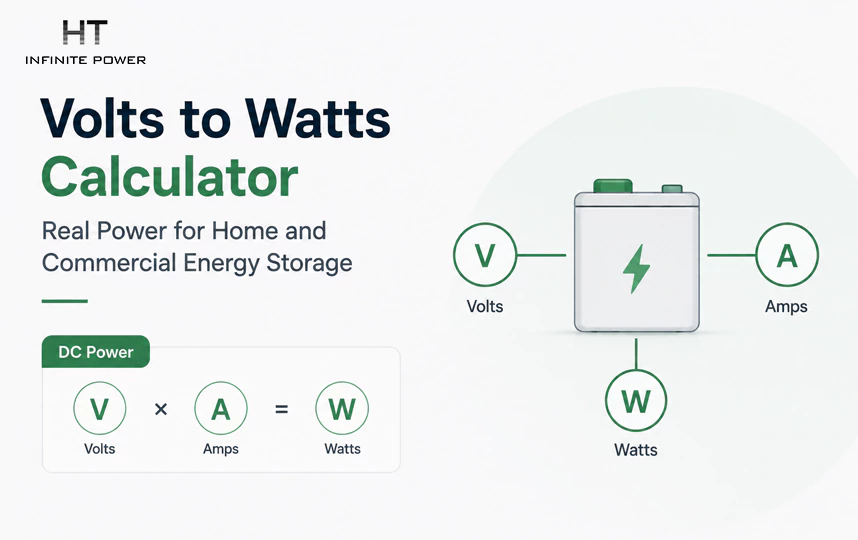
To convert volts to watts, you need both voltage (V) and current (A). Voltage alone cannot determine watts.
DC Power
Single‑Phase AC Power
Three‑Phase AC Power
These formulas are the basis of the Volts to Watts Calculator placed at the top of this guide. The sections below explain how these formulas apply to household electricity, solar systems, batteries, inverters, and commercial energy storage.
1. What Are Volts, Amps, and Watts?
Volts, amps, and watts describe different aspects of electrical power. Volts (V) represent electrical potential, amps (A) represent current flow, and watts (W) represent real power — the actual work being done. A simple way to understand the relationship is:
Volts push, amps flow, watts do the work.
Because watts depend on both volts and amps, voltage alone cannot tell you how much power a device or system is producing.
2. Volts to Watts Formula
DC Systems
DC calculations are straightforward:
Single‑Phase AC Systems
AC systems require power factor (PF):
Power factor describes the relationship between real power and apparent power. A lower PF generally means more current is required to deliver the same real power.
Three‑Phase AC Systems
For three‑phase systems using line voltage and line current:
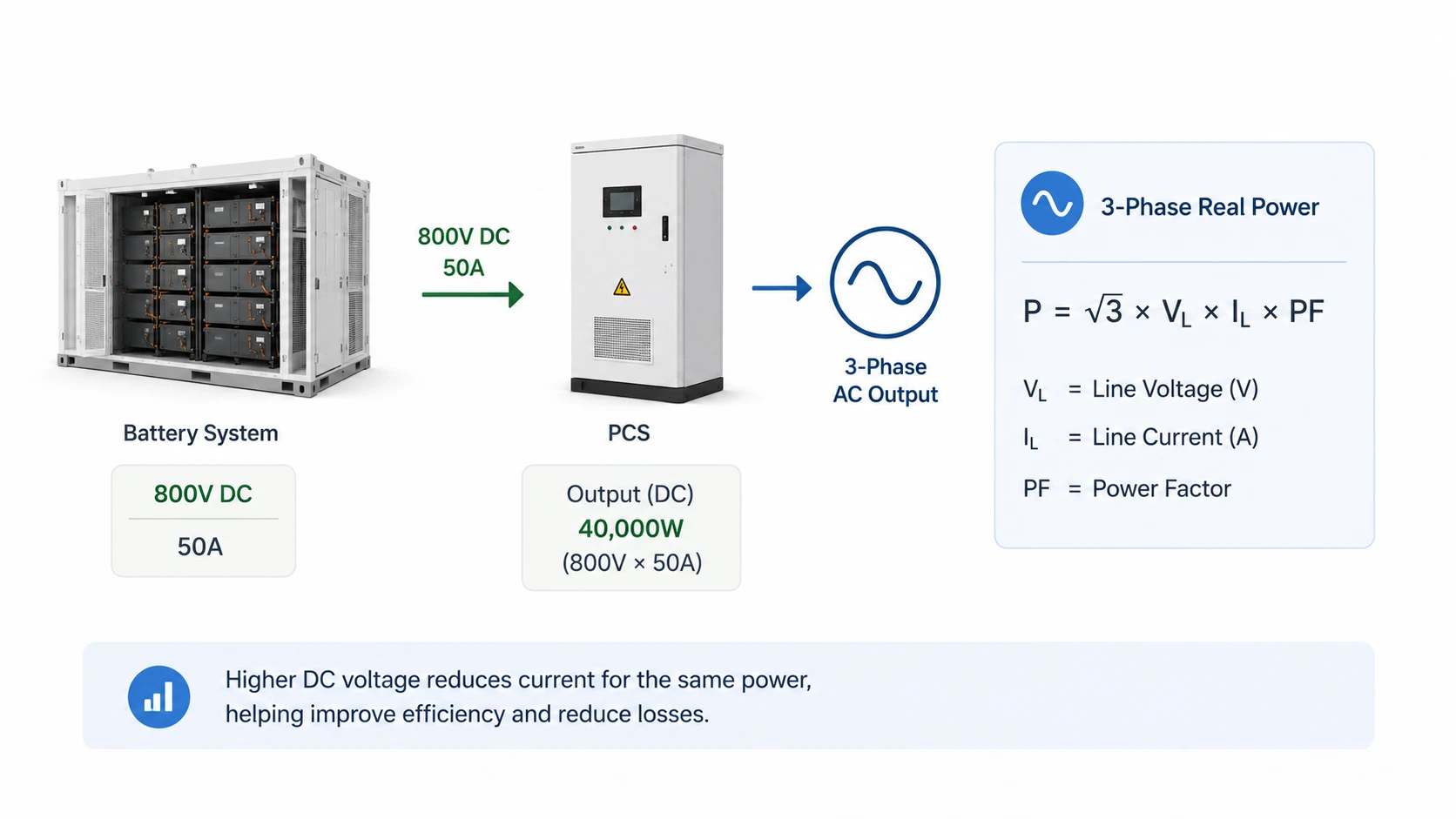
This formula is used for industrial loads, commercial inverters, and PCS units in energy storage systems.
3. How to Convert Volts to Watts
Converting volts to watts simply requires identifying the voltage, current, and — for AC systems — the power factor. Once these values are known, apply the appropriate formula.
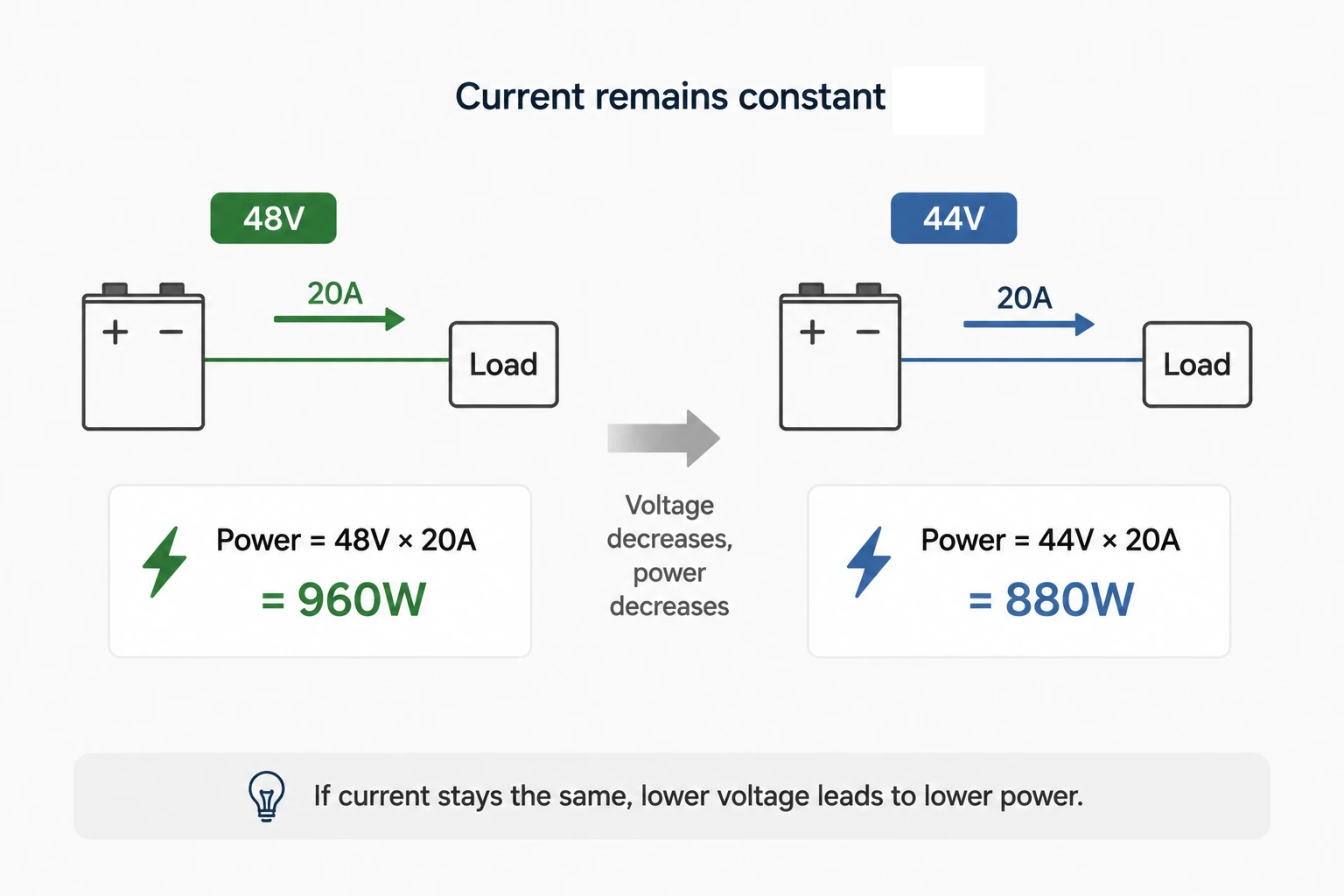
For example, a 48V battery supplying 20A produces 960W in a DC system. A single‑phase AC load drawing 10A at 120V with a PF of 0.9 produces 1080W. A three‑phase system operating at 400V and 20A with a PF of 0.95 produces roughly 13kW using the √3 multiplier.
These examples illustrate how voltage and current combine to produce real power in different electrical systems.
4. How Many Watts Is 12V, 24V, 48V, 120V, 230V, 240V, 400V and 800V?
Many users search for voltage‑specific conversions such as “how many watts is 12V” or “how many watts is 48V.” The correct answer always depends on current. Voltage alone cannot determine watts.
Using 10A as a reference:
- 12V → 120W
- 24V → 240W
- 48V → 480W
- 120V → 1,200W
- 230V → 2,300W
- 240V → 2,400W
- 400V → 4,000W
- 800V → 8,000W
These examples cover a range of voltage levels commonly encountered in household, RV, solar, battery, inverter, and commercial energy systems.
5. Volts to Watts Conversion Chart
| Voltage | Current | Power |
|---|---|---|
| 12V | 10A | 120W |
| 24V | 10A | 240W |
| 48V | 10A | 480W |
| 120V | 10A | 1,200W |
| 230V | 10A | 2,300W |
| 240V | 10A | 2,400W |
| 400V | 10A | 4,000W |
| 800V | 10A | 8,000W |
This chart provides quick reference values for common voltages across home, solar, battery, inverter, and commercial systems.
You can use the Volts to Watts Calculator above to perform these calculations without manually applying the formulas.
6. Real‑World Household Examples
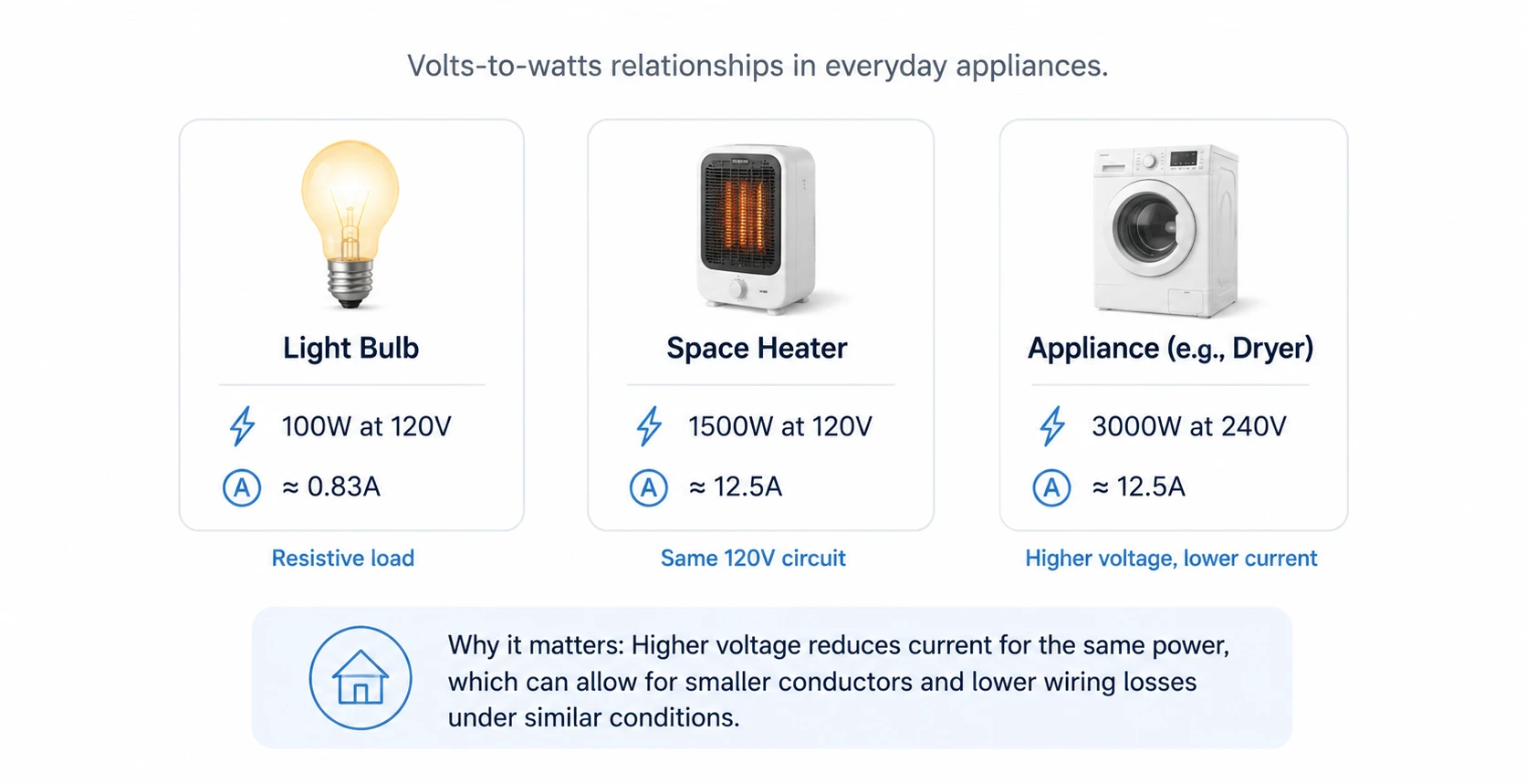
Household appliances provide simple illustrations of volts‑to‑watts relationships. A 100W light bulb on a 120V circuit draws roughly 0.83A under a resistive‑load assumption. A 1500W space heater on the same circuit draws about 12.5A. At 240V, a 3000W appliance draws approximately 12.5A, showing how higher voltage reduces current for the same power.
These examples help explain why certain appliances require dedicated circuits and why higher‑voltage systems can reduce wiring losses when other conditions are comparable.
7. Volts to Watts in Solar, Batteries and Inverters
Residential and small off‑grid battery systems commonly use 12V, 24V, or 48V configurations, while larger solar and energy storage systems typically operate at much higher DC voltages. A 48V battery supplying 80A produces 3840W under ideal DC conditions. In real systems, battery voltage may vary with load, temperature, and state of charge. If an inverter needs to maintain constant output power, it may draw more current as battery voltage falls, provided both the battery and inverter remain within their operating limits.
Inverters convert DC battery voltage into AC output. The actual AC power available depends on battery voltage, inverter efficiency, current limits, and the characteristics of the connected load. These factors explain why inverter output may differ from simple DC calculations.
8. Volts to Watts in Commercial Energy Storage
Commercial battery energy storage systems operate at much higher DC voltages than residential systems. Depending on system architecture, DC bus voltage may range from several hundred volts to around 1000V or more.
For example, an 800V battery supplying 50A produces 40,000W. Many commercial PCS units supply three‑phase AC power. For a balanced three‑phase system, real power can be calculated using the √3 multiplier, line voltage, line current, and power factor. Voltage variation on the DC side can influence PCS current demand, efficiency, and output limits, but the basic conversion formulas remain the same.
9. How Power Factor Changes AC Calculations
Power factor describes the relationship between real power and apparent power in an AC system. For a given real power, a lower power factor generally means more current is required. Purely resistive loads have a PF close to 1, while inductive loads such as motors or compressors may have lower PF values.
Power factor does not change the rated wattage of a device. Instead, it affects how much current the system must supply to deliver that wattage.
10. How Voltage Drop Affects Real‑World Power
Voltage drop can occur in long cables, battery discharge, inverter input, PCS DC buses, or heavy loads. Its effect on watts depends on how the system responds.
Case 1: Current remains constant
If current stays the same:
Power decreases because voltage decreases.
Case 2: The system maintains constant power
If a device must maintain 960W:
Required current increases as voltage falls.
Actual system behavior depends on load characteristics, inverter control strategy, battery limits, and operating conditions. Some systems increase current to maintain power, while others reduce output to stay within safe operating limits.
11. Common Mistakes
- Assuming volts alone determine watts
- Using the wrong AC formula
- Ignoring power factor
- Mixing single‑phase and three‑phase calculations
- Confusing rated power with operating power
- Overlooking inverter efficiency
- Ignoring voltage drop
- Using nominal battery voltage instead of operating voltage
Conclusion
Converting volts to watts becomes straightforward once you understand the relationship between voltage, current, and — for AC systems — power factor. These principles apply across household electricity, solar systems, batteries, inverters, and commercial energy storage. With clear formulas, practical examples, and a conversion chart, this guide helps you accurately calculate watts for any voltage in home or commercial applications.
More Electrical Unit Conversions
12. FAQ
How do I convert volts to watts?
Use W = V × A for DC, or W = V × A × PF for AC.
Can you calculate watts from volts alone?
No. You need both volts and amps.
How many watts is 12 volts?
Depends on current. Example: 12V × 10A = 120W.
How many watts is 24 volts?
24V × 10A = 240W.
How many watts is 48 volts?
48V × 10A = 480W.
How many watts is 120 volts?
120V × 10A = 1,200W.
How many watts is 240 volts?
240V × 10A = 2,400W.
Do I need power factor to calculate watts?
For AC systems, power factor is needed when calculating real power from voltage and current. For a purely resistive load, PF is approximately 1.
What is the difference between volts, amps, and watts?
Volts push, amps flow, watts do the work.
How do I calculate watts for a three‑phase system?
Use W = √3 × V × A × PF with line voltage and line current.
Does voltage drop affect watts?
Yes. Lower voltage reduces watts unless current increases.
Energy Battery Cell vs Power Battery Cell: Which One Is Used in Energy Storage Systems?
Watts to Amps: Simple AC/DC Conversion Formulas & Examples