Watts to Amps: Simple AC/DC Conversion Formulas & Examples
author: HT infinitepower
2026-09-01
Watts → Amps
Amps → Watts
Watts to Amps Calculator
Result:
0.00 A
Formula:
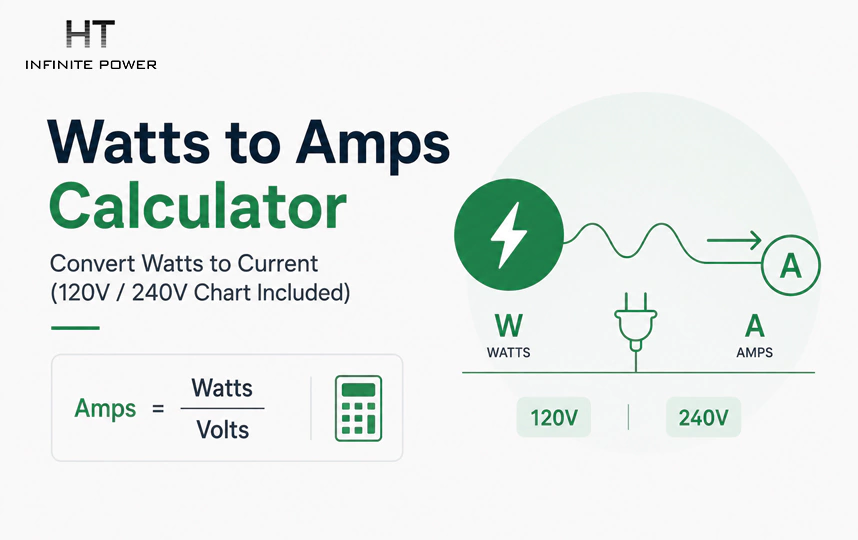
Amps = Watts ÷ Volts
Amps = Watts ÷ Volts
Quick answer: You can convert watts to amps using these formulas:
Single‑phase AC or DC
AC appliances with power factor (PF)
Three‑phase AC
If you only needed the formulas, you’re done. If you want a clear, practical explanation that works for homeowners, DIY users, RV/off‑grid users, solar users, electricians, and commercial users — keep reading.
Single‑phase AC or DC
AC appliances with power factor (PF)
Three‑phase AC
If you only needed the formulas, you’re done. If you want a clear, practical explanation that works for homeowners, DIY users, RV/off‑grid users, solar users, electricians, and commercial users — keep reading.
1. What Watts and Amps Really Mean (Simple Explanation)
You don’t need engineering theory to understand watts and amps.
- Watts (W) = how much power a device uses
- Amps (A) = how much electrical current flows
- Volts (V) = the electrical “pressure” pushing the current
They are connected by one simple relationship:
Rearranged:
This is the foundation of every watts‑to‑amps conversion.
2. Why People Need Watts → Amps Conversion
Most people search this topic because they need to solve real problems:
- Can my circuit handle this appliance?
- Will my inverter overload?
- How much current will my battery supply?
- How many amps does a 5000W inverter draw?
- Can I run multiple devices on one breaker?
- What wire size should I consider?
- How many amps is 100W / 500W / 1000W / 2000W / 5000W?
This article answers all of these questions using simple, practical examples.
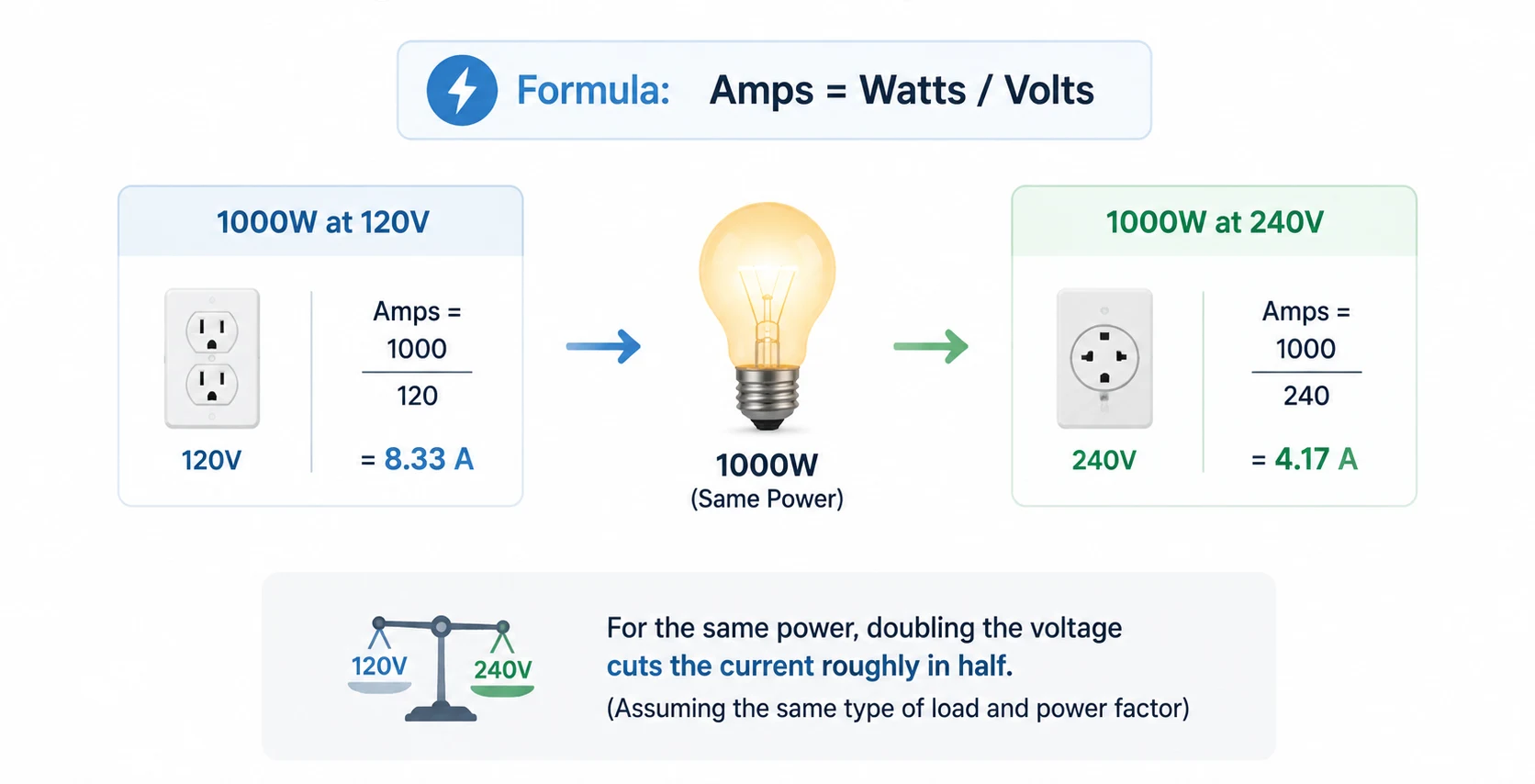
3. Single‑Phase Watts to Amps (120V / 240V)
Formula
Examples
1000W at 120V
1000W at 240V
For the same power, doubling the voltage cuts the current roughly in half, assuming the same type of load and power factor.
4. AC Appliances and Power Factor (PF)
Simple explanation
Power factor describes how effectively an AC load converts electrical power into useful real power. A lower PF means the load needs more current to deliver the same watts.
Typical PF values:
Resistive loads (heaters, toasters): PF ≈ 1.0
Motor loads (AC units, refrigerators): PF ≈ 0.7–0.9
LED drivers: PF ≈ 0.9–0.95
Typical PF values:
Resistive loads (heaters, toasters): PF ≈ 1.0
Motor loads (AC units, refrigerators): PF ≈ 0.7–0.9
LED drivers: PF ≈ 0.9–0.95
Formula
Example: 1500W air conditioner at 120V, PF = 0.8
If PF is ignored:
That’s a 25% difference, enough to trip a breaker.
5. DC Watts to Amps (12V / 24V / 48V Batteries)
DC is used in:
- solar systems
- battery banks
- RVs
- off‑grid systems
- inverter DC inputs
Formula
Examples
1000W at 12V
1000W at 24V
1000W at 48V
This is one reason 48V battery systems are commonly used for higher‑power solar and energy storage applications: the higher DC voltage reduces current for the same power output.
1000W at 24V
1000W at 48V
This is one reason 48V battery systems are commonly used for higher‑power solar and energy storage applications: the higher DC voltage reduces current for the same power output.
6. Three‑Phase Watts to Amps (Simple, Practical Explanation)
Three‑phase is common in:
- commercial buildings
- industrial equipment
- large HVAC systems
- generators
- data centers
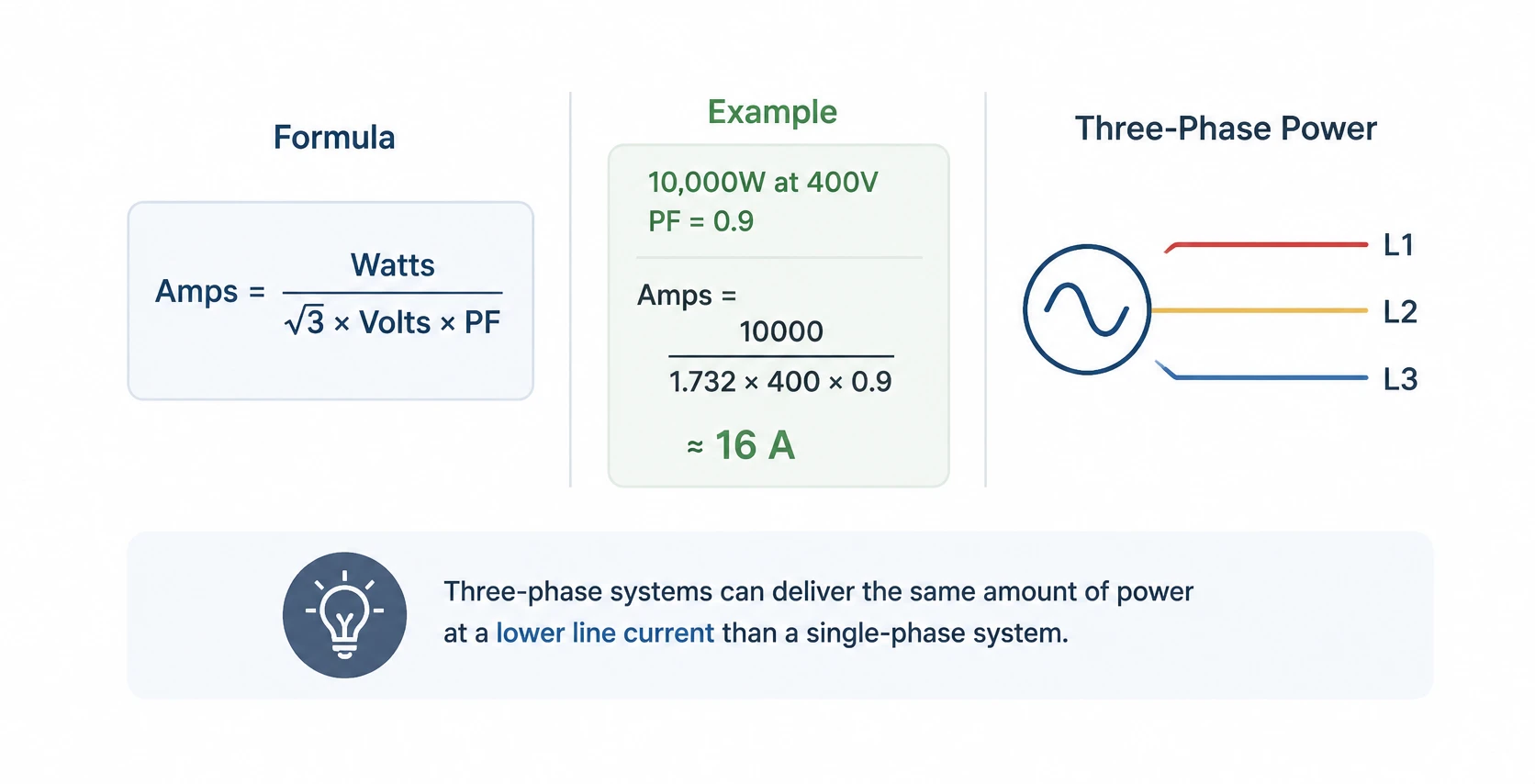
Formula
Example: 10,000W at 400V, PF = 0.9
Three‑phase systems can deliver the same amount of power at a lower line current than a single‑phase system because of the three‑phase power relationship.
7. Watts to Amps at Different Voltages (Very Useful Table)
| Power | 12V | 24V | 48V | 120V | 240V |
|---|---|---|---|---|---|
| 100W | 8.33A | 4.17A | 2.08A | 0.83A | 0.42A |
| 500W | 41.67A | 20.83A | 10.42A | 4.17A | 2.08A |
| 1000W | 83.33A | 41.67A | 20.83A | 8.33A | 4.17A |
| 2000W | 166.67A | 83.33A | 41.67A | 16.67A | 8.33A |
| 5000W | 416.67A | 208.33A | 104.17A | 41.67A | 20.83A |
This table covers the most common household, solar, battery, and inverter voltages.
8. Real‑World Examples (Expanded Section)
This is the section most users care about, so here are more examples.
How many amps is 100 watts?
120V:
12V:
How many amps is 500 watts?
120V:
240V:
12V:
48V:
How many amps is 1000 watts?
120V:
240V:
48V:
How many amps is 2000 watts?
120V:
240V:
48V:
How many amps is 5000 watts?
240V:
48V:
How many amps does a 3000W inverter draw?
12V:
24V:
48V:
Real battery current will be higher because the inverter is not 100% efficient.
9. How Inverter Efficiency Affects Battery Current
Inverters are not perfectly efficient. If an inverter is 95% efficient:
Example: 5000W inverter, 48V battery
Actual DC input power:
Battery current:
Ideal current:
Even a small efficiency loss can add several amps of battery draw.
Battery current:
Ideal current:
Even a small efficiency loss can add several amps of battery draw.
10. Wire Size and Safety (Simple but Accurate)
Watts → amps conversion gives you the current, which is the starting point for choosing a wire.
However, wire size also depends on:
- cable length
- conductor material
- installation conditions
- ambient temperature
- allowable voltage drop
- local electrical codes
So use the calculated amps as a baseline, but always follow proper electrical standards.
11. Common Mistakes to Avoid
Mistake 1: Ignoring power factor
Motor loads draw more current than their watt rating suggests.
Mistake 2: Using 12V for high‑power systems
Current becomes extremely high.
Mistake 3: Assuming watts automatically tell you wire size
Wire sizing requires more than just current.
Mistake 4: Forgetting inverter efficiency
Battery current is always higher than the ideal calculation.
Mistake 5: Mixing up AC and DC formulas
DC has no PF. AC often does.
Conclusion
If you remember only one thing:
If it’s an AC motor load:
If it’s three‑phase:
With these formulas — plus the charts and examples above — you can size circuits, choose inverters, estimate battery draw, and understand how much current your equipment really uses.
If it’s an AC motor load:
If it’s three‑phase:
With these formulas — plus the charts and examples above — you can size circuits, choose inverters, estimate battery draw, and understand how much current your equipment really uses.
More Electrical Unit Conversions
FAQ
How do I convert watts to amps?
Divide watts by volts.
Do AC appliances need power factor?
Yes, especially motor loads.
Why does voltage affect amps?
Higher voltage delivers the same power with less current.
Can I use this for solar and battery systems?
Yes — DC formulas work perfectly.
How do I convert amps back to watts?
Multiply amps × volts.
Volts to Watts Calculator: Real Power for Home and Commercial Energy Storage
Ah to kWh Calculator for Batteries, Solar Storage & Inverter Sizing