Ah to kWh Calculator for Batteries, Solar Storage & Inverter Sizing
author: HT infinitepower
2026-08-28
Ah → kWh Calculator
kWh: –
Wh: –
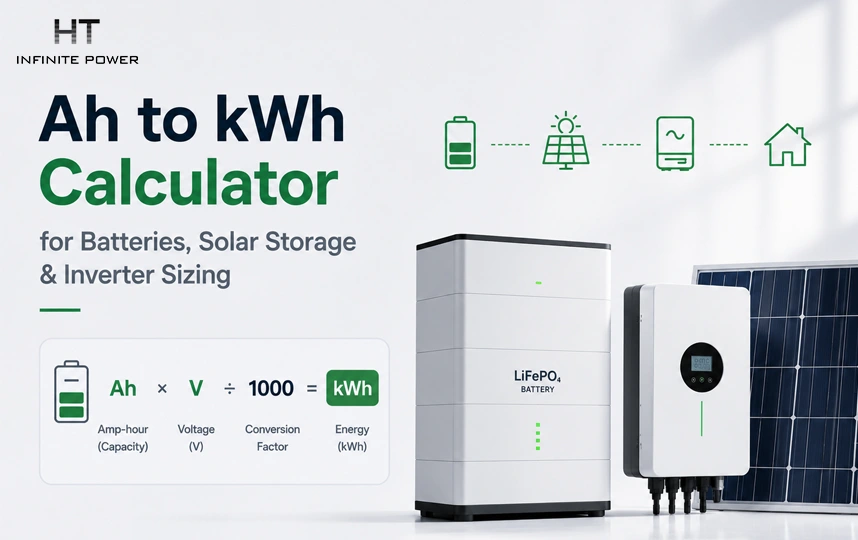
To convert Ah to kWh, multiply the battery’s amp‑hour rating by its nominal voltage and divide by 1000. Formula:
This conversion is fundamental in battery and energy‑storage engineering because amp‑hours describe the amount of charge a battery can hold, while kilowatt‑hours describe the actual usable energy delivered to loads, inverters, and power systems. In practical design work, Ah is still used for battery selection, BMS configuration, and series‑parallel planning, but kWh is the unit that determines how long a system can support real loads and how an inverter or solar array should be sized. Whether you are working with residential LiFePO4 storage, off‑grid solar systems, telecom backup batteries, or commercial ESS cabinets, converting Ah to kWh provides the energy‑based perspective required for runtime estimation, autonomy planning, and system integration. It is a foundational step that connects battery specifications to real‑world energy usage.
This conversion is fundamental in battery and energy‑storage engineering because amp‑hours describe the amount of charge a battery can hold, while kilowatt‑hours describe the actual usable energy delivered to loads, inverters, and power systems. In practical design work, Ah is still used for battery selection, BMS configuration, and series‑parallel planning, but kWh is the unit that determines how long a system can support real loads and how an inverter or solar array should be sized. Whether you are working with residential LiFePO4 storage, off‑grid solar systems, telecom backup batteries, or commercial ESS cabinets, converting Ah to kWh provides the energy‑based perspective required for runtime estimation, autonomy planning, and system integration. It is a foundational step that connects battery specifications to real‑world energy usage.
1. Why Ah → kWh Matters in Real Engineering Systems
In energy‑storage design, Ah is a battery‑centric unit, while kWh is a system‑centric unit. A battery may be rated at 100Ah, but without voltage, its usable energy cannot be determined. For example, a 100Ah battery at 12V stores 1.2 kWh, while a 100Ah battery at 51.2V stores 5.12 kWh—over four times more energy. This difference directly affects inverter compatibility, load runtime, and solar autonomy. Engineers rely on kWh because appliances, inverters, HVAC systems, and industrial equipment all operate in watts and kilowatts. Converting Ah to kWh bridges the gap between battery specifications and real‑world energy usage, enabling accurate system sizing and performance planning.
2. Engineering Formula Explained
Ah represents charge capacity, but charge alone does not determine energy. Voltage determines how much energy each amp‑hour carries. Multiplying Ah by voltage gives watt‑hours (Wh), and dividing by 1000 converts Wh to kWh. The key engineering detail is that nominal voltage must be used. Peak charging voltage (e.g., 54.6V for LFP) does not represent the battery’s operating voltage under load and will inflate energy calculations. Nominal voltage reflects the average discharge voltage and ensures consistent, realistic energy estimates for system design.
3. Voltage Determines Energy
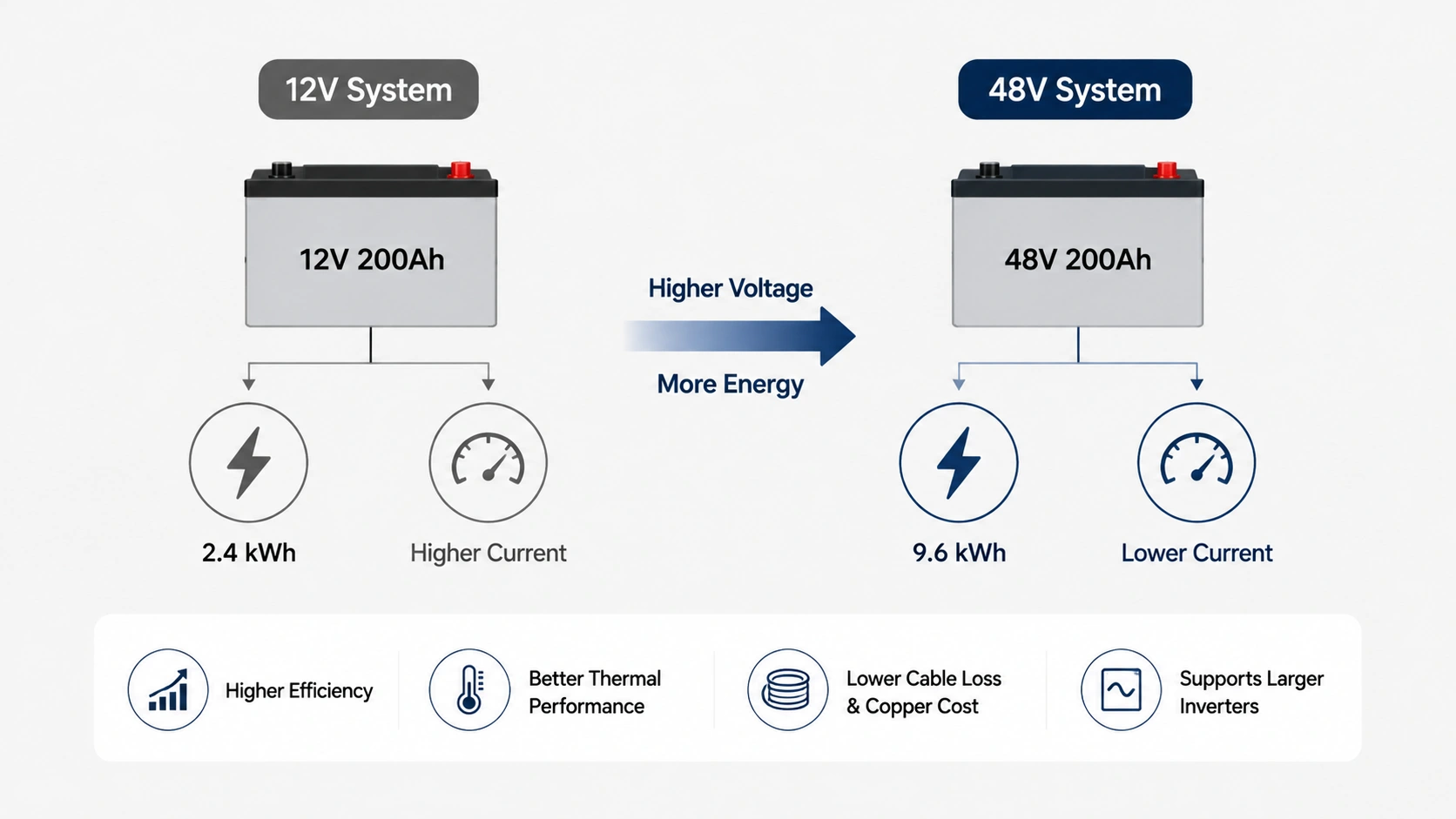
Voltage is the multiplier that transforms Ah into usable energy. Two batteries with identical Ah can have dramatically different kWh depending on voltage. A 200Ah 12V battery stores 2.4 kWh, while a 200Ah 48V battery stores 9.6 kWh. Higher voltage systems deliver more energy per amp‑hour, reduce current flow, minimize cable losses, and improve inverter efficiency. This is why modern ESS systems commonly use 48V or 51.2V architectures. Higher voltage also reduces copper cost, improves thermal performance, and supports larger inverters. In engineering practice, voltage is a core design parameter that determines system architecture, efficiency, and scalability.
4. Ah → kWh Conversion Table
| Voltage | 50Ah | 100Ah | 150Ah | 200Ah | 280Ah |
| 12V | 0.60 kWh | 1.20 kWh | 1.80 kWh | 2.40 kWh | 3.36 kWh |
| 24V | 1.20 kWh | 2.40 kWh | 3.60 kWh | 4.80 kWh | 6.72 kWh |
| 48V | 2.40 kWh | 4.80 kWh | 7.20 kWh | 9.60 kWh | 13.44 kWh |
| 51.2V (LFP) | 2.56 kWh | 5.12 kWh | 7.68 kWh | 10.24 kWh | 14.34 kWh |
This table allows quick estimation of system energy and highlights how voltage affects usable kWh. It is widely used in solar design, ESS planning, and inverter sizing.
5. Engineering Examples
Example 1 — 12V 100Ah AGM Battery
A 12V 100Ah AGM battery stores 1.2 kWh of energy. This capacity is suitable for RV systems, small UPS units, and basic off‑grid setups where loads are modest and autonomy requirements are limited. Although 12V systems remain common in low‑power applications, they become less efficient in higher‑power solar installations due to increased current, voltage drop, and cable size requirements.
Example 2 — 51.2V 100Ah LiFePO4 ESS Module
A 51.2V 100Ah LFP module stores 5.12 kWh, making it ideal for residential ESS systems. The higher voltage reduces current, improves inverter efficiency, and supports larger loads such as refrigerators, pumps, and air conditioners. LFP chemistry provides stable voltage curves and high cycle life, making it a preferred choice for modern hybrid solar systems.
Example 3 — 48V 280Ah Industrial Battery
A 48V 280Ah battery stores 13.44 kWh and is commonly used in commercial ESS cabinets, micro‑grids, and peak‑shaving applications. Its high energy density supports large inverters and long backup durations. Engineers select 48V or 51.2V systems for commercial applications due to their balance of efficiency, safety, and scalability.

6. Understanding Ah, Wh, and kWh
Ah represents charge capacity, Wh represents stored energy, and kWh represents usable energy at system scale. Understanding these units is essential for designing systems that meet load requirements, support autonomy, and ensure safety. For example, a home requiring 10 kWh of backup energy must select battery modules whose combined kWh meets that requirement. Converting Ah to kWh provides the energy‑based perspective needed for accurate system planning.
7. Nominal vs Actual vs Peak Voltage
Battery voltage varies with chemistry, state of charge, temperature, load, and age. Nominal voltage is used for engineering calculations because it reflects the battery’s average operating voltage. Actual voltage fluctuates during charge and discharge. Peak voltage represents maximum charging voltage and should not be used for Ah → kWh conversion. Using nominal voltage ensures realistic energy estimates and predictable system performance.
8. Battery Chemistry and Usable kWh
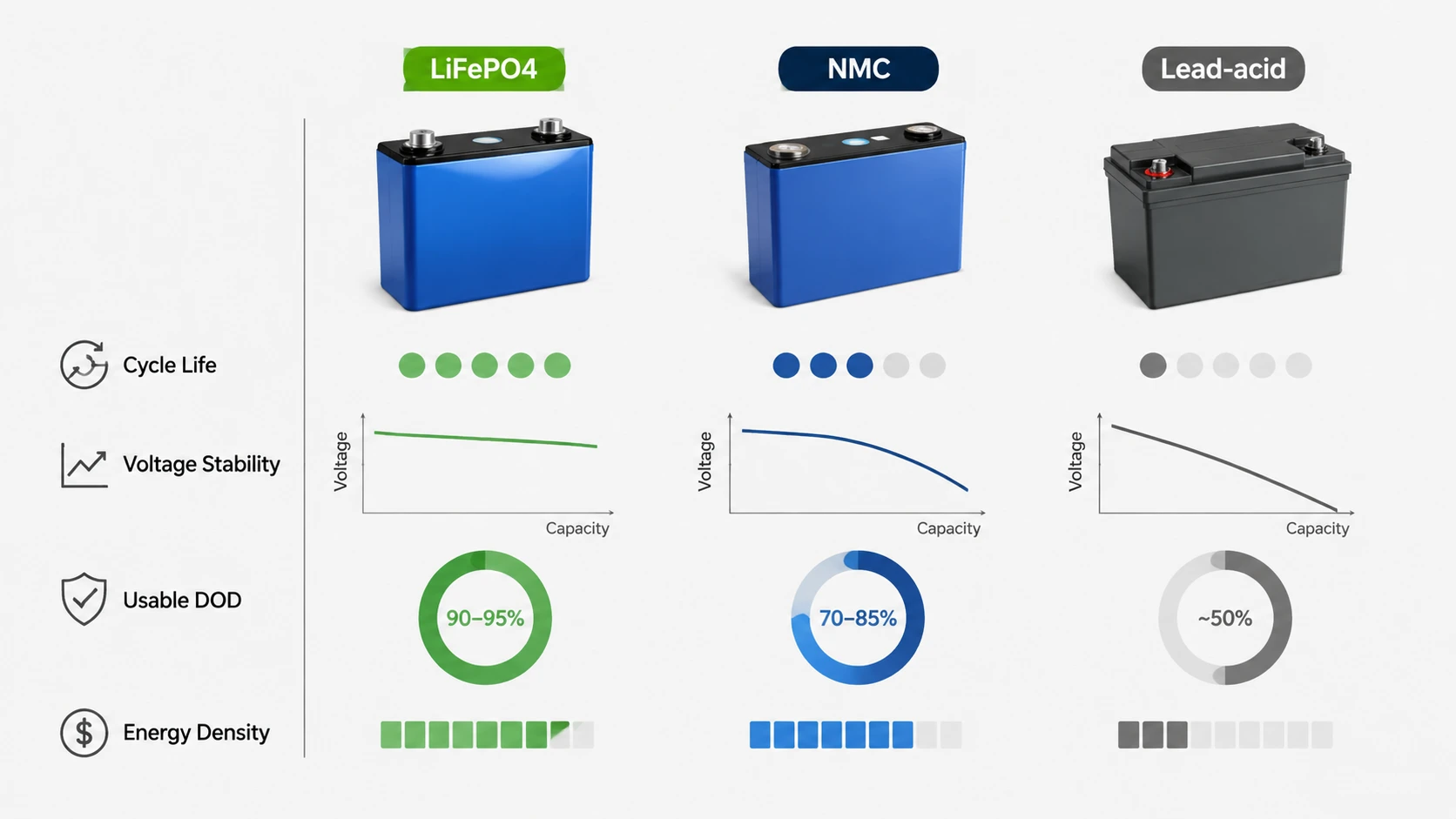
Different chemistries deliver different usable energy even with the same Ah. LiFePO4 (LFP) offers high cycle life, stable voltage curves, and high usable DOD (90–95%). NMC offers higher energy density but lower cycle life. Lead‑acid offers low usable DOD (~50%) and significant voltage sag under load. These differences affect system design, runtime, and cost. Engineers must consider chemistry when converting Ah to usable kWh.
9. Series and Parallel Configurations
Series configurations increase voltage while keeping Ah constant. Parallel configurations increase Ah while keeping voltage constant. For example, four 12V 100Ah batteries in series produce a 48V 100Ah system, while four in parallel produce a 12V 400Ah system. To calculate kWh, multiply total Ah by total voltage and divide by 1000. Engineers use series configurations to reduce current and improve efficiency, and parallel configurations to increase capacity and extend runtime.
10. Runtime Calculation Using kWh
DOD represents usable capacity, and efficiency represents inverter losses. For example, a 5.12 kWh battery powering a 1 kW load with 90% DOD and 94% efficiency delivers approximately 4.33 hours of runtime. Engineers use this formula to plan backup duration and load support.
11. Inverter Sizing Based on kWh
Inverters are rated in kW, not Ah. Therefore Ah must be converted to kWh before selecting an inverter. A common engineering guideline is to size battery energy at roughly 2× the inverter’s continuous power rating, depending on load profile, chemistry, and desired autonomy. This helps maintain stable DC bus voltage, support surge loads, and reduce voltage sag. For example, a 5 kW inverter often pairs well with around 10 kWh of battery storage.
12. Solar Storage Sizing
Solar systems use kWh for daily load consumption, autonomy days, PV array sizing, and charge controller selection. For example, a home consuming 6 kWh per day and requiring 2 days of autonomy needs 12 kWh of battery capacity. Using 51.2V 100Ah modules, this requires three modules. Engineers use kWh to plan solar autonomy and load support.
13. Off‑Grid System Design
Off‑grid systems rely heavily on kWh because loads vary, solar input fluctuates, and autonomy is critical. Engineers use kWh to plan daily consumption, autonomy, and backup duration. For example, a system consuming 2.4 kWh per day and requiring 2 days of autonomy needs 4.8 kWh of battery capacity.
14. Commercial ESS Design
Commercial systems use kWh for peak shaving, load shifting, backup power, micro‑grid stabilization, and demand charge reduction. Engineers use kWh to plan system capacity, module count, and inverter compatibility. For example, a 100 kWh ESS cabinet using 14.34 kWh modules requires seven modules per rack.
15. Common Mistakes in Ah → kWh Conversion
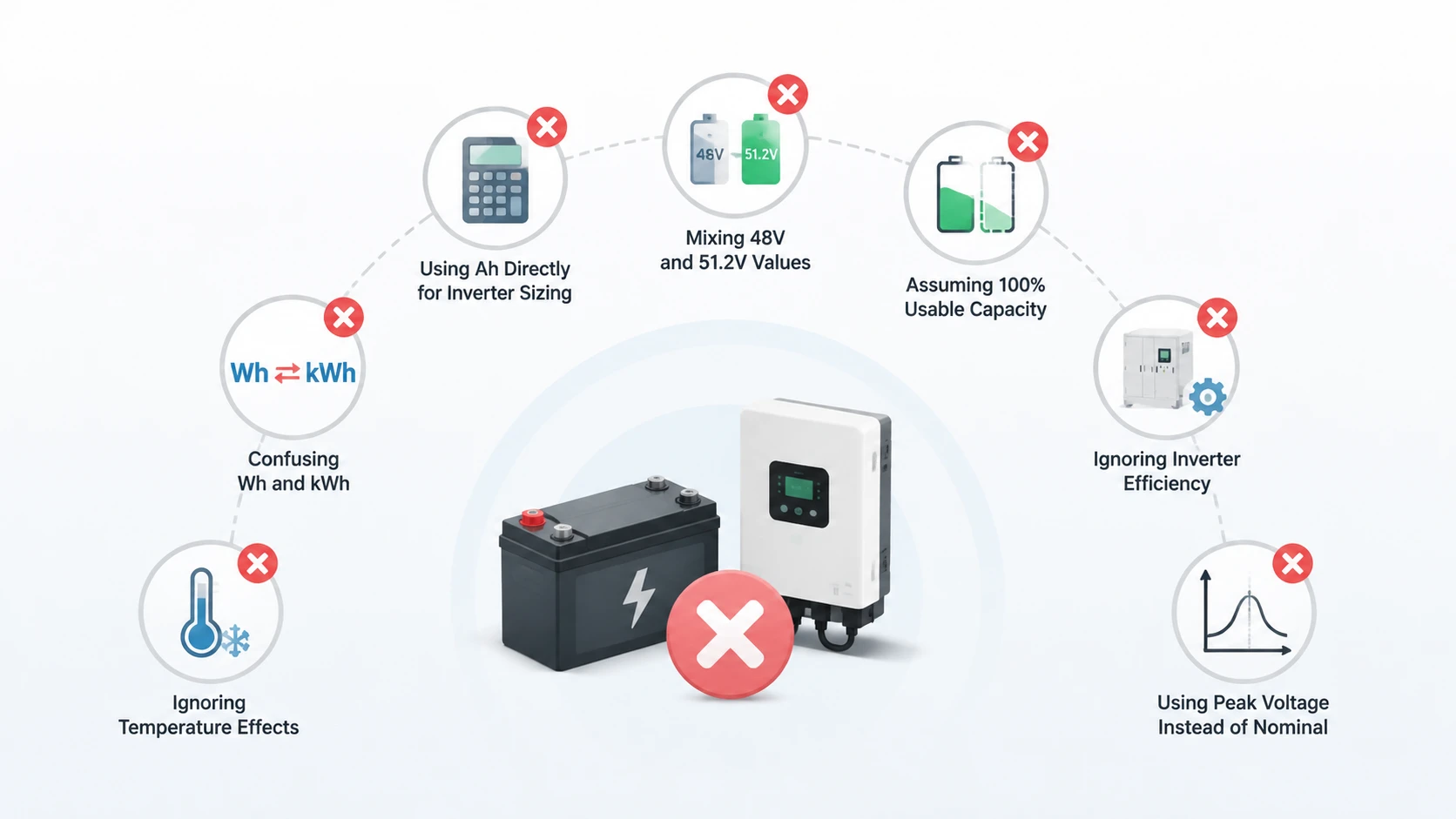
Common mistakes include using peak voltage instead of nominal, ignoring inverter efficiency, assuming 100% usable capacity, mixing 48V and 51.2V values, using Ah directly for inverter sizing, confusing Wh and kWh, and ignoring temperature effects. Avoiding these mistakes ensures accurate system design and predictable runtime.
16. Comparison Table
| Unit | Meaning | Used For |
|---|---|---|
| Ah | Charge capacity | Battery specification |
| Wh | Energy | Small systems |
| kWh | Usable energy | Solar, ESS, inverters |
| kW | Power | Inverter rating |
17. Reverse Calculation: kWh to Ah
This formula allows engineers to convert system energy requirements into battery capacity. For example, a 5 kWh system at 51.2V requires approximately 97.65Ah.
18. Hybrid Solar System Architecture
In hybrid solar systems, the Ah → kWh conversion becomes essential because hybrid inverters and battery modules are sized based on usable energy rather than charge capacity. A hybrid system integrates PV generation, battery storage, and grid interaction, and each part relies on kWh for planning backup duration, load support, and solar utilization. While Ah is still relevant for battery configuration and BMS settings, kWh determines how long the system can sustain critical loads during outages and how much solar energy can be stored each day. In practical design work, installers use kWh to match battery capacity with inverter power, daily consumption, and desired autonomy, making the Ah → kWh conversion a core step in hybrid system planning.
19. BESS Architecture
In commercial BESS systems, capacity planning is always performed in kWh because system‑level components—PCS, EMS, cooling, and fire protection—are designed around total energy rather than amp‑hour capacity. Ah remains important inside each battery module for cell grouping and BMS balancing, but kWh determines how many modules are required to meet a target energy capacity, how long the system can support peak‑shaving or backup loads, and how the ESS interacts with the grid. Converting Ah to kWh allows designers to translate module‑level specifications into cabinet‑level and site‑level energy planning, which is essential for micro‑grids, commercial backup systems, and industrial energy‑storage deployments.
20. FAQ
How many kWh is a 100Ah battery?
It depends on voltage. A 100Ah battery at 12V stores 1.2 kWh, at 24V stores 2.4 kWh, at 48V stores 4.8 kWh, and at 51.2V stores 5.12 kWh.
Is Ah or kWh more important?
Ah is useful for battery configuration, while kWh is essential for system‑level energy planning.
Can I convert kWh back to Ah?
Yes. Use the formula Ah = (kWh × 1000) / V.
Watts to Amps: Simple AC/DC Conversion Formulas & Examples
kW to kVA Calculator: Easy Conversion Formula, Chart & Load Examples