kW to kVA Calculator: Easy Conversion Formula, Chart & Load Examples
author: HT infinitepower
2026-08-27
⚡
kW to kVA Calculator
Quick answer: How to convert kW to kVA
The core relationship between kW and kVA is defined by power factor:
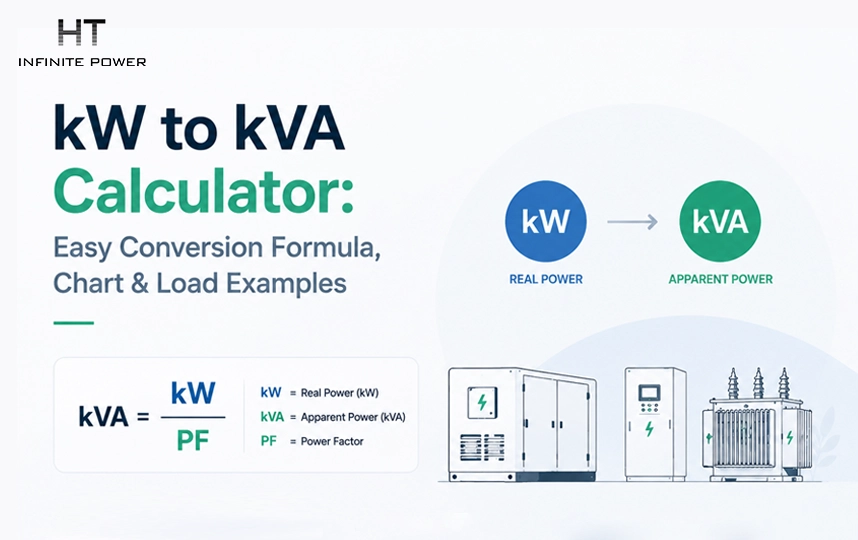
From this, the kW → kVA conversion formula is:
If you know the kW of your load and its power factor, you can immediately calculate the required kVA rating of your generator, inverter or transformer. For most commercial and industrial loads, PF typically falls between 0.75 and 0.95. Resistive loads such as heaters and incandescent lamps operate close to PF = 1.0, while motors, compressors, HVAC units and industrial machinery often run at lower PF values due to their inductive nature. The lower the PF, the higher the kVA required for the same kW.
From this, the kW → kVA conversion formula is:
If you know the kW of your load and its power factor, you can immediately calculate the required kVA rating of your generator, inverter or transformer. For most commercial and industrial loads, PF typically falls between 0.75 and 0.95. Resistive loads such as heaters and incandescent lamps operate close to PF = 1.0, while motors, compressors, HVAC units and industrial machinery often run at lower PF values due to their inductive nature. The lower the PF, the higher the kVA required for the same kW.
What kW, kVA and PF really mean in practice
When you look at a motor nameplate, a generator spec sheet or an inverter datasheet, you will often see both kW and kVA ratings, and sometimes a specified power factor. These are not just abstract numbers—they describe how the equipment behaves under load.
kW (kilowatts) represents the real power that actually performs work. If you have a 10 kW motor, that is the mechanical power it can deliver at its shaft under rated conditions. If you have a 5 kW heater, that is the thermal power it can convert into heat. Real power is what you pay for in terms of useful output.
kVA (kilovolt‑amps) represents the apparent power, which is the combination of real power and reactive power. Reactive power does not produce useful work, but it is required to establish magnetic fields in motors and transformers and to support inductive loads. Apparent power determines how much current flows through cables and how much capacity your generator, inverter or transformer must provide to avoid overheating and overloading.
Power factor (PF) is the ratio of real power to apparent power:
A PF of 1.0 means all the apparent power is converted into real power—this is typical of purely resistive loads. A PF of 0.8 means only 80% of the apparent power becomes useful work, while the remaining 20% circulates as reactive power. In practical terms, a lower PF means you need more kVA capacity to deliver the same kW of useful output.
kW (kilowatts) represents the real power that actually performs work. If you have a 10 kW motor, that is the mechanical power it can deliver at its shaft under rated conditions. If you have a 5 kW heater, that is the thermal power it can convert into heat. Real power is what you pay for in terms of useful output.
kVA (kilovolt‑amps) represents the apparent power, which is the combination of real power and reactive power. Reactive power does not produce useful work, but it is required to establish magnetic fields in motors and transformers and to support inductive loads. Apparent power determines how much current flows through cables and how much capacity your generator, inverter or transformer must provide to avoid overheating and overloading.
Power factor (PF) is the ratio of real power to apparent power:
A PF of 1.0 means all the apparent power is converted into real power—this is typical of purely resistive loads. A PF of 0.8 means only 80% of the apparent power becomes useful work, while the remaining 20% circulates as reactive power. In practical terms, a lower PF means you need more kVA capacity to deliver the same kW of useful output.
kW to kVA conversion formula and why it matters
Once you understand PF, the kW → kVA conversion becomes straightforward:
If you have a 10 kW load at PF 0.8, the required kVA is:
This means that even though the load is only 10 kW, your generator or inverter must be rated at least 12.5 kVA to handle it safely. If you size equipment only by kW and ignore PF, you risk selecting devices that are too small for the actual current and apparent power they must carry. This is especially critical in solar‑plus‑storage systems, where inverters and battery packs must support a mix of resistive and inductive loads, and where PF can vary over time as different loads switch on and off.
kW to kVA conversion chart (common PF values)
To make sizing easier, you can use a simple kW → kVA chart for typical PF values:
| kW | PF 1.0 | PF 0.95 | PF 0.90 | PF 0.85 | PF 0.80 |
| 1 | 1.00 | 1.05 | 1.11 | 1.18 | 1.25 |
| 3 | 3.00 | 3.16 | 3.33 | 3.53 | 3.75 |
| 5 | 5.00 | 5.26 | 5.55 | 5.88 | 6.25 |
| 10 | 10.00 | 10.53 | 11.11 | 11.76 | 12.50 |
| 20 | 20.00 | 21.05 | 22.22 | 23.53 | 25.00 |
| 30 | 30.00 | 31.58 | 33.33 | 35.29 | 37.50 |
| 50 | 50.00 | 52.63 | 55.55 | 58.82 | 62.50 |
This kind of chart is extremely useful when you are quickly checking whether a proposed generator or inverter rating is sufficient for a given load mix. It also helps you visualize how much extra kVA is required as PF drops from 1.0 to 0.8.
Step‑by‑step: How to convert kW to kVA for real loads
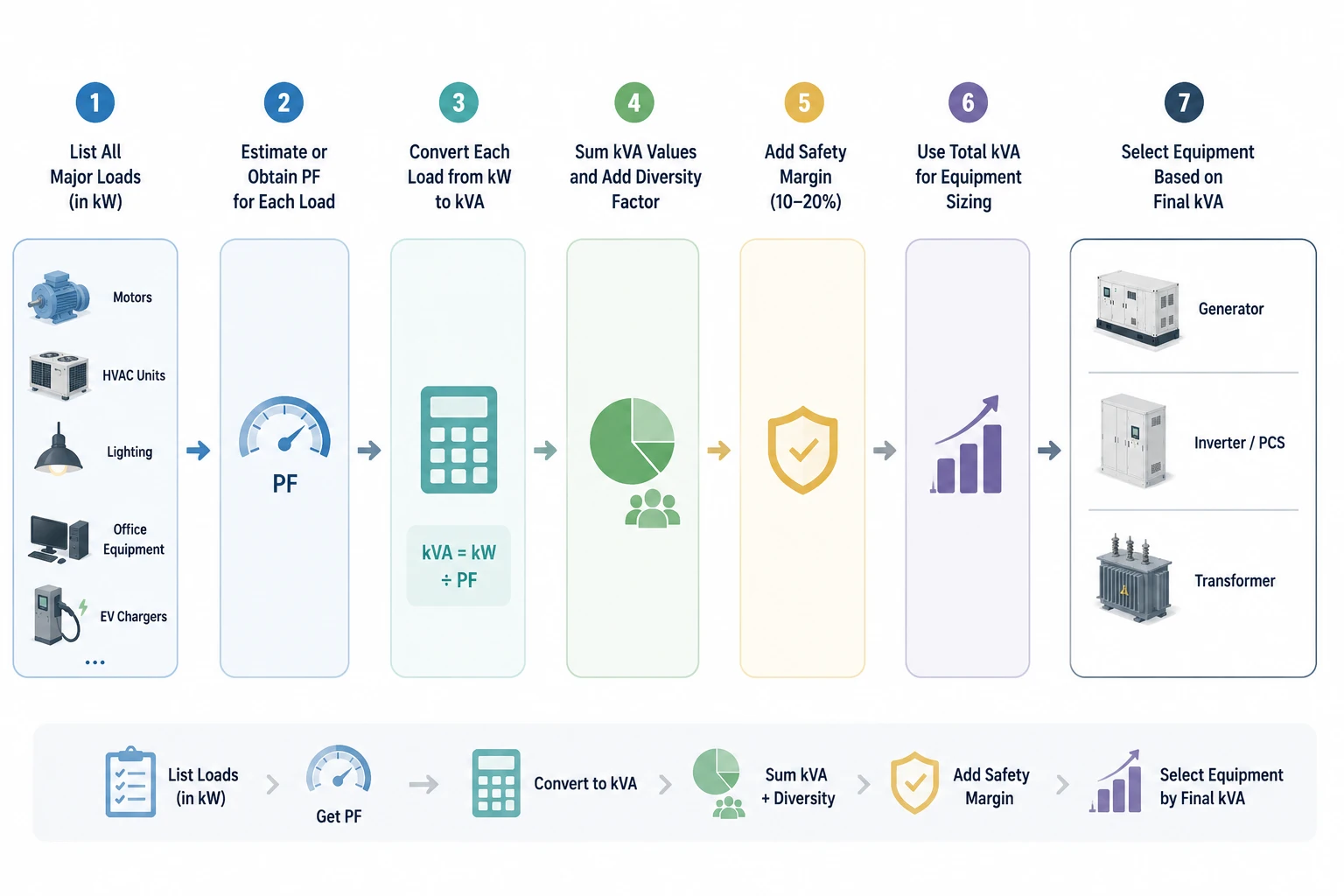
When you are sizing equipment for a real project, you rarely have a single clean resistive load. Instead, you have a mix of motors, HVAC units, lighting, office equipment and sometimes nonlinear loads like UPS systems or EV chargers. A practical workflow looks like this:
1.List all major loads in kW
Identify motors, pumps, compressors, HVAC units, lighting circuits and any other significant consumers. Use nameplate data or design specifications to estimate their kW.
2.Estimate or obtain PF for each load
For motors and pumps, PF is often around 0.8–0.9. For HVAC compressors, PF may be 0.75–0.85. For lighting and resistive heaters, PF is close to 1.0. If exact PF is unknown, use conservative typical values.
3.Convert each load from kW to kVA
Apply the formula kVA = kW ÷ PF for each major load. This gives you the apparent power contribution of each device.
4.Sum the kVA values and add diversity or simultaneity factors
Not all loads run at full power at the same time. Apply realistic diversity factors based on how the system will be used.
5.Add a safety margin (typically 10–20%)
Real‑world conditions, startup currents and PF variations can push the system beyond calculated values. A margin ensures stability.
6.Select generator, inverter or transformer based on total kVA
Use the final kVA figure, not just total kW, to choose equipment ratings.
This process is what separates a robust design from one that looks fine on paper but fails under peak load.
This process is what separates a robust design from one that looks fine on paper but fails under peak load.
Typical PF values by equipment type
Understanding typical PF ranges helps you make quick decisions when detailed data is not available:
| Equipment | Typical PF |
|---|---|
| Resistive heaters | 1.0 |
| Incandescent lamps | 0.95–1.0 |
| LED lighting (good drivers) | 0.90–0.98 |
| Small motors | 0.80–0.90 |
| Large industrial motors | 0.75–0.85 |
| HVAC compressors | 0.75–0.85 |
| Industrial pumps | 0.75–0.85 |
| UPS systems | 0.80–0.90 |
These values are not exact, but they give you a realistic starting point when designing systems for commercial buildings, factories, warehouses or farms.
Real‑world examples: kW to kVA in different scenarios
10 kW motor in a factory
A 10 kW motor driving a conveyor or pump in a factory might operate at PF 0.85 under typical load. Using the formula:
If this motor is part of a group of similar loads, the total kVA requirement quickly grows. A generator sized only at 10 kVA would be insufficient and could overload under startup or heavy operation.
If this motor is part of a group of similar loads, the total kVA requirement quickly grows. A generator sized only at 10 kVA would be insufficient and could overload under startup or heavy operation.
5 kW HVAC compressor in a commercial building
A 5 kW compressor serving a small office or shop might run at PF 0.80. The required kVA is:
If the building also has lighting, office equipment and other small motors, the total kVA demand can easily exceed the apparent simplicity of “just 5 kW”.
If the building also has lighting, office equipment and other small motors, the total kVA demand can easily exceed the apparent simplicity of “just 5 kW”.
20 kW irrigation pump on a farm
A 20 kW pump used for irrigation may operate at PF 0.75 due to long cable runs, transformer characteristics and motor design:
In this case, a 25 kVA generator would be marginal, while a 30 kVA unit would provide a safer margin for startup currents and PF variations.
In this case, a 25 kVA generator would be marginal, while a 30 kVA unit would provide a safer margin for startup currents and PF variations.
Why kVA is critical in solar‑plus‑storage and BESS systems

In battery energy storage systems (BESS) and solar‑plus‑storage setups, inverters are often advertised in kW, but internally they are limited by kVA and PF. A “10 kW” inverter may only be able to deliver 10 kW at PF 1.0; if the load PF drops to 0.8, the same inverter might hit its kVA limit before reaching 10 kW of real power. This becomes critical when you connect motors, pumps or HVAC units to a system originally designed for mostly resistive or electronic loads.
If you design a BESS purely based on kWh capacity and kW output, without checking kVA and PF, you may find that the system cannot support certain industrial or agricultural loads even though the energy capacity seems sufficient. Correctly converting kW to kVA and considering PF ensures that the inverter, battery pack and upstream equipment can handle both the energy and the instantaneous power demands.
If you design a BESS purely based on kWh capacity and kW output, without checking kVA and PF, you may find that the system cannot support certain industrial or agricultural loads even though the energy capacity seems sufficient. Correctly converting kW to kVA and considering PF ensures that the inverter, battery pack and upstream equipment can handle both the energy and the instantaneous power demands.
kW vs kVA vs PF: summary comparison
| Term | Meaning | Design impact |
|---|---|---|
| kW | Real power | Determines useful work and energy use |
| kVA | Apparent power | Determines equipment sizing and current |
| PF | kW ÷ kVA | Links real and apparent power |
In design work, you start from kW (what the load needs), convert to kVA using PF (what the system must supply), and then choose equipment ratings based on kVA with appropriate margins.
FAQ: Common questions about kW to kVA conversion
1. Why is kVA usually higher than kW?
Because kVA includes both real and reactive power. Unless PF is exactly 1.0, kVA will be greater than kW.
2. Can kW ever equal kVA?
Yes. When PF = 1.0, such as with purely resistive loads, kW and kVA are numerically equal.
3. What PF should I assume if I don’t know the load details?
For general commercial loads, PF 0.85 is a reasonable assumption. For motor‑heavy or industrial loads, PF 0.75–0.80 is safer.
4. Why do utilities care about PF and kVA?
Low PF increases current and apparent power, stressing the grid and equipment. Utilities may charge penalties or demand charges based on kVA or PF.
5. Do solar inverters and BESS systems really care about kVA?
Yes. Even if the marketing focuses on kW and kWh, the internal design is limited by kVA and PF. Ignoring this can lead to overloads.
6. How much margin should I add when sizing equipment?
Typically 10–20% above the calculated kVA, depending on startup currents, PF variability and criticality of the application.
Conclusion
Converting kW to kVA is not just a mathematical exercise—it is a fundamental step in designing reliable electrical and solar‑plus‑storage systems. By understanding how power factor affects the relationship between real and apparent power, and by using the formula:
along with charts, typical PF values and real‑world examples, you can size generators, inverters, transformers and BESS systems with confidence. This ensures that your installations can handle both the energy demand and the instantaneous power requirements of motors, HVAC units, pumps and other critical loads, without unexpected trips, overheating or premature failures.
Ah to kWh Calculator for Batteries, Solar Storage & Inverter Sizing
3 Storage Fires, 1 Week: Thermal Runaway Is a Global Wake-Up Call