Volts to Amps Calculator for Batteries, Inverters and Energy Storage
Quick Answer
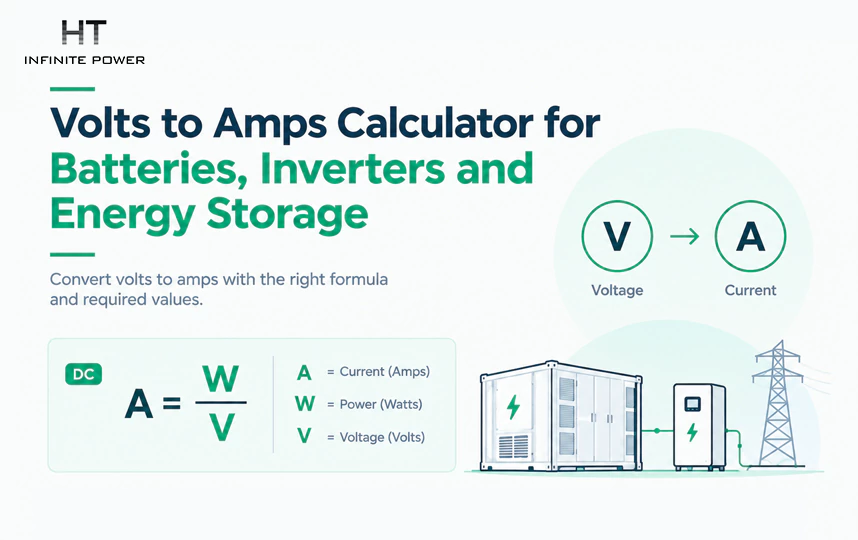
Voltage alone cannot determine current. To convert volts to amps, you must also know the power (watts). For AC systems, power factor (PF) may also be required.
DC
Single‑Phase AC
Three‑Phase AC
(Using line voltage and line current)
A higher voltage requires less current to deliver the same amount of power. This principle applies to household appliances, batteries, inverters, solar systems, and commercial energy storage installations.
1. What Are Volts, Amps, and Watts?
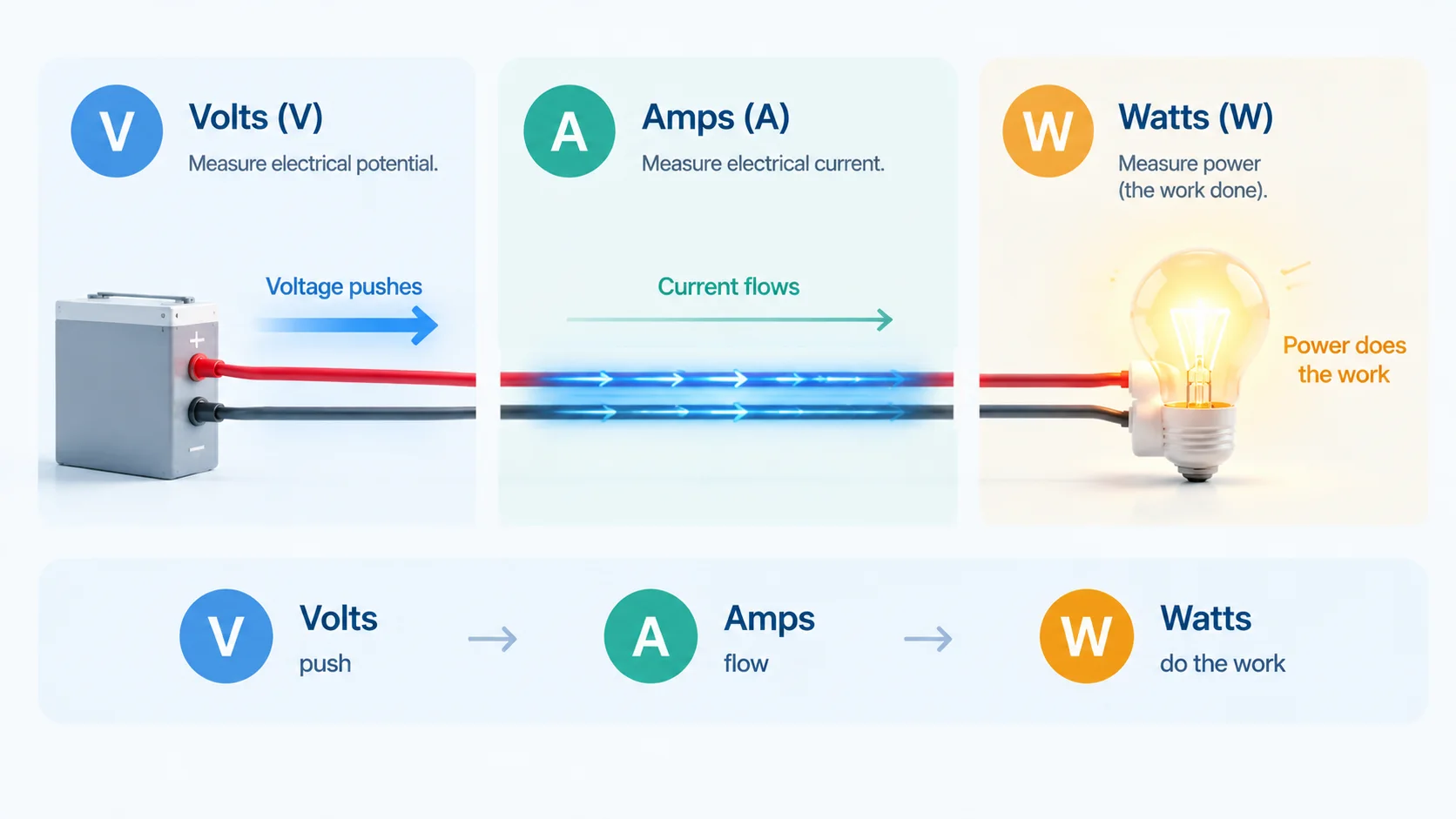
Volts, amps, and watts are closely related, but they measure different aspects of electricity.
- Volts (V) measure electrical potential.
- Amps (A) measure electrical current.
- Watts (W) measure power.
A simple way to remember the relationship is:
Volts push, amps flow, and watts do the work.
When people search for a volts to amps calculator, they are usually trying to determine how much current a device or system requires. The key point is that current cannot be calculated from voltage alone. Power must also be known.
2. Volts to Amps Formula
The correct formula depends on the type of electrical system.
DC Formula
Single‑Phase AC Formula
For most residential and commercial circuits:
Three‑Phase AC Formula
For industrial and commercial equipment using line voltage and line current:
3. How to Convert Volts to Amps
Once voltage and power are known, calculating current is straightforward.
Example 1: DC System
A 480W load connected to a 48V battery:
Example 2: Household AC System
A 1200W load operating on 120V with a power factor of 1:
Example 3: Battery Inverter System
A 5000W inverter powered by a 48V battery:
This example highlights why current can become very high in low‑voltage battery systems.
4. How Many Amps Is 12V, 24V, 48V, 120V, 230V, 240V, 400V and 800V?
Questions such as "How many amps is 12V?" are extremely common.
The correct answer is:
Voltage alone cannot determine amps. You must also know power.
Using examples based on a 10A load:
| Voltage | Power | Current |
|---|---|---|
| 12V | 120W | 10A |
| 24V | 240W | 10A |
| 48V | 480W | 10A |
| 120V | 1200W | 10A |
| 230V | 2300W | 10A |
| 240V | 2400W | 10A |
| 400V | 4000W | 10A |
| 800V | 8000W | 10A |
These examples simply demonstrate the relationship between voltage, current, and power. As voltage increases, the same current can deliver more power.
5. Volts to Amps Conversion Chart
The chart below is one of the most useful quick references for volts‑to‑amps conversion.
| Power | 12V | 24V | 48V | 120V | 230V | 240V |
| 100W | 8.3A | 4.2A | 2.1A | 0.83A | 0.43A | 0.42A |
| 500W | 41.7A | 20.8A | 10.4A | 4.2A | 2.2A | 2.1A |
| 1000W | 83.3A | 41.7A | 20.8A | 8.3A | 4.3A | 4.2A |
| 1500W | 125A | 62.5A | 31.3A | 12.5A | 6.5A | 6.3A |
| 2000W | 166.7A | 83.3A | 41.7A | 16.7A | 8.7A | 8.3A |
| 3000W | 250A | 125A | 62.5A | 25A | 13A | 12.5A |
| 5000W | 416.7A | 208.3A | 104.2A | 41.7A | 21.7A | 20.8A |
One pattern stands out immediately: current decreases dramatically as voltage rises. Delivering 5000W at 12V requires more than 400A, while the same power at 240V requires only about 21A.
6. Real‑World Household Examples
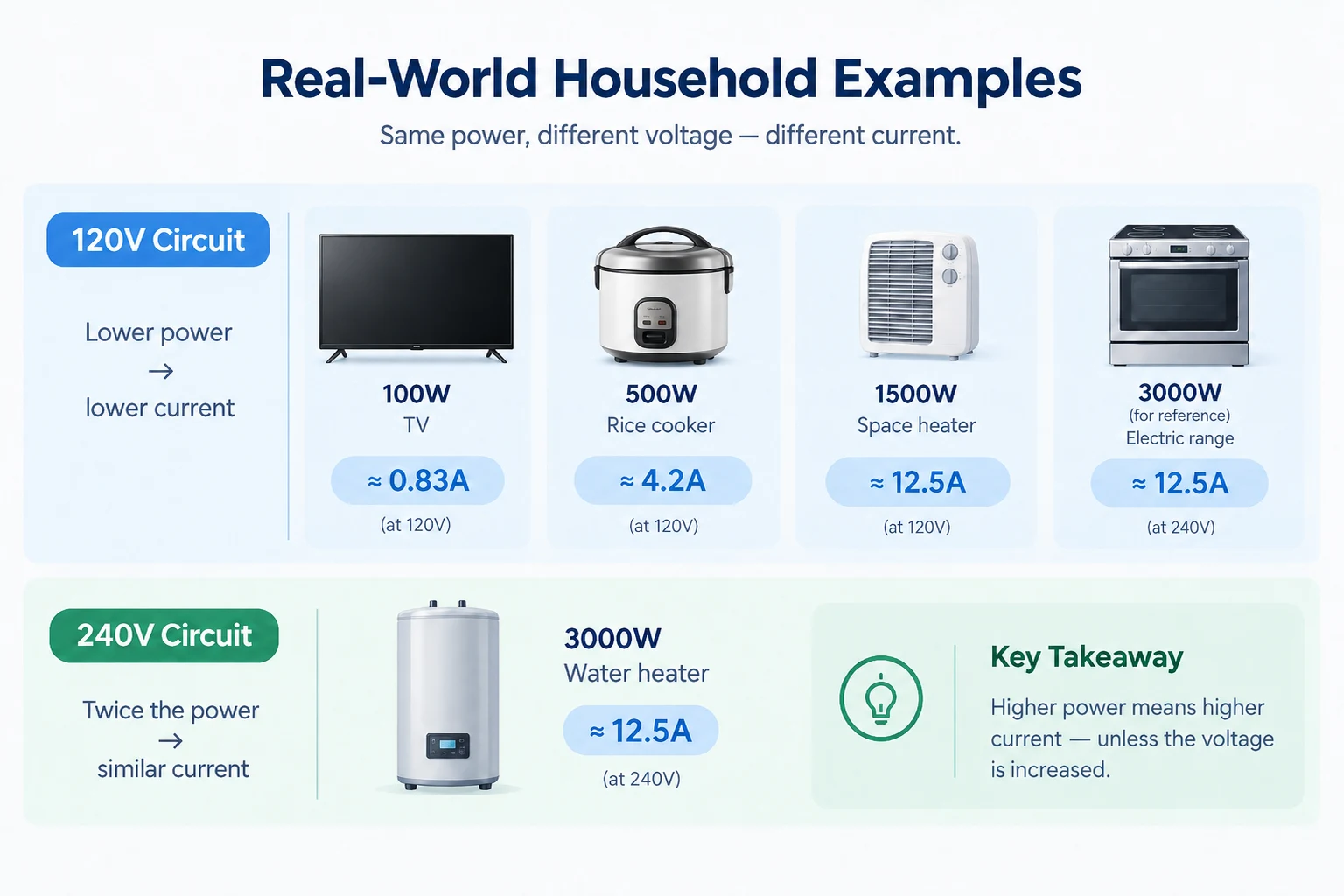
Household electrical loads provide useful examples of volts‑to‑amps calculations.
A 100W load operating on a 120V circuit draws approximately 0.83A. A 500W appliance requires around 4.2A, while a 1000W appliance draws about 8.3A.
As power increases, current increases proportionally when voltage remains unchanged. A 1500W heater operating on a 120V circuit draws approximately 12.5A, which is close to the continuous load limit of many household circuits.
At 240V, a 3000W appliance also draws about 12.5A. The power is twice as high, but because voltage is doubled, current remains similar.
| Power | Voltage | Current |
|---|---|---|
| 100W | 120V | 0.83A |
| 500W | 120V | 4.17A |
| 1000W | 120V | 8.33A |
| 1500W | 120V | 12.5A |
| 2000W | 240V | 8.33A |
| 3000W | 240V | 12.5A |
7. Volts to Amps in Solar, Batteries and Inverters
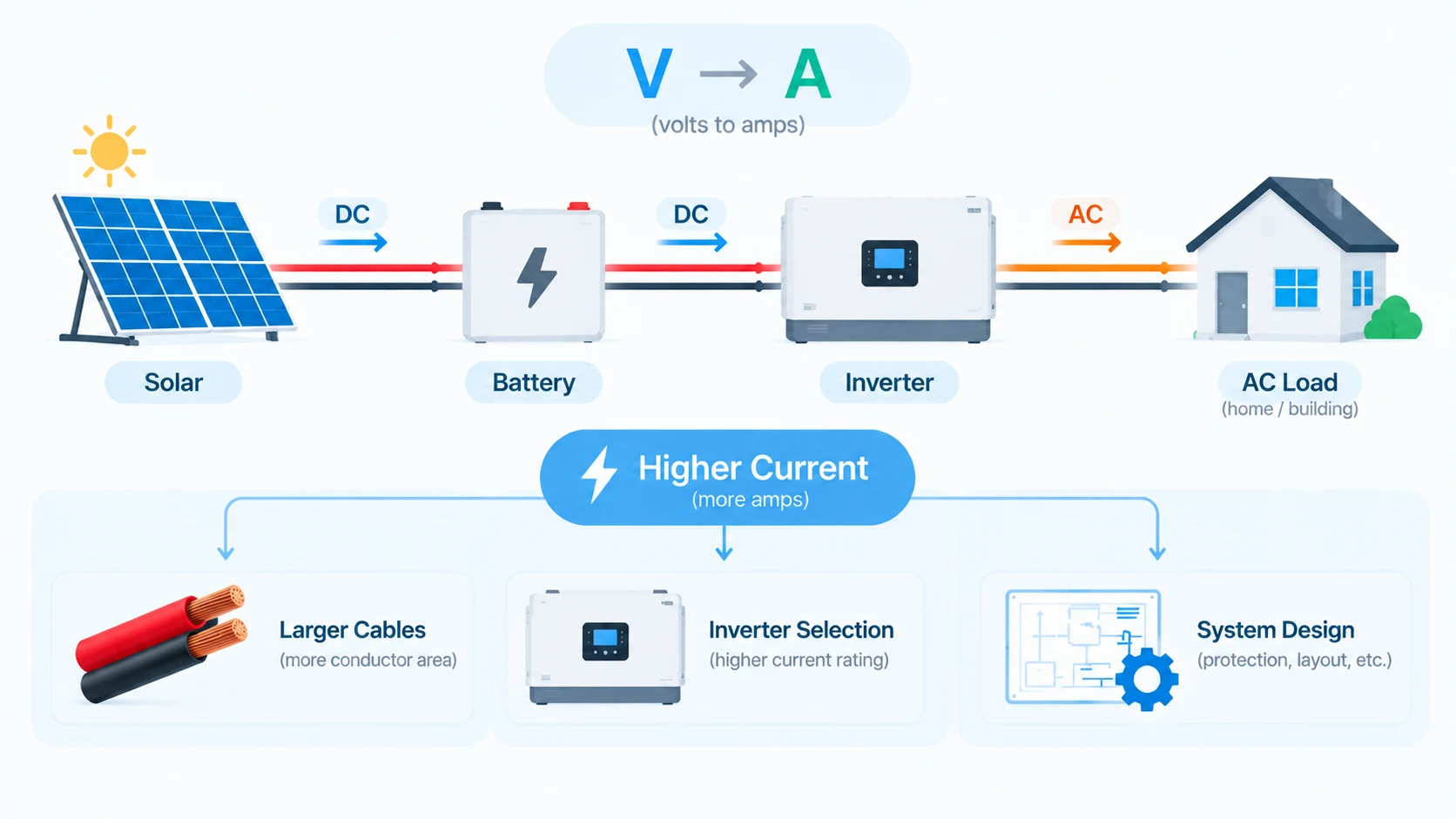
Volts‑to‑amps calculations become especially important in battery and inverter systems because current can quickly become very high.
In battery-based systems, current directly affects cable sizing, inverter selection, and overall system design. Higher current requirements may require larger conductors and more careful electrical planning.
A 1000W load connected to a 12V battery requires approximately:
A 2000W load connected to a 24V battery requires roughly:
A 5000W inverter connected to a 48V battery requires:
These values help explain why higher‑voltage battery systems are widely used in solar and energy storage applications.
Actual inverter performance may also be affected by efficiency, voltage variation, current limits, and overall operating conditions.
8. Battery Voltage and Current Examples
The following examples show how different battery voltages affect current requirements.
12V Battery
A 1000W load requires:
24V Battery
A 2000W load requires:
48V Battery
A 5000W inverter requires:
48V Battery and a 10kW Inverter
As system power increases, current quickly becomes difficult to manage at lower voltages. This is one reason why larger battery and inverter systems often operate at higher voltages.
In commercial energy storage applications, higher-voltage battery architectures help reduce current requirements for the same power output, which can simplify electrical design and reduce voltage drop under comparable conditions.
9. Volts to Amps in Commercial Energy Storage
Commercial battery energy storage systems operate at much higher voltages than residential battery systems. Depending on system architecture, battery voltage may range from several hundred volts to around 1000V or more.
For example, a system delivering 40kW from an 800V battery requires:
If the same power were delivered from a 48V system, current would exceed 800A.
Higher operating voltage reduces current requirements for the same power level, which can help reduce conductor losses and voltage drop when other system conditions remain comparable.
10. How Power Factor Changes AC Current
Power factor describes the relationship between real power and apparent power in an AC system.
For a given power level, a lower power factor generally requires more current.
Consider a 1000W load operating at 120V.
PF = 1
Current (A) = Power (W) ÷ Voltage (V)
PF = 0.8
The power remains 1000W, but the current required from the system increases as power factor decreases.
11. Choosing the Right Voltage for Your Power System
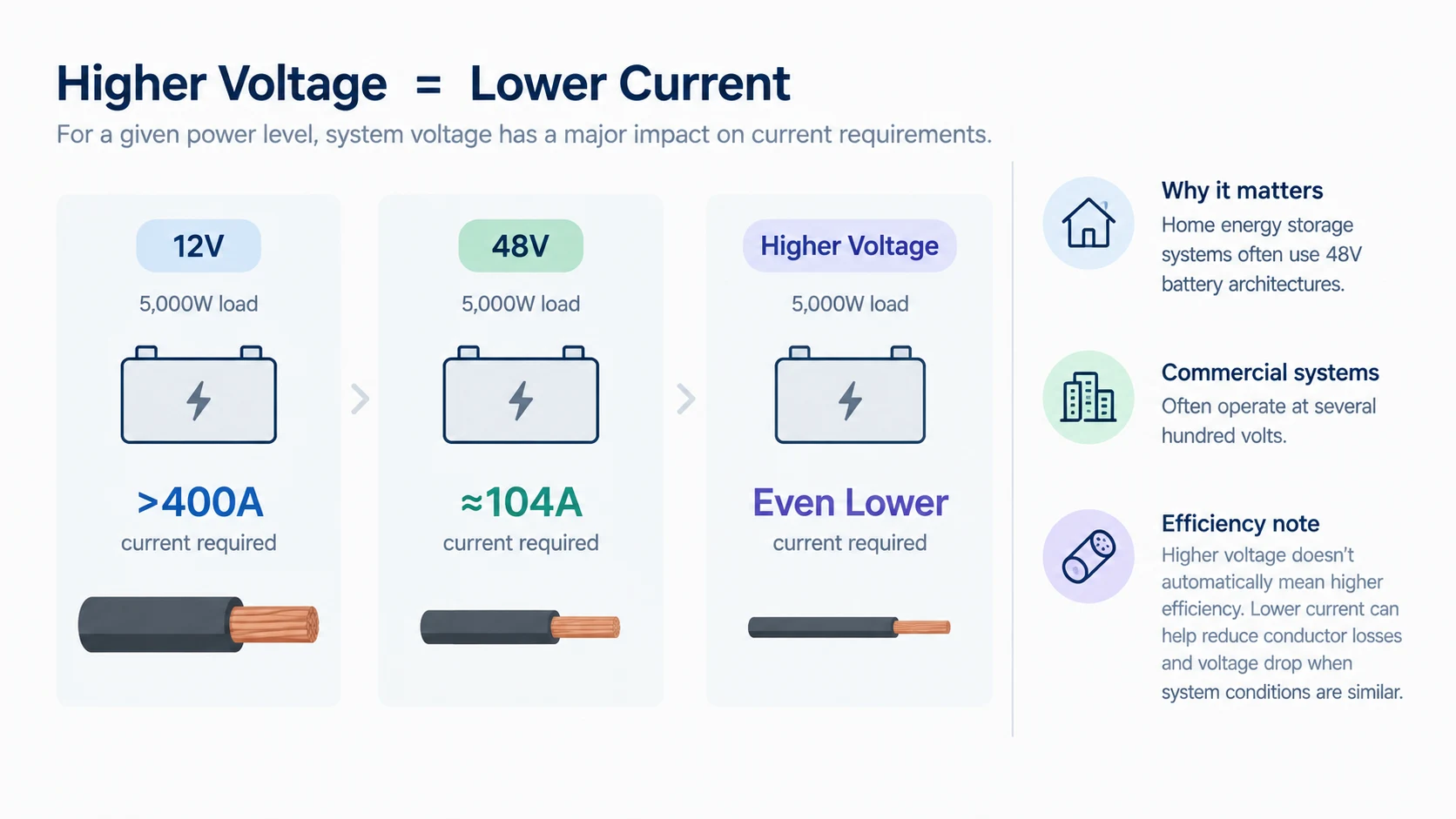
For a given power level, system voltage has a major impact on current requirements.
A 5000W load operating at 12V requires more than 400A. The same load operating at 48V requires roughly 104A. Increase the voltage further and the required current continues to decrease.
This is one reason home energy storage systems frequently use 48V battery architectures, while commercial energy storage systems often operate at several hundred volts.
Higher voltage does not automatically mean higher efficiency. However, lower current can help reduce conductor losses and voltage drop when system conditions are otherwise similar.
12. Why Higher Voltage Usually Means Lower Current
One of the most important principles in electrical systems is:
For the same power, higher voltage generally means lower current.
For example:
- 5000W at 48V requires approximately 104A
- 5000W at 240V requires approximately 21A
The power remains the same, but the current requirement changes dramatically.
This relationship influences the design of battery systems, solar installations, inverters, residential wiring, and commercial energy storage projects.
13. Common Mistakes
Assuming volts alone determine amps
Current calculations require both voltage and power.
Using a DC formula for AC systems
AC calculations may require power factor.
Ignoring power factor
Lower PF values increase current requirements.
Mixing single‑phase and three‑phase formulas
Three‑phase calculations require the √3 multiplier.
Ignoring inverter efficiency
Real systems often require more input power than ideal calculations suggest.
Using nominal battery voltage only
Battery voltage can change during charging, discharge, and varying operating conditions.
Conclusion
A volts to amps calculator is useful because current cannot be determined from voltage alone. To calculate amps accurately, you must know power, and AC systems may also require power factor. Once voltage and power are known, calculating current for household appliances, solar systems, batteries, inverters, and commercial energy storage systems becomes straightforward. Understanding this relationship helps with equipment sizing, cable selection, electrical planning, and overall system design in both residential and commercial applications.
More Electrical Unit Conversions
kW → kVA
Ah → kWh
Watts → Amps
Volts → Watts
FAQ
How do I convert volts to amps?
for DC systems.
Can you calculate amps from volts alone?
No. You must also know the power.
How many amps is 12V?
For a 120W load:
How many amps is 48V?
For a 480W load:
How many amps is 5000 watts at 48V?
Why does current decrease when voltage increases?
Why do battery systems use higher voltages?
Higher voltage reduces current requirements for the same power output and can help reduce voltage drop and conductor losses.
Do I need power factor to calculate amps?
Only for AC systems.
How do I calculate current in a three‑phase system?
Use:
using line voltage, line current, and power factor.
kVA to Amps Calculator for Inverters and Energy Storage
How to Choose Between Liquid Cooling and Air Cooling Energy Storage Systems?
Related Article