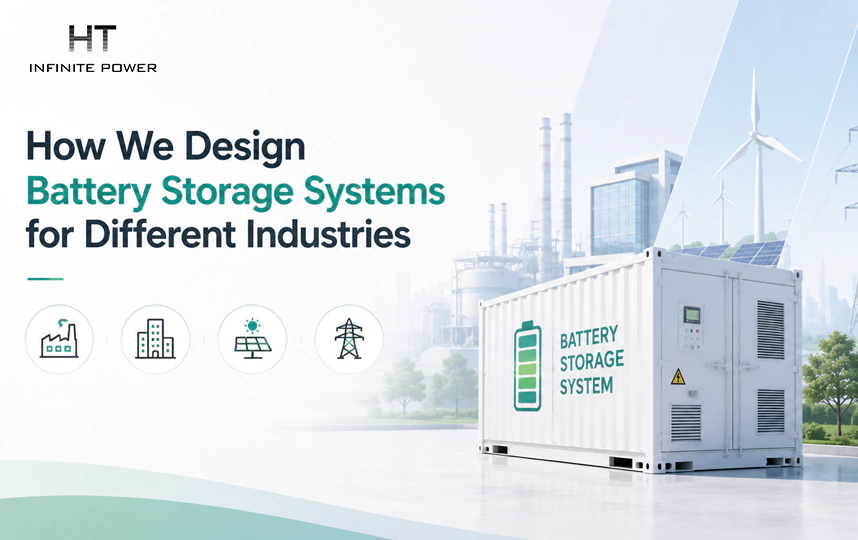
How We Design Battery Storage Systems for Different Industries
author: HT infinitepower
2026-08-20
When companies begin evaluating a commercial battery energy storage system, one of the first questions is often:
“How many kWh of battery storage do we need?”
“How many kWh of battery storage do we need?”
However, from a BESS engineering perspective, this is usually not the first question that should be answered.
The first question is:
“How does this facility actually use electricity?”
A battery storage system is not designed around battery capacity alone. The configuration must match the operational characteristics of the facility, including load behavior, peak demand patterns, operating schedule, reliability requirements, and economic objectives.
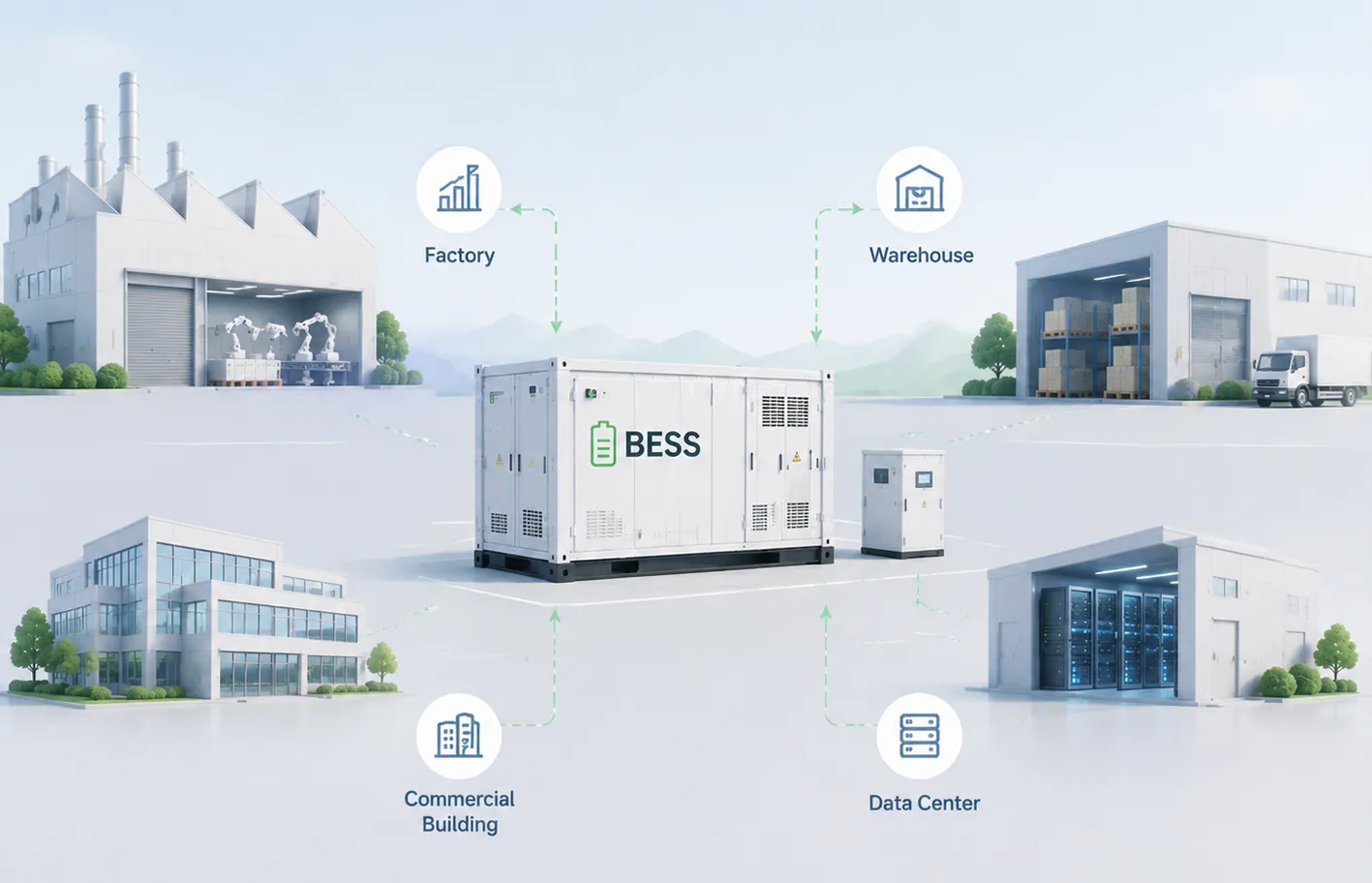
In practical commercial BESS projects, engineers often find that facilities with similar annual electricity consumption can require completely different system designs. A manufacturing plant, a logistics warehouse, a commercial building, and a data center may all consume large amounts of electricity, but the reason they consume electricity and the value they expect from energy storage are very different.
For example:
- A factory may need a high-power response to reduce short-duration demand peaks.
- A warehouse may benefit more from longer-duration energy shifting.
- A commercial building may focus on managing daytime demand and tariff periods.
- A data center may prioritize reliability, power continuity, and operational stability.
This is why battery storage system design starts with understanding facility operation rather than selecting a standard battery size.
In practice, engineers determine the final system configuration by balancing:
- Load characteristics
- Power requirements
- Energy requirements
- Control strategy
- Safety considerations
- Economic objectives
The industry itself often determines the design approach.
1. Why Industry Characteristics Affect BESS Design
Different industries create different engineering requirements because their
electricity consumption patterns are fundamentally different.
During commercial BESS design evaluations, engineers typically analyze several
factors before determining the system configuration:
- Load profile
- Peak demand behavior
- Operating hours
- Production or business schedule
- Energy cost structure
- Reliability requirements
These factors influence nearly every major design decision, including:
- Battery capacity sizing
- PCS selection
- EMS strategy
- Thermal management
- Economic evaluation
A common mistake during project development is assuming that a battery system can be standardized across applications.
For example, two facilities may both install a 500 kWh battery system, but the expected results may be completely different.
A manufacturing facility with frequent high-power demand spikes may require a system with stronger power output capability.
A warehouse with stable but longer operating hours may place more value on energy duration.
A data center may not primarily evaluate the battery by energy savings but by its ability to support critical operations.
Therefore, commercial BESS design should begin with the application objective.
Engineers need to understand:
What problem is the BESS solving?
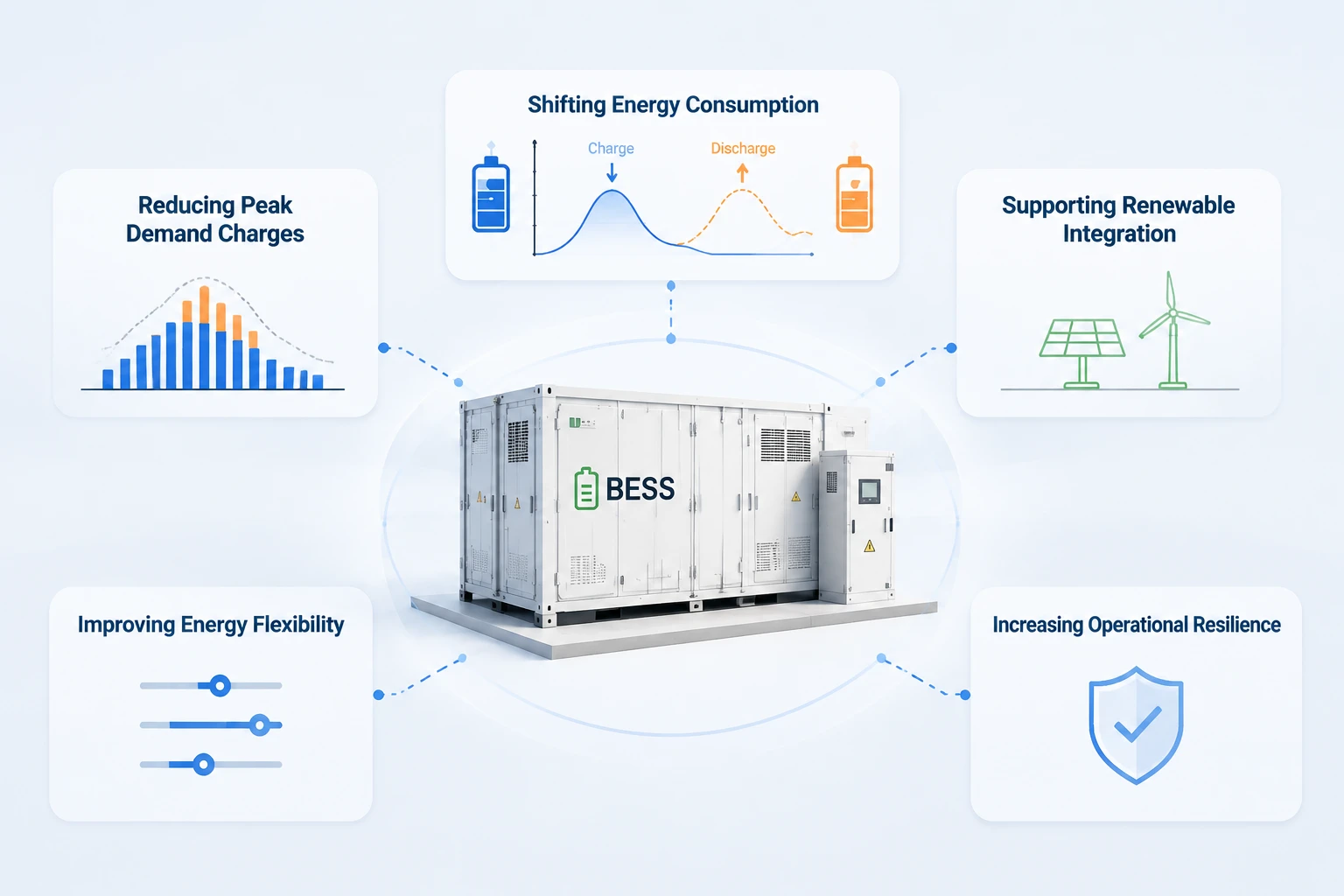
Possible objectives include:
- Reducing peak demand charges
- Shifting energy consumption
- Supporting renewable integration
- Improving energy flexibility
- Increasing operational resilience
The same battery capacity can have very different value depending on how the facility operates.
2. Factory BESS Design Logic
Industrial factories are among the most common applications for commercial battery energy storage systems because manufacturing facilities often have significant demand fluctuations.
However, factories are not all the same.
A factory operating with continuous production lines has different requirements compared with a facility running several production shifts with intermittent heavy machinery.
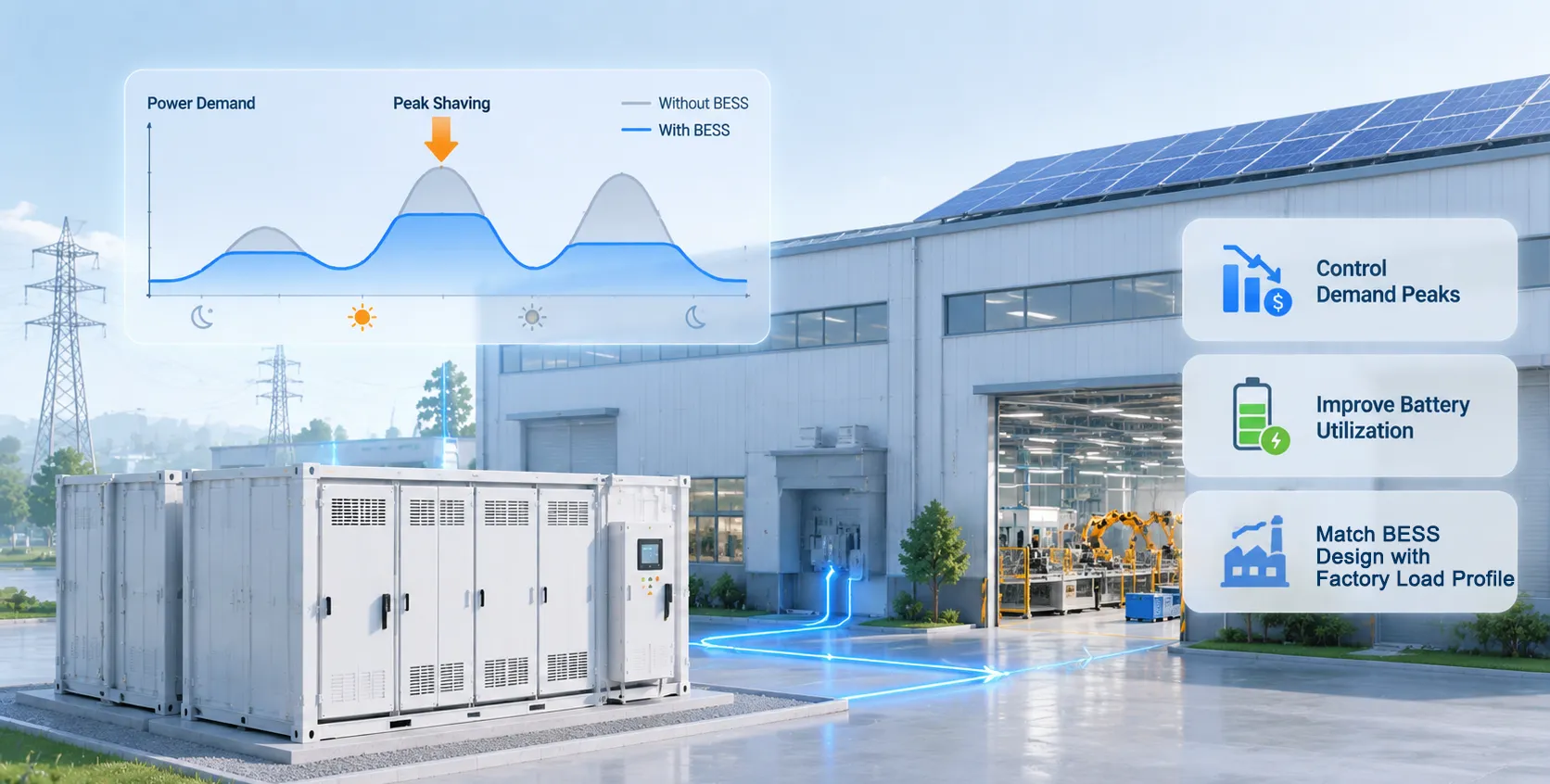
From an engineering perspective, factory BESS design usually focuses on controlling demand peaks while maintaining efficient battery utilization.
Load Analysis
For industrial applications, detailed load profile analysis is usually the starting point.
Engineers evaluate:
- Maximum demand periods
- Production shift patterns
- Machinery startup events
- Daily operating cycles
- Seasonal production changes
A factory may have relatively stable average consumption but experience short periods of very high demand when multiple machines operate simultaneously.
These short peaks can significantly affect electricity costs in regions where demand charges apply.
During engineering reviews, one common issue is that initial battery proposals are sometimes based only on monthly electricity consumption. However, monthly consumption does not show when and how demand peaks occur.
For peak shaving applications, the timing and duration of these peaks directly affect system design.
Battery Capacity Considerations
Factory battery capacity sizing depends on the actual peak reduction requirement.
Engineers typically evaluate:
- Required peak reduction level
- Peak duration
- Number of operating events per day
- Battery utilization frequency
If additional capacity is rarely used, the project may carry unnecessary investment without creating equivalent value.
For example, a factory with a 1,500 kW peak demand may target reducing demand by 250 kW during high tariff periods. If the peak event lasts two hours, the required usable energy would be approximately:
250 kW × 2 hours = 500 kWh
250 kW × 2 hours = 500 kWh
However, the final installed battery capacity may need to be higher after considering usable depth of discharge (DoD), system efficiency losses, and battery degradation over the project lifetime.
The purpose of capacity sizing is not to maximize installed energy, but to ensure the battery provides sufficient value under actual operating conditions.
The final battery capacity should be optimized based on actual operating requirements, expected utilization, and long-term project economics.
PCS Selection
Factories often place strong requirements on PCS power capability because demand peaks may occur quickly.
A battery may have sufficient stored energy, but if the PCS cannot deliver the required power level, the system cannot achieve the intended peak reduction.
This is why PCS selection must be considered together with battery capacity.
The engineering question is not only:
“How much energy can the battery store?”
“How much energy can the battery store?”
It is also:
“How much power must the system deliver during the critical operating period?”
“How much power must the system deliver during the critical operating period?”
EMS Strategy
The energy management system (EMS) plays an important role in coordinating factory energy storage operation.
A factory EMS strategy may consider:
- Production schedule
- Electricity tariff periods
- Battery SOC management
- Demand peak prediction
- Charging opportunities
For example, charging during low-cost periods and discharging during demand peaks requires coordination between grid conditions, production activity, and battery operating limits.
A well-designed EMS does not simply charge and discharge the battery according to a fixed schedule. It responds to actual facility conditions.
3. Warehouse BESS Design Logic
Warehouse applications often have different characteristics compared with manufacturing facilities.
Many warehouses have:
- Longer operating hours
- Relatively stable electricity demand
- Continuous refrigeration or HVAC loads
- Less frequent but longer-duration energy consumption patterns
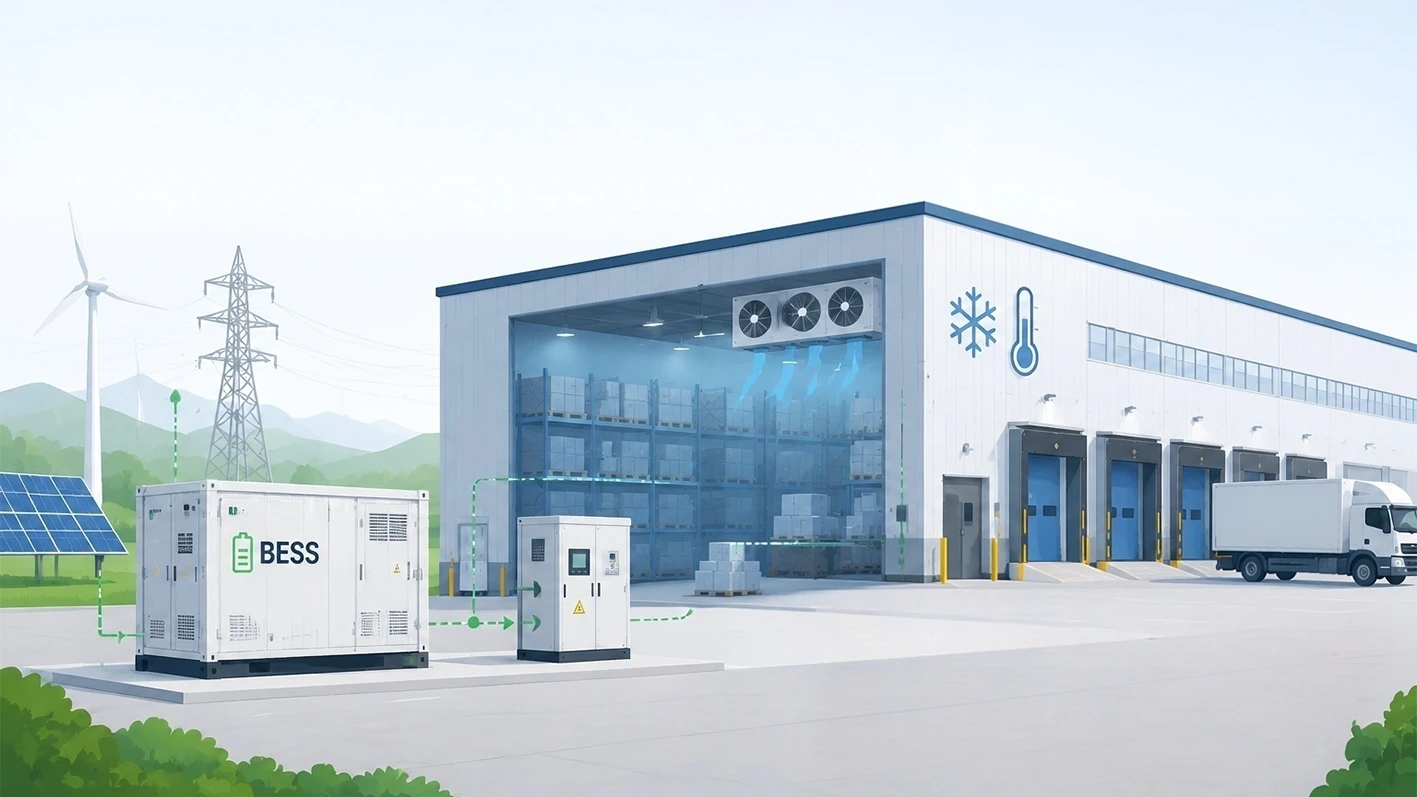
Cold storage warehouses are a typical example.
Although their peak demand may not be as aggressive as some industrial facilities, refrigeration systems can create continuous energy requirements that influence battery design.
Load Characteristics
Warehouse BESS design begins by understanding how energy is consumed throughout the day.
Engineers evaluate:
- Base load level
- Operating hours
- Refrigeration cycles
- Lighting and HVAC demand
- Weekend and seasonal variations
Unlike factories where short demand peaks may dominate the design, warehouses may require a different approach focused on longer-duration energy management.
Battery Duration Requirements
The required battery duration depends on the application objective.
For example:
A warehouse integrating solar generation may use storage to shift excess daytime generation into evening periods.
A warehouse integrating solar generation may use storage to shift excess daytime generation into evening periods.
A warehouse facing time-of-use electricity pricing may use a battery to reduce consumption during expensive tariff periods.
In these cases, battery capacity sizing may prioritize energy duration rather than short-duration power response.
This creates a different design strategy compared with factory peak shaving.
The same PCS rating and battery capacity combination that works well for a factory may not provide the same value in a warehouse environment.
Economic Evaluation
Warehouse projects are strongly influenced by electricity pricing structure and operating schedule.
Engineers typically evaluate:
- Energy price differences
- Daily charging and discharging opportunities
- Solar generation patterns
- Long-term utilization rate
A battery system that operates frequently according to a predictable schedule may achieve higher utilization than one designed only for occasional demand events.
Therefore, commercial energy storage design must consider how often the system will actually provide economic value.
4. Commercial Building BESS Design Logic
Commercial buildings, including offices, shopping centers, and mixed-use facilities, have their own operating characteristics.
Compared with factories, commercial buildings usually have:
- Strong daytime demand patterns
- HVAC-driven peaks
- Occupancy-related fluctuations
- Weather-dependent consumption changes
The challenge in these projects is often managing variable demand while maintaining economic operation.
Peak Demand Management
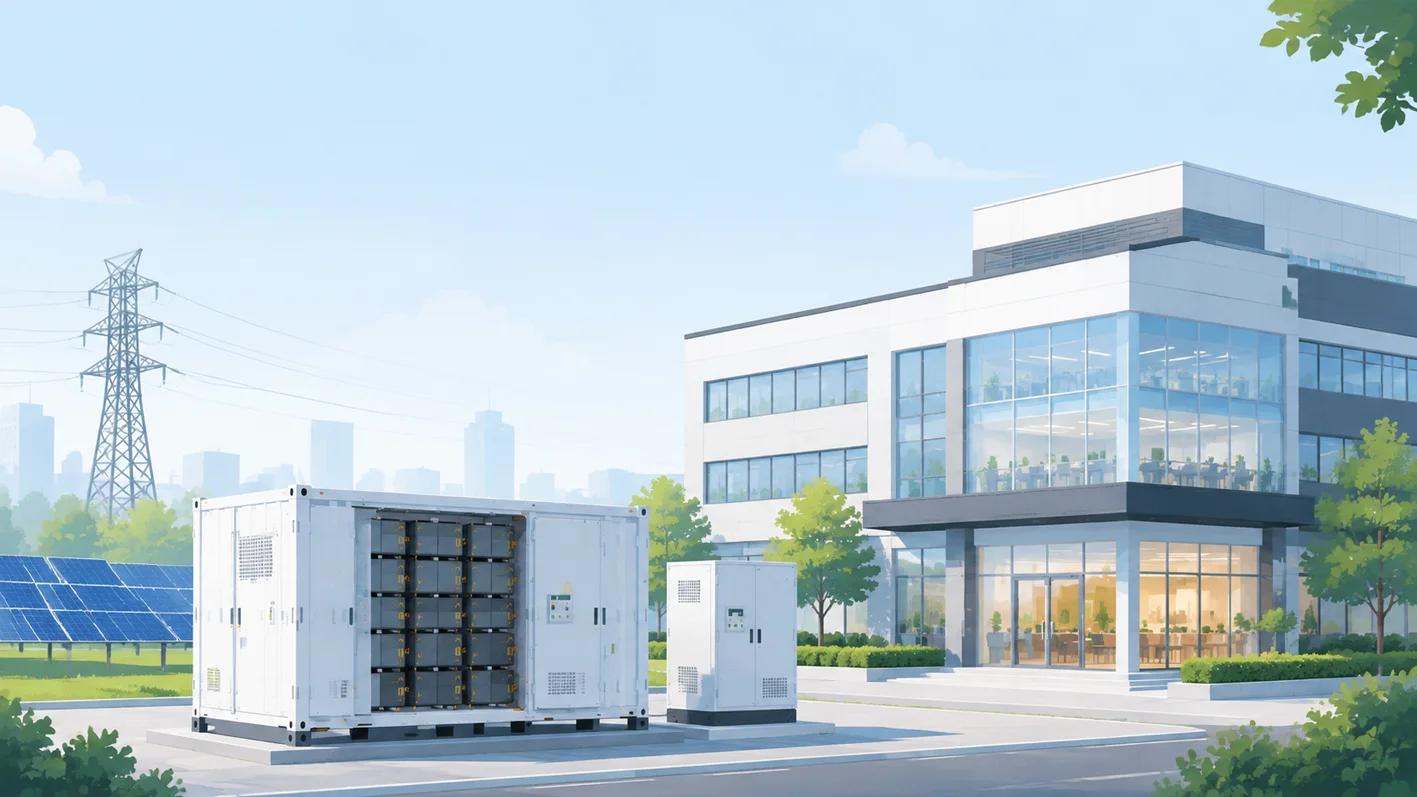
Commercial buildings commonly experience demand increases during business hours, especially when cooling systems operate at high capacity.
Engineers analyze:
- Afternoon peak periods
- HVAC operation patterns
- Occupancy schedules
- Building management system data
A battery system may help reduce demand charges by supporting the facility during expensive peak periods.
However, battery sizing should match actual building demand behavior.
Installing additional capacity without sufficient utilization may increase project cost without creating proportional savings.
EMS Requirements
For commercial buildings, EMS strategy becomes especially important because demand patterns can change daily.
An effective EMS may coordinate:
- Building load forecasts
- Tariff schedules
- Battery SOC targets
- Peak demand limits
For example, a building may need different dispatch strategies on weekdays, weekends, and seasonal periods.
A fixed operating schedule may not capture the actual energy behavior of the facility.
Battery Sizing Considerations
Battery capacity should be determined by real operating requirements rather than maximum possible storage.
Engineers consider:
- Target demand reduction
- Required discharge period
- Expected operating frequency
- Future energy management objectives
The objective is not simply to install more stored energy, but to configure a system that provides measurable operational value.
5. Data Center BESS Design Logic
Data centers represent one of the most demanding commercial BESS applications because their primary requirement is often different from traditional energy cost reduction projects.
For many industrial and commercial facilities, the main objective of battery storage is improving energy economics.
For data centers, reliability and operational continuity are usually much more important.
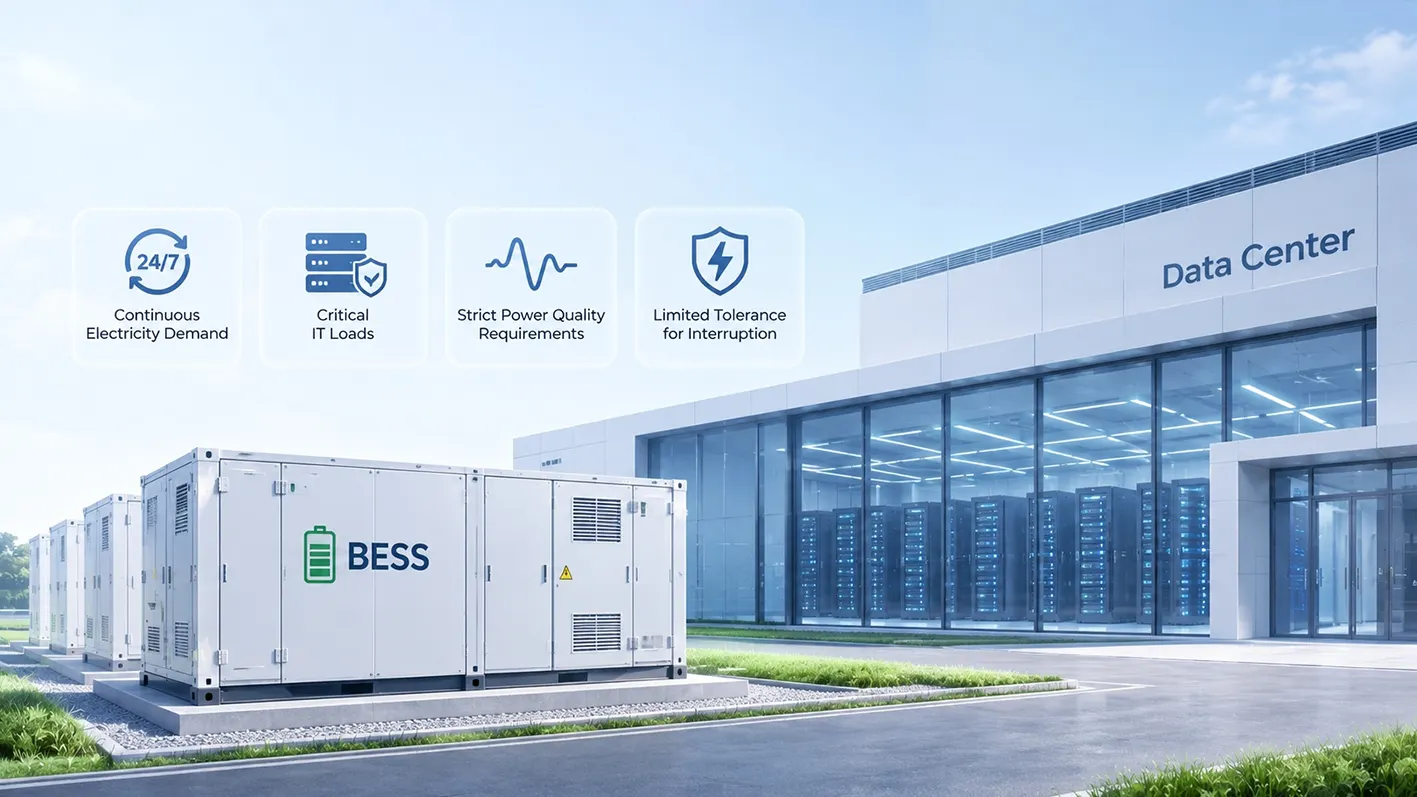
A data center operates with:
- Continuous electricity demand
- Critical IT loads
- Strict power quality requirements
- Limited tolerance for interruption
Because of these characteristics, data center BESS design requires a different engineering approach.
Reliability Requirements
In data center applications, engineers evaluate how the energy storage system interacts with the overall power architecture.
Important considerations include:
- Backup power strategy
- Response time requirements
- Critical load support
- System redundancy
Unlike a typical peak shaving project, where a short interruption may only affect energy savings, a power disturbance in a data center environment can directly affect critical operations.
For data centers, BESS is typically integrated with the overall power infrastructure rather than replacing traditional backup systems.
The battery system should be evaluated as part of the complete electrical infrastructure rather than as an independent energy storage device.
Engineers consider questions such as:
- How quickly must the system respond?
- Which loads require support?
- What level of redundancy is required?
- How does the BESS operate together with other power systems?
The answers influence system configuration decisions.
System Architecture
Data center applications place higher requirements on system reliability and control coordination.
During engineering evaluations, designers typically consider:
- PCS reliability
- Battery management capability
- Communication architecture
- Fault response strategy
- System availability
The BESS may need to coordinate with UPS systems, backup generators, and other critical power equipment to ensure seamless operation during grid disturbances.
The battery energy storage system must operate predictably under different conditions, including normal operation, grid events, and maintenance scenarios.
In these applications, the value of BESS is not only measured by stored energy capacity, but also by how effectively the system improves power resilience, operational continuity, and infrastructure reliability.
Safety and Thermal Management
High energy density and continuous operation create additional thermal management requirements.
Data center BESS projects require careful evaluation of:
- Operating temperature stability
- Cell and module temperature consistency
- Heat dissipation capability
- Thermal management strategy
Frequent charging and discharging cycles can increase thermal stress, especially when the system operates at high power levels.
Therefore, thermal management, battery management systems (BMS), and protection strategies must work together.
Cooling technology selection, including air cooling or liquid cooling approaches, depends on factors such as system scale, energy density, and operating requirements.
The design approach used for a small commercial application may not be suitable for a large-scale data center energy storage system.
6. Key Differences Between Industries
Although factories, warehouses, commercial buildings, and data centers may all use commercial battery energy storage systems, their design priorities are different.
Engineers do not select the system configuration first and then adapt it to the facility.
The facility requirements determine the configuration.
The following comparison summarizes the typical differences.
| Application | Load Pattern | Peak Characteristics | Battery Strategy | Main Economic / Operational Goal |
|---|---|---|---|---|
| Factory | Production-driven load, machinery operation, variable demand | Short-duration high-power peaks | Higher power capability, optimized battery duration | Demand charge reduction, production energy optimization |
| Warehouse | Stable but extended energy consumption, refrigeration/HVAC loads | Longer operating periods, moderate peaks | Longer-duration storage depending on application | Energy shifting, tariff optimization, renewable integration |
| Commercial Building | Daytime demand, HVAC and occupancy-driven changes | Predictable daytime peaks | Capacity matched to building demand pattern | Demand management and electricity cost reduction |
| Data Center | Continuous critical load | Reliability-focused power requirements | High reliability, controlled operation, advanced monitoring | Operational continuity and power support |
Load Pattern Differences
The load profile determines how the BESS interacts with the facility.
A factory may experience:
- Rapid demand increases
- Short peak periods
- High-power requirements
A warehouse may experience:
- Long operating hours
- Stable energy consumption
- Continuous demand
A commercial building may experience:
- Occupancy-driven changes
- HVAC-related peaks
- Time-dependent demand
A data center may experience:
- Continuous operation
- Limited load flexibility
- Critical power requirements
Because of these differences, there is no universal battery configuration that fits every industry.
Peak Characteristics
Peak demand behavior directly affects battery and PCS requirements.
Engineers evaluate:
- Peak magnitude
- Peak duration
- Peak frequency
- Required response time
For example, a factory with a 15-minute machinery peak may require a different system approach from a warehouse requiring several hours of energy shifting.
The battery capacity and PCS power rating must match the actual operating requirement.
Battery Strategy Differences
Different industries require different combinations of:
- Battery capacity
- PCS power
- EMS strategy
- Thermal management
For example:
A factory peak shaving BESS may prioritize power output.
A warehouse energy shifting system may prioritize usable energy duration.
A commercial building may require flexible EMS control based on tariffs.
A data center may prioritize reliability and system availability.
This is why battery storage system design cannot be separated from the application environment.
A warehouse energy shifting system may prioritize usable energy duration.
A commercial building may require flexible EMS control based on tariffs.
A data center may prioritize reliability and system availability.
This is why battery storage system design cannot be separated from the application environment.
ROI Evaluation Differences
The economic value of BESS also depends on industry characteristics.
Factory
Primary value:
- Demand charge reduction
- Peak load management
Warehouse
Primary value:
- Energy shifting
- Tariff optimization
- Renewable utilization
Commercial Building
Primary value:
- Demand management
- Electricity cost optimization
Data Center
Primary value:
- Reliability support
- Operational continuity
The same battery system may have different financial outcomes depending on how frequently and effectively it is used.
7. Engineering Rule: Industry Determines Design Strategy
A successful commercial BESS design does not begin with selecting a battery product.
It begins with understanding the facility.
The engineering process typically follows:
Understand facility operation
↓
Analyze load profile
↓
Define application objective
↓
Determine power requirement
↓
Determine energy requirement
↓
Select battery capacity and PCS configuration
↓
Develop EMS and thermal management strategy
↓
Evaluate lifecycle economics
Understand facility operation
↓
Analyze load profile
↓
Define application objective
↓
Determine power requirement
↓
Determine energy requirement
↓
Select battery capacity and PCS configuration
↓
Develop EMS and thermal management strategy
↓
Evaluate lifecycle economics
This approach ensures that the system configuration is driven by actual requirements.
During commercial BESS engineering reviews, one of the most common challenges is not selecting equipment, but correctly defining the problem the system needs to solve.
A battery system designed without understanding the facility operation may have:
- Excess capacity
- Insufficient power capability
- Low utilization
- Poor economic performance
The industry determines the design strategy because each facility creates a different operating environment.
A commercial battery energy storage system for a factory should not be designed the same way as one for a warehouse or data center.
The correct design approach is application-driven.
Conclusion
Different industries require different BESS engineering approaches because each facility has unique operating characteristics.
A factory, warehouse, commercial building, and data center may all use battery storage, but the system objectives, operating patterns, and technical requirements are fundamentally different.
Effective battery storage system design follows several engineering principles:
- Load analysis comes before battery sizing
- Application objectives determine system configuration
- Industry characteristics influence power and energy requirements
- Battery capacity, PCS, EMS, and thermal management must work together
The purpose of commercial BESS engineering is not to install the largest battery system possible.
It is to design a system that matches the facility's actual operational requirements and creates long-term technical and economic value.
The key engineering principle is:
The industry determines the BESS design strategy.
FAQ
1. Why do different industries require different BESS designs?
Different industries operate with different electricity consumption patterns, peak demand behaviors, and operational objectives. A factory may need short-duration peak shaving, while a warehouse may require longer-duration energy shifting. These differences directly affect battery capacity sizing, PCS selection, and EMS strategy.
2. How does a factory BESS design differ from a commercial building?
Factories typically have higher power fluctuations caused by machinery operation and production schedules. Commercial buildings usually have more predictable daytime demand patterns influenced by HVAC systems and occupancy. As a result, factories often focus on power response, while commercial buildings may focus more on demand management and tariff optimization.
3. Do all industries need the same battery capacity calculation method?
No. Battery capacity sizing depends on the application objective, operating schedule, required discharge duration, and expected utilization. The same calculation approach cannot be applied to every industry because each facility uses energy differently.
4. Why is load profile analysis important for industrial energy storage systems?
Load profile analysis helps engineers understand when and how electricity demand occurs. It provides the information needed to determine peak reduction requirements, discharge duration, battery capacity, and system operating strategy.
5. How do engineers select battery capacity and PCS for different applications?
Engineers evaluate the facility load characteristics, application objectives, required power response, and energy requirements first. Battery capacity is selected based on energy needs, while PCS selection is based on power requirements. Both must be designed together to ensure the commercial BESS performs as intended.
3 Storage Fires, 1 Week: Thermal Runaway Is a Global Wake-Up Call
12 Questions to Ask Before Buying a Commercial Battery Energy Storage System