Why Bigger Batteries Don't Always Deliver Better Returns
author: HT infinitepower
2026-08-10
When companies begin evaluating a commercial battery energy storage system, one of the most common assumptions is straightforward:
A larger battery can store more energy, therefore it should create more savings.
From a purely technical perspective, this seems reasonable. Increasing battery capacity provides more available stored energy, longer discharge capability, and potentially more operational flexibility.
However, commercial BESS engineering decisions are rarely determined by storage capacity alone.
During project evaluations, engineers often encounter situations where customers initially prefer larger battery systems because they believe additional capacity will automatically improve economic returns. In practice, the relationship between battery size and project value is more complex.
A larger battery only creates additional value when the additional energy capacity is actually required and regularly utilized.
For example, a manufacturing facility designed for peak shaving may only need to reduce a short-duration demand peak every working day. Installing significantly more battery capacity than required may increase investment cost without producing proportional additional savings.
This is why experienced engineers do not begin battery selection by asking:
"How much battery capacity can we install?"
The engineering question is:
"How much battery capacity does this project actually need to achieve its operational objective?"
"How much battery capacity does this project actually need to achieve its operational objective?"
In many projects, the answer comes from analyzing the site's load profile rather than selecting the largest battery available.
In commercial BESS design, battery capacity should be determined by several factors:
- Actual load requirements
- Peak shaving target
- Required discharge duration
- Operating frequency
- System utilization
- Lifecycle economics
The objective of a well-designed battery storage system is not to maximize installed kWh.
It is to achieve the best balance between system performance, investment cost, and long-term economic value.
1. The Common Assumption: Bigger Batteries Create More Savings
The preference for larger battery systems is understandable.
A bigger battery appears to provide several advantages:
- Longer discharge duration
- More available energy
- Greater operational flexibility
- More opportunities for future applications
For some projects, additional capacity can indeed provide value.
For example, a facility expecting future load growth may benefit from reserved energy capacity. A site with multiple operating objectives, such as peak shaving combined with renewable energy integration, may also require more flexibility than a single-purpose application.
However, additional capacity only creates value when the system has a clear operational need for it.
This is where oversizing becomes an engineering concern.
A battery storage system is an asset that requires significant upfront investment. Increasing capacity increases not only the amount of stored energy but also the total system cost. If the additional capacity remains unused for most operating hours, the project may carry higher capital expenditure without receiving equivalent financial benefits.
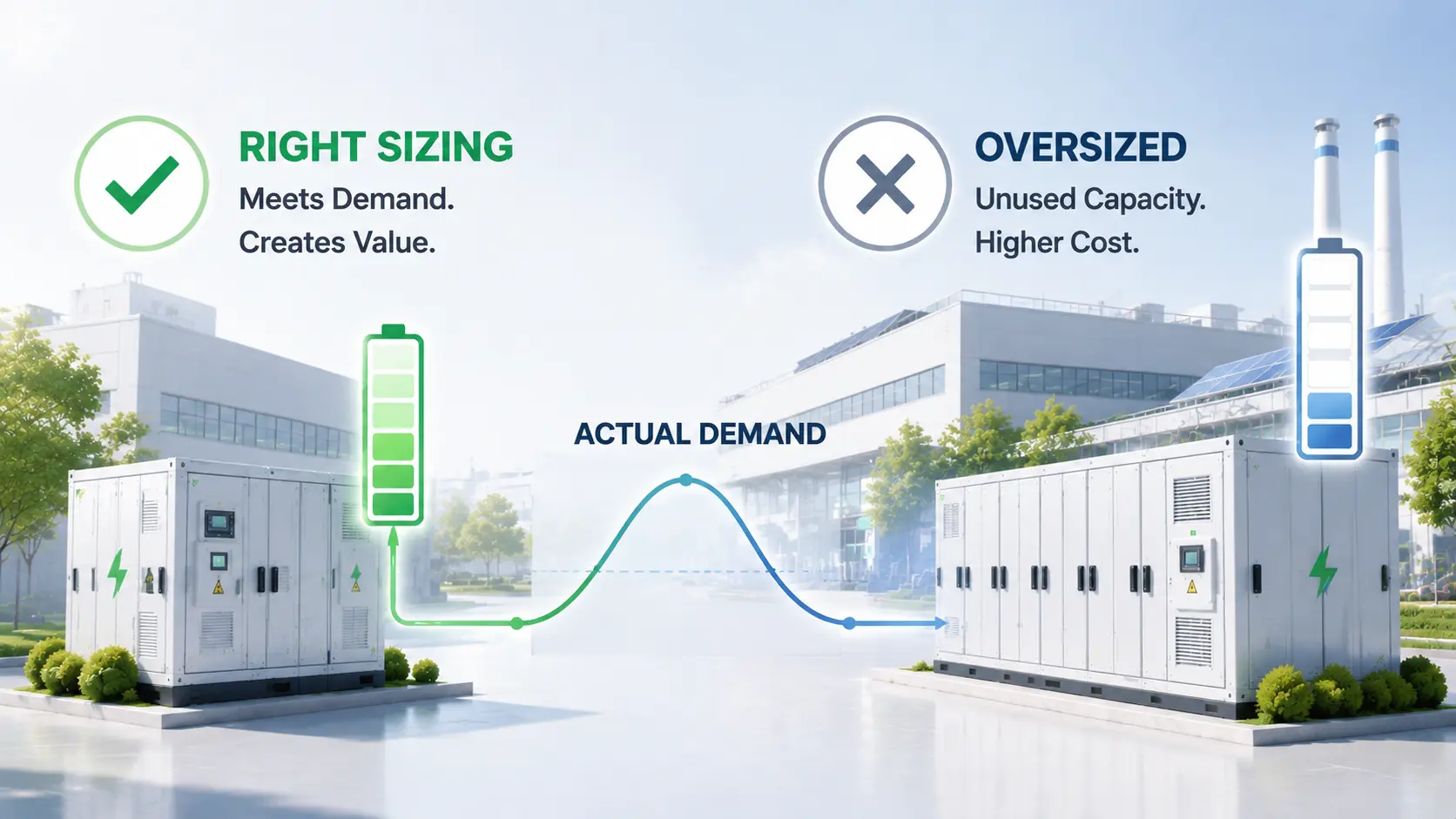
In commercial battery energy storage system projects, engineers evaluate the relationship between:
Installed capacity and Actual energy utilization
A 1 MWh system does not automatically create twice the value of a 500 kWh system simply because it contains twice the stored energy.
The additional 500 kWh must contribute measurable benefits through:
- Additional peak reduction
- Longer useful discharge periods
- More valuable energy shifting opportunities
- Additional revenue streams
Without these applications, the extra capacity becomes underutilized investment.
This is one reason professional BESS design focuses on application requirements rather than selecting the largest available battery configuration.
2. The Reality of Peak Shaving: More Capacity Has Diminishing Returns

Peak shaving applications provide a clear example of why larger batteries do not always deliver better returns.
In a peak shaving BESS project, the battery is not designed to supply all facility electricity demand.
Instead, the system is designed to reduce specific demand peaks that create higher electricity charges.
The engineering objective is usually defined by:
- Target peak reduction (kW)
- Peak event duration
- Frequency of peak events
- Required operating reliability
Consider an industrial facility with the following requirement:
Current peak demand:1,500 kW
Target demand after BESS operation:1,250 kW
Required peak reduction:250 kW
Expected peak duration:2 hours
The required usable energy can be estimated as:250 kW × 2 hours = 500 kWh
Current peak demand:1,500 kW
Target demand after BESS operation:1,250 kW
Required peak reduction:250 kW
Expected peak duration:2 hours
The required usable energy can be estimated as:250 kW × 2 hours = 500 kWh
In this scenario, a 500 kWh battery configuration may already provide sufficient energy to achieve the intended peak shaving objective.
Increasing the system size to 800 kWh or 1 MWh does not necessarily reduce demand charges further because the original peak shaving requirement has already been satisfied.
The additional energy capacity may remain unused during normal operation.
This creates a diminishing return relationship.
The first increase in battery capacity often provides significant improvement because it allows the system to meet the required operating condition.
However, once the project requirement is satisfied, additional capacity produces progressively smaller benefits.
Engineers therefore evaluate: Additional value created per additional kWh
rather than simply asking: How many more kWh can be installed?
This principle is particularly important in commercial projects where capital efficiency directly affects project feasibility.
3. Understanding the Cost Structure of Larger BESS Systems
A common misunderstanding is that increasing battery capacity mainly increases battery cell cost.
In reality, a larger commercial BESS affects multiple parts of the system.
Battery Cost
The most obvious impact is the battery itself.
Increasing energy capacity requires:
- More battery cells
- Additional modules
- Larger battery cabinets or containers
- Additional battery management components
The increase in battery capacity directly increases material cost.
However, battery cost is only one part of the overall investment.
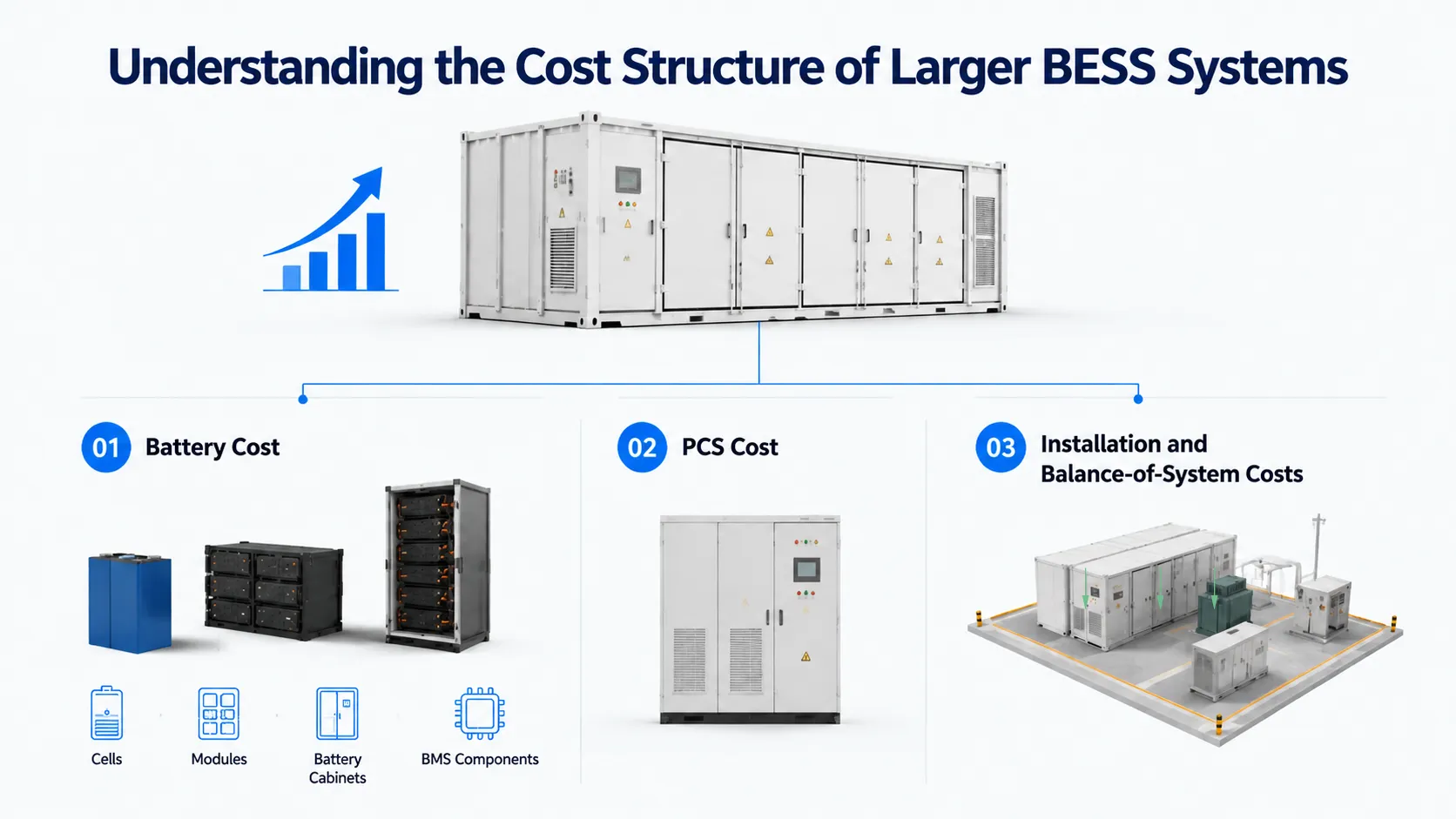
PCS Cost
Battery energy and power capability must be considered together.
A larger battery does not always require a proportionally larger PCS, but many applications require additional power capability when capacity increases.
For example:
A project requiring longer discharge duration may increase battery capacity while maintaining the same PCS rating.
However, a project requiring higher peak reduction power may require both:
- Higher battery capacity
- Higher PCS power rating
This relationship is why battery capacity sizing and PCS selection cannot be evaluated independently.
The PCS determines how quickly energy can be exchanged with the grid, while the battery determines how long that power can be maintained.
Oversizing one component without considering the other may increase cost without improving actual project performance.
Installation and Balance-of-System Costs
Larger systems also influence supporting infrastructure.
Additional impacts may include:
- Larger installation footprint
- More complex electrical protection
- Increased cable requirements
- Additional thermal management requirements
- Higher auxiliary energy consumption
For example, increasing battery capacity may require additional battery enclosures, which can affect site layout and installation complexity.
In some projects, available space becomes a limiting factor before battery technology does.
Engineers therefore evaluate the complete system cost rather than comparing battery price per kWh alone.
The true investment includes:
- Battery system
- PCS equipment
- Electrical infrastructure
- Thermal management
- Installation
- Commissioning
- Long-term operation requirements
This broader view is essential when evaluating the economics of a commercial battery storage system.
4. The Engineering Principle: Diminishing Returns of Battery Oversizing
Battery capacity selection is fundamentally a balance between additional performance and additional investment.
In commercial energy storage design, engineers rarely evaluate capacity increases by asking only:
"Can this battery store more energy?"
The more important question is:
"Does the additional stored energy create enough operational value to justify the additional cost?"
"Does the additional stored energy create enough operational value to justify the additional cost?"
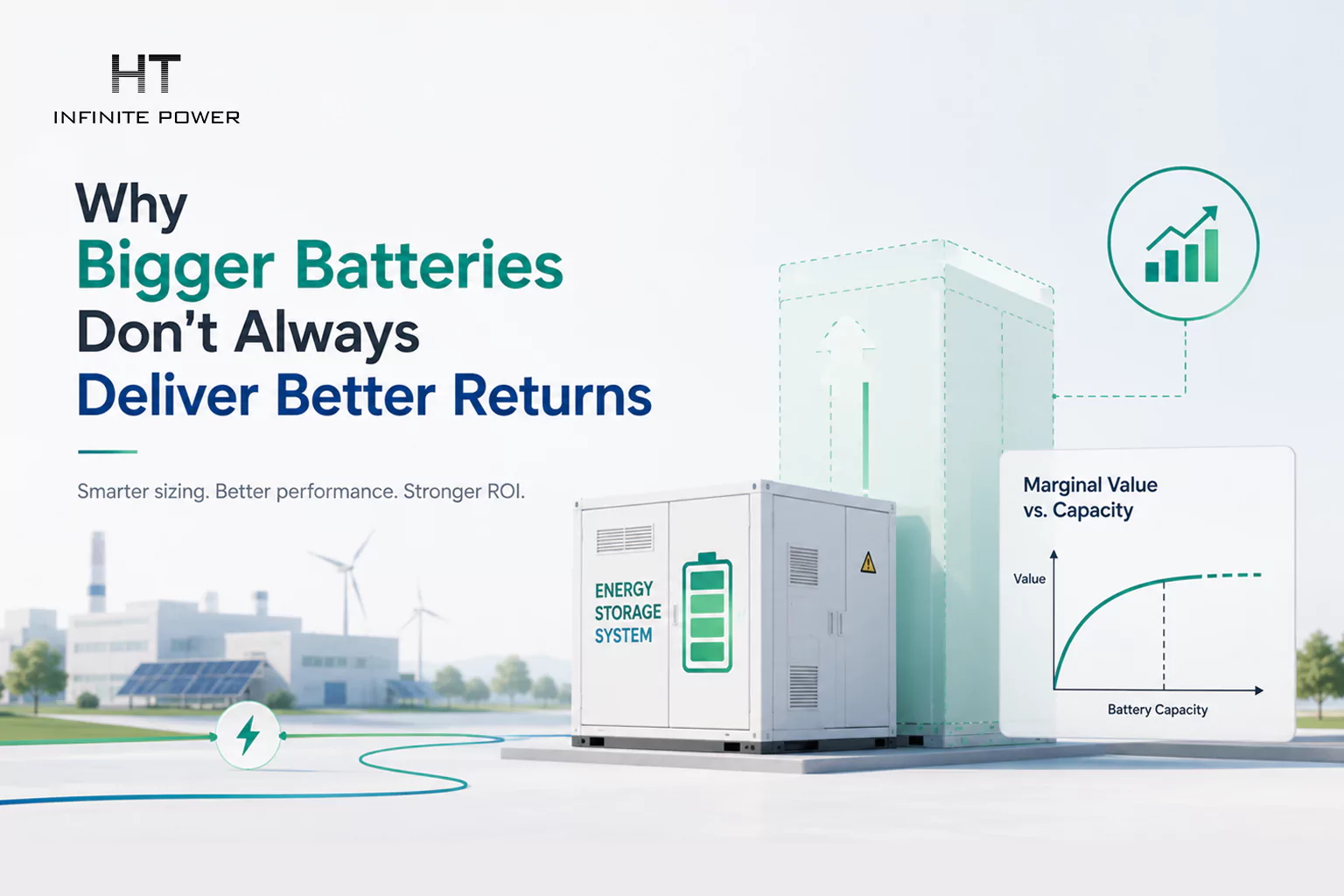
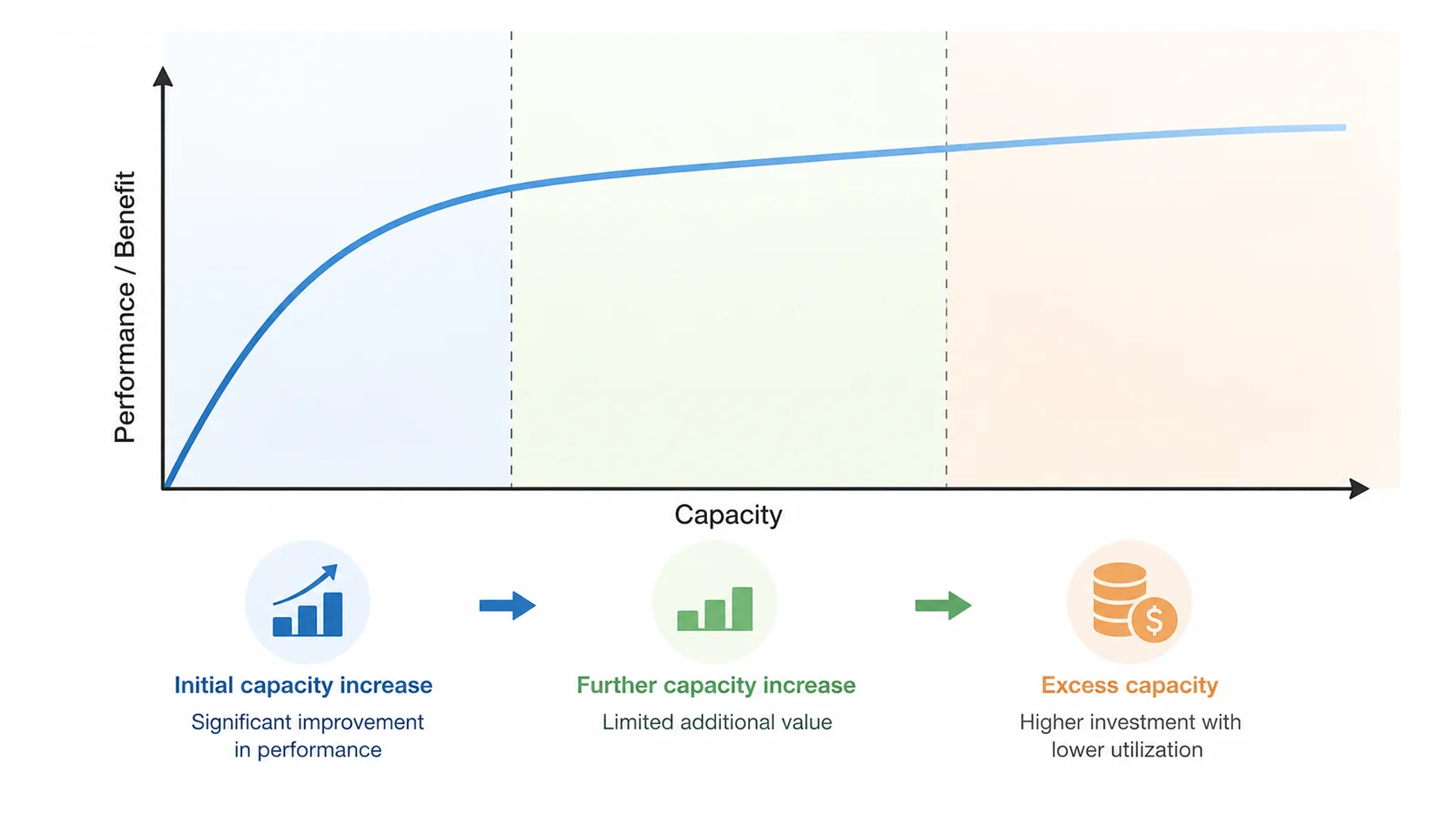
The relationship between battery capacity and economic return is usually not linear.
In the early stages of sizing, increasing battery capacity can create significant improvements.
For example:
- Increasing from an undersized system to a properly sized system may allow the facility to achieve its peak shaving target.
- Extending discharge duration may allow the BESS to cover the complete demand event.
- Increasing usable energy may improve operational flexibility.
However, after the required application target has been achieved, additional capacity often provides smaller incremental benefits.
A simplified engineering relationship can be described as:
Initial capacity increase → Significant improvement in performance
Further capacity increase → Limited additional value
Excess capacity → Higher investment with lower utilization
This does not mean larger batteries are unsuitable.
There are projects where additional capacity is justified, such as facilities expecting future demand growth, projects combining multiple applications, or systems requiring longer-duration energy management.
The key factor is whether the additional capacity supports a defined operational requirement.
During commercial BESS engineering reviews, teams typically evaluate the marginal value of additional capacity:
- How many additional peak events can be covered?
- How frequently will the additional energy be used?
- Does it improve demand charge reduction?
- Does it create additional operational revenue?
- Does the additional investment improve lifecycle economics?
A battery system should be sized based on the value it creates, not simply the amount of energy it can store.
5. Engineering Explanation: The Problem Is Utilization, Not Capacity
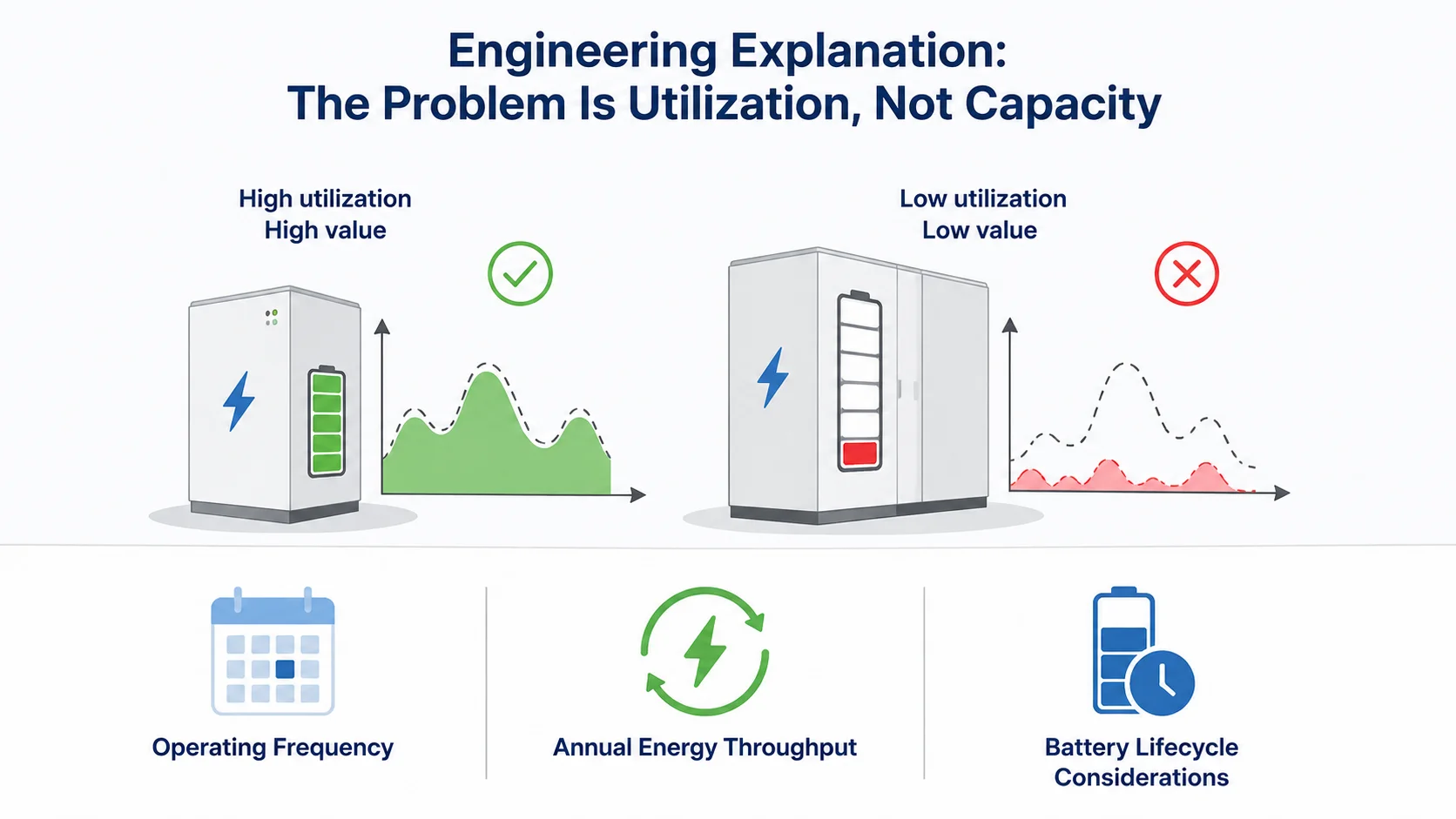
One of the most important concepts in commercial battery storage design is utilization.
A battery system generates value when its stored energy is actively used to solve an operational problem.
A larger battery with low utilization may provide less economic value than a smaller battery operating efficiently according to the facility's requirements.
For example:
A 1 MWh battery installed at an industrial facility may appear more capable than a 500 kWh system.
However, if the facility only requires 400–500 kWh of energy during daily peak periods, the additional capacity may remain unused for most of the year.
Meanwhile, the larger system still requires investment in:
- Additional battery modules
- Additional protection equipment
- Larger installation space
- More supporting infrastructure
The result can be a lower return on invested capital.
Engineers evaluate utilization through several operating factors:
Operating Frequency
How often does the battery perform its intended function?
A peak shaving system operating every working day may achieve higher utilization than a system designed for occasional events.
A peak shaving system operating every working day may achieve higher utilization than a system designed for occasional events.
Annual Energy Throughput
The amount of energy processed by the battery over time affects asset efficiency.
Higher useful throughput means the installed capacity is contributing more effectively to the project objective.
Higher useful throughput means the installed capacity is contributing more effectively to the project objective.
Battery Lifecycle Considerations
Battery degradation is related to operating conditions, including:
- Number of cycles
- Depth of discharge
- Charging and discharging power
- Operating temperature
Installing unnecessary capacity does not eliminate degradation. It may simply increase the amount of capital tied to unused energy capacity.
This is why experienced engineers consider:
How effectively will each installed kWh contribute to project value?
rather than:
How many kWh can the site accommodate?
How many kWh can the site accommodate?
The same principle applies when evaluating a complete commercial battery storage system design. The battery should match the actual operating requirement instead of being oversized based on assumptions.
6. Scenario Comparison: 300 kWh vs 500 kWh vs 800 kWh Battery Systems
To understand the impact of battery oversizing, consider a typical commercial peak shaving application.
Project Conditions
Industrial facility:
Maximum demand: 1,500 kW
Target demand reduction: 250 kW
Required peak shaving duration: 2 hours
Required usable energy: Approximately: 250 kW × 2 hours = 500 kWh
The engineering team evaluates three possible battery configurations.
Option A: 300 kWh Battery System
Advantages
- Lower initial investment
- Smaller footprint
- Lower equipment cost
Limitations
The available energy is insufficient to maintain the required peak reduction duration.
For example, a 300 kWh system could theoretically provide:
250 kW × 1.2 hours
before reaching its usable energy limit.
250 kW × 1.2 hours
before reaching its usable energy limit.
This means the system may reduce demand during the beginning of the peak event but fail to maintain the target reduction throughout the full period.
From an engineering perspective, this configuration may reduce investment but does not fully satisfy the application requirement.
Option B: 500 kWh Battery System
Advantages
- Matches the calculated energy requirement
- Higher utilization rate
- Balanced investment and performance
A 500 kWh configuration provides approximately the required usable energy for:
250 kW peak reduction
over: 2 hours
250 kW peak reduction
over: 2 hours
This configuration represents a closer match between:
- Required power reduction
- Required discharge duration
- Battery investment
However, the final installed battery capacity may still require adjustment based on:
- DoD limits
- Efficiency losses
- Degradation allowance
- Operating strategy
For example, engineers may select a slightly higher installed capacity to ensure the system can deliver the required usable energy throughout the project lifetime.
Option C: 800 kWh Battery System
Advantages
- Longer discharge capability
- Additional operational flexibility
- Potential support for future applications
An 800 kWh system may provide value if the facility expects:
- Higher future demand
- Additional energy shifting requirements
- Renewable integration needs
- Multiple operating strategies
However, if the only objective is reducing a 250 kW demand peak for two hours, the additional 300 kWh may not create proportional financial benefits.
The project would carry:
- Higher battery cost
- Larger installation requirements
- Additional system investment
without necessarily achieving significantly greater peak shaving savings.
Engineering Decision
The correct choice depends on the project objective.
The 500 kWh configuration may provide the best balance for this specific peak shaving requirement because it aligns closely with the required operating condition.
However, this does not mean 500 kWh is universally the correct answer.
A different facility with longer operating hours, higher demand fluctuations, or future expansion plans may require a different capacity.
The engineering principle remains:
Battery capacity should follow the application requirement, not the desire for maximum stored energy.
7. Engineering Rule for Battery Capacity Selection
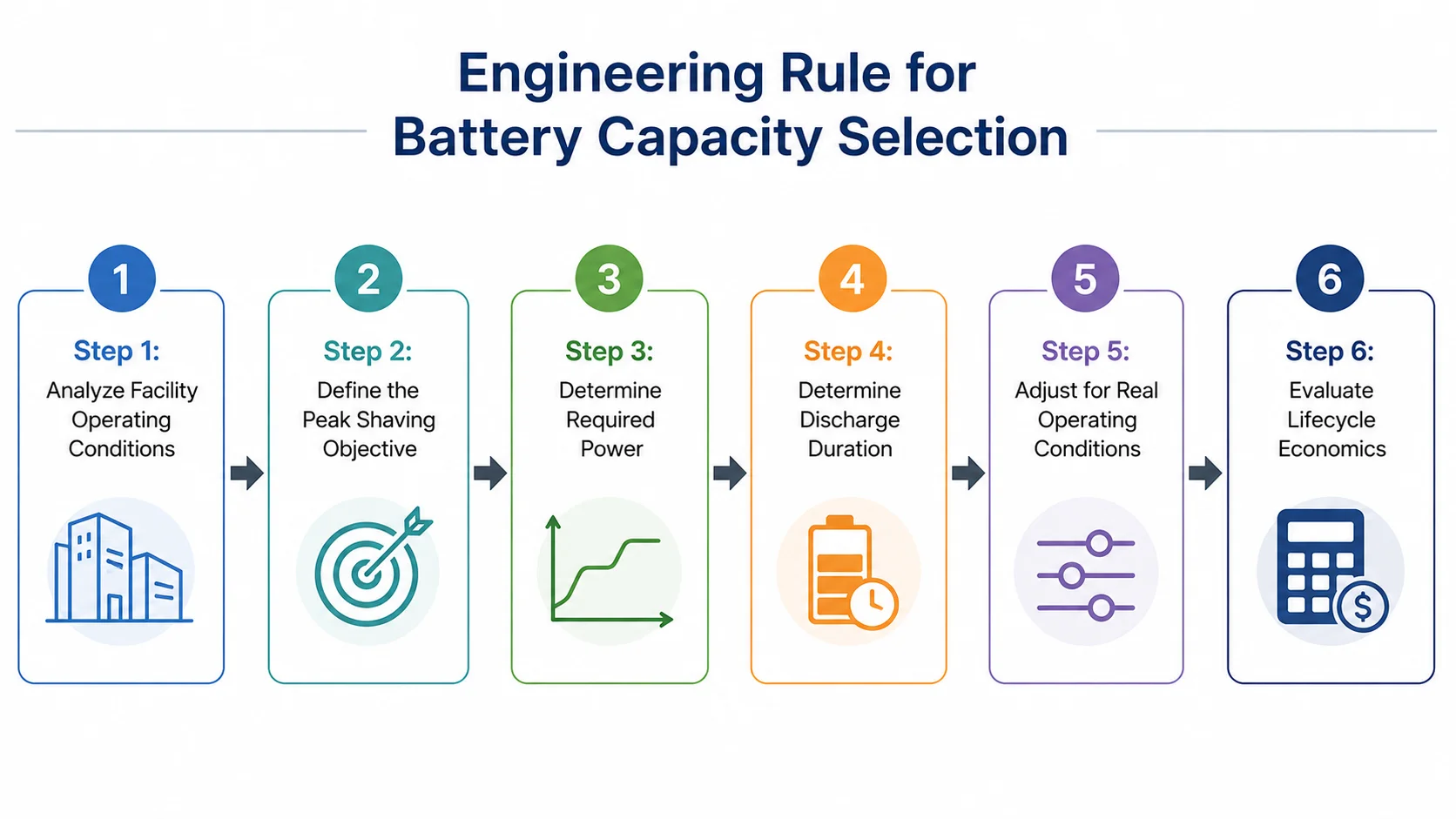
A practical battery capacity sizing process follows a structured engineering sequence.
Step 1: Analyze Facility Operating Conditions
Engineers begin with actual operational data, including demand behavior and energy usage patterns.
The purpose is not simply to understand electricity consumption, but to identify what the BESS needs to accomplish.
The purpose is not simply to understand electricity consumption, but to identify what the BESS needs to accomplish.
Step 2: Define the Peak Shaving Objective
The design team determines:
- Required peak reduction
- Target demand limit
- Expected operating frequency
This defines the required system function.
Step 3: Determine Required Power
The required power output determines the BESS power capability.
This is closely related to PCS selection because the system must deliver sufficient power during the demand event.
This is closely related to PCS selection because the system must deliver sufficient power during the demand event.
Step 4: Determine Discharge Duration
Once the required power is defined, engineers determine how long the system must maintain that output.
The basic relationship is:
Battery energy requirement = Required power × Required duration
The basic relationship is:
Battery energy requirement = Required power × Required duration
Step 5: Adjust for Real Operating Conditions
The theoretical energy requirement is adjusted considering:
- Usable depth of discharge
- System efficiency
- Battery degradation
- Operating margin
The final installed capacity is therefore usually higher than the simple calculated energy requirement.
Step 6: Evaluate Lifecycle Economics
The final decision considers:
- Initial investment
- Expected utilization
- Battery lifetime
- Maintenance requirements
- Long-term project value
The goal is not to install the largest battery.
he goal is to maximize the utilization of every installed kWh while achieving the project's operational objectives.
Conclusion
A larger battery can store more energy, but additional capacity does not automatically create additional economic value.
In commercial BESS projects, battery capacity must be evaluated together with:
- Application requirements
- Peak shaving objectives
- PCS power capability
- Operating strategy
- Utilization rate
- Lifecycle economics
Oversizing may provide additional flexibility, but it can also increase capital investment and reduce asset efficiency when the additional capacity is rarely used.
Successful commercial battery energy storage system design is not based on maximizing installed capacity.
It is based on understanding what the facility actually needs the battery to do.
A well-designed system balances:
Battery capacity, system performance, and economic return.
The optimal battery is not the largest battery.
It is the battery configuration that delivers the required operational value throughout the project lifecycle.
FAQ
1. Does a larger battery always provide better ROI in BESS projects?
No. A larger battery can improve ROI only when the additional capacity creates additional operational value. If the extra capacity is rarely used, the higher investment may reduce economic efficiency.
2. Why can battery oversizing reduce economic efficiency?
Oversizing increases system investment, including battery cost, infrastructure requirements, installation complexity, and sometimes thermal management requirements. If utilization remains low, the additional capacity may not generate enough value to justify the cost.
3. How do engineers determine the optimal battery capacity for peak shaving?
Engineers evaluate the required peak reduction, discharge duration, operating frequency, efficiency losses, degradation allowance, and lifecycle economics. Battery capacity is calculated based on the application requirement rather than selected arbitrarily.
4. What factors should be considered before increasing battery capacity?
Engineers consider:
- Future load growth
- Additional energy applications
- Required discharge duration
- Expected cycling frequency
- Available installation space
- Project economics
Increasing capacity should support a clear operational objective.
5. Is a larger battery better for future energy applications?
Not always. Additional capacity may provide future flexibility, but it should be evaluated against current investment and expected utilization. In many projects, modular expansion capability can provide a better balance than installing excessive capacity from the beginning.
12 Questions to Ask Before Buying a Commercial Battery Energy Storage System
Five Common Design Mistakes in Commercial BESS Projects