Why Load Profiles Matter More Than Battery Capacity in Commercial Battery Storage Design
author: HT infinitepower
2026-07-13

Introduction: The Wrong Question Customers Usually Ask
In commercial Battery Energy Storage System (BESS) projects, one of the first questions customers often ask is:
“How many kWh of battery storage do we need?”
This question is understandable. Battery capacity is one of the most visible parameters in a storage project, and it directly affects equipment size, installation requirements, and initial investment.
However, during early-stage EPC evaluation and commercial BESS feasibility studies, engineers often find that starting the discussion with battery capacity can lead to an incomplete understanding of the actual project requirement.
The first engineering question should usually be:
“What operational problem should the BESS solve?”
A manufacturing facility may require storage primarily to reduce short-duration demand peaks. A warehouse may need longer energy shifting because of refrigeration or operational schedules. A commercial building may have different requirements depending on HVAC operation and electricity tariff structure.
All of these customers may initially request a “500 kWh battery system,” but the correct system configuration may be completely different.
The reason is that battery capacity only describes the amount of energy available. It does not explain how the system will operate, when energy is required, or whether the stored energy will create meaningful value.
In real industrial projects, engineers typically begin by analyzing:
- When demand peaks occur
- How long those peaks last
- How frequently they repeat
- What level of power reduction is required
- How the storage system will operate under actual site conditions
Only after understanding these factors can engineers determine appropriate battery capacity
A commercial battery storage system is not designed by selecting the largest available battery and then finding an application for it.
The design starts with understanding the customer’s operating pattern.
Battery capacity is the result of the engineering analysis.
A commercial battery storage system is not designed by selecting the largest available battery and then finding an application for it.
The design starts with understanding the customer’s operating pattern.
Battery capacity is the result of the engineering analysis.
This approach is part of a complete commercial battery storage system design process, where load analysis, battery sizing, PCS selection, EMS strategy, and safety design are evaluated together.
1. What Is a Load Profile in Real Commercial BESS Projects?
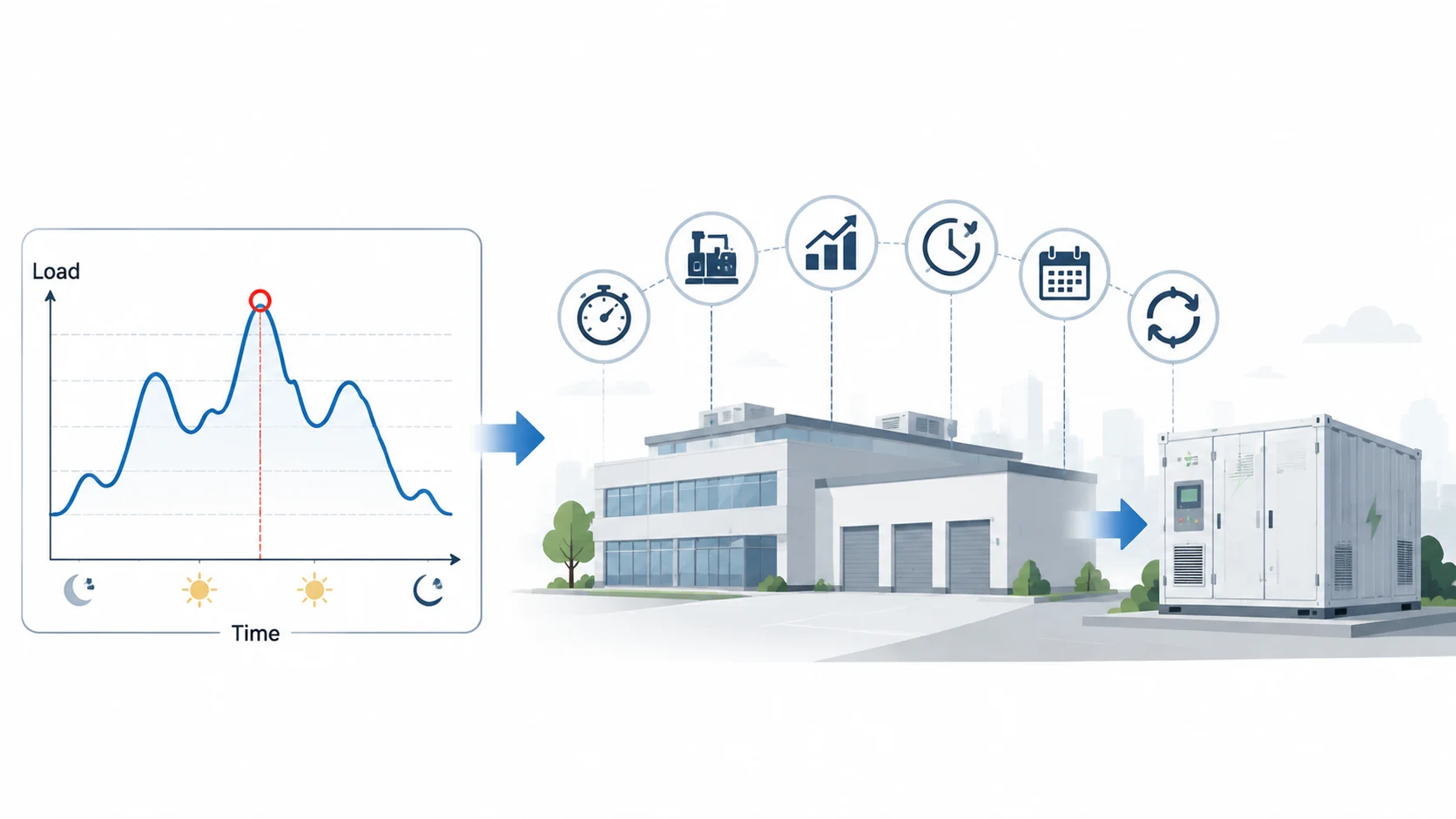
In commercial energy storage design, a load profile is not simply an electricity consumption graph.
It represents how a facility behaves electrically over time and provides engineers with the information required to determine what the BESS actually needs to accomplish.
It represents how a facility behaves electrically over time and provides engineers with the information required to determine what the BESS actually needs to accomplish.
During engineering reviews, BESS teams analyze load profiles to understand several practical questions:
- When does the facility reach maximum demand?
- What equipment creates the peak condition?
- How quickly does demand increase?
- How long does each peak event continue?
- Are these events predictable?
- How do operating patterns change throughout the year?
The goal is not only to measure electricity usage.
The goal is to identify the operating conditions that define the storage application.
The goal is to identify the operating conditions that define the storage application.
What Engineers Actually Evaluate During Load Profile Analysis
Peak Demand Timing
The timing of demand peaks often provides more useful design information than annual electricity consumption.
For example, an industrial facility may have stable electricity usage during normal production but experience significant demand increases when multiple production systems start simultaneously.
Another facility may experience predictable afternoon peaks caused by cooling loads.
Although both facilities consume electricity, their storage requirements can be completely different.
During commercial BESS feasibility studies, engineers often spend significant time identifying whether peak demand is caused by a repeatable operational event or a temporary abnormal condition.
This difference affects whether storage can provide measurable value.
Peak Duration
Peak duration is one of the most important factors in BESS load profile analysis.
A short demand spike and a long continuous load require different system designs.
A short demand spike and a long continuous load require different system designs.
For example:
- A 1 MW peak lasting 15 minutes represents mainly a power management challenge.
- A 1 MW load lasting 4 hours represents a larger energy requirement.
This difference directly influences battery capacity sizing and operating strategy.
A common engineering mistake is focusing only on the peak value while ignoring how long the peak actually exists.
A common engineering mistake is focusing only on the peak value while ignoring how long the peak actually exists.
Peak Frequency
Engineers also evaluate how often the battery will be required to operate.
A facility with occasional monthly demand peaks has a different storage requirement compared with a facility that requires daily cycling.
A facility with occasional monthly demand peaks has a different storage requirement compared with a facility that requires daily cycling.
Frequency influences:
- Expected battery utilization
- Operating strategy
- Battery lifecycle expectations
- Long-term system value
In real projects, a battery system that is technically capable of operating more frequently does not necessarily create additional value if the facility does not require that operation.
Daily and Seasonal Load Changes
Commercial and industrial loads rarely remain constant throughout the year.
During engineering evaluation, teams typically review:
- Production schedules
- Weekend operation
- Seasonal demand changes
- Weather-related consumption patterns
For example, a warehouse with refrigeration loads may have very different demand behavior between summer and winter.
A BESS designed from a single short-term dataset may not accurately represent the facility’s long-term operating conditions.
Common Data Sources for Commercial BESS Projects
In practical projects, engineers typically collect load information from:
- Utility interval data
- 15-minute demand records
- Smart meters
- Industrial energy monitoring platforms
- Building energy management systems
One of the most common challenges during early project development is obtaining accurate load information.
Many initial discussions begin with monthly electricity bills because they are easy to obtain.
However, monthly bills show total consumption, not the operating behavior behind that consumption.
For a reliable battery energy storage system design, engineers need to understand the demand pattern that creates the technical and economic opportunity for storage.
Engineering Perspective: A Load Profile Is a Design Input
A load profile is more than historical electricity data.
It is one of the main engineering inputs used to determine:
- System operating requirements
- Battery sizing
- Expected utilization
- Application suitability
Without accurate load information, battery sizing becomes based on assumptions rather than actual facility behavior.
2. Why Battery Capacity Can Be Misleading
Battery capacity is often the first specification discussed in commercial storage projects.
However, kWh alone cannot describe the complete performance requirement of a BESS.
However, kWh alone cannot describe the complete performance requirement of a BESS.
Battery capacity tells engineers:
How much energy can be stored.
How much energy can be stored.
It does not explain:
- When that energy is required
- How quickly energy needs to be delivered
- Whether the stored energy matches the customer’s operating objective
This is why focusing only on battery capacity can create an incomplete design approach.
Stored Energy Does Not Define Application Value
A battery system creates value through how it operates within the facility.
The same battery capacity can support completely different applications depending on:
- Load characteristics
- Electricity pricing structure
- Required operating duration
- Customer objectives
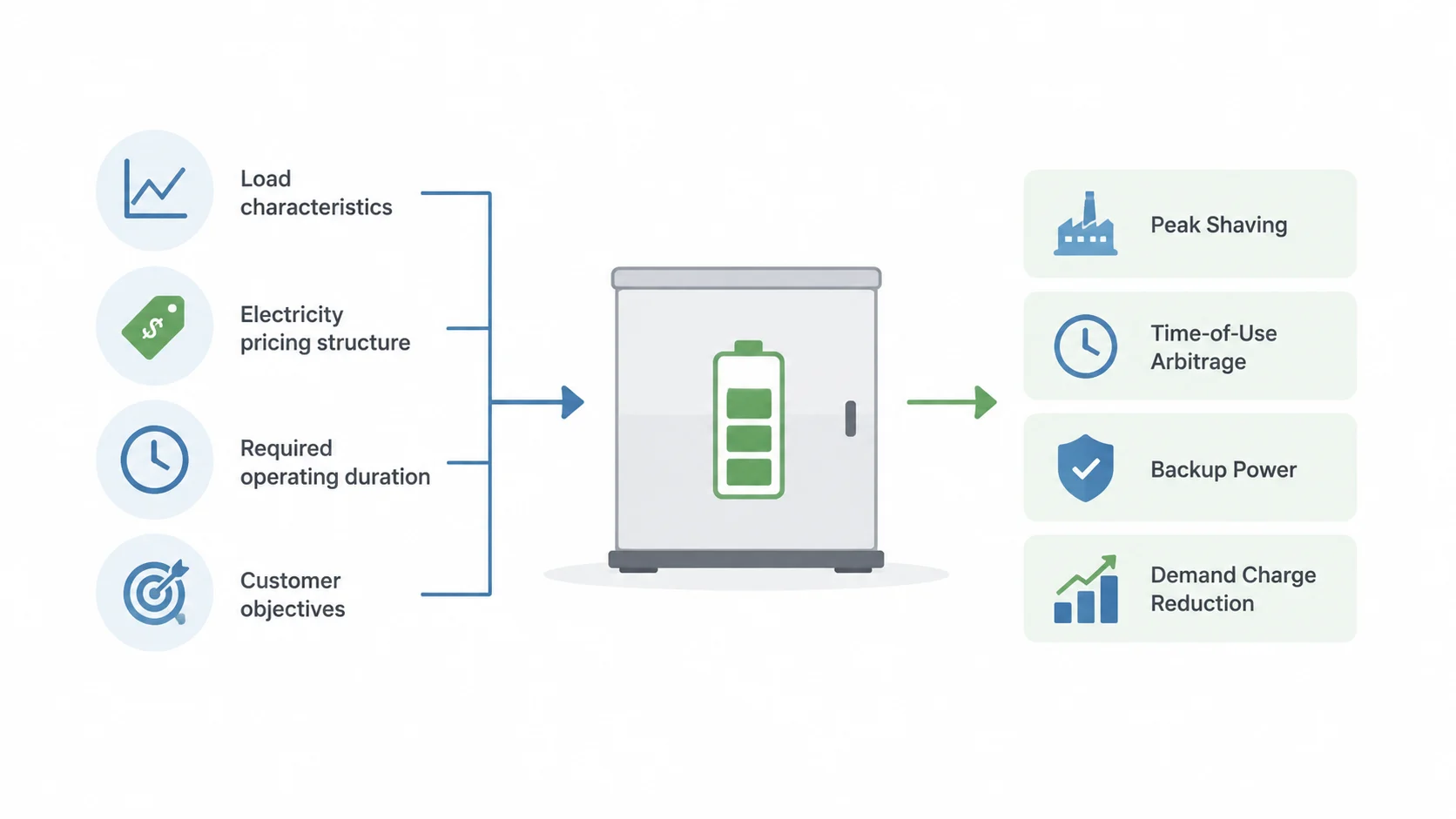
For example, a 500 kWh battery installed at an industrial factory may mainly support short demand peaks.
The same 500 kWh battery installed at a warehouse may be used for longer energy shifting.
The battery capacity is identical, but the engineering purpose is different.
The same 500 kWh battery installed at a warehouse may be used for longer energy shifting.
The battery capacity is identical, but the engineering purpose is different.
Why Larger Battery Capacity Is Not Always Better
In commercial BESS projects, customers sometimes assume:
“More battery capacity means more savings.”
However, additional capacity only creates value when the facility can effectively use that stored energy.
“More battery capacity means more savings.”
However, additional capacity only creates value when the facility can effectively use that stored energy.
For example:
A factory may experience a demand peak lasting only 20 minutes every afternoon.
Installing a battery designed for several hours of operation may increase capital investment while providing limited additional benefit for the actual application.
This can result in:
A factory may experience a demand peak lasting only 20 minutes every afternoon.
Installing a battery designed for several hours of operation may increase capital investment while providing limited additional benefit for the actual application.
This can result in:
- Higher CAPEX
- Lower system utilization
- Reduced return on investment
The objective of battery capacity sizing is not to maximize stored energy.
It is to match storage capability with the customer’s actual operating requirements.
It is to match storage capability with the customer’s actual operating requirements.
3. Peak Shaving Is Primarily a Power Problem, Not Only an Energy Problem
Peak shaving is one of the most common applications for commercial BESS projects.
However, many customers initially approach peak shaving by asking how much battery capacity is required.
From an engineering perspective, peak shaving is usually a combination of power and energy requirements.
However, many customers initially approach peak shaving by asking how much battery capacity is required.
From an engineering perspective, peak shaving is usually a combination of power and energy requirements.
Understanding Power Versus Energy
The difference between power and energy is fundamental.
Power (kW) describes how much electricity can be delivered at a specific moment.
Energy (kWh) describes how much electricity can be stored and delivered over time.
Both parameters are required, but they represent different design considerations.
Power (kW) describes how much electricity can be delivered at a specific moment.
Energy (kWh) describes how much electricity can be stored and delivered over time.
Both parameters are required, but they represent different design considerations.
Industrial Peak Shaving Example
Consider an industrial factory:
Normal demand:800 kW
Temporary peak demand:1.5 MW
Peak duration:15–30 minutes
Peak duration:15–30 minutes
The facility does not need the BESS to supply the entire factory load.
The objective is to reduce the temporary demand increase that creates additional electricity costs.
The objective is to reduce the temporary demand increase that creates additional electricity costs.
Required peak reduction:
1.5 MW - 800 kW = 700 kW
In this situation, the load profile determines:
- Required battery power level
- Expected discharge duration
- Battery operating frequency
It also influences other system design considerations, including:
- PCS power rating requirements
- Battery C-rate selection
- EMS operating strategy
These parameters are interconnected because load behavior is the input condition for the entire BESS architecture.
(Detailed PCS selection and power conversion design will be covered separately.)
(Detailed PCS selection and power conversion design will be covered separately.)
4. How Load Profiles Influence Real BESS Configuration Decisions
Load profile analysis is the stage where engineers translate facility operating behavior into actual system requirements.
The relationship can be summarized as:
Load Profile → Engineering Decision → BESS Configuration
The battery system is not selected first.
The required function of the system is identified first.
The battery system is not selected first.
The required function of the system is identified first.
During commercial BESS design reviews, engineers evaluate whether the facility’s challenge is mainly related to short-duration power demand, longer energy requirements, or a combination of both.
Short-Duration Peak Events: Higher Power Requirement
Consider an industrial manufacturing facility with:
- Sudden production-related demand spikes
- Short peak duration
- Significant demand charges
In this case, the main challenge is usually reducing short periods of high grid demand.
The engineering requirement is typically:
- Higher power capability
- Shorter discharge duration
- More frequent response to specific demand events
The battery system is designed around the peak event rather than the facility’s total electricity consumption.
For these applications, installing excessive energy capacity may not improve performance because the battery may not be fully utilized.
For these applications, installing excessive energy capacity may not improve performance because the battery may not be fully utilized.
Long-Duration Demand: Greater Energy Requirement
Now consider a warehouse or commercial facility with:
- Long operating hours
- Refrigeration or HVAC loads
- Extended electricity consumption during expensive tariff periods
The design requirement changes.
The facility may require:
- Longer discharge duration
- Greater usable energy capacity
- Different charging and discharging patterns
In this situation, energy availability becomes more important than short-duration peak response.
Why Similar Electricity Consumption Can Lead to Different BESS Designs
Two facilities may have similar annual electricity consumption but require completely different storage configurations.
Annual consumption answers:
“How much electricity does the facility use?”
Load profile analysis answers:
“How does the facility use electricity?”
For commercial energy storage design, the second question usually determines the system architecture.
This is why engineers do not size a BESS based only on annual energy consumption.
The operating pattern determines whether the system requires:
- Higher power capability
- Longer energy duration
- Different utilization expectations
5. How Engineers Use Load Profiles to Determine Battery Requirements
Professional battery capacity sizing follows a structured engineering process.
The typical sequence is:
Load profile analysis
↓
Identify critical demand events
↓
Define required system response
↓
Determine operating duration
↓
Calculate battery requirements
Load profile analysis
↓
Identify critical demand events
↓
Define required system response
↓
Determine operating duration
↓
Calculate battery requirements
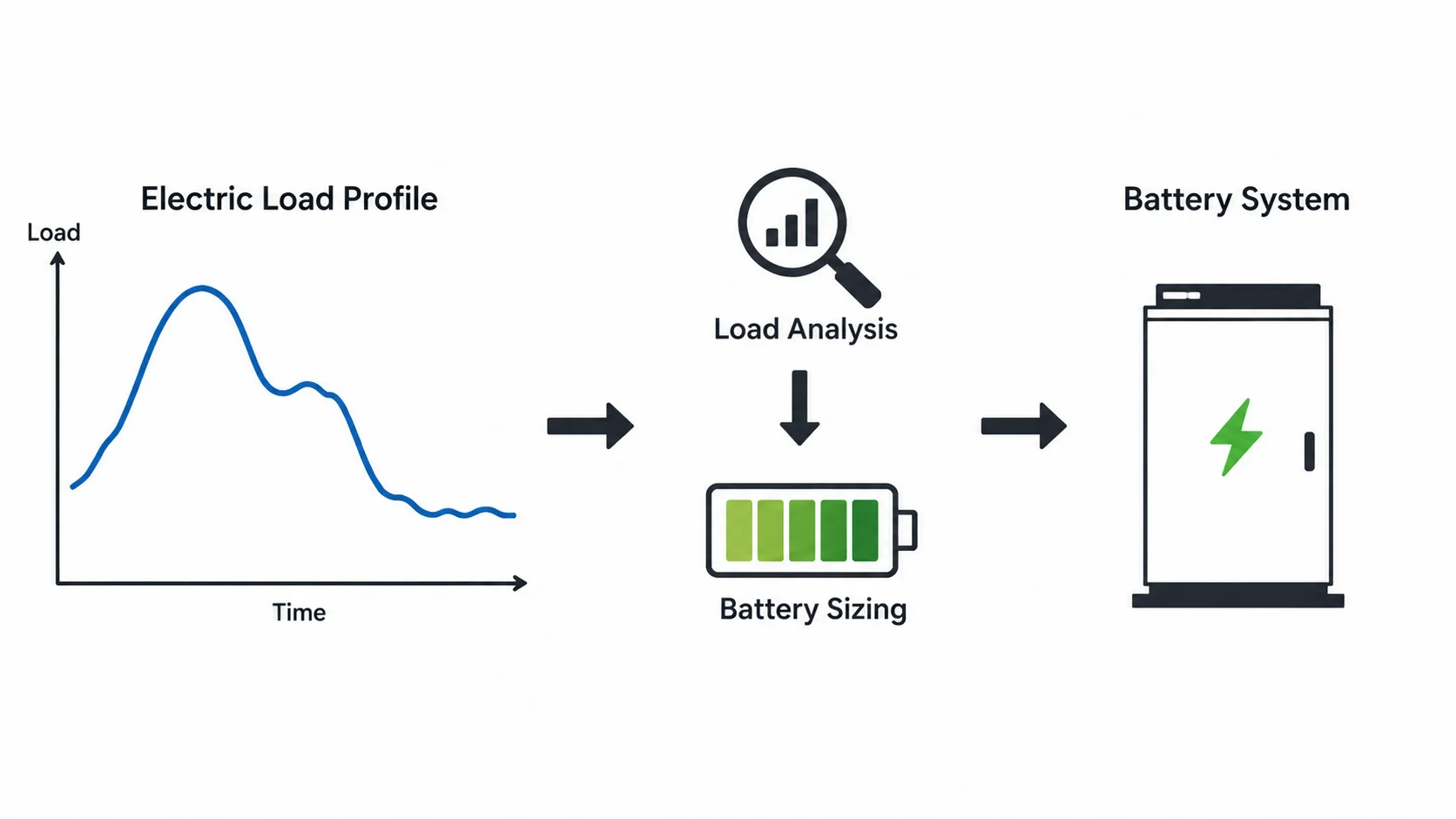
Translating Load Behavior Into Battery Requirements
In practical projects, engineers first identify what the battery is expected to accomplish.
For a peak shaving battery system, the key questions are:
- How much peak reduction is required?
- How long does the peak condition last?
- How often does the event occur?
Only after these questions are answered can battery capacity be properly determined.
A simplified engineering relationship is:
Required Battery Power ≈ Target Peak Reduction
This defines the instantaneous power capability required from the system.
Required Battery Power ≈ Target Peak Reduction
This defines the instantaneous power capability required from the system.
The energy requirement can be estimated as:
Required Battery Energy ≈ Power Requirement × Peak Duration
For example, reducing a 500 kW peak for 30 minutes requires a very different amount of stored energy compared with maintaining the same reduction for four hours.
Additional Factors Considered During Battery Capacity Sizing
The initial calculation is only the starting point.
During engineering evaluation, teams also consider:
- Usable depth of discharge (DoD)
- System efficiency losses
- Battery degradation over time
- Required operating margin
These factors ensure that the BESS can continue meeting the customer’s requirements throughout the expected project lifetime.
A common issue in early-stage projects is selecting battery capacity before understanding actual operating conditions.
A common issue in early-stage projects is selecting battery capacity before understanding actual operating conditions.
This can lead to:
- Oversized systems
- Higher capital investment
- Lower utilization
- Reduced lifecycle value
Proper battery capacity sizing begins with understanding the load profile, not selecting a battery first.
6. Common Design Mistakes When Load Profiles Are Ignored
Even technically advanced BESS equipment can underperform if the original design assumptions are incorrect.
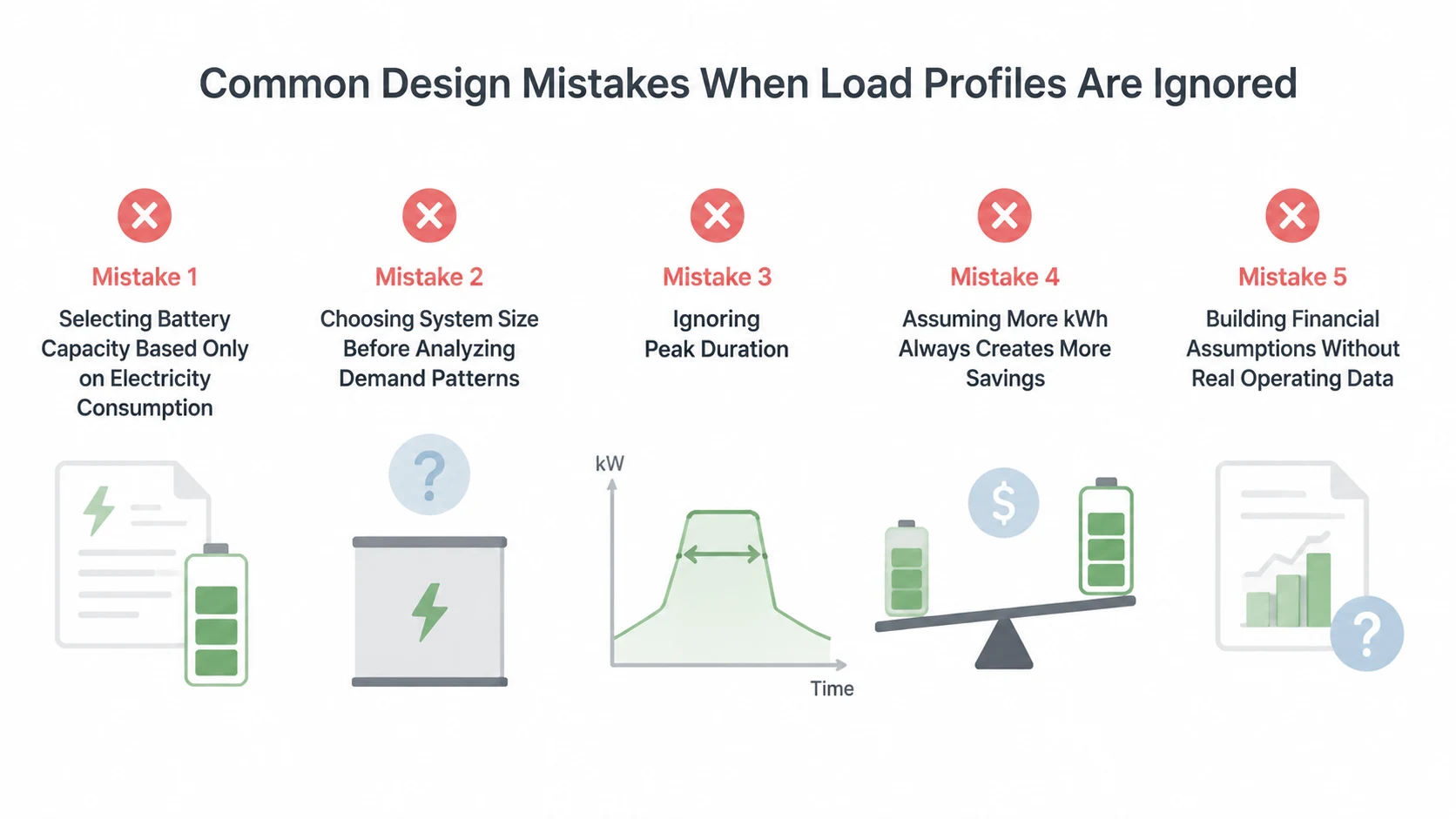
In real commercial projects, many sizing issues come from incomplete understanding of facility operation rather than limitations of the battery technology itself.
Mistake 1: Selecting Battery Capacity Based Only on Electricity Consumption
Annual electricity consumption is useful background information, but it does not define storage requirements.
A facility may consume a large amount of electricity but only require short-duration demand management.
Designing from total consumption alone can result in unnecessary storage capacity.
A facility may consume a large amount of electricity but only require short-duration demand management.
Designing from total consumption alone can result in unnecessary storage capacity.
Mistake 2: Choosing System Size Before Analyzing Demand Patterns
A common early-stage assumption is:
“We need a 1 MWh system.”
“We need a 1 MWh system.”
However, without understanding:
- Peak timing
- Peak duration
- Operating frequency
there is no clear engineering basis for that size.
The system may not match the actual customer objective.
The system may not match the actual customer objective.
Mistake 3: Ignoring Peak Duration
Peak demand values alone are incomplete.
A 1 MW peak lasting 10 minutes and a 1 MW peak lasting 5 hours represent completely different design challenges.
Ignoring duration can result in incorrect assumptions about required battery energy.
A 1 MW peak lasting 10 minutes and a 1 MW peak lasting 5 hours represent completely different design challenges.
Ignoring duration can result in incorrect assumptions about required battery energy.
Mistake 4: Assuming More kWh Always Creates More Savings
Additional battery capacity only creates value when it is used effectively.
Oversizing may increase:
- Equipment cost
- Installation requirements
- Unused capacity
without generating proportional benefits.
Mistake 5: Building Financial Assumptions Without Real Operating Data
During commercial BESS feasibility studies, inaccurate assumptions often originate from limited load information.
A realistic evaluation requires actual operating data, including:
A realistic evaluation requires actual operating data, including:
- Demand behavior
- Facility schedules
- Load variation patterns
Incorrect load assumptions can affect:
- CAPEX decisions
- System utilization
- Battery lifecycle expectations
- Overall project economics
7. Engineering Conclusion: Battery Capacity Is the Result, Not the Starting Point
A successful commercial BESS project does not begin with the question:
“How much battery can we install?”
“How much battery can we install?”
It begins with:
“What does the facility actually need the battery to do?”
“What does the facility actually need the battery to do?”
Battery capacity is determined after engineers understand:
- Customer operation
- Demand behavior
- Electricity usage patterns
- Required system performance
The role of load profile analysis is to define the actual engineering problem.
Battery capacity becomes the solution created from that analysis.
In practical BESS projects, the most common design improvement is not simply selecting larger equipment.
It is improving the understanding of what the system is expected to accomplish.
A well-designed commercial battery storage system is one where the storage capacity, operating strategy, and facility requirements are aligned.
Battery capacity becomes the solution created from that analysis.
In practical BESS projects, the most common design improvement is not simply selecting larger equipment.
It is improving the understanding of what the system is expected to accomplish.
A well-designed commercial battery storage system is one where the storage capacity, operating strategy, and facility requirements are aligned.
Load profile defines the problem.
Battery capacity becomes the solution.
FAQ
1. Why is load profile analysis important for commercial BESS design?
Load profile analysis allows engineers to understand when and why electricity demand occurs. It provides the foundation for determining required power, discharge duration, and battery capacity before system design decisions are finalized.
2. Can a larger battery always provide better savings?
No. A larger battery does not automatically create more value. If the additional capacity is rarely used, it may increase project cost without improving system performance.
The optimal BESS size depends on the customer’s actual operating requirements.
The optimal BESS size depends on the customer’s actual operating requirements.
3. What load data is required before designing a BESS?
Engineers typically require:
- Utility interval data
- Demand records
- Smart meter information
- Facility operating schedules
- Historical load patterns
The more accurately the load behavior is understood, the more reliable the battery capacity sizing process becomes.
4. How does load profile affect battery sizing?
Load profile determines:
- Required power level
- Required discharge duration
- Operating frequency
- Expected battery utilization
These factors directly influence the final battery capacity selection.
5. Why do engineers analyze peak demand instead of annual electricity consumption?
Annual electricity consumption only shows the total amount of energy used.
Commercial BESS systems operate around specific events, such as demand peaks, tariff periods, or operational requirements.
Peak demand analysis reveals when storage can create measurable value.
Commercial BESS systems operate around specific events, such as demand peaks, tariff periods, or operational requirements.
Peak demand analysis reveals when storage can create measurable value.
How to Size Battery Capacity for Peak Shaving Projects
How to Design a Commercial Battery Energy Storage System: A Step-by-Step Engineering Guide