12 Questions to Ask Before Buying a Commercial Battery Energy Storage System
author: HT infinitepower
2026-08-14
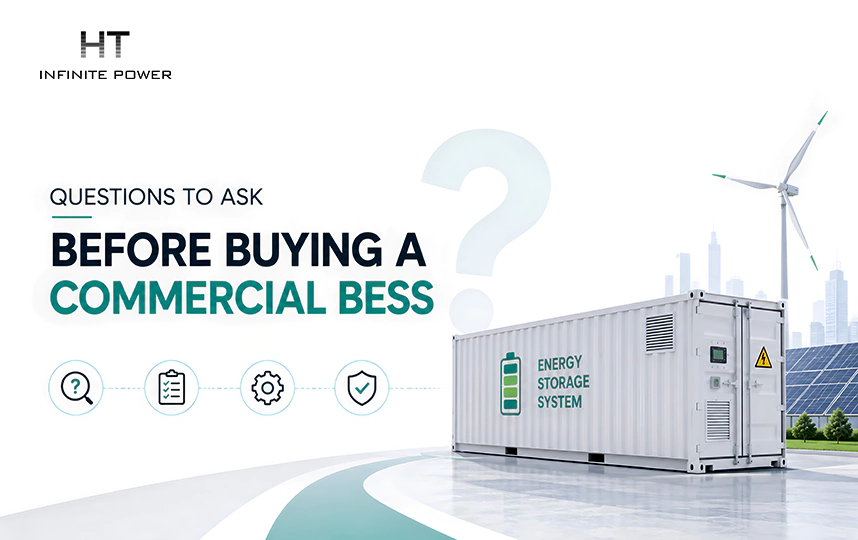
A commercial Battery Energy Storage System (BESS) is rarely a simple equipment purchase. Unlike buying a standalone electrical component, a BESS project requires coordination between energy demand, battery capacity, power conversion, control strategy, safety design, and long-term operating conditions.
During early-stage project discussions, many buyers naturally focus on questions such as:
“How many kWh of battery storage do we need?”
“How much does the system cost?”
“What battery technology is being used?”
These questions are important, but they do not provide a complete picture.
In practical commercial projects, many design problems do not originate from the battery cells themselves. They often come from decisions made before equipment selection, such as incorrect assumptions about load behavior, insufficient analysis of operating requirements, or selecting a system configuration without considering how the facility will actually use the energy storage system.
For example, an industrial facility with short peak demand periods may require a completely different configuration from a warehouse with long-duration energy shifting requirements, even if both facilities consume a similar amount of electricity annually.
This is why purchasing a commercial battery energy storage system should be treated as an engineering decision rather than simply an equipment transaction.
A reliable evaluation process should consider:
- The actual application objective
- Load characteristics
- Battery capacity sizing logic
- PCS selection
- Thermal management requirements
- EMS strategy
- Safety design
- Lifecycle economics
- Supplier engineering capability
A supplier that only provides equipment specifications may not be able to address the real challenges of a BESS project. Before investment decisions are made, buyers should understand whether the proposed system is technically suitable for their operating environment.
The following 12 questions help EPC contractors, system integrators, and industrial energy users evaluate BESS solutions from an engineering perspective.
1. Questions About Load and Application Requirements
Question 1: What problem is the BESS designed to solve?
Before discussing battery capacity or system configuration, the first engineering question should be:
What operational problem is the battery system expected to solve?
Commercial BESS projects can serve different purposes, including:
Commercial BESS projects can serve different purposes, including:
- Peak shaving
- Energy shifting
- Backup power support
- Renewable energy integration
- Demand management
- Grid-related applications
These applications may require completely different designs.
For example, a factory implementing peak shaving may need a system capable of responding quickly during short demand peaks. In contrast, a commercial building using storage for energy shifting may require longer discharge duration and different operating strategies.
During project evaluation, engineers usually start by defining the application objective because the objective determines almost every following design decision.
A common procurement mistake is selecting a battery size first and trying to determine the application afterward. This often leads to systems that contain sufficient stored energy but cannot deliver the required operational value.
A well-designed commercial BESS begins with understanding the facility’s actual energy challenge.

Question 2: Have you analyzed the facility load profile?
A supplier should understand how the facility consumes electricity before recommending a system configuration.
Load profile analysis provides information about:
- Peak demand periods
- Peak duration
- Demand fluctuation
- Daily operating patterns
- Seasonal changes
- Frequency of high-load events
In real commercial BESS projects, one of the most common issues during early evaluation is that initial system proposals are based only on monthly electricity bills or annual energy consumption.
However, annual consumption does not show when and why energy demand occurs.
A manufacturing facility operating heavy machinery for short periods may require a different BESS design compared with an office building with stable daytime demand.
Engineers typically review interval data, such as 15-minute utility demand records, to understand:
- How high the demand peaks are
- How long they last
- How often the battery will need to operate
This information directly influences battery capacity sizing, PCS selection, and operating strategy.
A supplier that recommends a system without requesting load information may not be evaluating the project from a complete engineering perspective.
Question 3: How is battery capacity determined?
Battery capacity should be the result of system analysis, not a predefined selection.
When evaluating battery capacity sizing, engineers normally consider:
When evaluating battery capacity sizing, engineers normally consider:
- Required power reduction
- Expected discharge duration
- Depth of discharge (DoD)
- System efficiency losses
- Battery degradation allowance
- Operating frequency
For example, a peak shaving project requiring 250 kW reduction for two hours may require approximately 500 kWh of usable energy. However, the final installed battery capacity may need to be higher after considering usable DoD, efficiency losses, and long-term degradation.
A larger battery is not automatically a better investment.
In some projects, additional capacity provides useful flexibility for future expansion or additional applications. In others, the extra investment may remain unused for most operating hours, reducing overall asset utilization.
During commercial BESS design evaluation, experienced engineers focus on matching battery capacity with actual operating requirements rather than maximizing installed kWh.
A qualified supplier should be able to explain:
- Why a specific capacity was selected
- What assumptions were used
- How the system will perform over its expected lifetime

2. Questions About System Design and Configuration
A commercial BESS is not defined by battery capacity alone. The battery module, PCS, thermal management system, EMS, and electrical architecture must operate as one coordinated system.
During engineering reviews, one common difference between equipment-focused suppliers and system-oriented suppliers is whether they can explain the reasoning behind the complete configuration.
The following questions help buyers evaluate whether the proposed system has been designed around the actual application.
Question 4: How is the PCS selected?
The PCS (Power Conversion System) is one of the most important components affecting whether the BESS can deliver its intended function.
A common misunderstanding during procurement is assuming that battery energy capacity and PCS power rating should have a direct 1:1 relationship.
For example:
- 500 kWh battery → 500 kW PCS
However, this approach is not always technically appropriate.
Battery capacity determines how much energy can be stored, while PCS rating determines how much power can be exchanged between the battery and the grid.
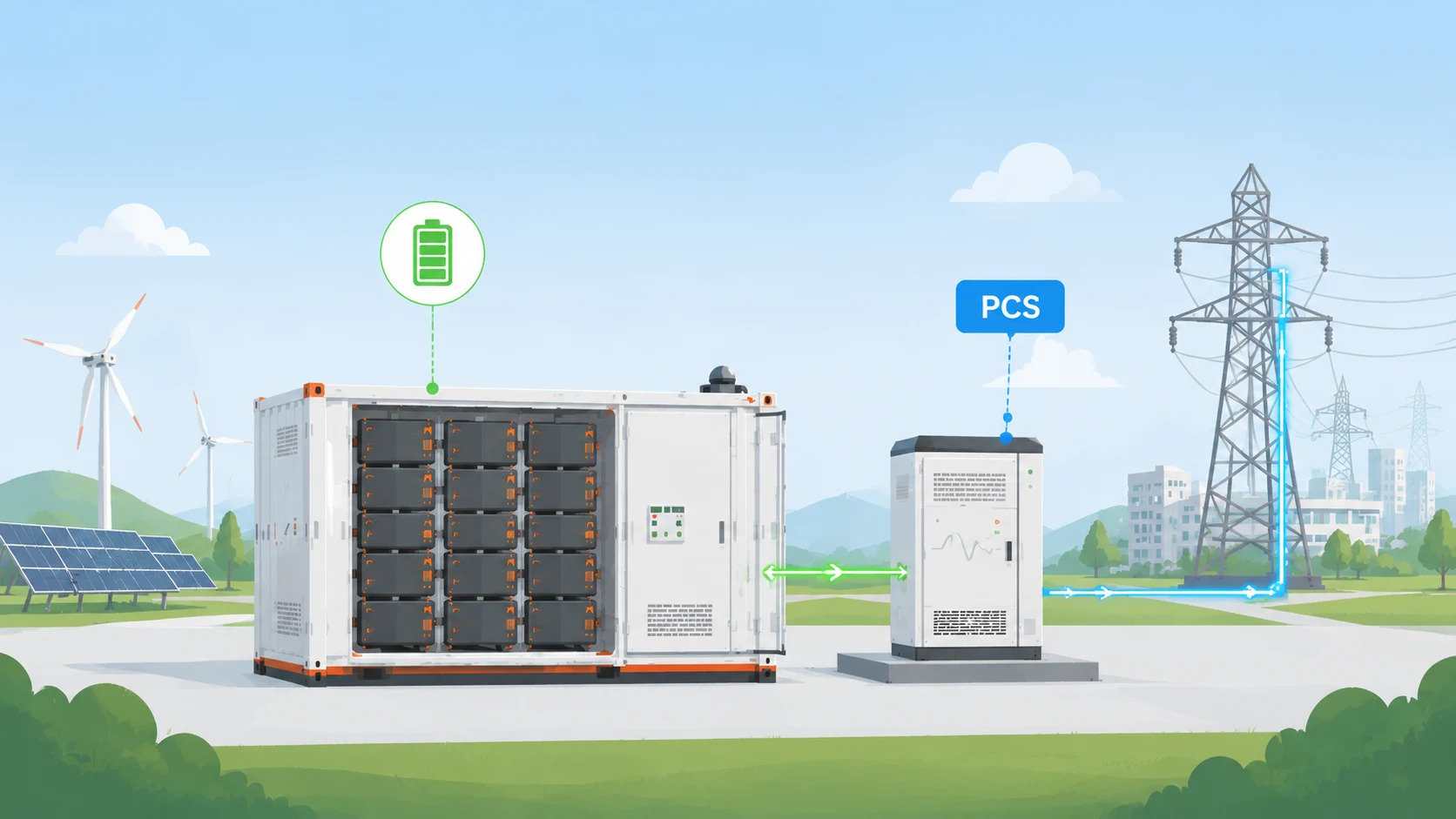
During commercial BESS design, PCS selection is usually based on:
- Required power output
- Application objective
- Peak shaving requirements
- Charging and discharging profile
- Grid requirements
- Battery operating limitations
For example, a facility may have a 500 kWh battery system designed for peak shaving. If the required demand reduction is 250 kW, a 100 kW PCS may prevent the system from achieving the expected result, even though the battery contains enough stored energy.
The opposite situation can also occur. An oversized PCS may increase project cost without providing additional operational value if the battery capacity and application do not require higher power output.
A supplier should be able to explain the relationship between:
- Battery energy capacity (kWh)
- PCS power capability (kW)
- Operating duration
- Expected system performance
This is a key part of evaluating the engineering quality of a commercial battery energy storage system.
Question 5: What cooling method is used and why?
Thermal management is another area where buyers should evaluate the engineering reasoning behind a system design.
A BESS operates through repeated charging and discharging cycles, and battery performance is strongly affected by operating temperature, temperature uniformity, and heat dissipation capability.
The appropriate cooling method depends on factors such as:
- Battery system size
- Energy density
- Power intensity
- Cycling frequency
- Installation environment
- Expected lifecycle
Commercial BESS projects commonly use different thermal management approaches, including air cooling and liquid cooling.
Air cooling may be suitable for smaller systems where:
- Heat generation is moderate
- System complexity needs to be minimized
- Operating conditions are relatively stable
However, as battery systems become larger and more compact, maintaining temperature consistency across modules becomes more challenging.
In high-energy-density systems, engineers need to consider:
- Temperature differences between cells and modules
- Cooling response during high-power operation
- Thermal stress during frequent cycling
Liquid cooling can provide a more direct heat transfer path and may offer better thermal uniformity for larger systems with higher heat generation rates.
However, liquid cooling also introduces additional engineering considerations, including:
- Pump systems
- Cooling circuits
- Maintenance requirements
- Auxiliary energy consumption
A supplier should not simply state that one cooling method is superior.
The important question is whether the selected thermal management approach matches the project requirements.
For example, a small commercial installation and a large containerized industrial BESS may have completely different cooling requirements.
The cooling decision should be connected with the overall commercial BESS design, including system scale, operating profile, and lifecycle expectations.
Question 6: How is the EMS designed?
The Energy Management System (EMS) is responsible for coordinating how the BESS operates.
Many buyers initially view EMS as simply a control system that charges and discharges the battery. In practical projects, however, EMS strategy has a much larger influence on system performance.
A properly designed EMS may coordinate:
- Peak shaving operation
- Energy scheduling
- State of charge (SOC) management
- Grid interaction
- Battery protection requirements
- Demand response strategies
For example, in a peak shaving application, the EMS needs to determine when the battery should discharge and how much power should be delivered.
Discharging too early may leave insufficient energy available during the actual demand peak. Discharging too aggressively may increase battery stress and reduce available capacity over time.
During commercial BESS operation, engineers typically consider the relationship between:
- Customer load behavior
- Electricity tariff periods
- Battery SOC condition
- PCS capability
- Battery degradation characteristics
A well-designed EMS does not control individual components independently. Instead, it coordinates the battery, PCS, and facility load to achieve the intended operating objective.

When evaluating a supplier, buyers should ask how the EMS strategy is developed and whether it is customized according to project requirements.
A generic control approach may not deliver the expected performance when applied to different facilities with different operating patterns.
3. Questions About Safety and Reliability
Safety evaluation is one of the most important parts of commercial BESS procurement.
A battery storage system is a combination of electrical equipment, battery modules, thermal management systems, control software, and protective devices.
Therefore, safety cannot be evaluated by a single component or certification alone.
Experienced project developers usually evaluate safety from a system engineering perspective.
Question 7: What safety standards and certifications does the system comply with?
Commercial BESS projects may involve different international standards depending on the market and application.
Common standards considered during project evaluation include:
- UL 9540
- UL 9540A
- UL 1973
- NFPA 855
- IEC battery safety standards
However, certification documents are only one part of the evaluation process.
During engineering reviews, suppliers should also explain how these standards are reflected in the actual system design.
Important considerations include:
- Battery enclosure design
- Electrical protection strategy
- Thermal management
- Monitoring capability
- Installation requirements
A system can meet certification requirements, but poor integration or unsuitable project design may still create operational challenges.
Buyers should therefore evaluate both compliance and engineering implementation.
Question 8: How does the system handle thermal and electrical protection?
A reliable BESS requires multiple protection layers working together.
These may include:
- Battery Management System (BMS)
- Temperature monitoring
- Voltage and current protection
- Fault detection
- Electrical isolation
- Fire suppression design
- Thermal event mitigation strategy
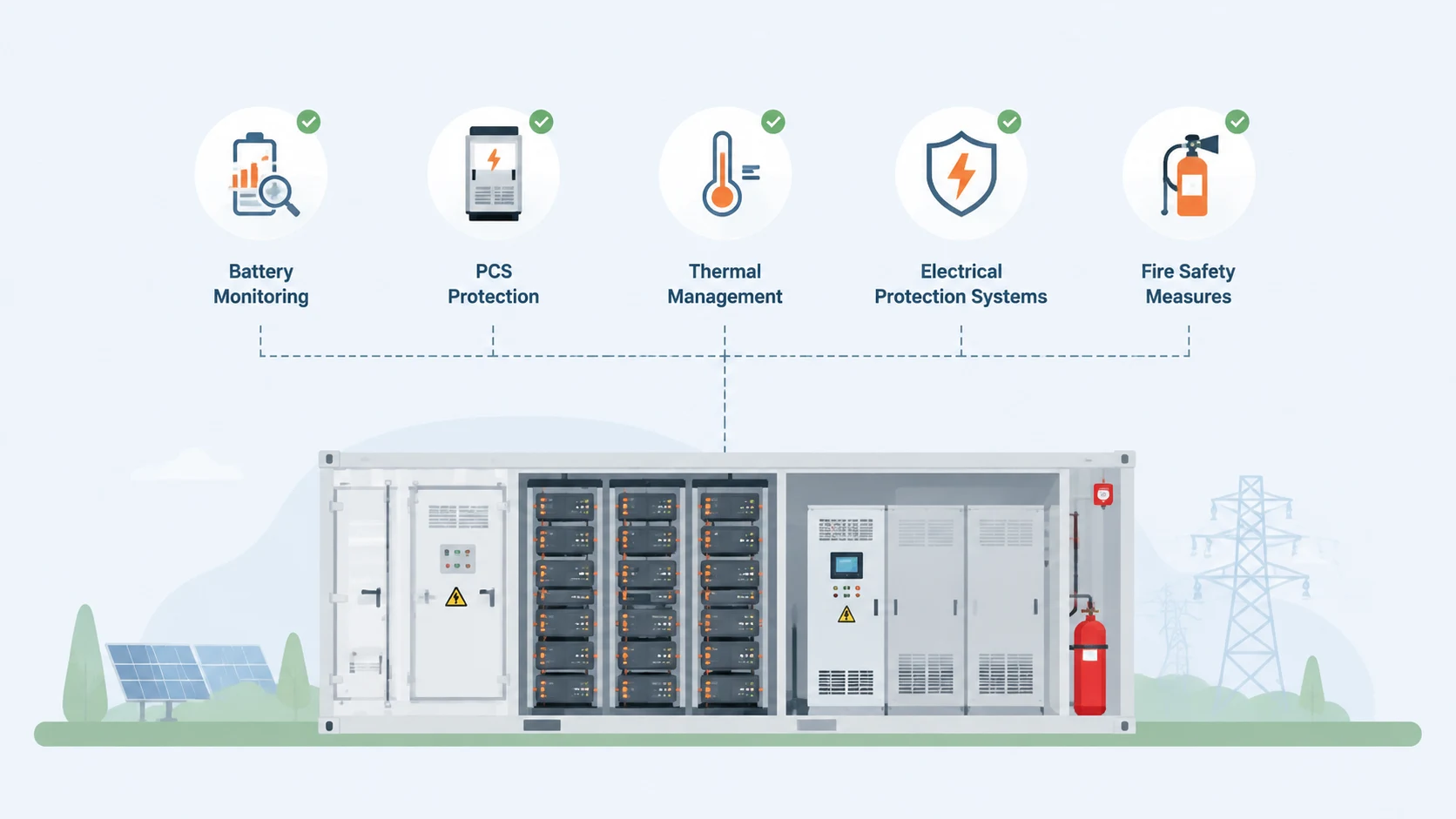
The BMS plays an important role by monitoring battery operating conditions and identifying abnormal conditions.
However, BMS alone is not a complete safety solution.
A complete commercial BESS safety design requires coordination between:
- Battery monitoring
- PCS protection
- Thermal management
- Electrical protection systems
- Fire safety measures
During supplier evaluation, buyers should ask how these systems interact during abnormal operating conditions.
The quality of the overall protection strategy often reflects the supplier’s system integration capability.
Question 9: What is the expected lifecycle performance?
Battery performance should not be evaluated only based on initial specifications.
Commercial BESS projects typically operate for many years, meaning lifecycle performance directly affects project economics.
Important evaluation factors include:
- Cycle life
- Capacity retention
- Operating temperature
- Charging and discharging conditions
- Annual energy throughput
For example, two systems may have similar initial capacity, but different operating strategies can result in different degradation rates.
A supplier should clearly explain:
- Expected capacity retention over time
- Assumptions behind performance estimates
- Recommended operating conditions
This information helps buyers evaluate the long-term value of different energy storage solutions.
4. Questions About ROI and Economic Evaluation
A commercial BESS project is ultimately an investment decision. Technical performance determines whether the system can operate as intended, but economic value depends on how effectively the system is used under real operating conditions.
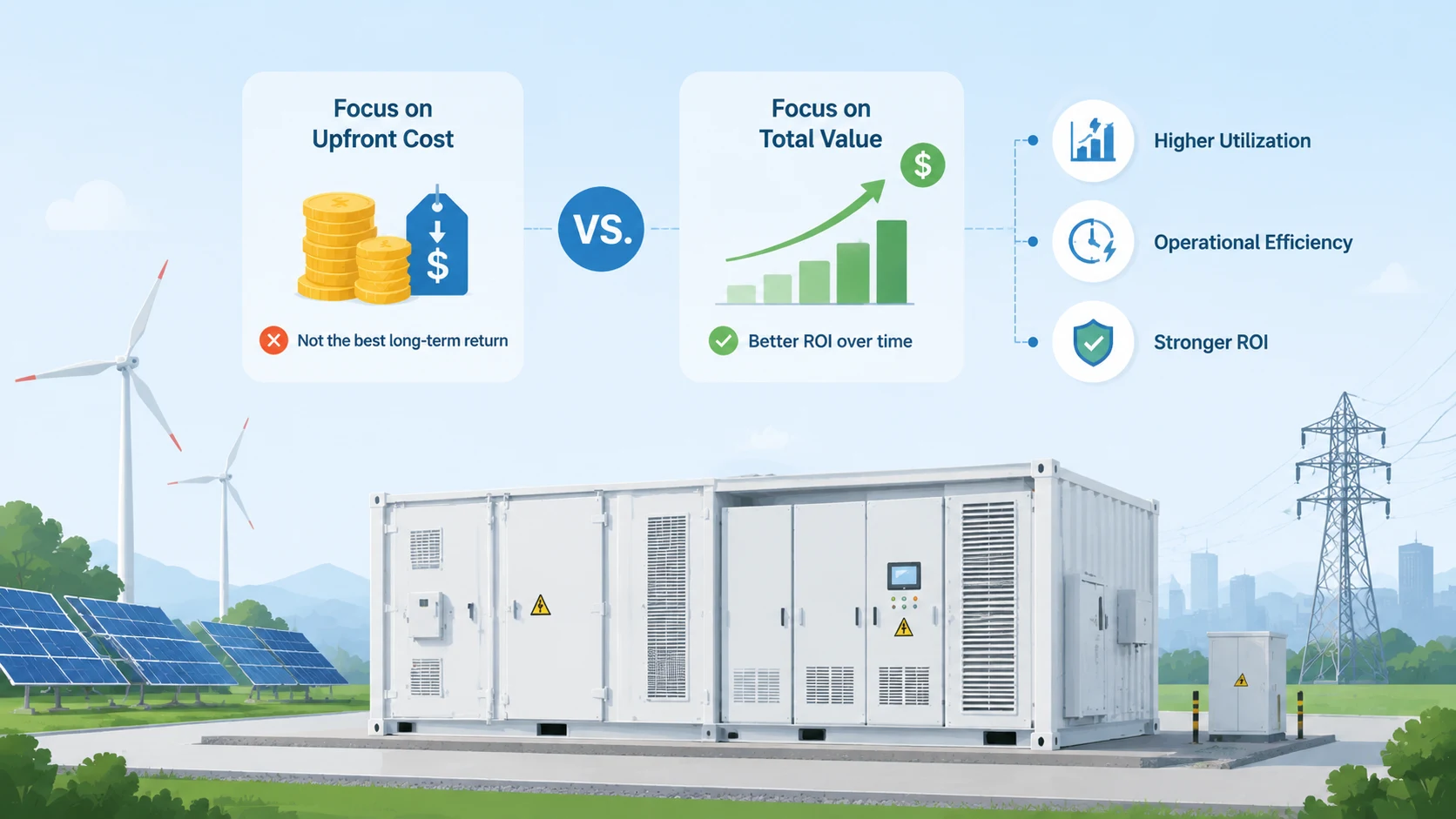
During project development, one common mistake is evaluating BESS only by upfront equipment cost.
A lower initial price does not always result in better project economics if the system cannot achieve the expected operational objectives.
Experienced engineers evaluate the relationship between:
- System configuration
- Electricity tariff structure
- Operating strategy
- Battery degradation
- Long-term maintenance requirements
The following questions help buyers understand whether the economic assumptions behind a project are realistic.
Question 10: How is the project ROI calculated?
A supplier should be able to explain how the economic model is developed and what assumptions are included.
For commercial BESS applications, ROI calculations often depend on factors such as:
- Electricity tariff structure
- Demand charges
- Time-of-use electricity pricing
- Energy shifting opportunities
- Operating frequency
- Battery degradation
- Maintenance requirements
For example, a peak shaving project may generate value by reducing demand charges during high-load periods. However, the actual savings depend on when those demand peaks occur and how frequently the battery can respond.
A system designed for a facility with predictable peak demand may perform differently from a facility with irregular load patterns.
During engineering evaluation, suppliers should explain:
- How the operating strategy creates economic value
- What assumptions are used in the calculation
- How battery performance changes over the project lifetime
A reliable economic assessment should be based on realistic operating conditions rather than ideal scenarios.
Question 11: What assumptions are used in the economic model?
A projected ROI is only as reliable as the assumptions behind it.
Before purchasing a commercial battery energy storage system, buyers should understand the key inputs used in the financial analysis.
Important assumptions include:
Battery degradation assumptions
Battery capacity decreases gradually over time.
A realistic model should consider:
- Initial usable capacity
- Annual degradation
- Operating temperature
- Charging and discharging frequency
Ignoring degradation may create unrealistic expectations about long-term savings.
Operating frequency
A battery system used daily will have different economics from one used only during occasional demand events.
Engineers typically evaluate:
- Number of annual cycles
- Energy throughput
- Average discharge depth
- Expected operating hours
Electricity price assumptions
Electricity tariffs can change significantly depending on region, market conditions, and utility policy.
A supplier should clarify whether the calculation assumes:
- Current electricity prices
- Future price changes
- Demand charge structures
- Time-of-use periods
A professional BESS evaluation focuses not only on initial savings but also on whether the system remains economically reasonable throughout its operating life.
5. Questions About Supplier Capability
Commercial BESS projects require more than battery equipment delivery.
The final system performance depends heavily on engineering integration, commissioning quality, control strategy, and long-term technical support.
During EPC project development, buyers often find that the difference between suppliers is not only the equipment itself, but also the depth of engineering support behind the solution.
Question 12: Can the supplier provide complete engineering support?
A commercial BESS supplier should be able to support the project beyond basic equipment supply.
Important capabilities include:
- System design
- Electrical integration
- Battery capacity sizing
- PCS selection
- EMS configuration
- Commissioning support
- Technical documentation
- After-sales service
For example, during a commercial project, the supplier may need to coordinate with:
- EPC contractors
- Electrical engineers
- Facility operators
- Grid connection teams
A supplier that only provides a battery cabinet without supporting system integration may create additional engineering challenges during installation and commissioning.
From a project perspective, equipment availability is only one part of success.
The supplier’s ability to understand the application, make design decisions, and support the complete lifecycle is equally important.
How to Interpret Supplier Answers: Evaluating BESS Supplier Capability
The quality of a supplier’s answers often reveals their engineering capability.
During procurement discussions, buyers can compare whether the supplier focuses mainly on equipment specifications or demonstrates a complete system design approach.
Weak supplier responses may focus on:
- Battery capacity only
- Product dimensions and specifications
- Initial equipment price
- Standard configurations without application analysis
These responses may indicate that the supplier is treating BESS as a hardware purchase rather than an integrated energy system.
Engineering-focused supplier responses usually discuss:
- Load profile analysis before system sizing
- Battery capacity sizing based on operating requirements
- PCS selection according to power demand
- Cooling strategy based on system scale and operating conditions
- EMS strategy based on application objectives
- Safety design throughout the system lifecycle
For example, if a supplier immediately recommends a fixed battery capacity without understanding the facility load pattern, tariff structure, or operating objective, the proposed solution may not reflect the actual project requirements.
A capable supplier will usually ask detailed questions before recommending a configuration.
This approach helps ensure that the commercial battery energy storage system is designed around the facility’s needs rather than a predefined product configuration.
Conclusion: Choosing a BESS Supplier Requires Engineering Evaluation
Purchasing a commercial Battery Energy Storage System is not simply a decision about selecting battery capacity or comparing equipment prices.
A successful project requires coordination between multiple engineering factors:
- Application requirements
- Load analysis
- Battery capacity sizing
- PCS selection
- Thermal management
- EMS strategy
- Safety design
- Economic evaluation
- Supplier engineering capability
The most suitable supplier is not necessarily the one offering the lowest equipment cost.
A technically capable supplier should be able to explain why a specific system configuration is selected, how the system will operate under real conditions, and how the design supports long-term performance.
For EPC contractors, integrators, and industrial energy users, asking the right technical questions before purchase can reduce design risks and improve the probability of achieving the expected project value.
A commercial BESS should ultimately be evaluated as a complete engineered system, not as a collection of individual components.
FAQ
1. What should I consider before buying a commercial battery energy storage system?
Before purchasing a commercial BESS, buyers should evaluate the application objective, load characteristics, battery capacity sizing method, PCS selection, thermal management approach, safety design, economic assumptions, and supplier engineering capability.
The system should be designed around the facility’s actual operating requirements rather than selected only by battery capacity or price.
The system should be designed around the facility’s actual operating requirements rather than selected only by battery capacity or price.
2. How do I evaluate a BESS supplier?
A qualified BESS supplier should be able to explain the engineering logic behind system configuration decisions.
Important evaluation areas include:
Important evaluation areas include:
- Experience with similar applications
- System design capability
- Battery and PCS integration knowledge
- EMS strategy
- Safety engineering
- Commissioning support
The supplier should demonstrate the ability to solve project requirements, not only provide equipment.
3. Why is load analysis important before selecting battery capacity?
Load analysis shows when and how the facility uses electricity.
Without understanding demand patterns, engineers cannot accurately determine:
Without understanding demand patterns, engineers cannot accurately determine:
- Required battery power
- Discharge duration
- Battery capacity
- Operating strategy
A system based only on annual electricity consumption may not achieve the expected performance.
4. Should I choose the largest battery system available?
Not necessarily.
A larger battery provides more stored energy, but additional capacity only creates value if it is used effectively.
A larger battery provides more stored energy, but additional capacity only creates value if it is used effectively.
Oversized systems may increase:
- Initial investment
- Footprint requirements
- Maintenance requirements
The appropriate battery size depends on the application objective, operating conditions, and lifecycle economics.
5. What technical questions should I ask a BESS manufacturer?
Important questions include:
- How is battery capacity determined?
- How is PCS rating selected?
- What cooling method is used and why?
- How is EMS strategy designed?
- What safety standards are considered?
- What lifecycle performance can be expected?
- What engineering support is provided during installation and operation?
These questions help buyers evaluate whether the supplier has the technical capability required for a commercial BESS project.
How We Design Battery Storage Systems for Different Industries
Why Bigger Batteries Don't Always Deliver Better Returns