Five Common Design Mistakes in Commercial BESS Projects
author: HT infinitepower
2026-08-06
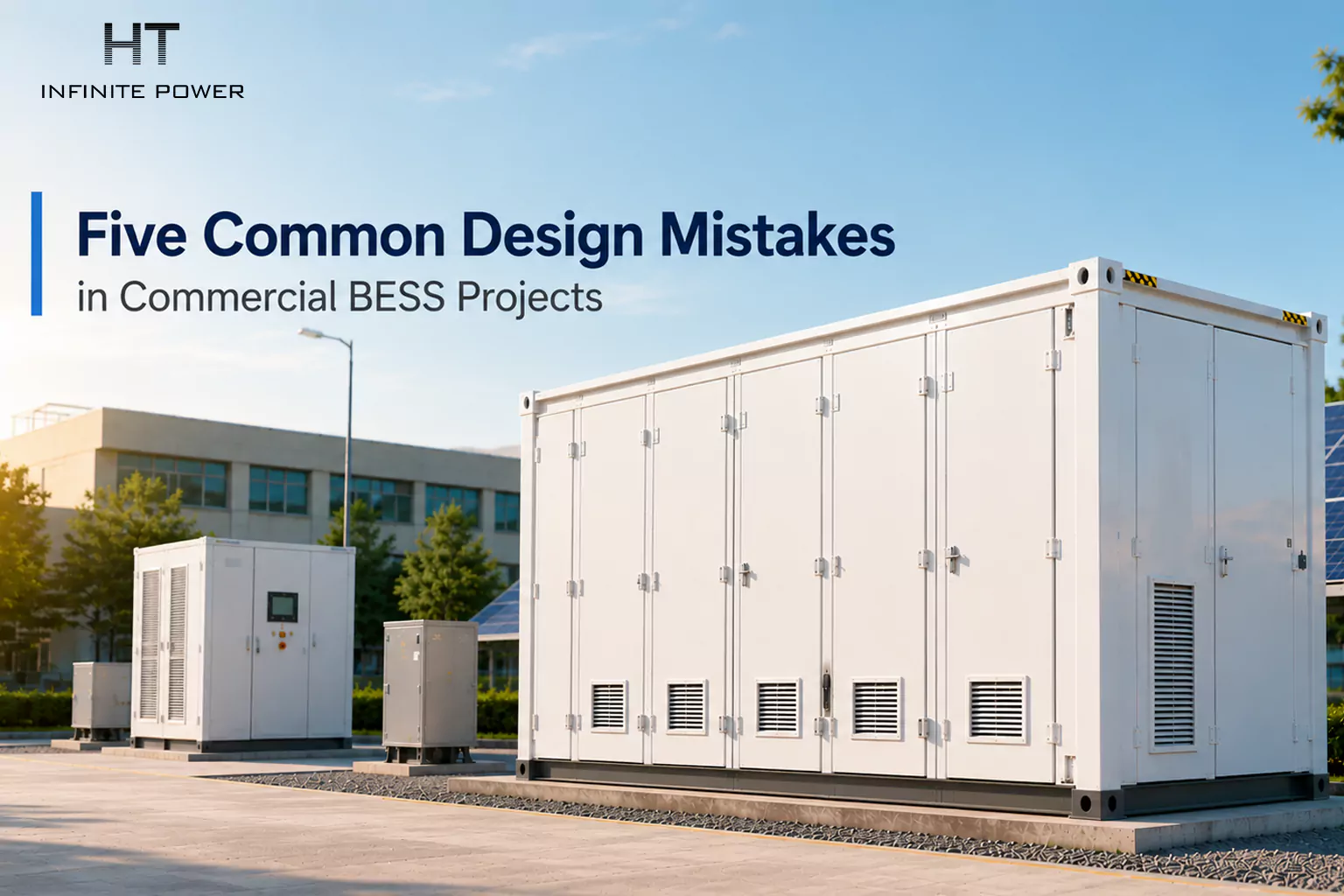
Commercial battery storage projects rarely fail because a battery module or inverter does not meet its specification. More often, performance problems can be traced back to decisions made long before any equipment is purchased.These decisions are closely related to commercial BESS design, including load analysis, battery sizing, PCS configuration, and energy management strategy. By the time a project reaches procurement, many of the most important engineering assumptions have already been established, influencing everything from system configuration to long-term operating economics.
During engineering reviews, it is common to encounter projects where the discussion begins with equipment selection rather than system requirements. Questions such as "Should we install a 500 kWh battery?" or "Which PCS should we use?" appear early, while more fundamental questions about facility operation, electricity pricing, and load behavior receive less attention. Although these discussions are well intentioned, they reverse the engineering process.
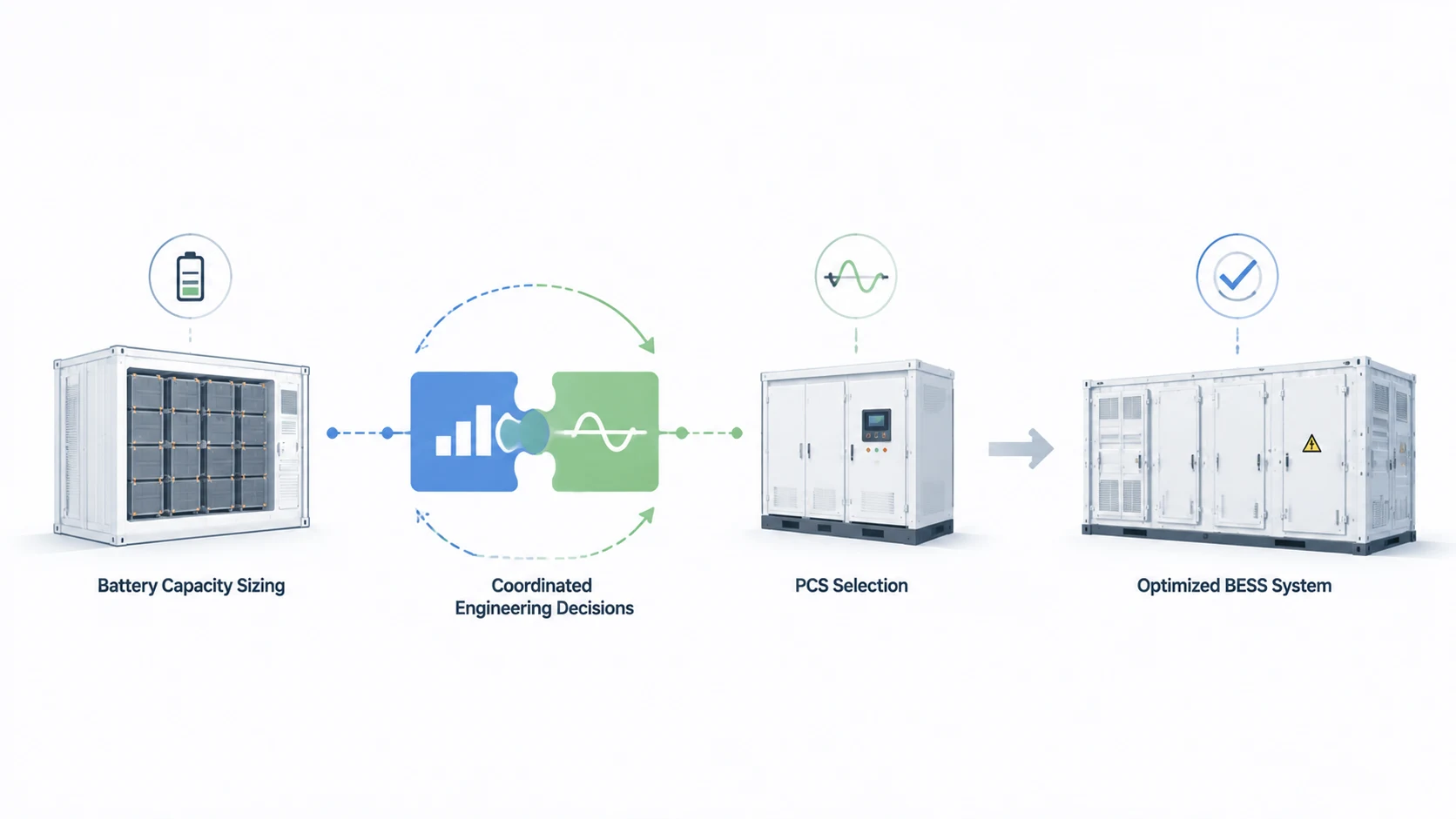
A commercial Battery Energy Storage System is not simply a collection of batteries, converters, and control software. It is a coordinated engineering system in which load profile analysis, battery capacity sizing, PCS selection, thermal management, EMS strategy, and economic evaluation influence one another. Decisions made in one area often constrain the available options elsewhere. An oversized battery may increase capital cost without improving demand reduction. An undersized PCS may prevent the system from responding quickly enough during peak events. A sophisticated EMS cannot compensate for incorrect assumptions made during the initial design stage.
One of the recurring observations in commercial BESS engineering is that mistakes are rarely isolated. A single incorrect assumption often creates a chain of secondary problems. For example, inaccurate estimates of demand duration may lead to oversized battery capacity, which affects PCS utilization, increases auxiliary energy consumption, alters thermal management requirements, and ultimately changes project economics.
This article reviews five engineering mistakes frequently observed in commercial battery storage system design. The objective is not to criticize project owners or EPC contractors, but to explain the engineering reasoning behind these issues and demonstrate how experienced system designers evaluate projects from a system perspective rather than an equipment perspective.
Mistake 1 — Starting Without Proper Load Profile Analysis

Among all early-stage engineering mistakes, beginning a project without detailed load profile analysis is probably the most common.
Many commercial projects start with a request such as:
"We need a 1 MWh battery for peak shaving."
However, experienced engineers rarely discuss battery size before understanding how electricity is actually consumed.
The first engineering question is different:
What does the facility's electrical demand look like throughout the day, week, and year?
Battery capacity is a design outcome rather than an initial design input.
In practical commercial BESS projects, the challenge is often not calculating battery size—it is obtaining sufficiently detailed operational data. Monthly electricity bills provide total energy consumption and billing demand, but they reveal little about how demand changes throughout the day. Two facilities with identical annual electricity consumption may require completely different battery configurations because their load behavior differs significantly.
During feasibility studies, engineers typically evaluate several characteristics simultaneously:
- Daily demand variation
- Peak demand duration
- Peak frequency
- Seasonal operating changes
- Weekend versus weekday operation
- Process-related demand fluctuations
- Maximum demand compared with average demand
These characteristics determine what the battery is expected to accomplish.
For example, consider two manufacturing facilities with similar annual electricity consumption.
Facility A experiences brief production peaks lasting approximately 20 minutes whenever several production lines start simultaneously. Outside these periods, demand remains relatively stable.
Facility B operates large refrigeration equipment that creates elevated demand for four to five hours every afternoon during summer.
Although annual energy consumption may be nearly identical, the engineering requirements are fundamentally different. Facility A requires rapid power support over a relatively short period, while Facility B requires sustained energy delivery for several hours. Applying the same battery configuration to both projects would almost certainly produce disappointing results.
This distinction becomes even more important when peak shaving is the primary project objective. Short-duration demand events are often limited by available PCS power, whereas long-duration demand reduction may require significantly greater usable battery energy. Without understanding the load profile, neither the battery nor the PCS can be sized appropriately.
Another common issue is designing from maximum demand alone. Maximum demand represents only a single operating point. It does not indicate how frequently that condition occurs or whether reducing it provides meaningful financial benefit. In some facilities, the monthly peak occurs only once. In others, elevated demand repeats every working day. These situations require different operating strategies despite having similar recorded peak demand.
Engineers also consider how load characteristics influence later design stages. Load behavior affects dispatch logic, battery cycling frequency, thermal loading, and even auxiliary energy consumption. As a result, load profile analysis becomes the foundation for subsequent decisions involving battery capacity sizing, PCS selection, and EMS strategy.
Skipping this step often produces predictable consequences:
- Oversized battery systems with low utilization
- Undersized systems that cannot sustain required discharge duration
- Incorrect PCS ratings
- Inefficient dispatch strategies
- Reduced demand charge savings
- Longer project payback periods
The engineering effort invested in understanding load behavior is therefore rarely wasted. On the contrary, it reduces uncertainty across the entire commercial battery storage system design process.
Mistake 2 — Selecting PCS Based Only on Battery Capacity
Another engineering misconception appears when battery energy and PCS power are treated as equivalent.
It is surprisingly common to hear statements such as:
"We selected a 500 kWh battery, so we should use a 500 kW PCS."
"We selected a 500 kWh battery, so we should use a 500 kW PCS."
Although convenient, this assumption ignores the different functions performed by these two components.
Battery capacity describes how much energy can be stored.
PCS rating determines how quickly that energy can be exchanged with the electrical system.
The relationship between kWh and kW is therefore application dependent rather than fixed.
The relationship between kWh and kW is therefore application dependent rather than fixed.
Consider two commercial BESS configurations:
System A
- Battery: 500 kWh
- PCS: 100 kW
System B
- Battery: 500 kWh
- PCS: 250 kW
Both systems contain the same usable energy. However, their operating capabilities are very different.
If the project objective is to reduce facility demand by 250 kW during short production peaks, System A cannot deliver the required response because the PCS limits maximum discharge power to 100 kW. Increasing battery capacity alone does not solve this problem.
Conversely, if the application requires relatively low charging and discharging power over extended periods, specifying a significantly larger PCS may increase equipment cost while contributing little additional operational value.
During engineering evaluations, PCS sizing is determined primarily by power requirements rather than battery energy. Engineers typically assess:
- Required peak reduction
- Maximum charge and discharge power
- Expected operating duration
- Battery C-rate capability
- PCS overload characteristics
- Partial-load efficiency
- Utility interconnection requirements
- Reactive power and grid support functions
Battery characteristics also influence the practical operating range. A battery repeatedly operating at high C-rates experiences greater thermal stress and accelerated degradation compared with operation at more moderate discharge rates. PCS selection therefore affects not only immediate power capability but also long-term battery performance.
Overload capability is another parameter frequently misunderstood. Many PCS units can temporarily exceed rated output for short periods. This additional capability is useful when responding to brief demand spikes, but it should be regarded as an operating margin rather than a substitute for correct sizing. Designing around continuous overload operation usually increases thermal stress and reduces long-term operating stability.
Efficiency should also be evaluated carefully. Maximum conversion efficiency quoted in product specifications often represents performance near rated output under laboratory conditions. In commercial projects, PCS units frequently operate across a wide range of loading conditions. Engineers therefore examine efficiency curves over the expected operating profile instead of focusing solely on the peak efficiency figure.
Incorrect PCS selection creates several downstream effects. Insufficient power capability limits demand reduction performance, while oversized PCS capacity may reduce utilization and increase project cost. Because PCS operation directly shapes battery charging and discharging behavior, it also influences thermal management requirements and EMS control strategies.
For this reason, experienced BESS engineers rarely size the battery first and add a PCS later. Battery capacity sizing and PCS selection are coordinated engineering decisions developed together according to application objectives rather than equipment specifications.
Mistake 3 — Ignoring Electricity Tariff Structure
A commercial BESS does not generate value simply because it stores electricity. Its economic value comes from changing when electricity is purchased, consumed, or exported. For this reason, electricity tariff analysis is not merely a financial exercise—it is a core engineering input that directly influences system sizing and operating strategy.
During early-stage project discussions, engineers occasionally receive requests based only on available installation space or budget constraints:
"We have room for a 1 MWh battery. Can you design a system around it?"
While physical constraints are certainly important, they should not be the primary basis for system configuration. Before recommending battery capacity or PCS power, experienced engineers first evaluate how the local tariff structure rewards different operating behaviors.
A commercial battery storage system installed under a tariff dominated by demand charges will be engineered differently from one operating under strong time-of-use (TOU) pricing, even if both facilities have similar load profiles.
Typical tariff elements evaluated during engineering studies include:
- Demand charges based on monthly peak demand
- Time-of-use electricity pricing
- Critical peak pricing
- Seasonal tariff variations
- Energy export compensation
- Demand response incentives
- Grid service opportunities where applicable
Each pricing mechanism changes the operational objective of the BESS.
For example, if demand charges account for a significant proportion of the electricity bill, engineers focus on reducing short-duration peak demand events. In this case, PCS power capability often becomes one of the most influential design parameters because the battery must respond quickly enough to prevent demand spikes from reaching the utility meter.
Conversely, when the largest savings come from energy arbitrage under TOU pricing, discharge duration becomes increasingly important. The system may operate for several hours during expensive tariff periods, requiring greater usable battery energy rather than simply higher instantaneous power.
This distinction explains why identical battery systems can produce very different financial results.
Consider two industrial facilities, each evaluating a 500 kWh battery energy storage system.
Facility A pays substantial monthly demand charges but has relatively flat energy prices throughout the day.
Facility B faces modest demand charges but experiences large differences between off-peak and peak electricity prices.
Although the hardware could be identical, the engineering priorities are not.
For Facility A, engineers would optimize control logic to reduce monthly peak demand by discharging rapidly during short high-load events.
For Facility B, engineers would likely prioritize charging during low-price periods and discharging over longer peak-price windows.
The same battery therefore follows two completely different operating strategies because the tariff structure changes the project's economic objective.
Another issue observed during commercial BESS feasibility studies is assuming that larger batteries automatically produce higher returns.
This assumption is rarely valid.
Beyond a certain point, additional battery capacity may remain underutilized because there are insufficient economically valuable charging and discharging opportunities. Increasing installed capacity without corresponding revenue opportunities increases capital expenditure while reducing asset utilization.
Experienced engineers therefore evaluate tariff structure before finalizing battery capacity sizing. Economic analysis is performed alongside technical design rather than after equipment has already been selected.
Tariff evaluation also influences later engineering decisions.

For example:
- Dispatch priorities configured within the EMS
- Expected annual cycling frequency
- Required battery throughput
- Thermal loading over the system lifetime
- Expected degradation profile
- Overall lifecycle economics
These relationships illustrate why tariff analysis cannot be separated from engineering design. It provides one of the boundary conditions that determine how the commercial BESS is expected to operate throughout its service life.
Mistake 4 — Designing Only for Today's Requirements
Commercial facilities rarely remain unchanged throughout the twenty-year design life typically considered for electrical infrastructure.
Production lines expand.
New equipment is installed.
Electric vehicle charging stations are added.
Rooftop photovoltaic systems increase in capacity.
Operating schedules evolve.
These changes alter the electrical characteristics of the facility, yet many battery storage projects are designed only around current operating conditions.
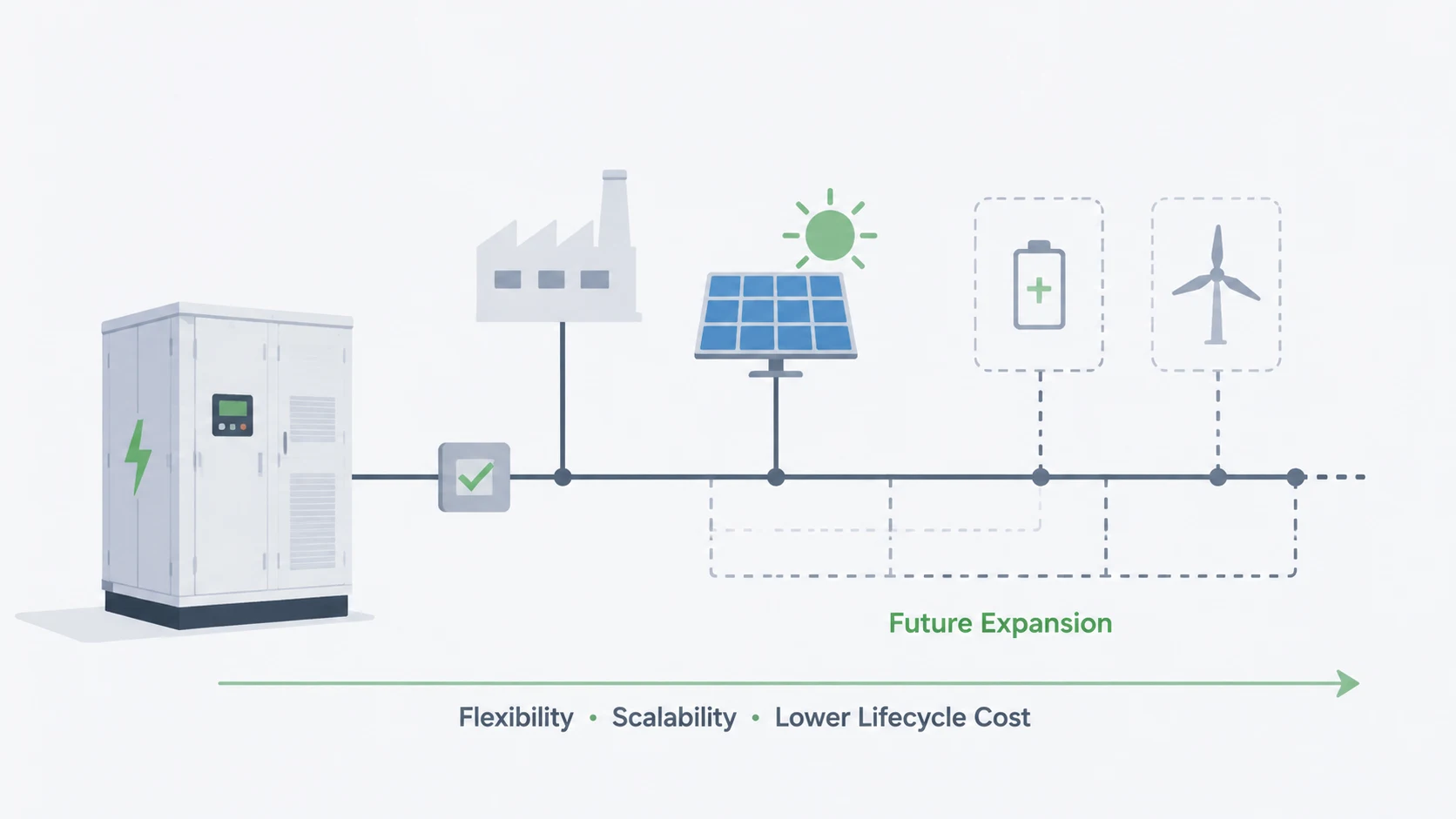
During engineering reviews of retrofit projects, one recurring observation is that the original battery system often cannot be expanded economically—not because of battery technology limitations, but because the supporting electrical infrastructure was never designed with future growth in mind.
Expansion planning should therefore begin during the initial engineering stage rather than after the first phase has been commissioned.
This does not necessarily mean installing a larger battery immediately.
Instead, it involves creating a system architecture that can accommodate future requirements without major reconstruction.
Several engineering considerations are commonly evaluated.
Reserve Space for Future Equipment
Battery containers, PCS equipment, transformers, switchgear, and auxiliary systems all require physical installation space.
If the initial layout fully occupies the available area, future expansion may require relocating equipment or constructing additional infrastructure.
Experienced designers therefore evaluate not only the first installation phase but also potential second-stage expansion during site planning.
Design Scalable Electrical Architecture
Electrical scalability extends beyond battery capacity.
Engineers review:
- DC bus configuration
- AC distribution capacity
- Transformer loading margin
- Switchgear capacity
- Cable routing
- Cable tray utilization
Oversizing every component is rarely economical, but identifying future expansion pathways can significantly reduce retrofit complexity.
Consider PCS Scalability
Future operational requirements may require higher discharge power rather than simply greater stored energy.
For example, an industrial customer may initially install a battery system primarily for peak shaving. Several years later, the same facility may add electric vehicle charging infrastructure that creates additional high-power demand events.
If the original PCS configuration cannot accommodate future power requirements, upgrading becomes substantially more expensive than allowing for modular expansion during the initial design.
Communication and EMS Architecture
Expansion also affects system control.
Battery modules, PCS units, meters, protection devices, and higher-level supervisory systems exchange operational data continuously.
A communication architecture designed only for the initial installation may become increasingly difficult to integrate as additional equipment is added.
During commercial BESS engineering, designers therefore evaluate network topology, controller capacity, communication protocols, and future integration capability before commissioning the first phase.
Planning for Renewable Integration
Many industrial facilities install photovoltaic systems after their battery storage project becomes operational.
If solar integration has not been considered during the original engineering phase, additional electrical modifications may be required later.
Planning for future renewable generation does not necessarily require immediate installation, but reserving electrical interfaces and communication capability can substantially reduce future engineering effort.
Expansion planning ultimately improves project flexibility.
Rather than attempting to predict every future operational change, experienced engineers design systems capable of adapting to reasonable growth scenarios.
This approach generally produces lower lifecycle costs than repeatedly modifying infrastructure designed only for short-term requirements.
Mistake 5 — Oversimplifying EMS Strategy
When discussing commercial battery storage projects, attention is often focused on visible equipment such as battery cabinets, PCS units, or transformers. By comparison, the Energy Management System (EMS) is sometimes viewed as little more than software that tells the battery when to charge and discharge.
In practice, this is one of the most significant misconceptions encountered during commercial BESS engineering.
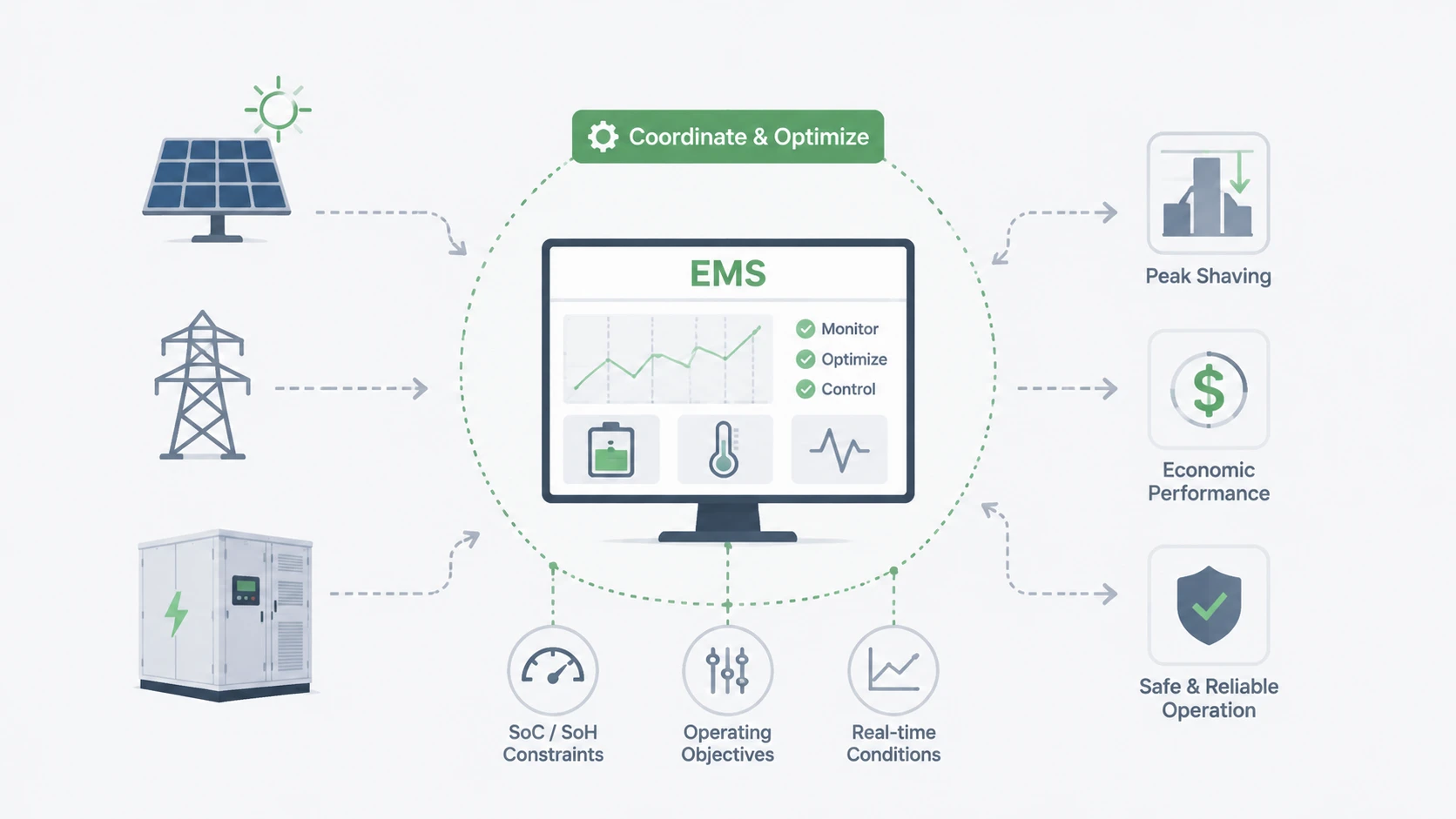
An EMS is not simply a timer or scheduling tool. It acts as the operational coordinator for the entire battery energy storage system, continuously balancing technical constraints, operating objectives, and real-time system conditions. Even a well-designed battery and correctly sized PCS may fail to deliver the expected economic performance if the control strategy does not match the application.
During engineering reviews, it is not unusual to find projects where hardware selection is technically appropriate, but system performance remains below expectations because the EMS logic was oversimplified. In many cases, the battery is physically capable of reducing demand peaks, yet the control strategy reacts too late, maintains an unnecessarily conservative state of charge, or cycles the battery inefficiently.
These problems rarely originate from software alone. More often, they reflect insufficient engineering definition of how the system is expected to operate.
Peak Shaving Requires Predictive Rather Than Reactive Control
Consider a manufacturing facility where several production lines start automatically at the beginning of each shift.
If the EMS waits until grid demand has already exceeded the target before commanding battery discharge, the demand spike may already have been recorded by the utility meter. Although the battery responds correctly, the customer still pays the higher demand charge.
Experienced engineers therefore evaluate whether predictable load events can be anticipated rather than simply reacted to.
Depending on the application, the EMS may combine:
- Historical operating patterns
- Real-time power measurements
- Production schedules
- Load forecasting
- Demand thresholds
This allows the battery to respond before peak demand reaches its maximum rather than after the event has already occurred.
State of Charge Must Balance Availability and Battery Protection
Maintaining battery State of Charge (SOC) is another area where engineering judgement becomes important.
Keeping the battery fully charged at all times maximizes available energy, but reduces charging flexibility and may accelerate long-term degradation.
Maintaining a very low SOC leaves insufficient energy available when demand reduction is needed.
Neither approach is appropriate for every project.
Instead, engineers establish SOC operating windows according to the application's objectives.
For example:
- Peak shaving projects often maintain sufficient reserve capacity for expected demand events.
- Time-of-use applications may allow wider SOC variation to maximize energy arbitrage.
- Backup power systems usually prioritize availability over daily cycling.
The EMS continuously manages these operating windows while considering battery protection limits and expected operating schedules.
Dispatch Strategy Determines System Utilization
Commercial BESS projects rarely operate under a single objective throughout the year.
Depending on electricity tariffs, seasonal demand, and facility operation, the EMS may prioritize different functions at different times.
Typical dispatch priorities include:
- Peak shaving
- Demand charge management
- Time-of-use optimization
- Renewable energy utilization
- Backup power reservation
- Grid support functions where permitted
Without clearly defined priorities, different operating objectives may compete with one another.
For example, fully discharging the battery during an energy arbitrage event may leave insufficient reserve capacity for a demand peak later that afternoon.
These operational conflicts cannot be solved through battery capacity alone. They require coordinated EMS decision-making.
Battery, PCS, and EMS Must Operate as One System
One recurring observation during commissioning is that battery performance depends not only on battery specifications but also on how the EMS commands the PCS.
The PCS determines how power flows between the battery and the electrical network.
The EMS determines when, how fast, and under which conditions those power exchanges occur.
As a result, charging rates, discharge rates, battery temperature, C-rate, and cycling frequency are all influenced indirectly by the control strategy.
Aggressive dispatch algorithms may increase short-term economic returns while also increasing thermal stress and battery degradation.
Conversely, overly conservative operation may protect the battery but leave substantial economic value unrealized.
Engineering teams therefore seek a balance between performance and lifecycle preservation rather than optimizing either objective independently.
Demand Forecasting Improves Operational Decisions
Modern commercial EMS platforms increasingly incorporate demand forecasting into routine operation.
Forecasting does not need to predict future demand perfectly.
Even relatively accurate short-term predictions allow the EMS to prepare battery availability more effectively.
For facilities with stable production schedules or repetitive operating patterns, predictive control often improves:
- Peak demand reduction
- Battery utilization
- Energy scheduling
- Operational stability
The objective is not to make the system more complicated, but to improve decision quality using information already available within the facility.
6. Engineering Impact of These Design Mistakes
Each design mistake discussed in this article may appear manageable when viewed independently. In practice, however, commercial BESS engineering rarely involves isolated problems.
A single incorrect assumption often propagates throughout the entire project.
For example, inadequate load profile analysis may result in inaccurate battery capacity sizing. Incorrect battery sizing then affects PCS selection, which influences EMS operating strategy and ultimately changes thermal loading and lifecycle performance.
Similarly, ignoring electricity tariff structure may lead to a technically functional system that generates disappointing financial returns because the battery is optimized for the wrong operating objective.
From an engineering perspective, these interactions are more important than any individual equipment specification.
Common consequences include:
| Engineering Issue | Potential Project Impact |
| Poor load analysis | Incorrect battery utilization and dispatch strategy |
| Incorrect PCS sizing | Reduced power capability and lower demand reduction performance |
| Oversized battery capacity | Higher CAPEX and reduced asset utilization |
| Weak EMS strategy | Increased cycling, lower efficiency, accelerated degradation |
| No expansion planning | Expensive retrofits and limited future flexibility |
| Inadequate thermal management coordination | Higher battery stress and reduced long-term reliability |
These issues also influence key project performance indicators, including:
- Battery utilization rate
- PCS utilization
- Round-trip efficiency
- Battery degradation rate
- Demand charge reduction
- Annual operating savings
- Payback period
- Lifecycle cost
- System availability
One of the characteristics that distinguishes experienced BESS engineering from equipment-oriented design is the recognition that optimizing one component does not necessarily optimize the system.
The best-performing commercial battery storage systems are usually those in which each subsystem has been designed with the others in mind.
Engineering Review Summary
A structured engineering workflow helps reduce design risk by ensuring that each decision is based on verified project information rather than assumptions.
A typical engineering sequence follows this logic:
Load analysis
↓
Electricity tariff evaluation
↓
Define application objectives
↓
Battery capacity sizing
↓
PCS selection
↓
Thermal management design
↓
EMS strategy development
↓
Economic optimization
Although actual projects may revisit earlier stages as new information becomes available, this sequence reflects how experienced engineering teams progressively refine a commercial Battery Energy Storage System.
Rather than selecting equipment independently, each design stage builds upon the engineering decisions established previously.
This system-level approach reduces technical uncertainty while improving long-term operational performance.
Conclusion
Successful commercial battery storage projects are rarely defined by selecting the highest-capacity battery or the most advanced PCS.
Instead, long-term project performance depends on following a disciplined engineering process in which every major design decision is supported by operational data, technical analysis, and clearly defined application objectives.
The five design mistakes discussed throughout this article share a common characteristic.
They originate from engineering assumptions made early in the project:
- Beginning without sufficient understanding of facility load behavior.
- Treating battery capacity and PCS power as interchangeable.
- Ignoring how electricity tariffs create project value.
- Designing only for today's operating conditions.
- Oversimplifying the role of EMS in coordinating system operation.
Avoiding these mistakes improves much more than technical performance.
It contributes to:
- More effective battery utilization
- Better coordination between battery and PCS
- Higher operational efficiency
- Lower lifecycle degradation
- Greater demand charge reduction
- More predictable economic returns
- Improved long-term system reliability
Ultimately, a successful commercial battery storage system is not defined by individual components working well in isolation.
It is the result of a coordinated engineering process in which load characteristics, electrical infrastructure, operating strategy, thermal management, and economic objectives are considered together throughout the project lifecycle.
FAQ
1. Why is load profile analysis important before battery sizing?
Load profile analysis identifies when demand peaks occur, how long they last, and how frequently they repeat. Engineers use this information to determine battery power and energy requirements. Without accurate load data, battery capacity sizing is likely to be either excessive or insufficient for the intended application.
2. Can a larger battery compensate for poor PCS selection?
No.
A larger battery increases available energy, but it cannot overcome insufficient PCS power capability. If the PCS cannot deliver the required discharge power, the system may fail to achieve its peak shaving objective regardless of battery capacity.
A larger battery increases available energy, but it cannot overcome insufficient PCS power capability. If the PCS cannot deliver the required discharge power, the system may fail to achieve its peak shaving objective regardless of battery capacity.
3. How does electricity tariff affect battery ROI?
Electricity tariffs determine how a commercial BESS generates financial value. Demand charges, time-of-use pricing, and other tariff mechanisms influence operating strategy, cycling frequency, and battery sizing. Identical battery systems can produce very different economic results under different tariff structures.
4. Why should commercial BESS be designed for future expansion?
Industrial and commercial facilities often add production equipment, renewable generation, or EV charging infrastructure over time. Designing scalable electrical architecture, communication systems, and installation space during the initial project can significantly reduce future retrofit costs and operational disruption.
5. How does EMS influence battery lifetime?
The EMS controls charging, discharging, SOC management, and dispatch strategy. These decisions affect battery C-rate, cycling frequency, thermal stress, and depth of discharge, all of which influence long-term battery degradation and overall system efficiency. A well-designed EMS balances economic performance with battery protection rather than optimizing either objective independently.
Why Bigger Batteries Don't Always Deliver Better Returns
Why Cooling Is a System-Level Engineering Decision