How to Choose Between Liquid Cooling and Air Cooling Energy Storage Systems?
author: HT infinitepower
2026-09-14
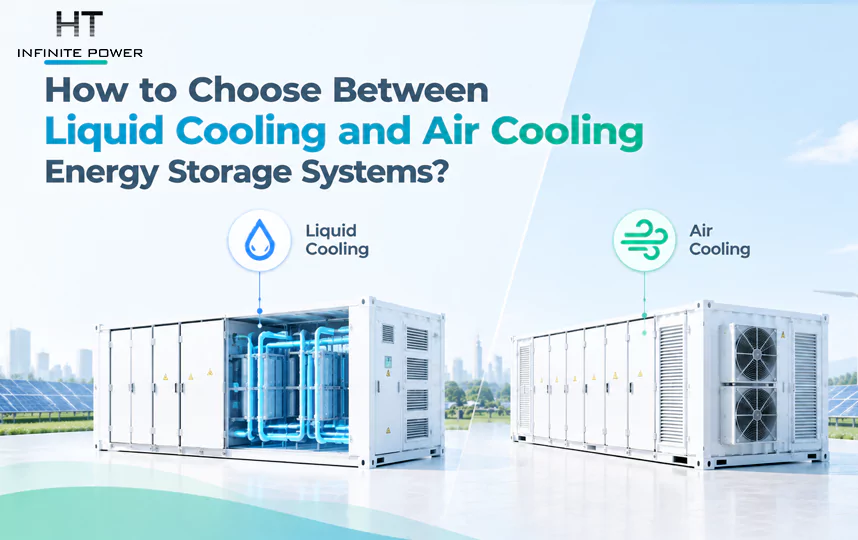
Core Guide to Selecting Liquid Cooling or Air Cooling for Energy Storage Systems
Liquid cooling generally merits evaluation for high-density BESS requiring controlled heat removal and tighter temperature uniformity. Air cooling may remain practical for lower-density systems where simpler installation and accessible maintenance matter.
Select neither by label alone: compare duty cycle, climate, layout, auxiliary demand, service capability, safety evidence, and lifecycle cost under the proposed configuration.
Liquid systems transfer heat through coolant circuits and heat exchangers; air systems move conditioned air across heat-producing components.
System capacity alone does not decide the architecture; heat density, ambient conditions, cycling profile, enclosure design, and allowable cell-temperature spread also matter.
Compare measured thermal maps, auxiliary energy, maintenance tasks, alarms, failure responses, warranty conditions, and applicable safety documents.
Define the Operating Envelope
Document ambient temperature and humidity, altitude, dust or corrosive exposure, charge-discharge profile, available space, noise limits, and maintenance access.
Compare Verified Thermal and Auxiliary Performance
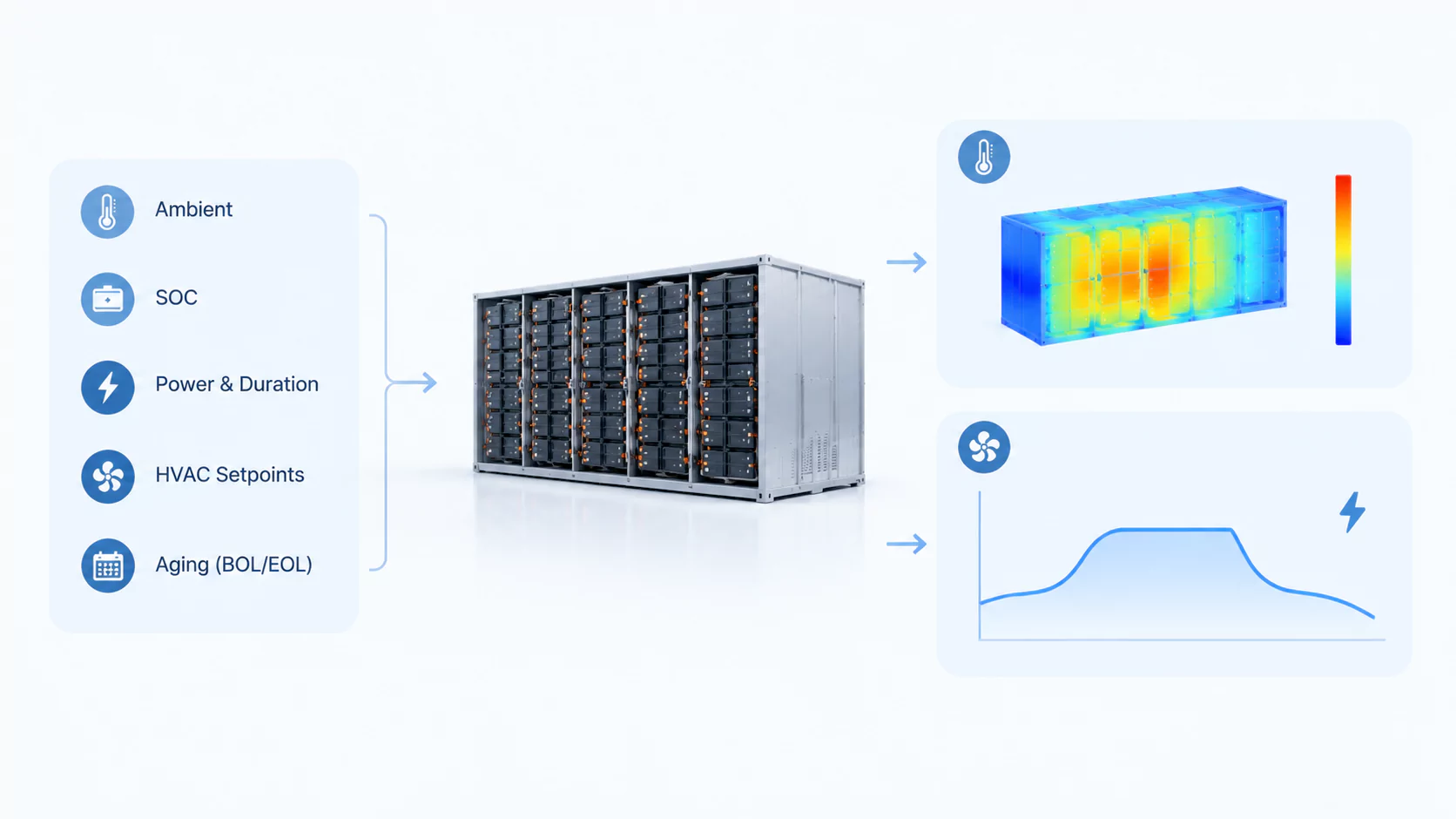
Request cell or module temperature-distribution data at defined ambient conditions, state of charge, power, duration, HVAC setpoints, and beginning- and end-of-life assumptions.
Obtain cooling parasitic-load curves rather than one unexplained efficiency value.
Obtain cooling parasitic-load curves rather than one unexplained efficiency value.
Evaluate Installation, Maintenance, and Failure Modes
Air Cooling Considerations
For air cooling, review airflow paths, filters, fans, condensation control, and dust ingress.
Liquid Cooling Considerations
For liquid cooling, review pumps, coolant compatibility, leak detection, isolation, refill procedures, and service responsibility.
Verify Safety and Calculate Total Cost
Confirm that test evidence covers the offered cells, modules, racks, enclosure, controls, and cooling arrangement.
Compare capital cost, auxiliary electricity, planned parts, labor, downtime, coolant or filter service, warranty exclusions, and end-of-life obligations.
Frequently Asked Questions About Liquid Cooling and Air Cooling
Is liquid cooling always better for a BESS?
No. It can improve controllability in dense systems, but it introduces pumps, coolant circuits, seals, and leak-management duties. The benefit must be verified against the actual project profile.
Can air cooling serve commercial and industrial storage?
Yes, when the enclosure heat load, climate, airflow design, cleanliness, and maintenance plan remain within validated limits. Cabinet energy capacity alone is not sufficient evidence.
What should buyers request from suppliers?
Request thermal maps and test conditions, auxiliary-load data, operating limits, architecture drawings, maintenance schedules, alarm logic, safety test records, certification scope, warranty terms, spare-parts plans, and local service responsibilities.
How the Two Cooling Methods Work
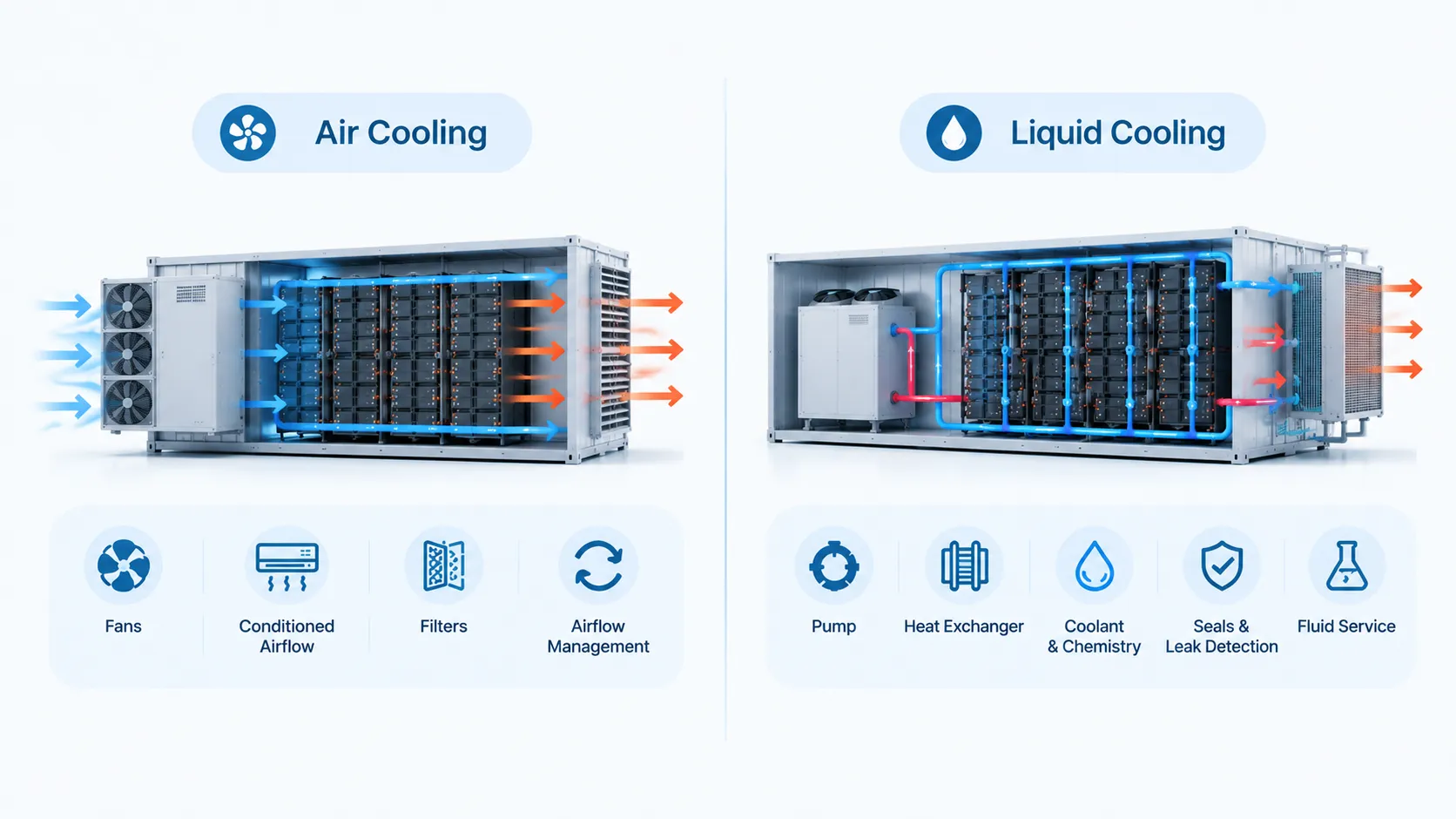
Air cooling uses fans and usually conditioned airflow to remove heat from modules and power equipment. It can reduce hydraulic complexity, but airflow resistance, recirculation, filters, and uneven paths require attention.
Liquid cooling circulates a heat-transfer fluid through plates or channels near heat sources, then rejects heat through a heat exchanger. This can support compact layouts and controlled heat transport, while adding pumps, seals, coolant chemistry, leak detection, and fluid-service procedures.
Liquid cooling circulates a heat-transfer fluid through plates or channels near heat sources, then rejects heat through a heat exchanger. This can support compact layouts and controlled heat transport, while adding pumps, seals, coolant chemistry, leak detection, and fluid-service procedures.
Balanced Comparison
| Decision factor | Air cooling | Liquid cooling |
|---|---|---|
| Typical fit | Lower heat density and service-accessible projects | Dense, high-throughput cabinets or containers |
| Key evidence | Airflow model, thermal map, filter and fan plan | Thermal map, hydraulic design, leak and coolant plan |
| Operational risk | Blocked filters, fan failure, dust, recirculation | Leaks, pump failure, corrosion, coolant degradation |
| Site impact | Ducting, clearance, noise, air cleanliness | Fluid service access, drainage or containment, freeze protection |
Application and Lifecycle Logic
Residential and smaller distributed systems often prioritize simplicity, noise, footprint, and technician availability.
Commercial sites and farms require a climate-specific assessment of dust, humidity, cycling, access, and downtime.
Dense industrial cabinets and containerized projects may justify liquid cooling when validated thermal control offsets added hydraulic complexity.
Evaluate auxiliary electricity across the actual load and weather profile; nameplate cooling power does not establish annual consumption.
Safety Considerations Beyond Cooling Selection
Safety selection extends beyond cooling.
The International Electrotechnical Commission explains in IEC 62933-5-2 that grid-integrated electrochemical storage requires system-level hazard consideration.
This supports reviewing thermal management together with controls, protection, installation, and emergency measures—not as an isolated feature.
For North American projects, UL Solutions states that UL 9540A evaluates thermal-runaway fire propagation in battery energy storage systems.
It does not rank liquid versus air cooling; it helps authorities and designers assess propagation behavior in a tested configuration.
Buyers should therefore verify the tested model and configuration rather than accept an unspecific claim.
The U.S. Department of Energy's Energy Storage Safety Strategic Plan emphasizes safety across design, validation, commissioning, operation, and incident response.
For procurement, that supports requesting operating limits, alarms, commissioning records, maintenance procedures, and response responsibilities throughout the system lifecycle.
Procurement Checklist
- Project ambient envelope, altitude, ingress exposure, duty cycle, and usable-capacity assumptions
- Temperature maps with sensor locations and complete test conditions
- Cooling power curves and the boundary used for efficiency calculations
- Airflow or hydraulic diagrams, redundancy, alarms, and failure response
- Filter, fan, pump, seal, coolant, corrosion, condensation, and freeze-control plans
- Installation clearances, noise, drainage, fire strategy, commissioning, and training
- Applicable standards and certifications, including exact model and configuration scope
- Warranty exclusions, preventive maintenance, spare parts, service ownership, and downtime assumptions
Conclusion
HT Infinite Power can use these project inputs when discussing residential, commercial, industrial, or containerized configurations.
Regardless of supplier, compare documented evidence under equivalent conditions before approving the cooling architecture.
Regardless of supplier, compare documented evidence under equivalent conditions before approving the cooling architecture.
Volts to Amps Calculator for Batteries, Inverters and Energy Storage
What Is Computing-Power Coordination?
Related Article