What is container energy storage and its applications and advantages?
2025-03-07

With the transformation of the global energy structure and the rapid development of renewable energy, energy storage technology has gradually become a key factor in supporting energy transformation. Container energy storage systems, with their modularity, mobility and high efficiency, have gradually emerged in the field of energy storage.
This article will introduce the working principle and advantages of container energy storage systems in detail.
1. Basic composition of container energy storage system

Container energy storage system is mainly composed of energy storage unit, energy conversion system, control system and auxiliary facilities. Among them, the energy storage unit is responsible for the storage and release of energy, the energy conversion system realizes the conversion and transmission of energy, the control system monitors and dispatches the entire system, and the auxiliary facilities include cooling system, fire protection system, etc. to ensure the safe operation of the system.

2. Working principle of energy storage unit
The energy storage unit of the container energy storage system generally uses batteries, supercapacitors or flywheels as energy storage media. Taking batteries as an example, its working principle is to convert electrical energy into chemical energy through chemical reactions for storage, and then convert chemical energy into electrical energy through reverse reactions when needed. Supercapacitors store charges through electric fields to achieve rapid storage and release of electrical energy. Flywheels use high-speed rotating flywheel bodies to store kinetic energy.
3. Energy conversion and transmission
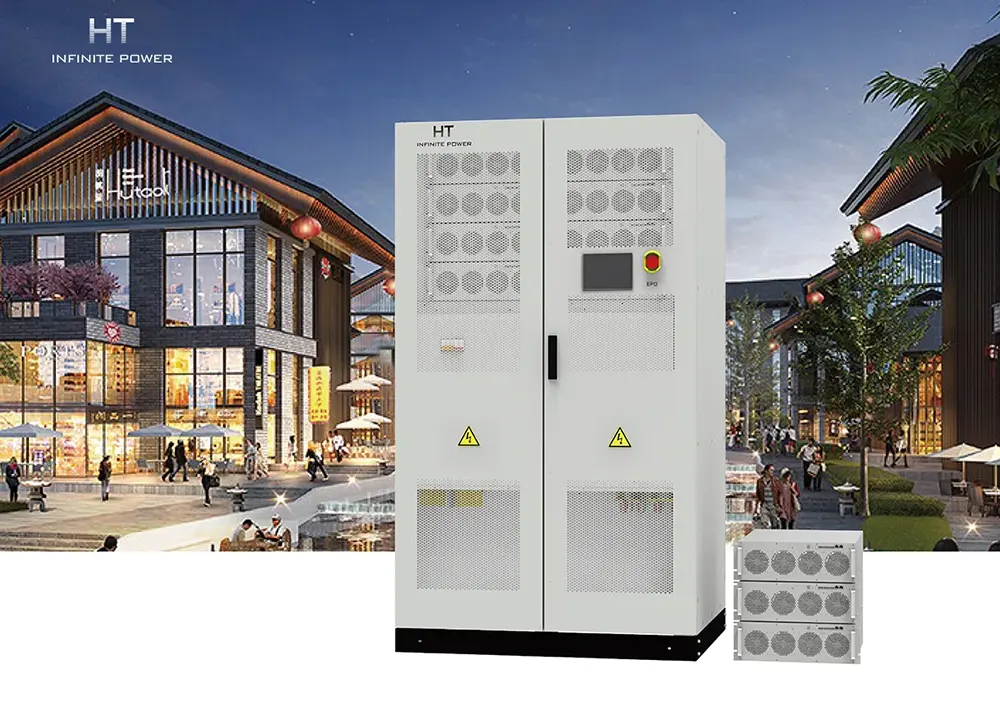
The energy conversion system of the container energy storage system mainly includes converters, inverters and other equipment. During the charging process, the converter converts the AC power of the external power grid into DC power suitable for charging the energy storage unit; during the discharge process, the inverter converts the DC power released by the energy storage unit into AC power for external loads. Through the energy conversion system, the container energy storage system can achieve flexible interconnection with the power grid or off-grid loads.
4.The role of the control system
The control system is the "brain" of the container energy storage system, responsible for real-time monitoring and scheduling of the operating status of the entire system. The control system collects and analyzes the operating data of key equipment such as energy storage units and energy conversion systems, optimizes and schedules the system according to the preset control strategy, and ensures safe and efficient operation of the system. At the same time, the control system also has remote communication functions, which can realize remote monitoring and operation and maintenance.
5. Importance of auxiliary facilities
The auxiliary facilities of the container energy storage system are crucial to ensure the safe and stable operation of the system. The cooling system is responsible for maintaining the appropriate operating temperature of key equipment such as the energy storage unit and the energy conversion system to prevent overheating and performance degradation or damage. The fire protection system can be activated in time in emergencies such as fires to prevent accidents from expanding and ensure the safety of personnel and equipment.
6. Advantages of container energy storage system

(1). Modular design:
Easy to produce and transport, and can flexibly configure energy storage capacity and power according to demand.
(2). Mobility:
The container structure is easy to relocate and reinstall, suitable for temporary or mobile application scenarios.
(3). High integration:
Integrate energy storage units, energy conversion systems, control systems, etc. into one, simplify system design, and improve space utilization.
(4). Fast response:
The energy storage unit has high power density and fast charging and discharging capabilities, which can meet instantaneous high power requirements.
(5). Environmental protection and energy saving:
Adopt clean energy storage technology to reduce fossil fuel consumption and pollutant emissions, and promote sustainable development.
7. Main application scenarios of container energy storage

(1). Power balance:
In large power stations or long-distance transmission lines, energy storage containers are important energy storage facilities for power balance, which can help regulate power supply and demand and ensure the stable operation of the power system.
(2). New energy power generation system:
For new energy power generation systems such as solar energy and wind energy, energy storage containers are key energy storage equipment, which can provide power support when wind and solar energy are insufficient to ensure the stable operation of the power generation system.
(3). Power grid peak and frequency regulation:
In power grid peak and frequency regulation, energy storage containers are indispensable energy storage facilities, which can help the power grid to adjust during peak and valley periods and improve the flexibility and reliability of the power grid.
(4). Industrial power distribution system:
In the industrial power distribution system, energy storage containers, as important energy storage equipment, can provide stable power supply for factories, mines, etc., to ensure continuous production.
(5). Public power system:
In public power systems such as large commercial, entertainment venues and public buildings, energy storage containers also play an important role, which can provide additional power support during peak power demand to ensure that power demand is met.
(6). Hydrogen production from renewable energy:
In the process of hydrogen production, storage and release from renewable energy, energy storage containers are important facilities that can help store and release hydrogen energy and promote the efficient use of renewable energy.
(7). Temporary power supply facilities:
In disasters or emergencies, energy storage containers can be used as temporary power supply facilities to provide emergency power support for remote areas or resource conversion sites.
(8). Industrial and commercial energy storage:
In industrial and commercial energy storage systems, energy storage containers reduce electricity costs and improve economic benefits through peak-valley arbitrage models. Users can charge during low electricity consumption and discharge during peak hours, thereby saving electricity costs and avoiding the risk of power outages.
8. Classification of container energy storage systems
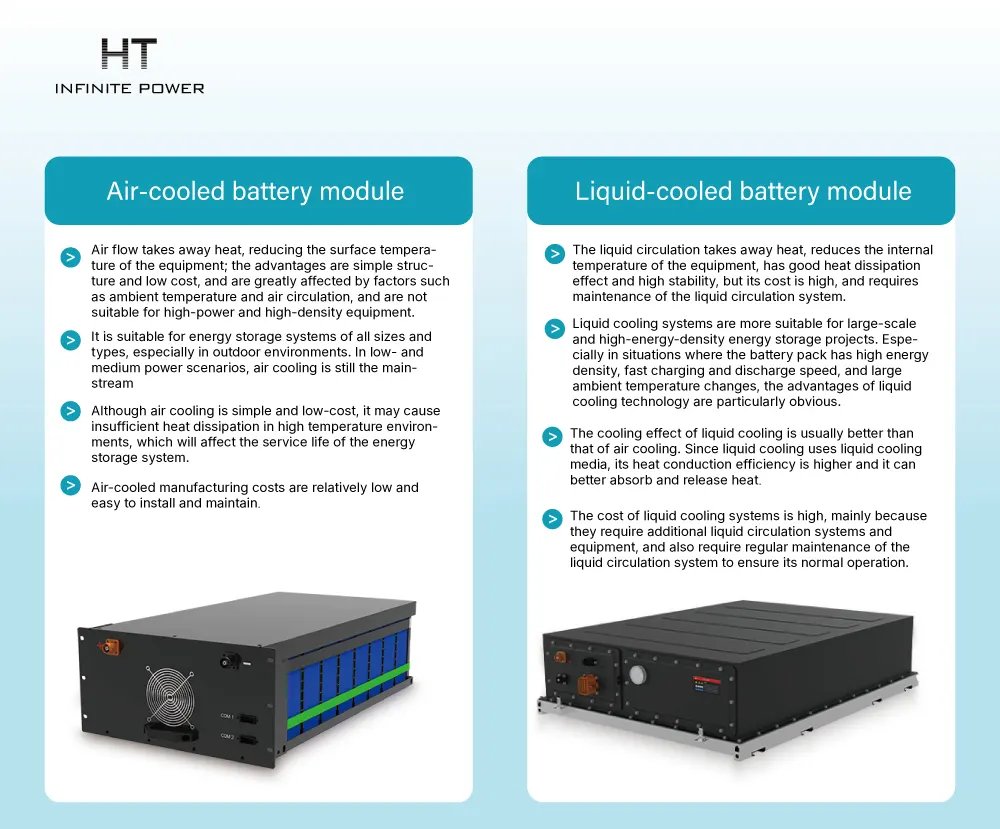
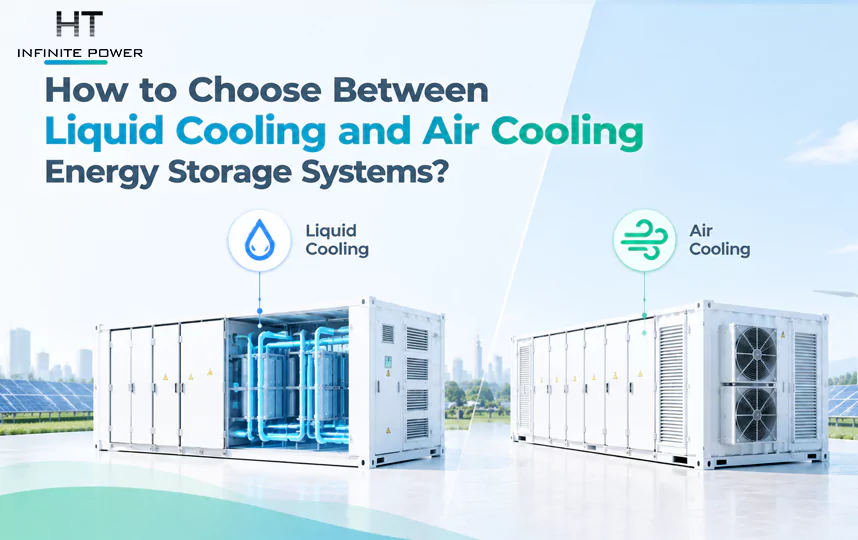
At present, container energy storage is mainly divided into two types: air cooling and liquid cooling according to different cooling methods.
(1). Different heat dissipation principles
Air cooling is to remove heat through air flow to reduce the surface temperature of the equipment. The advantages of air cooling are simple structure and low cost, but its heat dissipation effect is greatly affected by factors such as ambient temperature and air circulation, and is not suitable for high-power and high-density equipment.
Liquid cooling is to remove heat through liquid circulation to reduce the internal temperature of the equipment. The advantages of liquid cooling are good heat dissipation effect and high stability, but its cost is high and the liquid circulation system needs to be maintained.
(2). Different applicable scenarios
The air cooling system is suitable for energy storage systems of various sizes and types, especially in outdoor environments. In medium and low power scenarios, air cooling is still the mainstream. The liquid cooling system is more suitable for large-scale, high-energy density energy storage projects, especially in situations where the battery pack has high energy density, fast charging and discharging speed, and large ambient temperature changes, the advantages of liquid cooling technology are particularly obvious.
(3). Heat dissipation effect
The heat dissipation effect of liquid cooling is usually better than that of air cooling. Since liquid cooling uses liquid cooling medium, its heat conduction efficiency is higher and it can better absorb and release heat. Although air cooling is simple and low-cost, it may cause insufficient heat dissipation in high-temperature environments, affecting the service life of the energy storage system.
(4). Cost and maintenance
The manufacturing cost of air cooling is relatively low, and it is easy to install and maintain. The cost of the liquid cooling system is relatively high, mainly because it requires additional liquid circulation systems and equipment, and the liquid circulation system needs to be regularly maintained to ensure its normal operation.
In general, air cooling and liquid cooling each have their own advantages and disadvantages and applicable scenarios. When choosing, it is necessary to make comprehensive considerations based on the specific needs, budget and environmental conditions of the energy storage system. In the future, with the implementation of more high-power energy storage projects and the continuous development of battery technology, the demand for liquid cooling technology may gradually increase.
In summary
Container energy storage systems have broad application prospects in the field of energy storage due to their unique advantages. Container energy storage systems are mainly composed of energy storage units, energy conversion systems, control systems and auxiliary facilities. With the continuous advancement of technology and the reduction of costs, container energy storage systems will play an increasingly important role in the future energy system and promote the green transformation of the global energy structure.
PCS vs. Inverters in Energy Storage: Functions and Applications
What is lithium titanate battery ?