How Federal Policy Shifts Are Reshaping the U.S. Energy Storage Outlook
2025-11-03

Walk into a project-control room in 2025 and the first thing you notice is a new vocabulary: “triage,” “policy-scenarios,” “queue pressure.” The tone moved this year from confident expansion to cautious planning. That shift tracks to a handful of federal moves—grant cancellations, re-scoped programs and tighter administrative tax guidance—that together changed the economics and timing assumptions underpinning many storage projects and U.S. manufacturing bets. These policy actions didn’t break the storage case — demand drivers remain — but they reshuffled who can build, how quickly, and under what financing terms.
Policy volatility in 2025: a quick scene-setting
In mid-2025 federal agencies began re-evaluating awards and programs issued earlier in the decade. The Department of Energy’s review and termination of several hundred awards — announced as stewardship of taxpayer dollars — suddenly removed billions that had been expected to underwrite demonstrations, manufacturing support and grid resilience projects. The headlines prompted immediate legal and financial reviews at developers and forced lenders to rethink exposure.
At the same time, new legislative and administrative rules tightened the conditions around tax incentives and procurement preferences, creating ambiguity for projects that had been modeled on earlier assumptions. The net effect: large parts of the pipeline accelerated into a “rush-to-file” phase while financing desks tightened covenants and loan tenors. Industry trackers still report record installation numbers in 2025, but warn of a more uncertain 2026–27 unless policy clarity returns.

Immediate market responses: what developers and financiers are doing
Rush-to-file and queue congestion — signals from interconnection desks
The rush looked like lives run against a deadline: engineering teams scrambling to get applications out, interconnection portals logging surges, and project managers reprioritizing sites that could show immediate offtake or site control. That behavior worsened queue congestion in many ISOs and RTOs, converting administrative uncertainty into real construction delay for projects that couldn’t prove immediate bankability. The upshot was a temporary pile-up of “permitting-stalled” projects even as quarterly installation records were posted.
Debt repricing and more conservative financing
Banks moved from predictive optimism to conservative underwriting: higher DSCR thresholds for merchant exposure, larger letters of credit, and shorter tenors on construction loans. Lenders did not stop financing; they simply demanded clearer revenue stacks — corporate PPAs, state incentives, or multi-year capacity contracts — before committing to long tenors. Smaller developers reliant on grant sweeteners felt that pressure first.
Manufacturing and investment implications: timing, scale, and scenarios
Factory investment is a long game; policy wobble rewrites the math.
Phased CAPEX and export-first playbooks
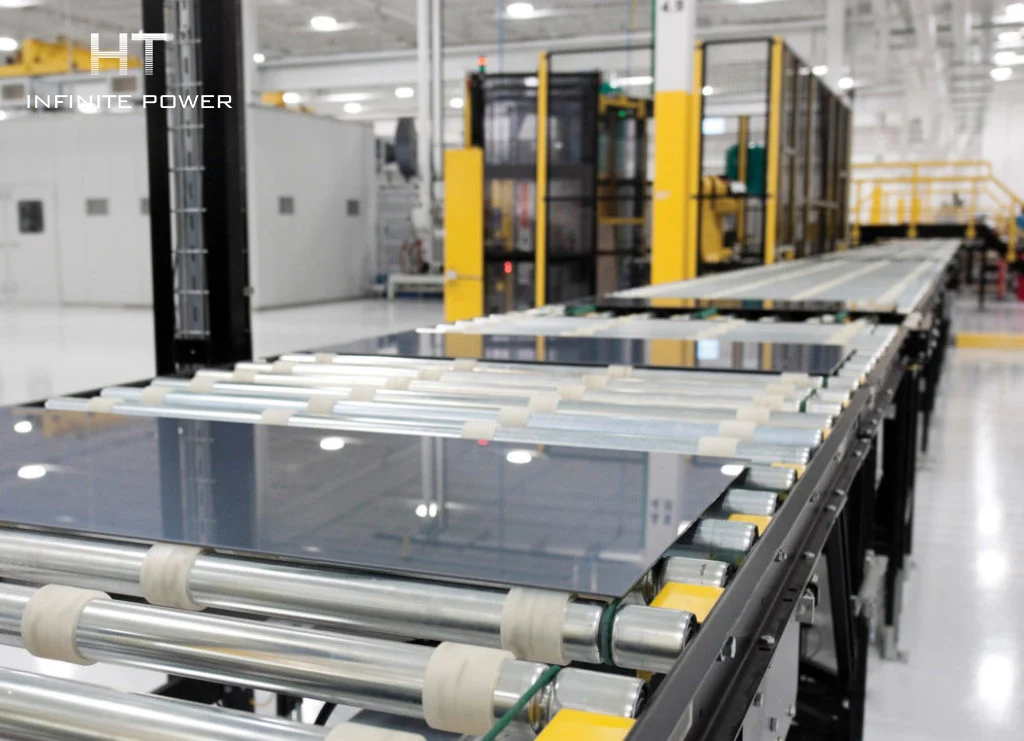
Several manufacturers quietly shifted to staged investments: start with module/test lines or local assembly (lower capex), and defer full cell-line buildouts until demand signals firm. Others redirected early output to export markets with stable incentives, preserving optionality for the U.S. while hedging near-term policy risk. That behavior reduces headline factory announcements but keeps supply chains flexible.
Scenario-driven underwriting for boards
Investor committees now expect scenario tables — “full incentive / partial incentive / no federal support” — with sensitivity on tax-credit timing, interconnection lead times, and merchant price assumptions. Boards increasingly require that projects meet at least one conservative scenario before greenlighting CAPEX, slowing down approvals but improving risk discipline.
Winners, losers and fast adapters: who feels policy swings most
Policy whiplash is not democratic.
Most exposed: small developers and specialized suppliers
Smaller firms, early-stage IPPs and narrow-balance-sheet suppliers are most dependent on grants and predictable tax treatments; they are the first to see projects delayed or finance tightened.
More resilient: large utilities and global groups
Integrated utilities and multinational developers can shuffle projects across geographies, cross-subsidize or take longer financing tenors, making them more insulated from federal noise.
Fast adapters: commercial model innovation
Firms adopting EaaS, staged rollouts, modular hardware and comprehensive O&M offerings are closing deals because they reduce buyer risk. In practice, vendors that present a clear “day-one to day-1,825” maintenance and spare-parts plan win procurement conversations in 2025.
Three pragmatic moves for developers, manufacturers and policymakers
This is intentionally tactical — what teams are actually doing and what policymakers can do to stabilize markets.

1. Stress-test projects across concrete policy scenarios
Model cash flows for “full credits,” “delayed credits,” and “no federal support.” Include +12–18 month permitting risk and use conservative merchant price curves. Use these scenarios as gating criteria for committing long-lead equipment.
2. Design modular, finance-friendly projects
Staged battery additions, local pack assembly and flexible procurement let developers convert one big CAPEX into smaller, financeable tranches. That reduces timing risk and lets revenue stacking evolve as market rules clarify.
3. Layer state and private incentives
Stack state rebates, utility programs and corporate PPAs to dilute federal exposure. Policymakers can help by publishing clear administrative timelines (IRS/Treasury guidance) — even modest clarity materially restores lender confidence.
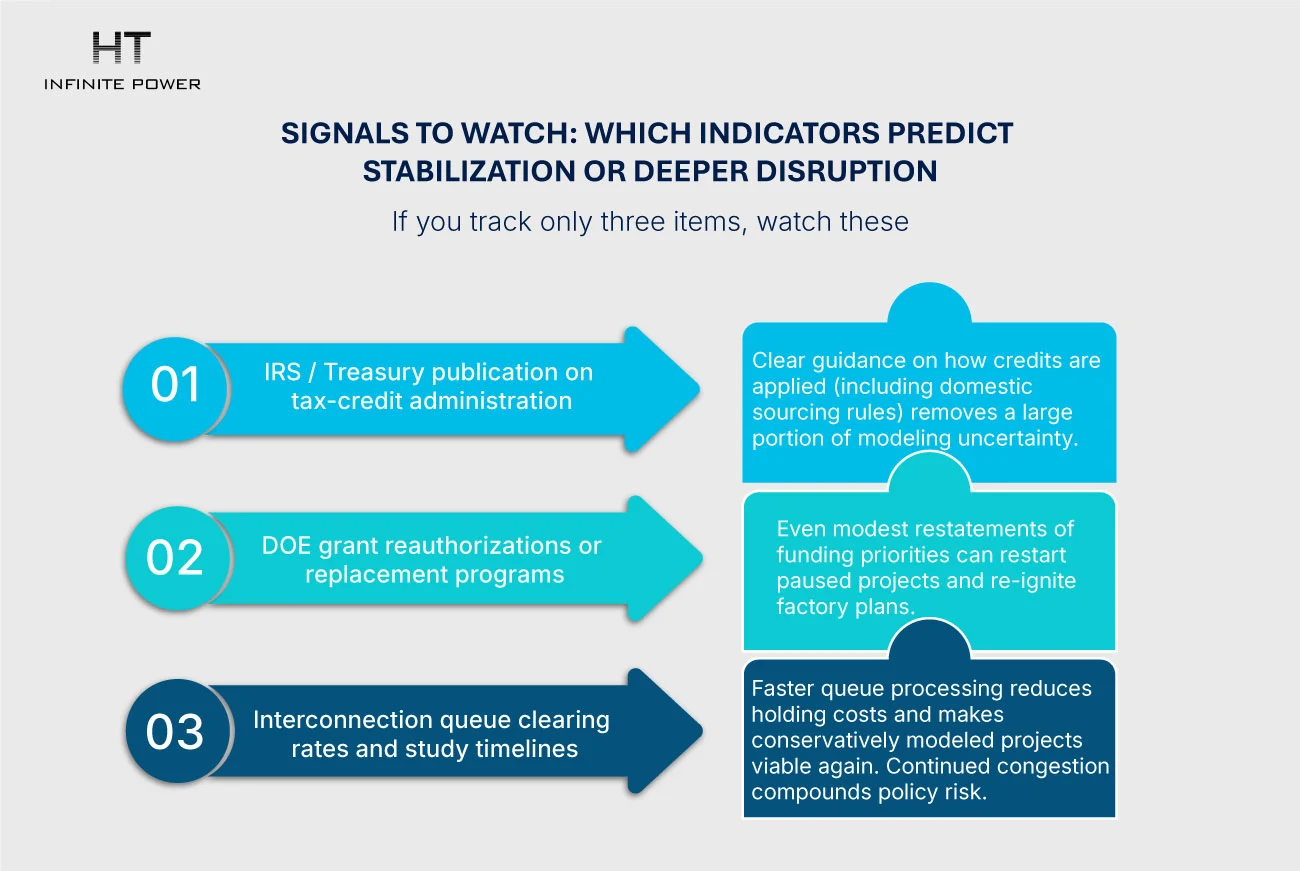
Signals to watch: which indicators predict stabilization or deeper disruption
If you track only three items, watch these:
1. IRS / Treasury publication on tax-credit administration
Clear guidance on how credits are applied (including domestic sourcing rules) removes a large portion of modeling uncertainty.
2. DOE grant reauthorizations or replacement programs
Even modest restatements of funding priorities can restart paused projects and re-ignite factory plans.
3. Interconnection queue clearing rates and study timelines
Faster queue processing reduces holding costs and makes conservatively modeled projects viable again. Continued congestion compounds policy risk.
Long view: temporary wobble or structural shift?
Short-term, the market is wobbling — projects pause, finance tightens, and some factory plans are deferred. But long-term fundamentals remain compelling: falling battery costs, increasing grid flexibility needs, and commercial demand for resilience. The most likely structural change is regionalization of growth and a greater role for state/local policy and corporate offtakes. That means the U.S. may still lead overall capacity, but manufacturing footprints and project timing could tilt toward jurisdictions with stable, predictable policy signals.
Conclusion: treat policy as risk to manage, not as an anchor
For practitioners, the takeaway is plain: build optionality. Design projects modularly, insist on conservative underwriting assumptions, and use state and private stacks to bridge federal uncertainty. For policymakers, the message is equally simple — clarity matters more than occasional largesse. Publish rules, set timelines for tax-credit administration, and underwrite a small, well-scoped set of manufacturing supports to keep capital engaged. The market’s long-run direction hasn’t reversed; it’s simply asking for clearer signals about timing and scale.
FAQ
Q: Is the U.S. storage market collapsing?
A: No — fundamentals remain intact. But near-term project timing and some factory plans are being re-priced due to policy uncertainty.
A: No — fundamentals remain intact. But near-term project timing and some factory plans are being re-priced due to policy uncertainty.
Q: Should manufacturers pause U.S. factory plans?
A: Not necessarily. Consider phased builds, export-first models, and scenario-driven commitments.
A: Not necessarily. Consider phased builds, export-first models, and scenario-driven commitments.
Q: Can states fill federal gaps?
A: Partially — state incentives can bridge economics, but large federal manufacturing programs remain harder to replace fully.
A: Partially — state incentives can bridge economics, but large federal manufacturing programs remain harder to replace fully.
Q: What’s the single best short-term recovery signal?
A: Clear IRS/Treasury guidance on tax-credit application and recognized grant reauthorizations.
A: Clear IRS/Treasury guidance on tax-credit application and recognized grant reauthorizations.
Fast-Ramp Battery Packs: Design for High C-Rate Industrial Use
Grid-Scale vs Distributed Storage: Where the Real Growth Lies