Europe's Energy Storage Boom: What It Means for Global Manufacturers
2025-10-16

Europe is building batteries at a scale and speed that just a few years ago would have seemed unlikely. Rapid additions of grid-scale battery capacity, clearer product-level rules from Brussels and a raft of national programs have turned Europe into a high-pressure market for battery cells, modules and turnkey systems. For global manufacturers — from cell makers to system integrators — the opportunity is obvious. But so are the new constraints: localization requirements, lifecycle reporting, and delivery complexity now shape who wins and who lags. This article maps the boom, explains the commercial levers, and offers a practical strategic playbook for manufacturers that want to succeed in Europe and in other fast-moving markets.
Quick market snapshot: scale and speed
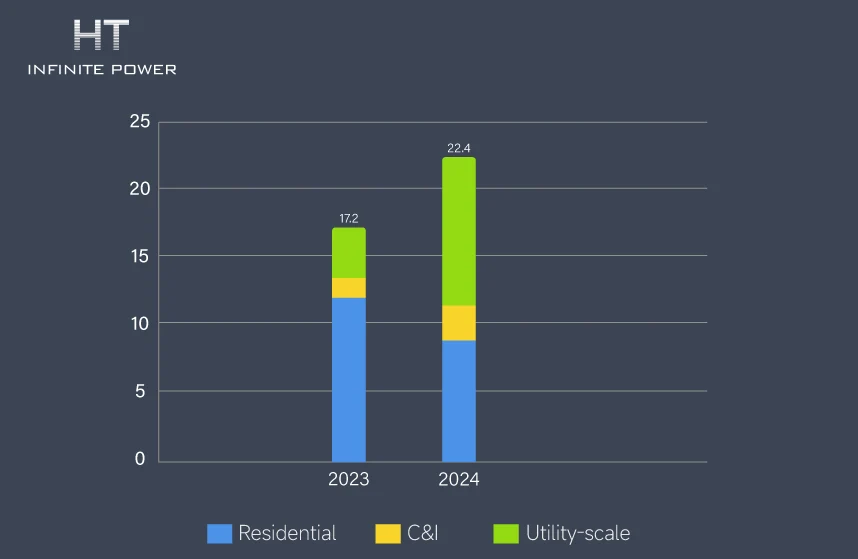
European battery energy storage installations have surged in recent years. Industry trackers reported that Europe installed record volumes through 2024 and into 2025, with double-digit growth and significant deployment pipelines in key markets such as the UK, Germany, Spain and Italy. Analysts forecast Europe will reach many tens of GWh by the end of the decade as merchant, utility and ancillary-service uses scale.
Country snapshots underline the pace: the UK now approaches ~10 GWh of operational large-scale BESS, while Germany’s operational capacity and construction pipelines surged in 2025—figures that reflect both rapid permitting and developer appetite. Those national builds feed a continental demand signal that global suppliers cannot ignore.
Why Europe is different: policy, grid needs and procurement signals
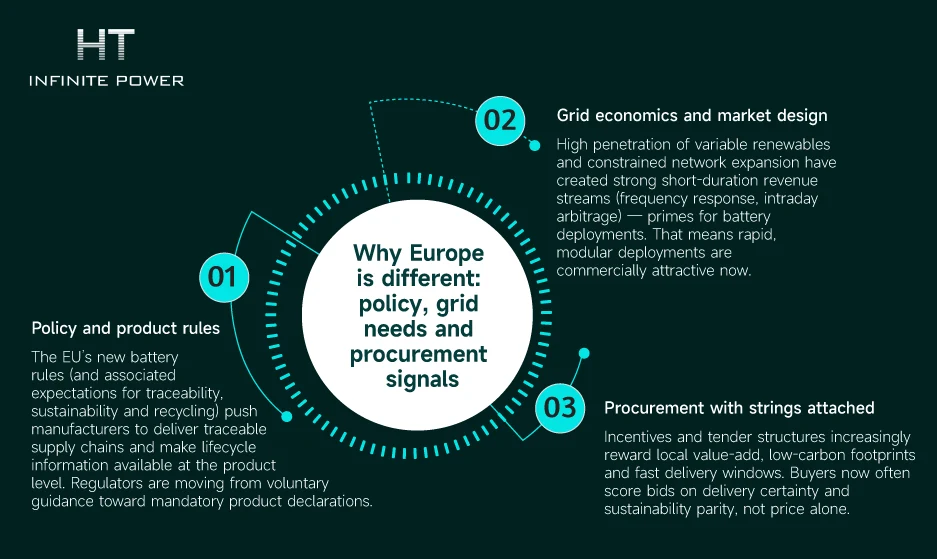
Three structural factors make Europe a distinctive market:
1.Policy and product rules
The EU’s new battery rules (and associated expectations for traceability, sustainability and recycling) push manufacturers to deliver traceable supply chains and make lifecycle information available at the product level. Regulators are moving from voluntary guidance toward mandatory product declarations.
2.Grid economics and market design
High penetration of variable renewables and constrained network expansion have created strong short-duration revenue streams (frequency response, intraday arbitrage) — primes for battery deployments. That means rapid, modular deployments are commercially attractive now.
3.Procurement with strings attached
Incentives and tender structures increasingly reward local value-add, low-carbon footprints and fast delivery windows. Buyers now often score bids on delivery certainty and sustainability parity, not price alone.
Put together, these forces create a market that rewards suppliers who can combine manufacturing scale, credible environmental claims and the ability to service projects on the ground.
Who’s winning today: cells, modules and integrators (market dynamics)
Europe’s demand profile creates room for several supplier archetypes — and each has advantages.
- Global cell manufacturers with local or near-shore plants. They win where scale and chemistry leadership matter. Local plants avoid long, complex cross-border logistics and can be positioned to meet regulatory and procurement content requirements.
- Module and pack specialists. These firms add mechanical design, thermal systems and testing expertise; they become natural partners for cell producers that prefer to remain component-focused.
- System integrators and EPCs. Turnkey providers that can manage permitting, interconnection and commissioning reduce owner risk and increasingly capture large grid projects where single-point accountability is prized.
Winners so far are those that align product availability with local deployment windows, and those that demonstrate traceability and compliance. The market has pushed integrators and cell firms to cooperate more closely — long-term supply agreements, co-located assembly and joint warranties are becoming common.
Supply-chain pain points: localization, lead times and certification
The boom has exposed friction points that matter for commercial success.
- Localization pressure. Buyers and regulators prize local value-add. For manufacturers with only overseas plants, winning tenders in some EU jurisdictions now requires partnerships, local assembly or validated subcontracting.
- Lead times and inventory. Rapid procurement windows collide with long upstream lead times for cells and critical materials. Manufacturers that cannot guarantee delivery or that hold minimal buffer inventory lose competitive tenders or face penalties.
- Certification & grid approvals. Each market and even each grid operator can have specific testing and safety expectations. A supplier’s certification backlog can delay project COD (commercial operation date) and cost developers penalties — so certification readiness is a commercial differentiator.
- Workforce and installation bottlenecks. Rapid project queues stress local installation capacity and O&M resources; integrators with local service footprints can turn this into an advantage.
In practice, overcoming these pain points often requires investment — not only in factories but in local teams, certification labs and partner ecosystems.
Strategic options for global manufacturers: localize, partner, or specialize
Faced with the European signal, manufacturers typically consider three paths.
1.Localize manufacturing (build plants / co-locate assembly)
Pros: faster delivery, local content credentials, lower transport emissions and easier regulatory alignment. Cons: capex-intensive and exposes firms to new labor, permitting, and energy-price risks.
2.Partner and assemble locally
Pros: lower capital outlay, faster market access via a local partner; still demonstrates local value-add if assembly is significant. Cons: requires tight quality and traceability controls, and legal contracts to manage warranty and liability.
3.Specialize and outsource integration
Maintain focus on cell chemistries, scale production in low-cost locations, and sell to local integrators/EPCs. Pros: maintain core cost advantage. Cons: may lose out on tenders that prize turnkey delivery or local content.
There is no one right answer. The profitable strategy depends on the firm’s balance sheet, portfolio, and appetite for operational complexity. Many firms will adopt hybrid approaches: keep large-volume, commodity production in existing hubs while building smaller regional assembly plants or partnerships for local compliance.
Sustainability & LCA: how carbon and circularity shape procurement
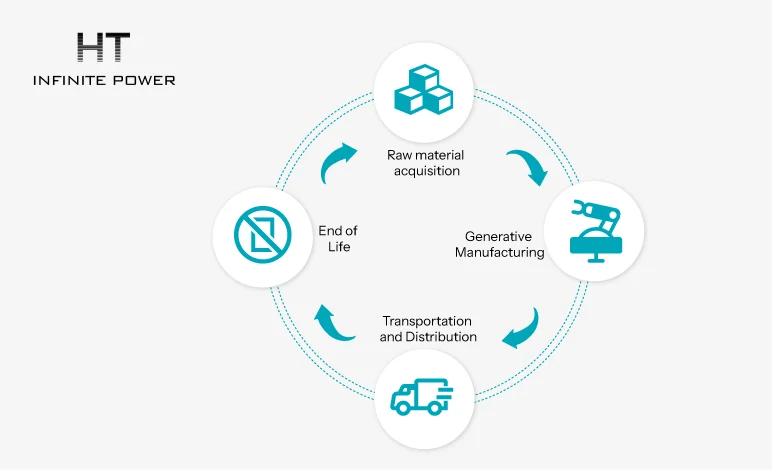
Sustainability is no longer optional rhetoric — it’s a procurement criterion. The EU Battery Regulation and buyer expectations push lifecycle transparency: EPDs, supplier traceability and recycling plans are increasingly table stakes. Manufacturers that can credibly show lower production emissions — by using clean electricity in factories, improving material sourcing or designing for reuse — get preferential scoring in tenders.
Practical implications:
- Investment in renewable PPAs for factories yields quick reductions in reported cradle-to-gate emissions.
- Second-life and recycling partnerships reduce net lifecycle impact and create new revenue streams from recovered materials.
- Transparent, third-party-verified LCA work lets manufacturers avoid being excluded on sustainability grounds.
For global manufacturers, sustainability investments improve competitive positioning in Europe and future-proof access to other markets where lifecycle claims will follow.
Practical playbook: 10 tactical moves for the next 12–24 months
Map procurement rules by country and by major tender issuer. Know the local content and LCA expectations before bidding.
Secure near-term assembly partners in priority markets (UK, Germany, Spain, Italy). Local assembly often clears content/traceability checks.
Lock in long-lead materials and cells via multi-year agreements to protect delivery windows.
Invest in third-party LCA audits and publish EPDs. Procurement teams prize independent verification.
Negotiate PPAs or onsite renewables for factories to lower disclosed manufacturing emissions quickly.
Standardize module families for repeatable regional deployments — repeatability reduces engineering hours and site issues.
Build or partner for EU recycling and second-life programs to capture circular value and meet regulatory expectations.
Pre-certify equipment for major grid codes in target countries to speed commissioning.
Offer hybrid commercial terms (e.g., supply + local assembly + limited warranty) that reduce perceived risk for buyers.
Monitor market intelligence and shift capacity toward the fastest growth corridors in Europe — agility matters.
Conclusion — where to place bets
Europe’s storage boom is a market-designed stress test for global manufacturers. Winning requires more than low per-kWh manufacturing cost; it demands delivery certainty, product traceability, sustainability credentials and the ability to operate inside national procurement rules. For some firms, the right move is local factories. For others, it is partnerships, pre-assembly, or focused specialization paired with trusted integration partners. The short window for deployment in many tenders rewards those who act decisively — the next 18 months will sort leaders from laggards.
FAQ
Q1: Is Europe’s storage growth a short-term spike or a structural change?
A: Structural. Policy, market design and high renewable penetration create recurring revenue models for storage; growth is expected to continue through the decade.
Q2: Should a non-European cell manufacturer build a local plant?
A: Not always. Evaluate total cost (capex, local energy, labor) vs the value of local content scoring in tenders; many firms find local assembly partners are a faster, lower-risk route.
A: Not always. Evaluate total cost (capex, local energy, labor) vs the value of local content scoring in tenders; many firms find local assembly partners are a faster, lower-risk route.
Q3: How important is lifecycle carbon reporting for bids?
A: Very. The EU Battery Regulation and buyer practices increasingly treat EPDs and verified LCAs as procurement criteria, not optional marketing.
A: Very. The EU Battery Regulation and buyer practices increasingly treat EPDs and verified LCAs as procurement criteria, not optional marketing.
Q4: Which European countries should manufacturers prioritize?
A: Start with the UK, Germany, Spain and Italy — all have large pipelines or mature markets — then layer in countries with strong policy incentives or rapid grid-scale buildouts.
A: Start with the UK, Germany, Spain and Italy — all have large pipelines or mature markets — then layer in countries with strong policy incentives or rapid grid-scale buildouts.
Q5: Can sustainability investments pay off commercially?
A: Yes — via preferential tender scoring, eligibility for green incentives, and reduced risk of future regulatory exclusion. They also lower lifecycle emissions, which matters to corporate buyers and financiers.
A: Yes — via preferential tender scoring, eligibility for green incentives, and reduced risk of future regulatory exclusion. They also lower lifecycle emissions, which matters to corporate buyers and financiers.
Why Modular Energy Storage Systems Are the Future of Scalable Power Solutions
System Integrators vs Cell & Module Manufacturers: Cost, Customization and Global Delivery