Energy Battery Cell vs Power Battery Cell: Which One Is Used in Energy Storage Systems?
author: HT infinitepower
2026-09-07
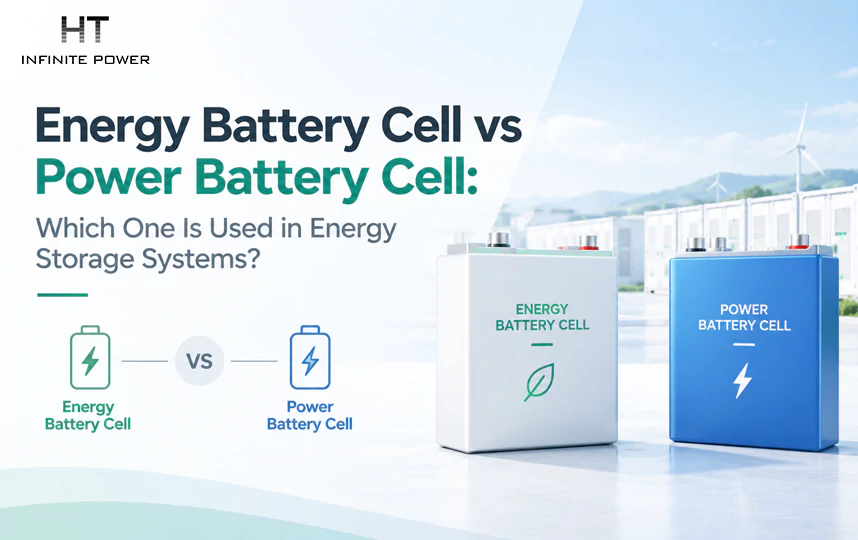
Battery cells used in a battery energy storage system are designed for different operating requirements. Some cells prioritize energy capacity for longer-duration storage, while others focus on power capability and fast response.
The majority of commercial BESS projects today use energy-type cells, while power-type cells are mainly selected for applications where response speed and high power output are critical.
This difference directly affects BESS battery selection, system configuration, and lifecycle economics.
In commercial BESS design, engineers evaluate key parameters including power requirement (kW), energy capacity (kWh), discharge duration, cycling frequency, and operating conditions.
Most commercial BESS projects use energy-type cells because applications such as peak shaving and energy arbitrage prioritize energy capacity and discharge duration. Power-type cells are mainly selected for high-power applications such as frequency regulation. Power-type cells are mainly considered for applications requiring rapid response and high-power output, such as frequency regulation.
1. What Is an Energy-Type Battery Cell?
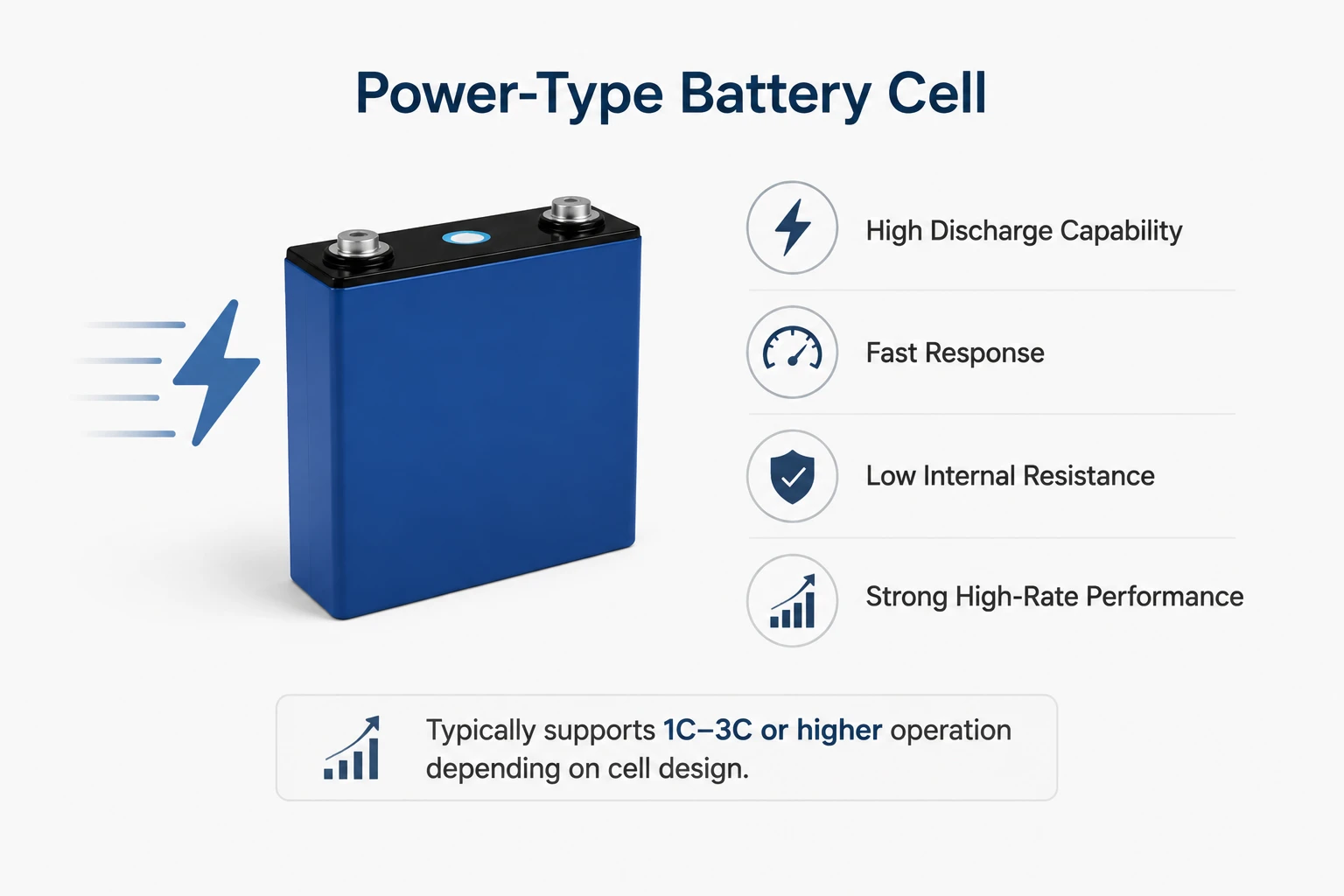
An energy-type battery cell is designed to provide high energy capacity and support longer-duration operation.
Its main characteristics include:
- High energy capacity
- Long discharge duration
- High energy density
- Lower cost per kWh
Energy-type cells typically operate at 0.25C–0.5C.
C-rate describes the relationship between battery capacity and charging or discharging power. For example, a 1 MWh battery operating at 0.5C can provide approximately 500 kW output for two hours.
These characteristics make energy-type cells suitable for applications where stored energy is the primary requirement, including:
- Peak shaving
- Energy arbitrage
- Renewable energy shifting
- Commercial battery storage systems
For these projects, battery capacity sizing is usually determined by load profile, required discharge duration, and operating strategy.
2. What Is a Power-Type Battery Cell?
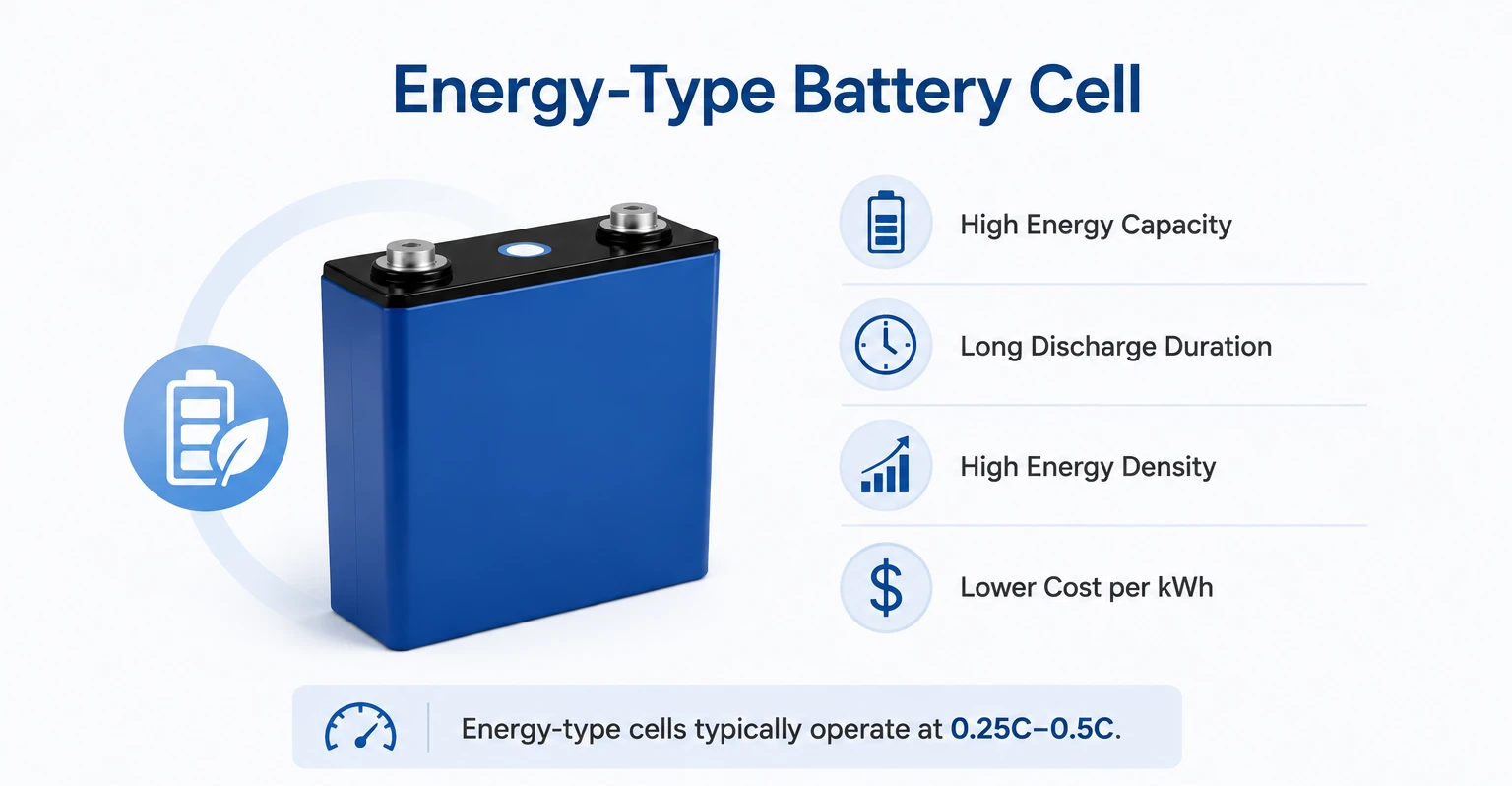
A power-type battery cell is designed for applications requiring higher power output and faster response.
Its design priorities include:
Its design priorities include:
- High discharge capability
- Fast response
- Low internal resistance
- Strong high-rate performance
Power-type cells typically support 1C–3C or higher operation depending on cell design.
For example, a 1 MWh battery operating at 2C could theoretically deliver 2 MW output for approximately 30 minutes.
These cells are commonly applied in:
- Frequency regulation
- Grid services
- UPS systems
- Short-duration high-power applications
In these applications, system value mainly comes from rapid power response rather than long-duration energy delivery.
3. Energy-Type vs Power-Type Battery Cells Comparison
| Comparison Factor | Energy-Type Battery Cell | Power-Type Battery Cell |
|---|---|---|
| Main purpose | Higher energy capacity | Higher power capability |
| Typical duration | 2–4 hours or longer | Seconds to short duration |
| Energy capacity | Priority on kWh capacity | Balanced with power output |
| Power capability | Moderate discharge rate | High discharge rate |
| Typical C-rate | 0.25C–0.5C | 1C–3C or higher |
| Internal resistance | Optimized for energy efficiency | Optimized for high-power operation |
| Thermal requirements | Moderate under normal operation | Higher requirements during frequent high-rate cycling |
| Typical applications | Peak shaving, energy arbitrage, commercial BESS | Frequency regulation, grid services |
| BESS suitability | Energy-focused projects | Power-focused projects |
Actual performance depends on cell design, operating conditions, and system configuration.
During energy storage system design, engineers evaluate the relationship between:
- Battery capacity (kWh)
- PCS power rating (kW)
- Discharge duration
- Power-to-energy ratio (P/E ratio)
Battery cell selection is based on system requirements rather than a single specification.
4. Which Battery Cell Type Is Used in BESS?
Battery cell selection depends on the operating profile of the project.
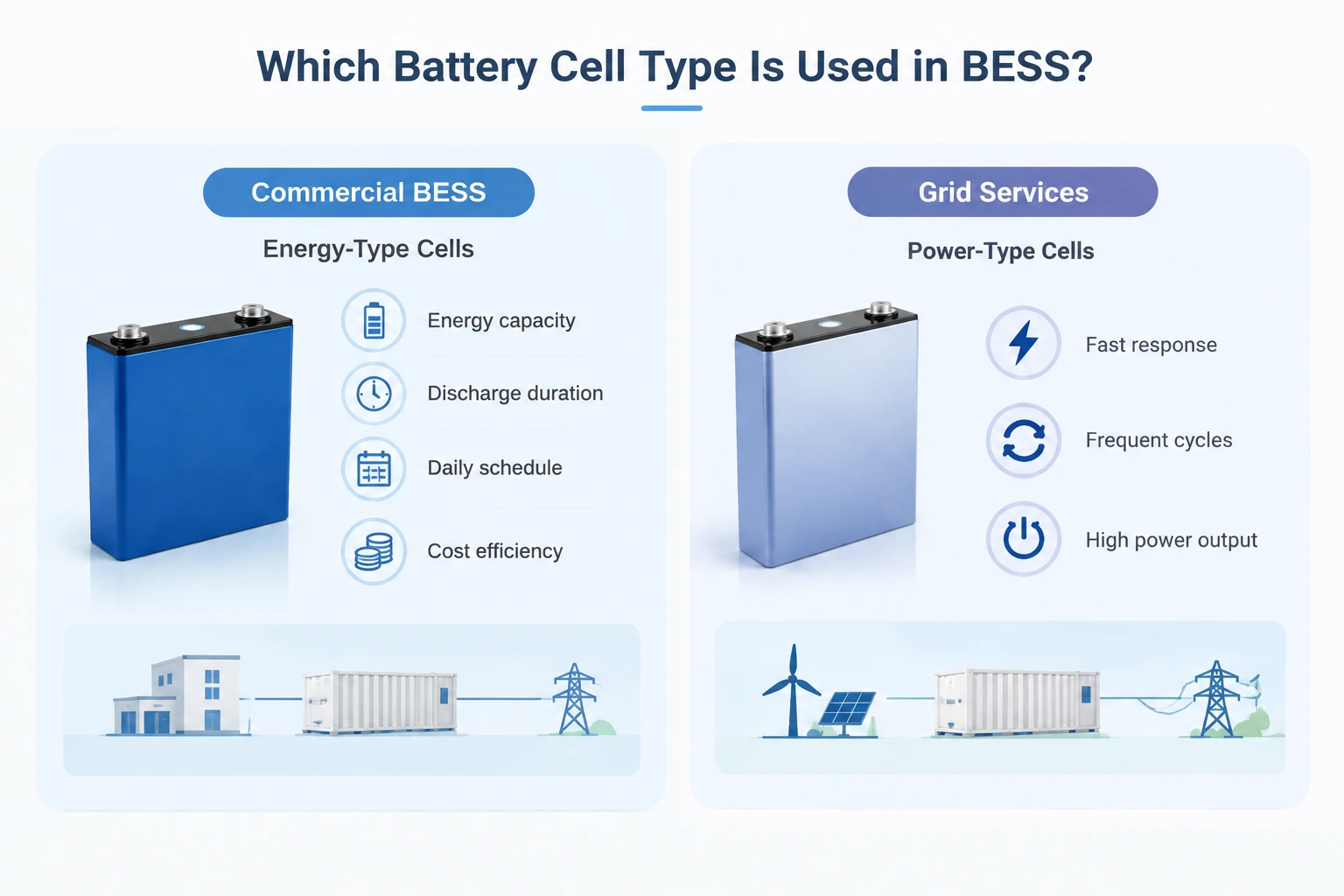
For most commercial applications, energy-type cells are commonly selected because these systems require controlled energy delivery over a defined operating period.
4.1 Commercial BESS Applications: Energy-Type Cells
Peak shaving and energy arbitrage projects typically focus on:
- Energy capacity
- Discharge duration
- Daily operating schedule
- Cost efficiency
For example, a factory using BESS for peak shaving may require the system to reduce demand during several high-load periods each day.
The required configuration is determined through:
- Load profile analysis
- Peak demand level
- Required power output
- Battery duration
Additional battery capacity only creates value when it can be effectively utilized within the operating strategy.
4.2 Grid Services: Power-Type Cells
Frequency regulation and grid service applications have different operating requirements.
These systems require:
- Fast response
- Frequent charge and discharge cycles
- High power output
A frequency regulation system may adjust output continuously according to grid signals. The primary requirement is rapid power response rather than extended energy delivery.
Power-type cells can support these operating conditions, However, cell selection depends on the required power-to-energy ratio rather than application name alone.but system design must also consider degradation, thermal performance, and lifecycle economics.
5. How Battery Cell Selection Affects BESS Design
Battery cell characteristics influence the overall battery energy storage system configuration, including PCS selection, thermal management, and EMS strategy.
PCS Selection
Battery capacity and PCS power rating must be matched according to the application requirements.
A battery with sufficient energy capacity may still be unable to deliver the required power output if the PCS rating or cell power capability is insufficient.
For example, two 1 MWh systems can have different operating characteristics. One may be designed for 250 kW output over four hours, while another may require 2 MW output for short-duration operation.
During commercial BESS design, engineers consider:
- Battery capacity (kWh)
- PCS rating (kW)
- C-rate capability
- Required discharge duration
Proper matching ensures the battery system can deliver the expected performance throughout operation.
Thermal Management
Battery cell characteristics also affect thermal design requirements.
Higher C-rate operation generally produces more heat because of increased current flow and internal losses. Systems with frequent high-power cycling require stronger cooling capability and tighter temperature control.
Thermal design considerations include:
- Heat dissipation capability
- Cell and module temperature uniformity
- Operating environment
- Cycling profile
Energy-focused systems typically operate at lower power intensity, while power-focused applications require more demanding thermal management due to frequent high-rate operation.
EMS Strategy
The EMS determines how the battery system operates within its application.
For energy-focused applications, EMS mainly manages:
- Charge and discharge scheduling
- State of charge (SOC)
- Energy cost optimization
For power-focused applications, EMS must support:
- Fast response control
- Frequent power adjustments
- Grid interaction
A properly configured EMS coordinates battery operation with PCS performance and external operating conditions to maintain system efficiency and reliability.
6. How Engineers Select Battery Cells for Energy Storage Projects
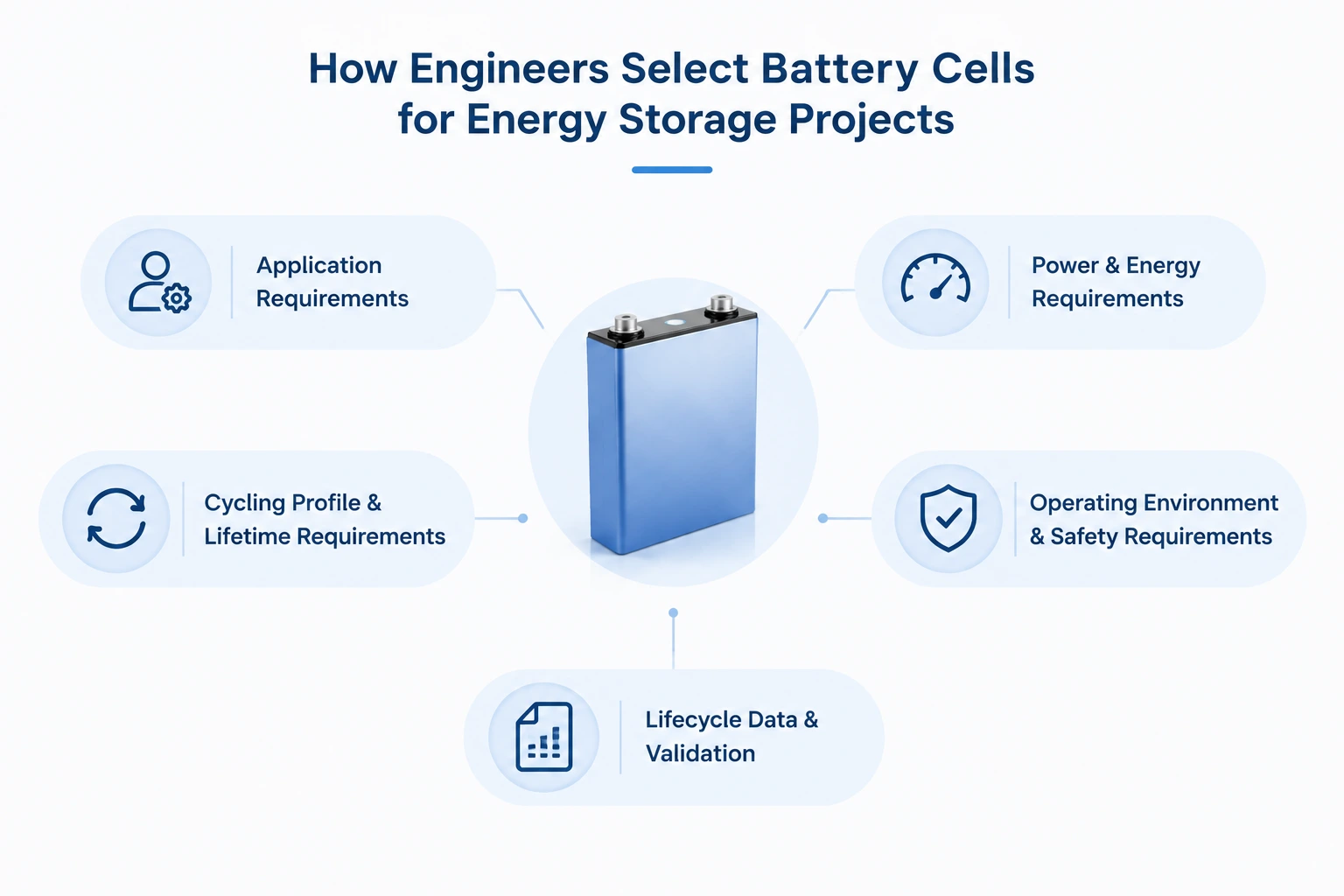
Battery cell selection is part of the overall energy storage system design process.
Engineers typically evaluate:
Application Requirements
The first step is identifying the system objective, such as peak shaving, energy arbitrage, renewable integration, frequency regulation, or backup power.
Power and Energy Requirements
The relationship between kW and kWh determines the required battery configuration.
Long-duration applications usually require higher energy capacity, while high-power applications require stronger discharge capability and higher power-to-energy ratios.
Cycling Profile and Lifetime Requirements
Operating frequency affects degradation, thermal stress, and long-term capacity retention.
A battery designed for occasional energy shifting may not be suitable for continuous high-power operation.
Operating Environment and Safety Requirements
Battery selection also considers:
Ambient temperature
Thermal management requirements
Installation conditions
Safety requirements
Thermal management requirements
Installation conditions
Safety requirements
Lifecycle Data and Validation
Before completing BESS battery selection, project developers should review performance data, degradation characteristics, and supplier validation information.
The selected cell should match the project’s technical requirements and lifecycle economics.
7. Common Misunderstandings About Battery Cell Selection
Misunderstanding 1: Higher C-rate always means a better battery
A higher C-rate indicates stronger power capability, but it does not automatically improve project value.
Many commercial storage projects depend more on energy utilization, operating strategy, and lifecycle economics than maximum power capability.
Misunderstanding 2: All BESS projects require power-type cells
Commercial battery storage systems commonly use energy-type cells because many applications require longer-duration energy delivery.
Power-type cells are mainly considered for projects where rapid response and frequent high-power operation are required.
Misunderstanding 3: Energy density is the only factor in battery selection
Energy density affects system footprint, but it is only one design parameter.
Engineers also consider:
- Power capability
- Cycling performance
- Thermal requirements
- Safety requirements
- Lifecycle cost
The highest specification does not always provide the best technical or economic outcome for a specific project.
Conclusion
Energy-type and power-type battery cells serve different roles in a battery energy storage system.
Energy-type cells are commonly applied in commercial storage projects such as peak shaving and energy arbitrage because these applications prioritize energy delivery and operating duration.
Power-type cells are typically selected for applications requiring rapid response and high-power performance, including frequency regulation and grid services.
Effective BESS battery selection requires evaluation of:
- Application requirements
- Power and energy requirements
- Discharge duration
- Cycling profile
- Thermal conditions
- Safety requirements
- Lifecycle economics
Successful commercial BESS design depends on integrating the battery cell, PCS, EMS, and thermal management system according to the project’s operating conditions and performance objectives.
FAQ
1. What is the difference between energy-type and power-type battery cells?
Energy-type cells prioritize energy capacity and longer-duration discharge, while power-type cells focus on high power output and rapid response.
The selection depends on the operating requirements of the battery energy storage system.
The selection depends on the operating requirements of the battery energy storage system.
2. Which battery cell type is commonly used in commercial BESS?
Most commercial BESS applications commonly use energy-type cells for peak shaving, energy arbitrage, and renewable energy shifting.
Power-type cells are typically used for frequency regulation and other high-power applications.
Power-type cells are typically used for frequency regulation and other high-power applications.
3. Are energy-type cells suitable for peak shaving?
Yes. Peak shaving projects usually require sustained energy delivery during demand periods.
Energy-type cells are commonly suitable because they provide the required discharge duration.
Energy-type cells are commonly suitable because they provide the required discharge duration.
4. Can energy storage systems use power-type batteries?
Yes. Power-type batteries can be used when fast response and high power output are required, such as frequency regulation or grid service applications.
The system design must still consider degradation, thermal management, and lifecycle cost.
The system design must still consider degradation, thermal management, and lifecycle cost.
5. How does C-rate affect battery selection?
C-rate represents the relationship between battery capacity and charging or discharging power.
It affects power capability, PCS matching, thermal requirements, and expected battery lifetime.
It affects power capability, PCS matching, thermal requirements, and expected battery lifetime.
6.What type of battery cells are used in utility-scale BESS?
Utility-scale BESS projects commonly use energy-type lithium-ion cells because many applications require large energy capacity and multi-hour discharge duration. Power-type cells may be selected when high power response is the primary requirement.
What Is Computing-Power Coordination?
Volts to Watts Calculator: Real Power for Home and Commercial Energy Storage