What is a High-Voltage Direct-Connected PCS?
2026-05-20
High-voltage direct-connected Power Conversion Systems (HVDC PCS) are increasingly recognized as a transformative technology in modern energy storage projects. Unlike traditional low-voltage PCS setups, which often rely on cascaded or modular configurations, high-voltage PCS allows for direct integration with the AC grid, simplifying architecture and improving overall system efficiency. This article explores the principles, design considerations, advantages, and practical applications of HVDC PCS.
Understanding the Basics of High-Voltage Direct-Connected PCS
At its core, a high-voltage PCS serves the same fundamental purpose as any power conversion system: it converts DC electricity from battery storage into AC electricity compatible with the grid, and vice versa. What differentiates HVDC PCS is its ability to operate at high voltage levels—typically in the range of several hundred volts to over a kilovolt—without intermediate low-voltage stages.
This architecture eliminates the need for multiple low-voltage converters and large step-up transformers, resulting in a system that is both more compact and more efficient. For large-scale industrial or utility-scale storage, these benefits translate into lower losses, reduced installation complexity, and faster deployment timelines.
How High-Voltage PCS Works
HVDC PCS employs advanced semiconductor devices, such as IGBTs and SiC MOSFETs, to handle direct high-voltage DC input and output efficiently. The system manages three primary functions:
1.Bidirectional Power Flow: It allows energy to flow to and from the grid, supporting both charging and discharging operations.
2.Voltage Conversion and Stabilization: It regulates voltage levels to ensure compatibility with grid standards, compensating for fluctuations in supply or load.
3.System Integration: It interfaces with battery management systems (BMS), energy management systems (EMS), and grid protection devices to maintain safe and stable operation.
2.Voltage Conversion and Stabilization: It regulates voltage levels to ensure compatibility with grid standards, compensating for fluctuations in supply or load.
3.System Integration: It interfaces with battery management systems (BMS), energy management systems (EMS), and grid protection devices to maintain safe and stable operation.
In practice, an HVDC PCS unit can connect directly to high-voltage battery strings, reducing the number of converters required compared to a conventional low-voltage system, which typically necessitates multiple parallel modules.

Key Advantages of High-Voltage Direct-Connected PCS
High-voltage PCS offers several advantages that make it particularly suitable for large-scale energy storage:
- Higher Efficiency: Eliminating intermediate voltage conversion steps reduces total energy losses, often improving round-trip efficiency by 1–3% over comparable low-voltage systems.
- Reduced Footprint: Fewer converter modules and transformers reduce the overall system footprint, freeing up site space and lowering civil engineering costs.
- Simplified Architecture: Direct high-voltage connection simplifies cabling, reduces electrical interfaces, and minimizes points of failure.
- Faster Deployment: With fewer components and less complex assembly, installation timelines are shortened, accelerating project commissioning.
Operational experience from utility-scale projects demonstrates that HVDC PCS can reliably manage hundreds of megawatts of power, while maintaining high safety and control standards.
Comparing Conventional PCS and High-Voltage Direct-Connected PCS
To understand why HVDC PCS represents a shift in system design, it’s helpful to compare it with conventional low-voltage PCS:
| Feature | Conventional PCS | High-Voltage Direct-Connected PCS |
|---|---|---|
| Voltage Level | Typically 400–800 V |
1,000–1,500 V or higher
|
| Converter Modules | Multiple low-voltage modules in series | Single high-voltage module per string |
| Step-Up Transformer | Often required | Typically unnecessary |
| Efficiency | Slightly lower due to multiple conversions | Higher round-trip efficiency, lower losses |
| Footprint | Larger due to multiple modules and transformers | Smaller, more compact layout |
| System Complexity | More cabling, control interfaces | Simpler, fewer connection points |
| Applications | Small to medium industrial or commercial storage | Utility-scale, high-capacity industrial systems |
This comparison highlights how HVDC PCS reduces system complexity while maintaining or improving performance. By directly connecting high-voltage battery strings to the AC grid, the system avoids cascading losses, simplifies protection schemes, and facilitates large-scale deployments.
Practical Applications and Case Studies
High-voltage direct-connected PCS is particularly well-suited for scenarios where efficiency, space, and reliability are critical. Notable applications include:
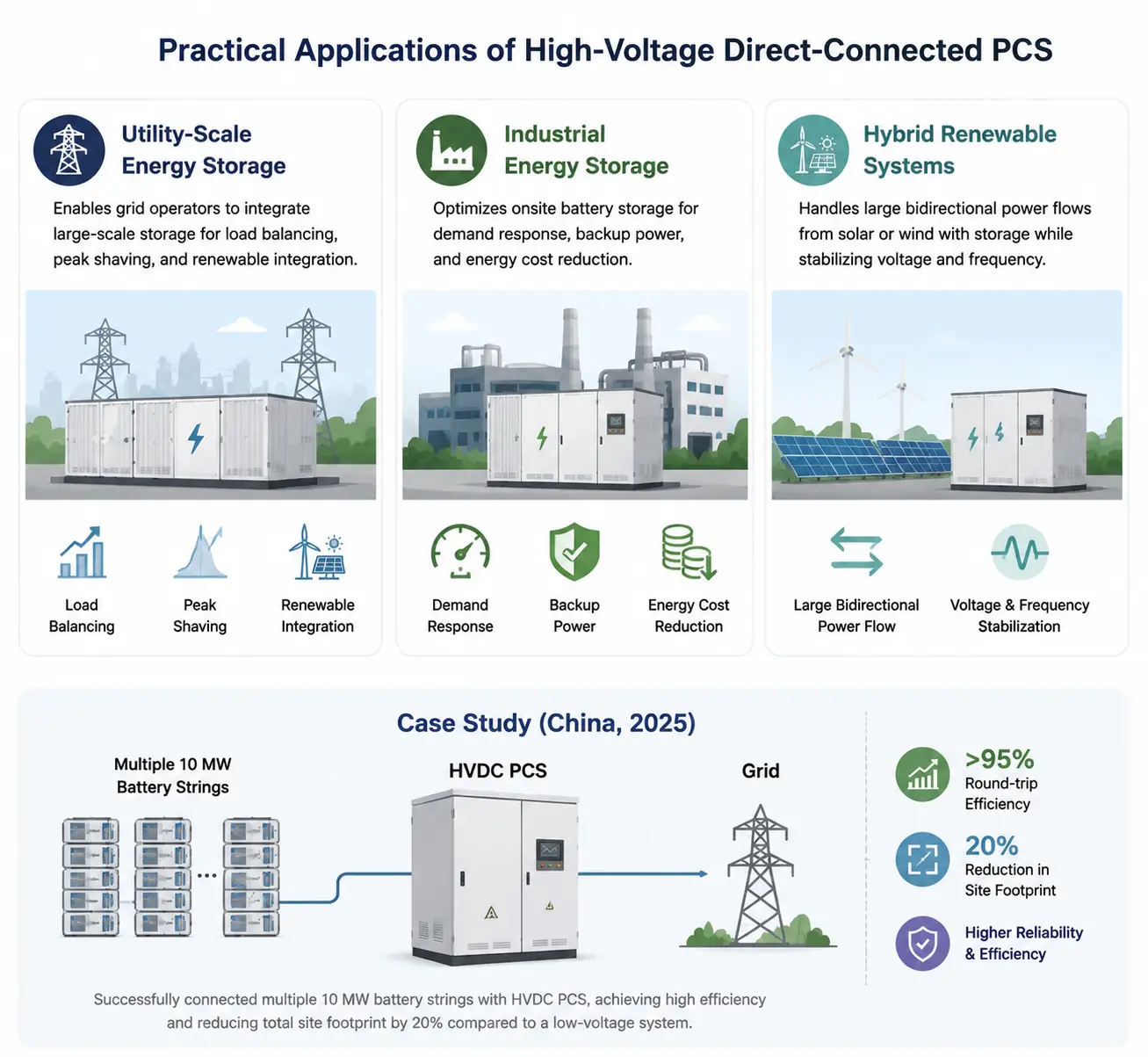
- Utility-Scale Energy Storage: HVDC PCS enables grid operators to integrate hundreds of megawatts of storage with minimal losses, supporting load balancing, peak shaving, and renewable integration.
- Industrial Energy Storage: Large industrial facilities benefit from HVDC PCS by optimizing onsite battery storage for demand response, backup power, and energy cost reduction.
- Hybrid Renewable Systems: Solar or wind farms combined with high-capacity storage utilize HVDC PCS to handle large bidirectional flows while stabilizing voltage and frequency.
For example, a 2025 utility-scale deployment in China successfully connected multiple 10 MW battery strings using HVDC PCS, achieving round-trip efficiency above 95% while reducing total site footprint by 20% compared to a low-voltage system.
Operational Considerations
While HVDC PCS provides many benefits, certain technical considerations must be addressed:
- Thermal Management: High-voltage converters generate significant heat, requiring advanced cooling systems and careful placement of modules to avoid hotspots.
- Protection Coordination: High-voltage operation demands precise protection settings, including overcurrent, short-circuit, and grounding systems.
- Grid Compliance: Interconnection with the utility grid must meet local standards for voltage regulation, frequency response, and anti-islanding protection.
- Maintenance and Monitoring: Reduced component count simplifies maintenance, but monitoring systems must provide real-time visibility across high-capacity strings to prevent imbalances or faults.
By carefully addressing these factors, operators can ensure that HVDC PCS systems achieve long-term reliability and safety.
Conclusion
High-voltage direct-connected PCS represents a significant evolution in energy storage system design. By directly interfacing high-voltage battery strings with the AC grid, it eliminates unnecessary conversions, reduces footprint, and increases system efficiency. Compared to conventional low-voltage PCS, it offers a simpler, more scalable solution for industrial and utility-scale applications.
Experience from recent deployments confirms that HVDC PCS is not just a theoretical improvement—it provides measurable gains in efficiency, installation speed, and operational reliability. As energy storage projects continue to grow in scale and complexity, high-voltage direct-connected PCS is poised to become a standard for large-scale, high-performance systems.
Solid-State Batteries: The Final Push Toward Mass Production
High-Voltage Cascaded Energy Storage Systems: Rethinking Large-Scale Grid Storage