STS vs Online UPS: Why 10ms and 0ms Can Decide Whether Equipment Stays Online
2026-05-09
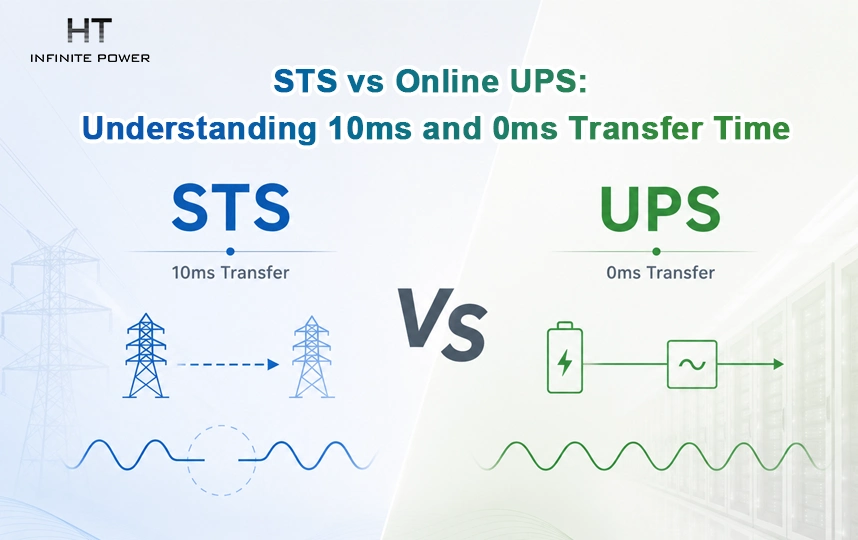
A power outage does not always need to last long to cause damage. Sometimes the real problem is not the blackout itself, but the tiny gap in between. Ten milliseconds may sound harmless on paper. In a server room, an ICU, or a production line, it can be enough to stop a process, corrupt data, or interrupt a machine that was never designed to forgive even a brief break.
That is why transfer time matters so much in critical power systems.
When people compare STS and online UPS, they often focus on the word “backup.” That is only part of the story. The more important question is simple: how long does the load go without power when the main source fails? With an STS, the answer is usually around 10ms. With an online UPS, the answer is effectively 0ms.
That difference sounds small. It is not.
Why milliseconds matter more than most people expect
Most electrical loads can tolerate a short disturbance. A lamp may flicker, a desktop computer may ride through briefly, and nothing dramatic happens. But once the load becomes more sensitive, the margin disappears very quickly.
A server is a good example. If power drops long enough for memory state to vanish, the system may crash immediately. In industrial automation, a short interruption can stop a servo drive or force a machine to re-home before production resumes. In medical environments, even a brief gap can be unacceptable because continuity is tied directly to patient safety.
That is why engineers care about transfer time, not just backup presence.
A useful way to think about it is this: some systems only need protection from a long outage. Others need protection from the transition itself.
What an STS actually does
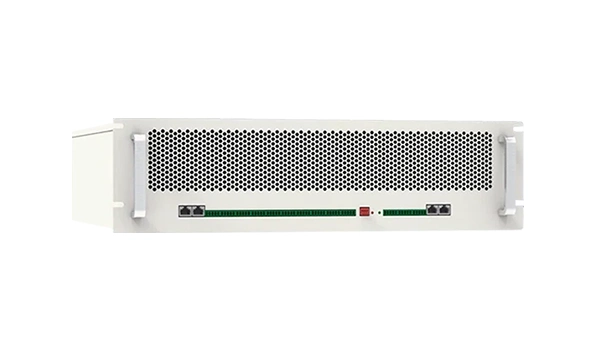
STS stands for Static Transfer Switch. It is not a UPS. It does not store energy in batteries, and it does not keep equipment running through an outage by itself. Its job is narrower, but still important: it transfers a load from one power source to another, quickly.
In practice, that usually means switching between two independent sources such as two utility feeds, a utility feed and a generator line, or two UPS outputs. The device monitors voltage, frequency, and synchronization. When the preferred source becomes unstable, it changes over to the alternate source through solid-state components, usually SCRs.
Because the switching is electronic rather than mechanical, it is fast. Typical transfer time is around 5–10ms, depending on design and operating conditions.
For many loads, that is good enough.
For others, it is not.
For others, it is not.
Where 10ms works, and where it does not
STS fits well in places where brief interruptions are acceptable or where the connected load already has enough ride-through capability.
That includes commercial buildings, lighting systems, HVAC equipment, non-critical office loads, and some telecommunications infrastructure. In these settings, the equipment may never notice the transfer, or the interruption is short enough to be negligible.
But once the load becomes sensitive enough, 10ms stops being “small.” It becomes a risk.
Servers, medical monitoring equipment, robotics, and precision manufacturing lines can react badly to even a very short gap. A 10ms transfer may be enough to trip a device, lose a process state, or trigger a shutdown that takes far longer to recover from than the original event itself.
That is the real limit of STS. It is fast, but not invisible.
How online UPS reaches 0ms transfer
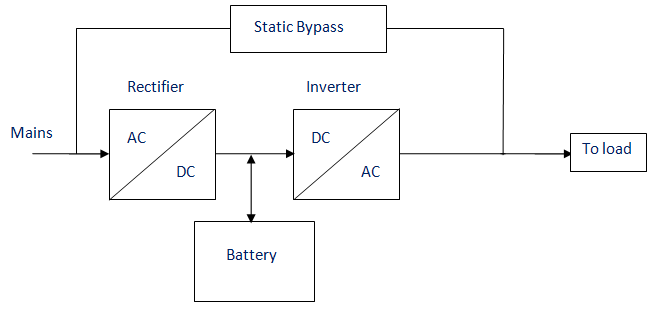
An online UPS takes a different approach. Instead of waiting for the source to fail and then switching, it keeps the load continuously fed through its inverter. In other words, the output is always being regenerated. The battery is part of the system, but it is not sitting idle in the background. The UPS is already in the power path before anything goes wrong.
That is why its transfer time is considered 0ms.
The load does not experience a changeover event because the inverter is already supplying stable AC power. When the utility source fails, the system simply keeps going. No gap appears at the output.
This is the reason online UPS is the preferred choice in environments where interruption is unacceptable.
The trade-off: better continuity, higher cost
There is, of course, a reason not every site uses online UPS for everything. Zero-transfer protection comes with overhead.
A double-conversion UPS runs power through rectifier and inverter stages continuously. That means more conversion loss, more heat, and more hardware. It also means a larger battery system and more maintenance over time.
In simple terms, you are paying for continuity.
For critical loads, that cost is justified. For general-purpose loads, it may be excessive. A warehouse office does not need the same level of protection as a hospital ICU. A retail lighting circuit does not need the same protection as a trading platform or a semiconductor fab.
This is why the choice is never just about the technology. It is about the load profile.
STS vs Online UPS at a glance
| Comparison Item | STS (10ms Switching) | Online UPS (0ms Switching) |
| Core function | Transfers load between two power sources | Continuously supplies conditioned power |
| Transfer time | 5–10ms | 0ms |
| Switching method | Solid-state transfer | Inverter already on line |
| Suitable loads | Offices, lighting, non-critical equipment | Servers, medical systems, industrial automation |
| Cost | Lower | Higher |
| Energy efficiency | Higher | Lower due to continuous conversion |
| Best use case | Fast source transfer without full ride-through | Zero-interruption protection |
The table looks simple, but the decision behind it usually is not. In real projects, engineers often combine both technologies, because each one solves a different problem.
Why many modern facilities use both
In a larger installation, STS and online UPS are not always competitors. They often work together.
A data center may use online UPS units to protect core IT loads, while STS devices manage source transfers between redundant power paths. A hospital may use UPS systems for life-support and imaging equipment, but rely on STS for less sensitive distribution branches. An industrial plant may use UPS for control systems while using STS at the switchboard level to coordinate source transitions across a broader network.
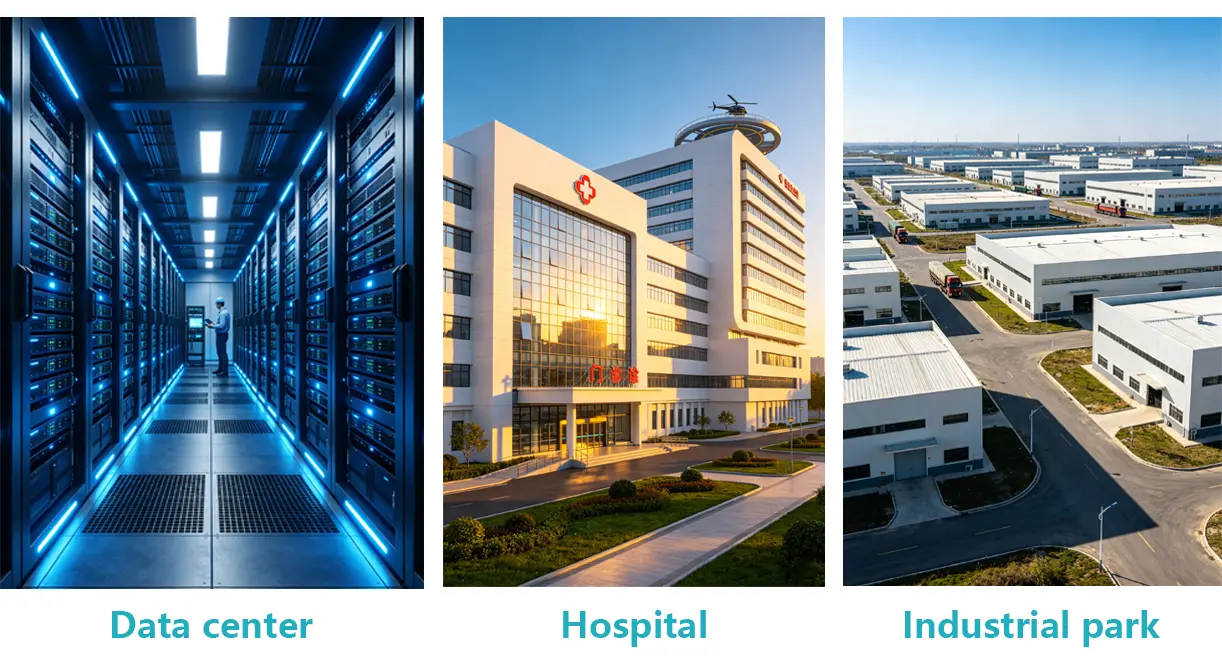
That layered approach is practical. It avoids overspending where it is unnecessary, while still protecting the equipment that truly cannot afford a pause.
The point is not to buy the fastest device available. The point is to match the transfer strategy to the tolerance of the load.
A simple way to decide which one you need
If the connected equipment can tolerate a short interruption without losing state, STS may be enough. If the equipment cannot tolerate even a brief gap, online UPS is the safer choice.
The easiest questions to ask are these: will a 10ms interruption matter, and what is the cost of getting it wrong?
For a desktop PC, the answer may be no. For a database cluster, it may be very much yes. For a ventilator or a robotic control system, the margin is even tighter.
Once that is clear, the choice usually becomes straightforward.
Where power transfer technology is heading
As AI computing, edge data centers, and high-density automation continue to expand, the demand for cleaner and faster power transfer keeps rising.
STS vendors are pushing transfer times lower, with some systems moving beyond the traditional 10ms range. At the same time, online UPS technology is becoming more efficient, with improved inverter designs and smarter control logic reducing energy loss during normal operation.
Battery energy storage is also starting to play a larger role. In some facilities, it is no longer just backup power. It becomes part of a broader resilience strategy, supporting peak shaving, load balancing, and grid interaction as well.
The direction is clear: faster response, lower loss, and tighter integration.
Final takeaway
The difference between STS and online UPS is not just technical. It is operational.
STS gives you rapid transfer between two power sources, which is enough for many general-purpose loads. Online UPS removes the transfer gap altogether, which is why it protects the most sensitive systems so well.
One is built for speed.
The other is built for continuity.
The other is built for continuity.
Choosing the right one starts with a simple question: how much interruption can the load actually tolerate?
Once that is answered honestly, the rest of the design becomes much easier.
Understanding Charge and Discharge Rates in Battery Energy Storage Systems
What is the difference between power batteries and energy storage batteries?