What Is Grid-Forming vs Grid-Following Control?
2026-01-21

Engineers and owners now hear two phrases everywhere: grid-forming and grid-following. They sound like academic labels, but choosing the right mode changes how a power system behaves under stress. Put simply, grid-forming control lets an inverter set the voltage and frequency reference — it acts like a miniature synchronous generator. Grid-following control, on the other hand, makes the inverter follow an existing grid reference, injecting current to meet a power setpoint while using a phase-locked loop (PLL) to stay in step. Both are essential in modern power systems, but their roles, limitations and implementation details differ in ways that matter at the site level.
Below I unpack the concepts using practical reasoning, short calculations, and two field examples (microgrid and BESS-backed commercial site). Expect clear design guidance you can use in procurement specs and technical meetings.
Why the distinction matters now

Historically, the grid was dominated by synchronous machines — spinning generators that inherently provided inertia, short-circuit strength and a voltage/frequency reference. Inverter-based resources (IBRs) such as PV and battery inverters were secondary players and simply injected current while “listening” to the grid. As inverter penetration grows, grid strength falls and system behavior changes: less inertia, wider frequency swings, and different fault contributions. In that world, “follow the grid” is not always enough. Grid-forming control lets inverters create the reference so systems can island, black-start, and maintain stability with fewer or no synchronous machines.
Quick technical contrast (plain engineering)
Grid-forming control
- Acts as a voltage source: sets amplitude, phase and frequency.
- Provides virtual inertia and damping (via control loops such as virtual synchronous machine — VSM).
- Enables black-start and stable islanding.
- Needs careful voltage regulation and protection tuning because it changes local fault behavior.
Grid-following control
- Acts as a current source synchronized to an external voltage reference (via PLL).
- Excellent for injecting power into a stiff grid and for precise current control (harmonics, reactive power).
- Cannot establish a grid reference if no healthy voltage exists.
- Simpler protection coordination with traditional AC systems.
Both paradigms share hardware, but the firmware, control priorities and protection settings differ. Importantly, grid-forming capability is not a free lunch: it requires control maturity, thermal headroom and tested fault responses.

A practical calculation: how much “inertia” does a battery provide?
People often ask: “How much energy do I need to emulate inertia for 10 seconds at 1 MW?” We can show it with a simple energy conversion.
1 MW sustained for 10 seconds corresponds to:
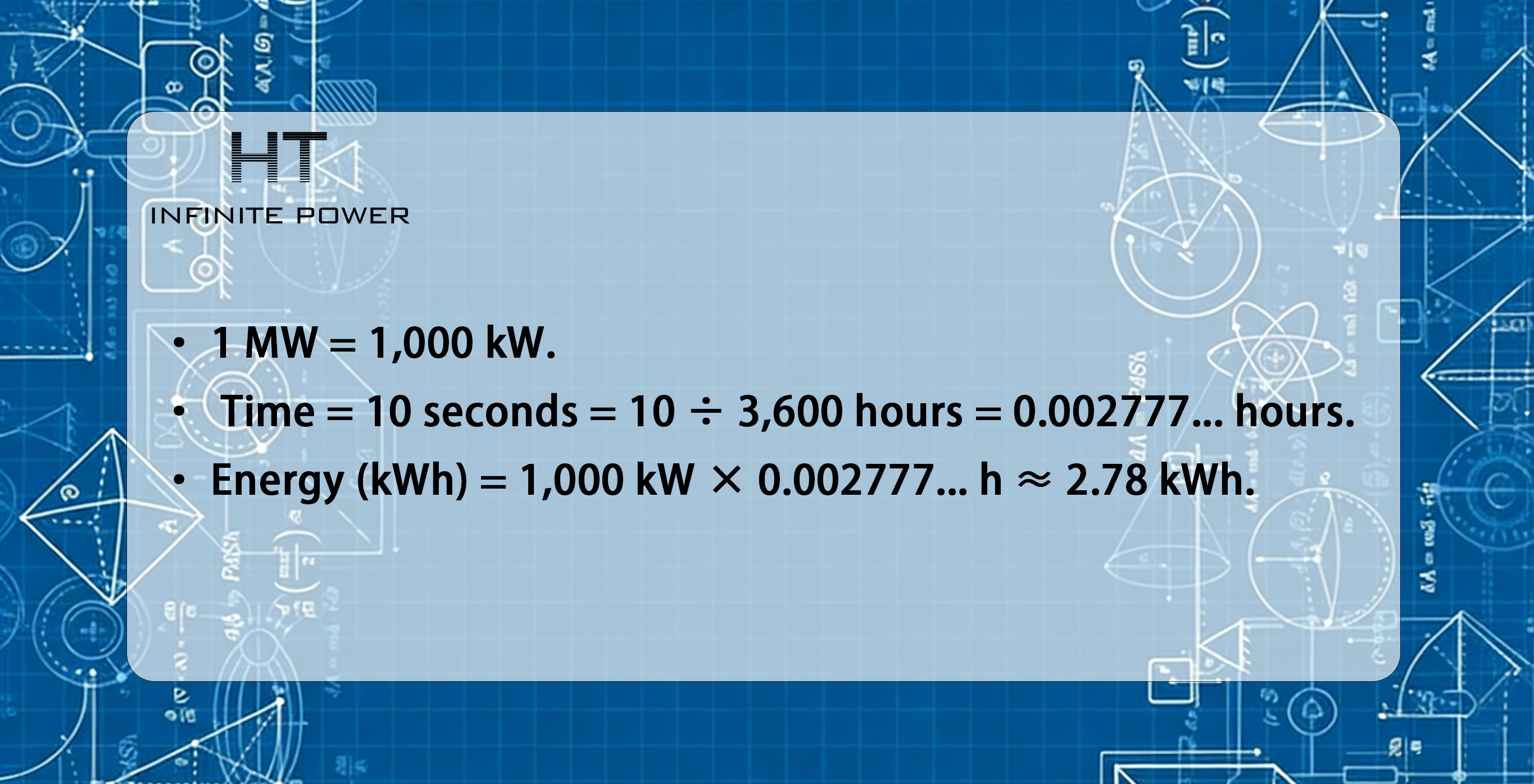
- 1 MW = 1,000 kW.
- Time = 10 seconds = 10 ÷ 3,600 hours = 0.002777... hours.
- Energy (kWh) = 1,000 kW × 0.002777... h ≈ 2.78 kWh.
So, if a grid-forming inverter needs to supply an extra 1 MW for 10 s during a frequency event, the battery must be capable of delivering roughly 2.78 kWh of energy for that burst. That’s a small fraction of typical BESS capacity — but note two caveats: (1) high power for short duration stresses inverter thermal limits and DC bus dynamics, and (2) many such events accelerate battery wear.
Another example: supplying 500 kW for 5 minutes (300 seconds):
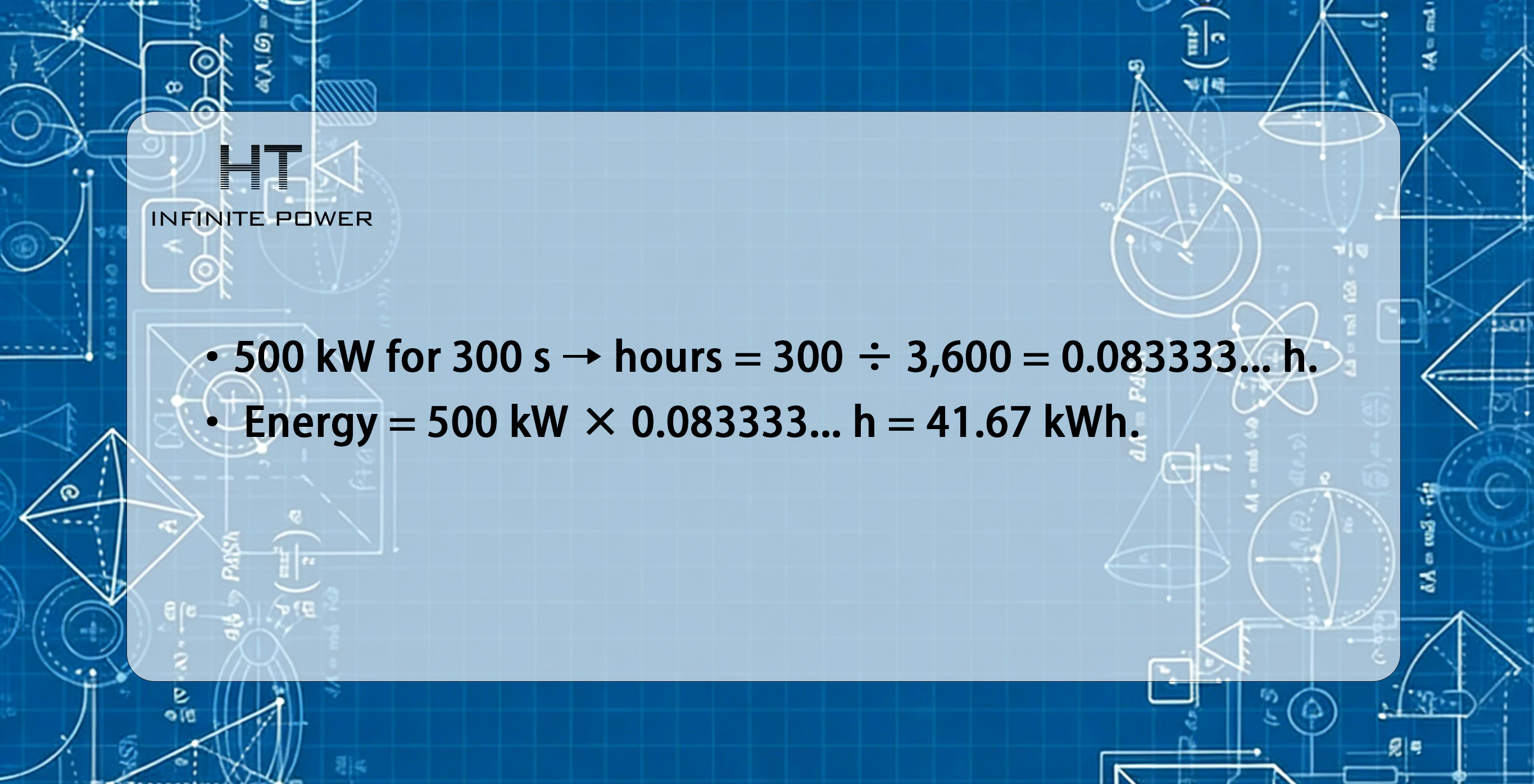
- 500 kW for 300 s → hours = 300 ÷ 3,600 = 0.083333... h.
- Energy = 500 kW × 0.083333... h = 41.67 kWh.
These back-of-envelope numbers help size short-term synthetic inertia reserves and assess whether a given BESS can support grid-forming duties without unduly depleting SOC.
Droop control and a simple numerical example
Droop control defines how multiple sources share load changes. A 5% droop means full power change corresponds to a 5% change in system frequency:
- For a 50 Hz system: 5% × 50 Hz = 2.5 Hz full scale.
In practical terms, the droop law sets proportional response; it does not imply frequency will swing that far — rather it defines contribution sharing among resources.
- For a 60 Hz system: 5% × 60 Hz = 3 Hz.
Engineers typically tune droop to small fractions so that frequency deviations remain acceptable while enabling proportional sharing. When many IBRs adopt droop, you get distributed support without a centralized controller — but tuning must consider effective inertia and damping.
When to use grid-forming (practical rules of thumb)
- Microgrids and islanding: If you need a system to operate disconnected from the utility (campus, islanded facility), at least one unit must be grid-forming. It sets the bus reference and allows other inverters to operate in grid-following mode.
- Black-start capability: To start from dead grid conditions without conventional generators, grid-forming inverters are essential.
- Weak grids / low SCR (short-circuit ratio): In weak grids where PLLs struggle, grid-forming avoids instability tied to PLL locking.
- Voltage stability requirements: If you need fast voltage regulation or inertia emulation, grid-forming controls provide those services.

When grid-following is the smarter choice
- High-penetration, stiff grid with many synchronous machines: If the grid is stiff, grid-following inverters are simpler and highly effective for injecting power and controlling power quality.
- Precise current control and power factor correction: Grid-following architectures excel at harmonic compensation and tight current shaping.
- Retrofit and staged deployment: If you’re adding storage to an existing PV array and don’t want to rework the grid reference hierarchy, grid-following is lower-risk.
Case study 1 — Campus microgrid with a 2 MWh BESS (conceptual)
A university campus needs four hours of critical load autonomy at 500 kW. A 2 MWh BESS matches that requirement (2,000 kWh ÷ 500 kW = 4 hours). To island successfully, one or two inverters must be grid-forming to maintain frequency and voltage references. The system design assigns two high-capability inverters in grid-forming mode (for redundancy), while the rest operate grid-following to inject power and control reactive flows. Protection settings are tightened during islanded modes to handle changed fault contributions.

Operationally, the BESS provides:
- Instant ride-through (zero transfer time).
- Synthetic inertia during generator starts.
- Smooth handover to genset if a long outage occurs.
This mixed control architecture balances resilience and energy delivery while limiting inverter stress.
Case study 2 — Commercial BESS for grid services
A 1 MWh behind-the-meter BESS participates in frequency response markets and does peak shaving. When interconnected to a reasonably strong distribution system, the asset runs primarily in grid-following mode; it tracks grid frequency and injects current per dispatch signals. For market events requiring very fast frequency support, the operator may enable a temporary grid-forming-like mode (virtual inertia) within the inverter’s certified envelope — but only with careful validation and protection checks. This hybrid, software-driven flexibility is increasingly common among advanced battery energy storage manufacturers.
Implementation and testing — what to require in procurement
If you specify grid-forming capability, ask vendors for:
- Demonstrated VSM or droop performance with timestamped logs.
- Black-start tests and islanding transition recordings.
- Thermal and overload specs for short bursts (e.g., 10-s, 1-min ratings).
- Protection coordination reports and FAT/SAT evidence.
Also require firmware update procedures, cyber-security practices for controller updates, and clear handover tests during commissioning.
Practical limitations and gotchas
- Thermal limits: Supplying high power for inertia emulation risks inverter overheating; short-time ratings matter as much as continuous ratings.
- Battery SOC management: Grid-forming duties often need headroom. Reserve SOC so you can meet sudden active/reactive demands without starving energy services.
- Protection coordination: Grid-forming changes fault currents and relay behaviors; protection curves that were fine for a synchronous grid may nuisance-trip with inverter references.
- Control interactions: Multiple grid-forming units must be tuned to avoid oscillatory interactions — coordinated droop and damping tuning is essential.
Summary — practical decision flow
1.Define objectives: black-start, islanding, fast frequency support, or just precise current injection?
2.Assess grid strength: weak grid → favor grid-forming. Stiff grid → grid-following often adequate.
3.Size hardware for bursts: ensure inverter and BESS can meet short-term power requirements (use the kWh calculations shown above).
4.Test early and often: FAT/SAT, black-start drills, and recorded logs are non-negotiable.
5.Specify vendor deliverables: VSM logs, protection studies, firmware update policy, and documented performance guarantees.
2.Assess grid strength: weak grid → favor grid-forming. Stiff grid → grid-following often adequate.
3.Size hardware for bursts: ensure inverter and BESS can meet short-term power requirements (use the kWh calculations shown above).
4.Test early and often: FAT/SAT, black-start drills, and recorded logs are non-negotiable.
5.Specify vendor deliverables: VSM logs, protection studies, firmware update policy, and documented performance guarantees.
What Is Real, Reactive and Apparent Power?
Calcium-Based Batteries: The Next Generation of Low-Cost, High-Energy-Density Storage Technology