What Feeder-Level Energy Storage Is and Why It Matters
author: HT Infinitepower
2026-06-30
If you’ve spent time working around distribution transformers, you know the grid rarely fails in dramatic ways. It fails in small, subtle ones. A feeder that dips just enough for lights to flicker when several homes switch on their air conditioners. A transformer that runs hotter than it should on summer evenings. Solar output that surges at noon and collapses at sunset, leaving the feeder scrambling to stabilize itself. These aren’t catastrophic events—they’re symptoms of a grid being pushed far beyond the conditions it was originally designed for.
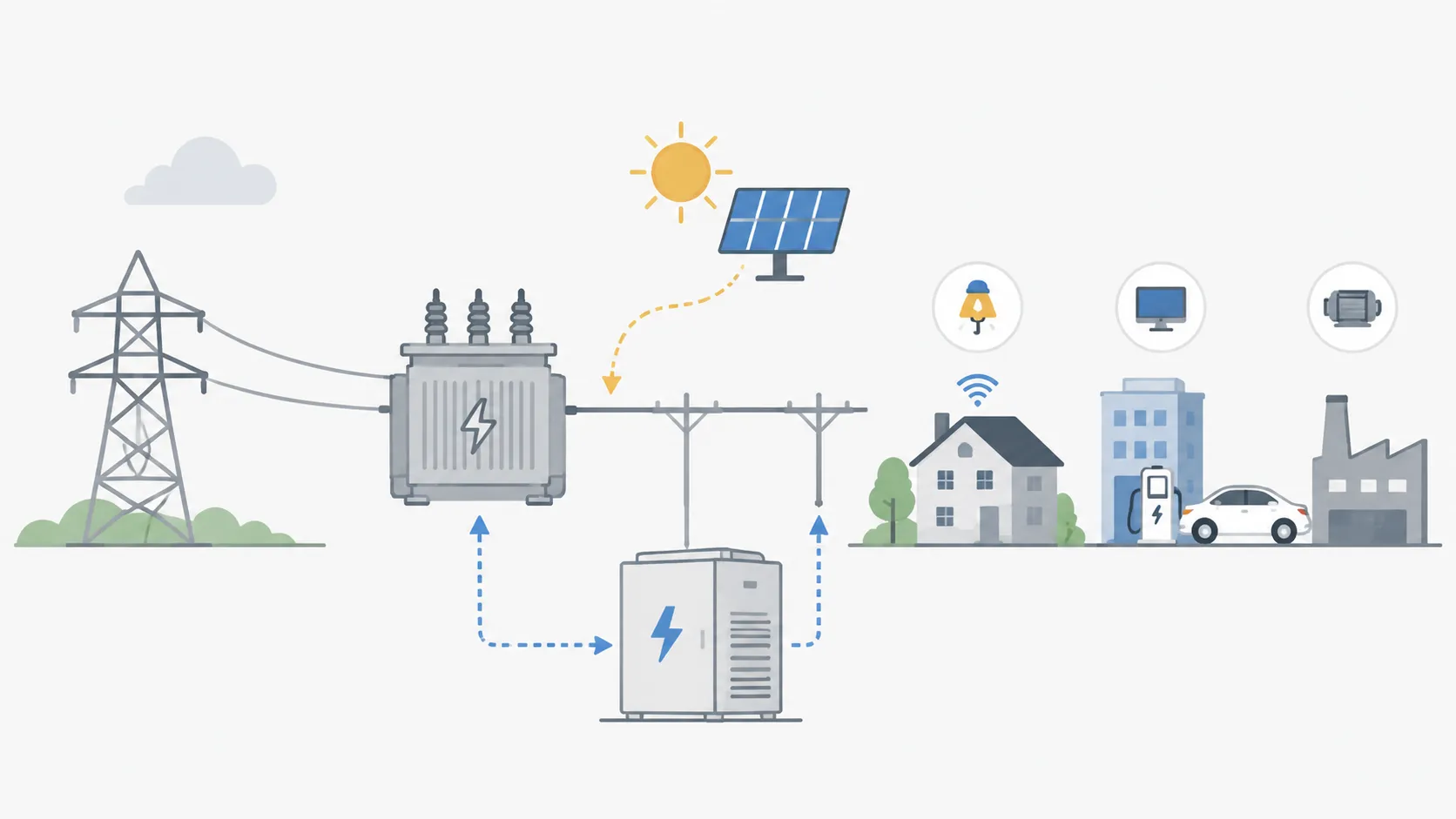
Feeder-level energy storage emerged not because someone wanted a new technology, but because the grid needed a new kind of flexibility. It sits quietly on the low-voltage side of a transformer, close to the loads that create the most volatility. And despite its modest size, it is reshaping how the last mile of the grid behaves.
The Feeder’s Changing Reality
A feeder used to be predictable. Loads followed a familiar daily curve. Voltage stayed within a narrow band. Equipment aged slowly and steadily. That stability has disappeared.
Today’s feeders face a completely different landscape. Electric vehicles plug in at unpredictable hours. Smart homes shift loads rapidly. Rooftop solar injects power at noon and disappears at dusk. Industrial parks add new machinery without warning. Rural feeders swing sharply between surplus solar and heavy evening demand. Extreme weather pushes equipment to its limits.
The feeder is no longer a passive conduit. It is a dynamic, volatile environment where traditional reinforcement—bigger transformers, thicker cables—cannot keep up with the pace or complexity of change.
Why Traditional Upgrades Aren’t Enough
Upgrading a feeder is expensive, slow, and often disruptive. Even when upgrades are possible, they cannot address the underlying issue: modern loads are not just larger, they are more erratic. The grid needs flexibility, not just capacity.
Feeder-level storage provides that flexibility. It doesn’t replace the transformer. It helps the transformer adapt.
A Tool Built for Real-World Conditions
Most feeder-level storage systems fall between 100 kWh and 1 MWh. That range is not arbitrary—it matches the scale of feeder loads. A 100 kWh system can stabilize a rural feeder with moderate solar penetration. A 500 kWh system can support an industrial feeder with sharp load spikes. A 1 MWh system can manage urban feeders with heavy EV charging.
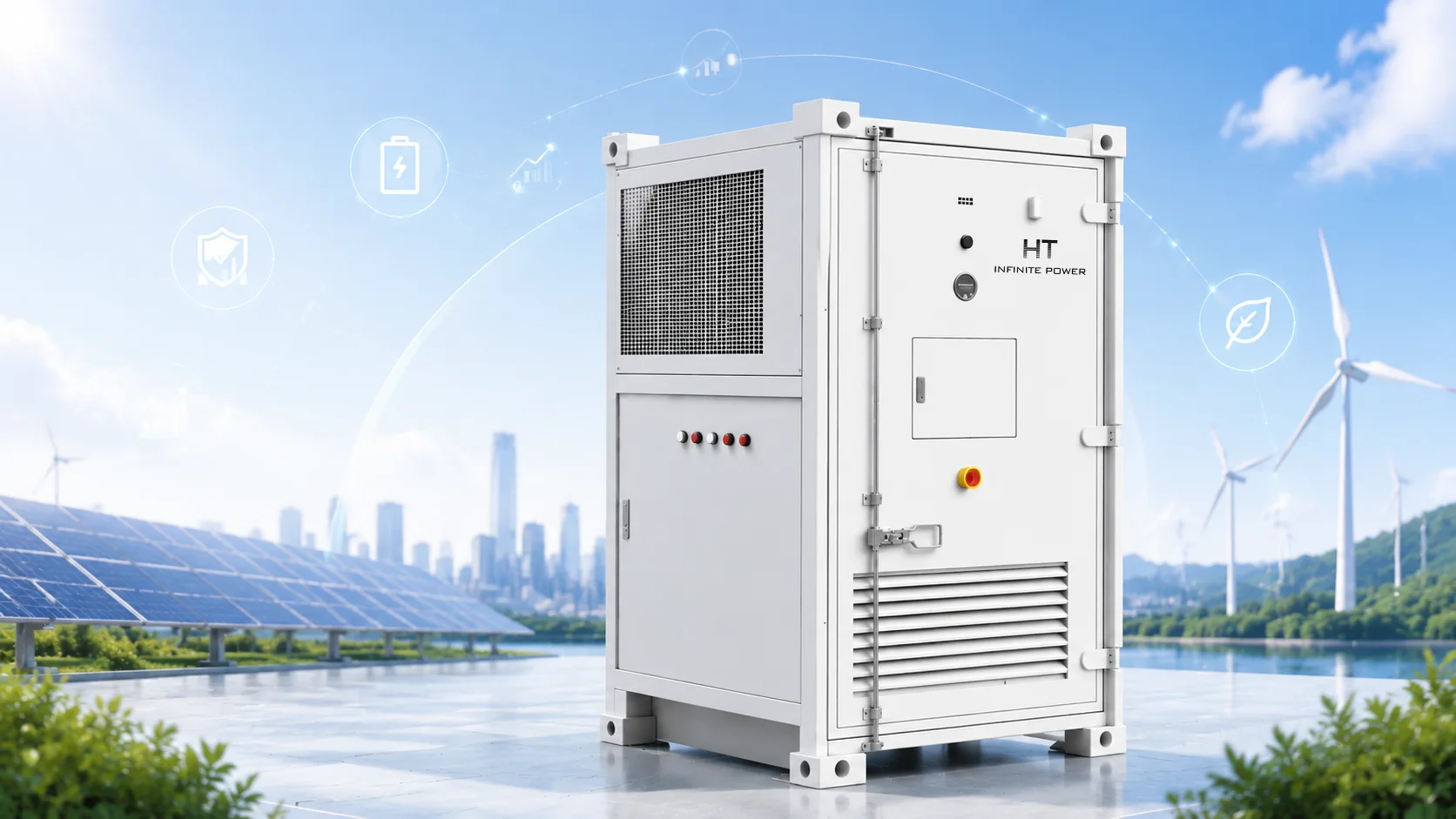
But the real value is not the battery capacity. It is the way the system interacts with the feeder.
Responsiveness That the Grid Never Had Before
Feeder-level storage senses load changes in milliseconds. It responds before voltage dips become noticeable. It absorbs solar surges before they ripple through the network. And when the grid falters, it can operate independently, keeping essential loads powered.
This is not something a transformer can do. It is not something a cable upgrade can do. It is flexibility—localized, intelligent, and fast.
How Storage Stabilizes the Feeder
If you plot feeder behavior over a full day, the value of storage becomes obvious. Loads rise sharply in the evening, especially in neighborhoods with heavy air-conditioning use. Voltage drops. Transformers run hot. In rural areas, solar output pushes voltage upward at noon, then collapses at sunset. Industrial feeders experience sudden spikes when machinery starts.
Storage acts as a buffer that smooths these swings.
During peak load, it discharges to reduce transformer stress. During low load, it absorbs surplus energy, reducing peak-valley differences. In feeders with phase imbalance—a common issue in rural areas—advanced PCS systems can regulate each phase independently, correcting imbalance within milliseconds.
The result is a feeder that behaves more predictably, even when the loads do not.
Solar Changes Everything
Distributed PV has grown rapidly across rural rooftops, industrial parks, and commercial buildings. But solar output is inherently unstable. On sunny days, generation exceeds local consumption. On cloudy days, it drops sharply. Without storage, excess solar is wasted, and fluctuations destabilize the feeder.
Local Consumption Becomes Possible
Storage solves this problem by storing surplus solar energy when generation is high and releasing it when solar output drops. This enables local consumption, reduces reverse power flow, and prevents voltage spikes.
Smoothing the Solar Roller Coaster
Solar output can change rapidly with passing clouds. Storage smooths these fluctuations, preventing sudden voltage swings and reducing stress on the transformer.
For rural feeders with large PV installations, this capability is transformative. It allows solar to be integrated smoothly rather than treated as a disturbance.
Resilience When the Grid Fails
Extreme weather, equipment faults, and accidents can disrupt feeder-level supply. When that happens, storage can switch to islanded operation within milliseconds, powering critical loads such as lighting, refrigeration, communications, and small businesses.
In many communities, even a short outage can disrupt daily life. For small businesses, it can halt operations. For rural areas, it can affect safety. Feeder-level storage provides a layer of resilience that traditional grid equipment cannot.
The Intelligence Behind Modern Feeder Storage
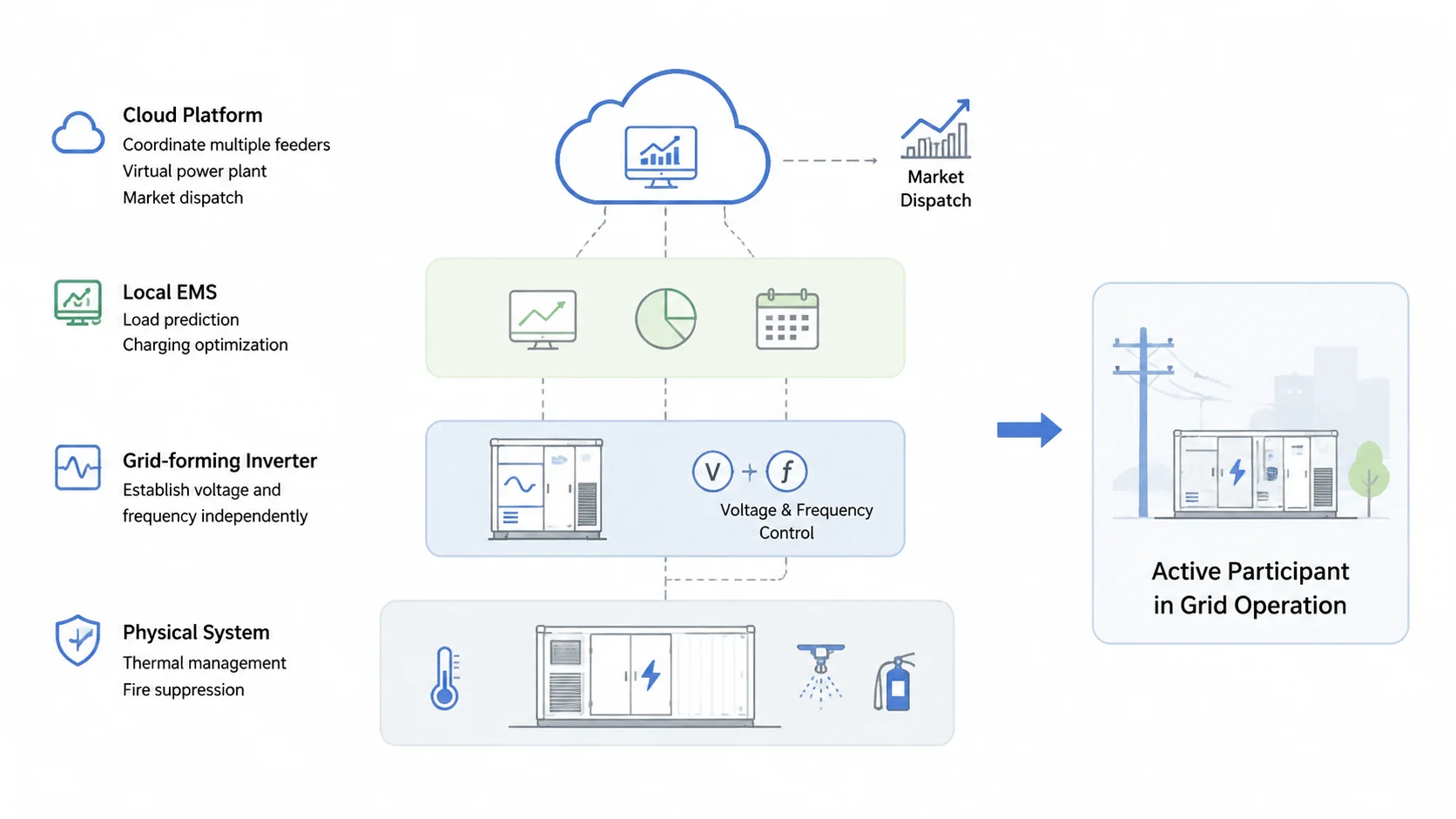
Modern systems combine several layers of intelligence that allow them to operate autonomously and safely.
Grid-forming inverters can establish voltage and frequency independently. Local EMS predicts load behavior and optimizes charging cycles. Cloud platforms coordinate multiple feeders, forming virtual power plants that can participate in market-based dispatch. Thermal management and fire suppression ensure safe operation in dense urban or rural environments.
This integration makes feeder storage more than a battery. It becomes an active participant in grid operation.
Why It’s Becoming a Strategic Asset
Policy momentum is strong. China’s energy framework now recognizes feeder-level storage as a key component of the new power system. This unlocks standardized interconnection rules, cost recovery mechanisms, and inclusion in grid investment budgets.
Market demand is rising. Urban feeders face EV charging peaks and aging infrastructure. Rural feeders face PV curtailment and voltage instability. Feeder-level storage addresses both, creating a dual
engine market across regions.
Technology maturity has arrived. Battery costs have fallen. PCS and EMS technologies have improved. Grid-forming inverters are commercially viable. Together, these advances make feeder storage not only technically feasible but economically compelling.
A New Operating Logic for the Grid
Feeder-level storage is transitioning from a patch to a foundational element of the modern distribution grid. As digitalization deepens, storage will integrate with intelligent distribution networks, virtual power plants, and community-level microgrids.
Its role will expand from stabilizing feeders to orchestrating local energy ecosystems. It will support higher distributed PV penetration, more flexible EV charging, improved rural electrification, lower grid reinforcement costs, and stronger resilience against extreme weather.
In the long term, feeder storage will help redefine how the distribution grid operates—not as a passive delivery system, but as a dynamic, intelligent network capable of adapting to the evolving demands of modern electricity consumption.
Closing Thoughts
Feeder-level energy storage is quietly reshaping the last mile of the power grid. By combining flexibility, intelligence, and resilience, it solves problems that traditional grid upgrades cannot address quickly or economically. As policies mature and technologies advance, feeder storage is becoming a strategic pillar of modern grid architecture—one that supports stability, enables distributed energy, and strengthens community-level resilience.
Its impact will be felt across every neighborhood, village, industrial park, and commercial district that depends on reliable, efficient, and clean electricity.
FAQ: Feeder-Level Energy Storage
Why does the feeder need energy storage in the first place?
Most feeder problems come from volatility—EV charging clusters, rooftop solar swings, and evening peak loads. Traditional reinforcement can increase capacity, but it cannot respond in milliseconds. Storage fills that gap. It absorbs sudden surges, stabilizes voltage, and gives the transformer breathing room during stressful periods.
How does feeder-level storage interact with rooftop solar?
Solar output is unpredictable. A cloud can drop generation instantly; noon sunlight can push voltage upward. Storage smooths these swings by absorbing excess solar and releasing it when generation falls. This keeps voltage stable and allows more solar to be consumed locally instead of being wasted.
Can feeder-level storage really prevent transformer overload?
Yes. During peak hours, storage discharges to reduce the load seen by the transformer. This prevents overload trips and reduces thermal stress. Utilities often see immediate improvements in feeder stability once storage is deployed.
What happens when the grid goes down?
Modern systems can switch to islanded operation almost instantly. Essential loads—lighting, refrigeration, communications—stay powered. For communities that experience weather-related outages, this capability significantly improves resilience.
Is feeder-level storage becoming standard in modern distribution grids?
With rising rooftop solar, growing EV adoption, and more volatile load patterns, feeder-level storage is quickly shifting from “nice to have” to “necessary infrastructure.” Falling battery costs and policy support are accelerating that transition.
Mining’s New Power Backbone: The Rise of On-Site Energy Storage
AIDC Energy Storage Enters a Strategic Era: Lithium, Semi-Solid, and Sodium Batteries Advance on Three Parallel Fronts