What is VSG technology and its applications in energy storage?
2025-12-17

With the rapid increase in the proportion of intermittent renewable energy sources such as wind and solar power in the power grid, the traditional power grid is undergoing a disruptive transformation. The "inertia" of the power grid—the natural barrier that maintains grid frequency stability and resists instantaneous disturbances—is being weakened. Against this backdrop, grid-based energy storage has emerged, and the most core technology is achieving "parallel grid connection" through energy storage converters (PCS). This article will delve into this key technology.

VSG (Virtual Synchronous Generator) grid-connected energy storage is a technology that allows energy storage systems to simulate the characteristics of traditional synchronous generators. It actively provides voltage and frequency support to achieve the "grid-connecting" function in a "source-grid-load-storage" system, rather than passively responding to grid commands.
Its core advantage is enhanced grid stability, especially in scenarios with a high proportion of renewable energy integration. It can compensate for the lack of inertia in fluctuating power sources such as photovoltaics and wind power, making the grid more "disturbance-resistant."
Core Advantages of VSG Technology in Energy Storage Applications:
1. Providing Inertial and Damping Support, Enhancing System Stability
VSG technology simulates the rotor inertia of a synchronous generator through software algorithms. This provides virtual inertial support when the grid frequency fluctuates rapidly (such as sudden load changes or abrupt changes in renewable energy output), suppressing drastic frequency shifts. Simultaneously, it simulates the damping characteristics of a generator, effectively suppressing power oscillations in the power system and improving the system's dynamic stability and disturbance rejection capability.
2. Achieving Independent Operation and Islanded Power Supply
In microgrid or off-grid scenarios, the VSG-mode energy storage converter (PCS) can proactively establish and maintain a stable and reliable AC voltage and frequency reference, providing continuous power to local loads without relying on the external grid. This is crucial for remote areas, islands, or critical loads requiring high power reliability (such as hospitals and data centers).
3. Improving Power Quality and Voltage Support
VSG control can dynamically adjust reactive power output as needed, responding quickly to load changes or faults, effectively supporting local grid voltage, improving power quality, and reducing voltage dips and fluctuations.
4. Enhanced Renewable Energy Absorption Capacity
By simulating the "friendly" characteristics of traditional generator sets, VSG technology enables renewable energy sources such as photovoltaics and wind power, based on power electronic interfaces, to possess inertia and frequency regulation capabilities similar to synchronous machines. This significantly increases their penetration rate in the grid and enhances the grid's ability to accommodate intermittent energy sources.
5. Flexible Grid-Connected and Off-Grid Switching
In hybrid energy systems such as photovoltaic-storage-diesel systems, the VSG mode can be flexibly combined with traditional PQ (constant power) control, VF (constant voltage and frequency) control, and other modes. For example, when operating in parallel with a diesel generator, the VSG mode can improve the system's dynamic response, reduce grid connection switching failures caused by the instability of diesel engine characteristics, and achieve smooth and seamless power supply switching.
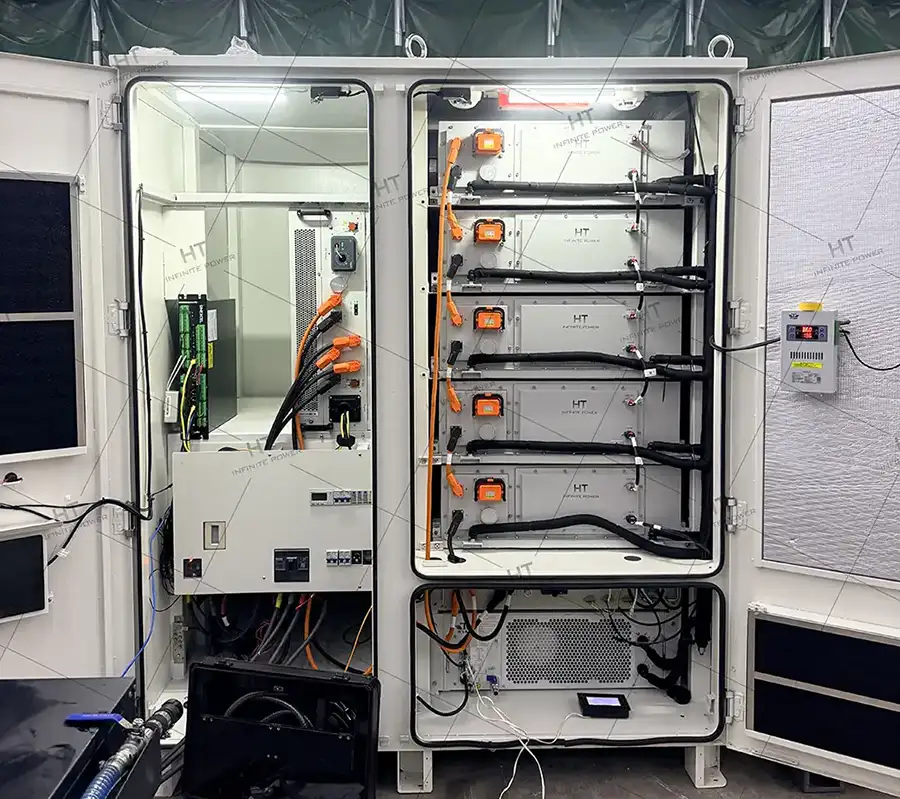
The core technical challenges of VSG grid-based energy storage mainly lie in three aspects:
1. Precise control of inertia and damping:
Dynamic matching with actual grid demands is required. Excessive damping leads to slow response, while insufficient damping fails to effectively suppress disturbances, making balance extremely difficult.
2. Multi-unit coordinated control:
During large-scale cluster operation, each VSG unit must avoid frequency/voltage oscillations and achieve precise synchronization to prevent "multi-unit instability."
3. Fault ride-through and protection strategies:
While providing rapid support during grid faults, the protection logic must also prevent damage from overcurrent and overvoltage. It must balance "support" and "safety."
Application Background
In remote areas and island applications, where there is no mains grid input, a purely off-grid photovoltaic-storage network is required. Furthermore, in large-scale backup power applications, multiple PCS (Power Conversion System Units) need to be connected in parallel in off-grid mode.
Traditional VF (Variable Frequency) off-grid PCS parallel connection is limited by communication load rate, restricting total network capacity and communication distance (within 50m). Moreover, in off-grid mode, it cannot actively control power or implement SOC (State of Charge) balancing strategies, affecting the stability of the entire system and increasing maintenance costs.
Off-grid Online SOC Balancing Function
1. Traditional VF Communication Architecture
Traditional VF mode parallel operation requires a CAN communication line connection, which limits the communication distance and the number of units that can be paralleled (4-6 units in off-grid parallel operation). Furthermore, in off-grid mode, active and reactive power cannot be controlled, easily leading to SOC imbalance.
2. VSG Parallel Architecture
In VSG mode, parallel operation requires no communication cable connection. The EMS only needs to individually control the secondary frequency and voltage regulation commands of each PCS to maintain system stability. Currently, up to 12 units can be paralleled. In off-grid mode, the charging and discharging commands of each PCS can be controlled separately via secondary frequency regulation commands.
3. Off-grid multi-unit parallel networking communication scheme
3.1 Multi-rack non-communication VSG parallel connection
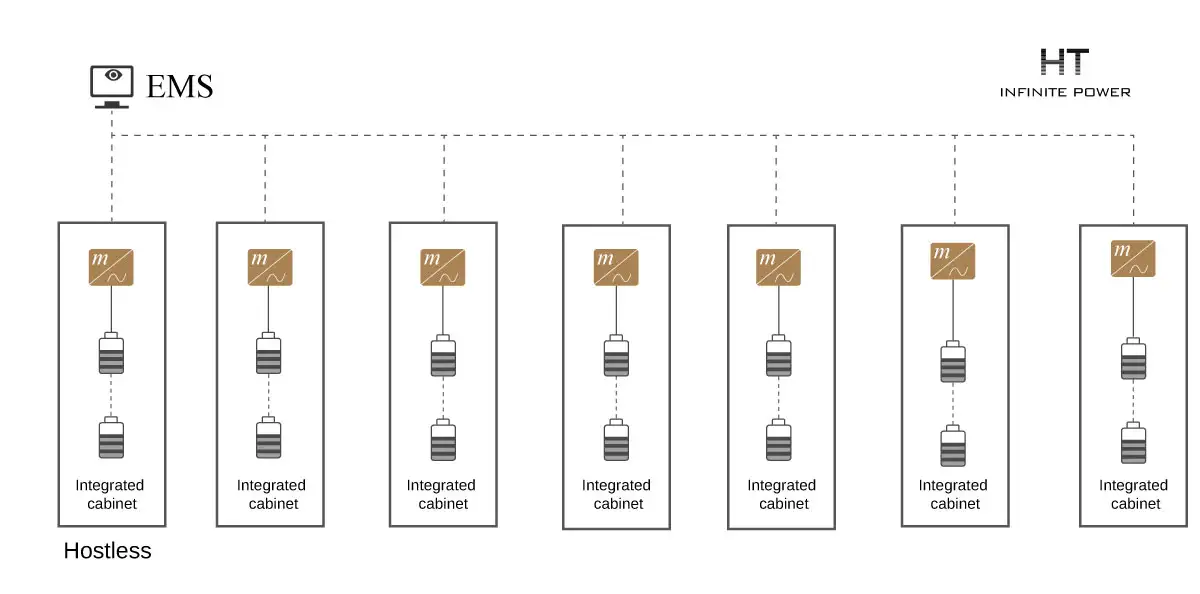
Control method: EMS sends a power-on command to any machine via the communication line. The machine then establishes voltage and then sends power-on commands to the slave machines in sequence to start them up, with an interval of 30 seconds.
3.2 Multi-rack weak communication VSG parallel connection
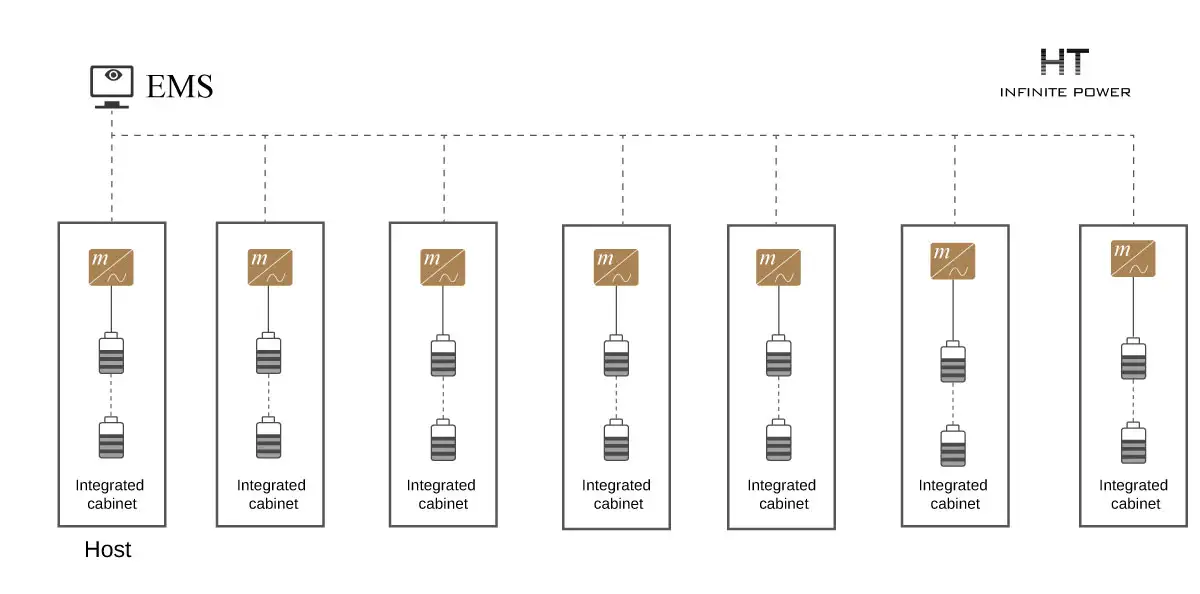
Control method: EMS sends a power-on command to all machines via the communication line. The master and slave machines then automatically synchronize and start automatically after the command is confirmed.
Weak communication feature: Capable of synchronous one-button black start and power command synchronization.
3.3 Multi-rack weak communication, long-distance networking without communication, parallel networking
Control method: The EMS first sends a power-on command to the host with the largest CAN group capacity via the communication line. After power-on is completed, it sends power-on commands to the hosts of the CAN communication groups with decreasing capacity in sequence, waiting 30s-60s in between.
Implementation Path and Technical Challenges
Achieving grid-connected PCS is no easy task, facing multiple challenges:
1. Core Control Algorithm:
High-precision, robust VSG control algorithms need to be developed, and key parameters such as virtual inertia and damping need to be optimized to adapt to complex grid conditions.
2. Hardware Overcurrent Capacity:
To provide grid support, the PCS needs to withstand currents several times its rated value during transient processes, placing higher demands on power devices and heat dissipation design.
3. Multi-Machine Parallel Operation and Coordination:
When multiple grid-connected PCSs operate in parallel, avoiding power oscillations and mutual interference, and achieving stable, current-sharing coordinated operation is crucial for engineering applications.
4. Standards and Specifications:
Global standards for grid-connected technologies are still under development, requiring joint efforts from industry and academia.
Conclusion
The grid-connected PCS for VSG-based energy storage is not merely a technological upgrade, but a revolutionary concept. It signifies that our power grid is moving from a "host-terminal" model reliant on a few large synchronous generators to a "peer-to-peer network" model constructed by countless distributed, intelligent "virtual generators."
In future new power systems dominated by renewable energy sources, grid-connected PCS will no longer be an "accessory" to the power grid, but rather a "cornerstone" and "stabilizing force" supporting its safe, stable, and efficient operation. Whoever takes the lead in this technological field will seize the initiative in the future energy revolution.
Energy storage battery balancing technology: Active balancing vs. Passive balancing
The Key to Enhancing Battery Pack Performance: Consistency Management