Top Battery Manufacturers in 2026: Global Leaders and BESS Suppliers
author: HT Infinite Power
2026-10-12
The global battery industry is expanding as renewable energy deployment, grid modernization, and demand for flexible electricity supply accelerate investment in energy storage. Battery manufacturers are increasing their role in this market, while system suppliers are developing integrated solutions for utility-scale projects, commercial and industrial (C&I) facilities, and residential applications.
However, battery manufacturing and battery energy storage system (BESS) integration are different businesses. A battery manufacturer supplies the cells or battery products that store energy. A BESS integrator combines batteries with power conversion systems (PCS), battery management systems (BMS), thermal management, protection equipment, and control software to deliver a functioning system.
For project developers, EPC contractors, energy investors, and procurement teams, understanding these differences helps make supplier comparisons more meaningful.
This guide reviews major global battery manufacturers, examines leading BESS suppliers using published industry rankings, and explains the technical and commercial factors buyers should consider when selecting an energy storage solution.
1. Leading Battery Manufacturers in 2026
The global energy storage battery market includes companies with different manufacturing capabilities, product portfolios, and market positions. Some lead global storage cell shipments, while others have established positions in residential storage, regional supply chains, or specialized battery applications.
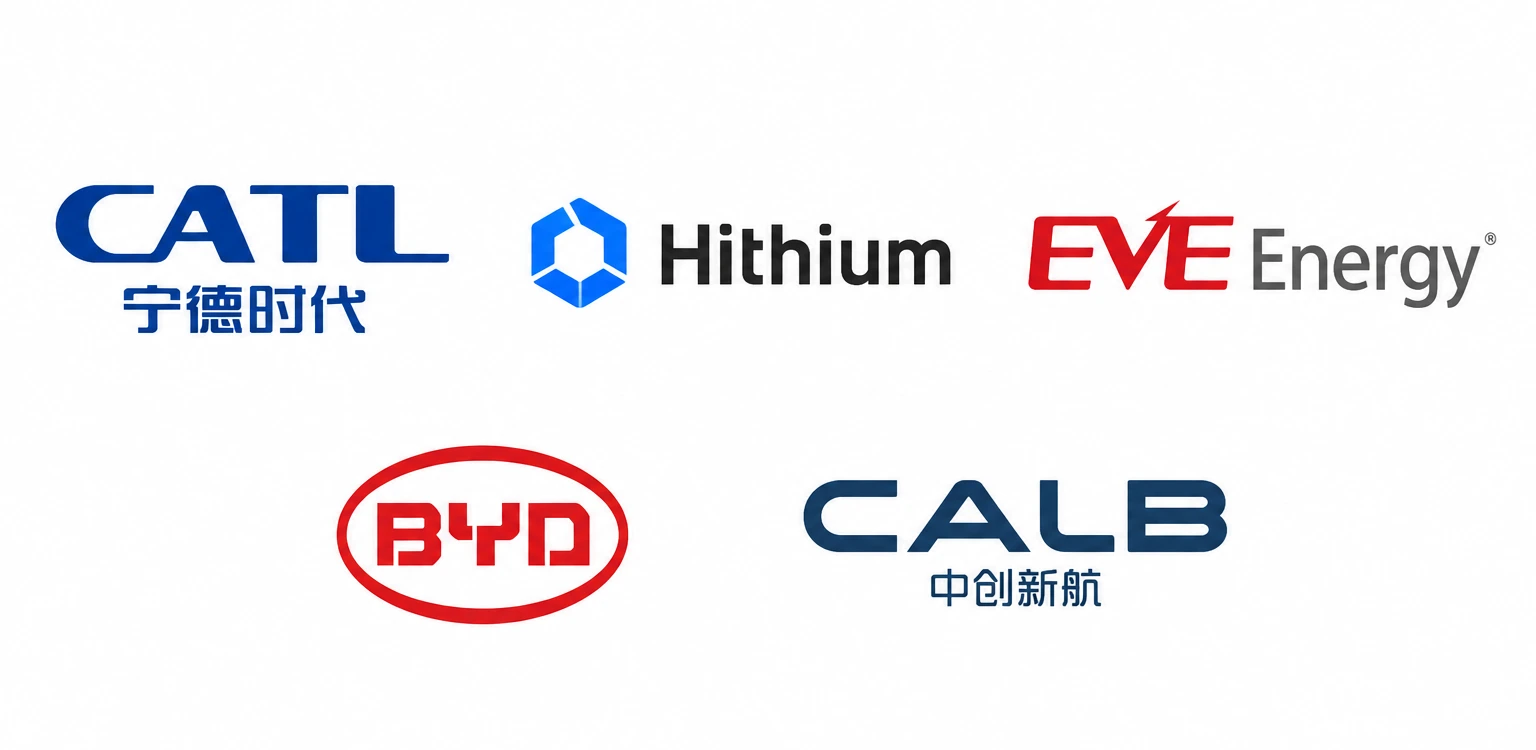
InfoLink Consulting's first-half 2026 global energy storage cell shipment ranking placed CATL, Hithium, EVE Energy, BYD, and CALB in the top five positions. Its ranking is based on energy storage cell shipments, not complete BESS deliveries.
The table below brings together these leading companies and other significant battery manufacturers in one overview. The five InfoLink-ranked companies retain their published positions; the remaining companies are included without assigning unsupported rankings.
Global Battery Manufacturer Overview
| Company | Headquarters | Market focus |
| CATL | China | Battery manufacturing for energy storage and electric mobility |
| Hithium | China | Energy storage battery manufacturing |
| EVE Energy | China | Batteries for energy storage and other applications |
| BYD | China | Battery manufacturing and integrated energy storage systems |
| CALB | China | Battery manufacturing for energy storage and mobility |
| Samsung SDI | South Korea | Rechargeable batteries and energy storage |
| LG Energy Solution | South Korea | Batteries for stationary storage and electric mobility |
| Gotion High-Tech | China | Battery manufacturing, including energy storage |
| REPT BATTERO | China | Battery manufacturing for energy storage and other applications |
| Great Power | China | Batteries for residential and other energy storage applications |
CATL
Contemporary Amperex Technology Co. Limited (CATL) ranked first in InfoLink's first-half 2026 global energy storage cell shipment ranking. The company supplies batteries for electric mobility and stationary energy storage, making it a major participant across the battery value chain.
For energy storage projects, CATL's role as a cell supplier should be distinguished from the responsibilities of the company delivering the complete BESS. System-level performance also depends on battery configuration, PCS selection, control strategy, thermal management, and protection coordination.
When evaluating a CATL-based solution, buyers should examine the proposed battery product's technical specifications, operating limits, test conditions, warranty provisions, and compatibility with the intended system architecture.
For energy storage projects, CATL's role as a cell supplier should be distinguished from the responsibilities of the company delivering the complete BESS. System-level performance also depends on battery configuration, PCS selection, control strategy, thermal management, and protection coordination.
When evaluating a CATL-based solution, buyers should examine the proposed battery product's technical specifications, operating limits, test conditions, warranty provisions, and compatibility with the intended system architecture.
Hithium
Hithium ranked second in InfoLink's first-half 2026 global energy storage cell shipment ranking and focuses on stationary energy storage batteries.
Battery requirements vary significantly by application. A long-duration storage project, for example, may place different demands on cell design and operating conditions than a C&I installation primarily intended to reduce short-duration peak demand.
Buyers should therefore compare battery specifications against the intended operating profile, including discharge duration, charge and discharge limits, temperature range, cycle-life test conditions, and warranty terms.
These considerations are particularly important when selecting batteries for systems expected to operate frequently throughout the year.
Battery requirements vary significantly by application. A long-duration storage project, for example, may place different demands on cell design and operating conditions than a C&I installation primarily intended to reduce short-duration peak demand.
Buyers should therefore compare battery specifications against the intended operating profile, including discharge duration, charge and discharge limits, temperature range, cycle-life test conditions, and warranty terms.
These considerations are particularly important when selecting batteries for systems expected to operate frequently throughout the year.
EVE Energy
EVE Energy ranked third in InfoLink's first-half 2026 global energy storage cell shipment ranking. The company serves multiple battery markets, including stationary energy storage.
For project procurement, the key question is how a particular battery product performs under the intended duty cycle. Frequent cycling, extended discharge periods, high ambient temperatures, and demanding power requirements can affect the suitability of a proposed battery configuration.
Buyers should evaluate verified product specifications and distinguish cell-level performance from complete-system results. PCS conversion losses, auxiliary consumption, thermal management, and operating controls can all affect the energy delivered by a finished BESS.
For project procurement, the key question is how a particular battery product performs under the intended duty cycle. Frequent cycling, extended discharge periods, high ambient temperatures, and demanding power requirements can affect the suitability of a proposed battery configuration.
Buyers should evaluate verified product specifications and distinguish cell-level performance from complete-system results. PCS conversion losses, auxiliary consumption, thermal management, and operating controls can all affect the energy delivered by a finished BESS.
BYD
BYD ranked fourth in InfoLink's first-half 2026 energy storage cell shipment ranking. The company is notable because it participates in both battery manufacturing and complete energy storage system supply.
This position across multiple stages of the value chain makes BYD relevant to both battery procurement and BESS system comparisons. Nevertheless, the evaluation criteria differ depending on the product being purchased.
For battery supply, buyers should focus on product specifications, operating limits, traceability, and warranty terms. For a complete system, the assessment should also cover power conversion, system integration, controls, commissioning, and long-term service responsibilities.
This position across multiple stages of the value chain makes BYD relevant to both battery procurement and BESS system comparisons. Nevertheless, the evaluation criteria differ depending on the product being purchased.
For battery supply, buyers should focus on product specifications, operating limits, traceability, and warranty terms. For a complete system, the assessment should also cover power conversion, system integration, controls, commissioning, and long-term service responsibilities.
CALB
CALB ranked fifth in InfoLink's first-half 2026 global energy storage cell shipment ranking.
For buyers considering CALB products, the evaluation should extend beyond nominal capacity. Rated performance, allowable operating conditions, cycle-life test methodology, product documentation, and warranty provisions are important when determining whether a battery is suitable for a particular installation.
The usable energy of a complete BESS also depends on system configuration and operating limits. Consequently, cell specifications should be assessed alongside the requirements of the proposed storage system.
Samsung SDI
Samsung SDI is a South Korean battery manufacturer with a portfolio spanning rechargeable batteries and energy storage applications.
Its position in the broader battery industry makes it relevant to buyers evaluating international supply options. However, Samsung SDI should not be assigned a position in InfoLink's first-half 2026 global energy storage cell top five without supporting data.
For a specific project, buyers should verify product availability, technical documentation, warranty arrangements, and compatibility with the proposed system architecture rather than relying solely on brand recognition.
LG Energy Solution
LG Energy Solution is a South Korean battery manufacturer serving electric mobility and stationary energy storage markets.
Its position varies according to the application, geographic market, and reporting methodology. InfoLink's first-half 2026 data placed LG Energy Solution eighth among energy storage cell suppliers serving markets outside China. This is a regional ranking and should not be confused with the global top-five ranking.
For procurement teams, the relevant questions include which products are available for the intended application, what operating conditions are supported, and what technical and commercial support is available for the project.
Gotion High-Tech
Gotion High-Tech is a Chinese battery manufacturer with products serving energy storage and other applications.
Its relevance to a project depends on the specific battery product, application requirements, and supply arrangements. Buyers should review technical documentation, operating limits, product consistency, and warranty conditions before comparing proposals.
Where batteries will be integrated into a complete BESS, compatibility with the selected BMS, PCS, and system control architecture must also be established.
REPT BATTERO
REPT BATTERO supplies batteries for energy storage and other applications. Its position in the market makes it relevant to buyers considering a broader range of battery suppliers.
Product-level evaluation remains essential. Buyers should compare rated capacity, operating limits, cycle-life test conditions, warranty terms, and available technical documentation under consistent assumptions.
A cycle-life figure alone does not establish the expected service life of a complete storage installation, which also depends on operating conditions, system design, and the terms of the relevant warranty.
Great Power
Great Power manufactures batteries for energy storage and other applications. The company is particularly relevant to residential storage battery supply, alongside its wider presence in the battery market.
For buyers assessing Great Power products, the key considerations include the specific battery format, supported operating conditions, product documentation, traceability, and supply arrangements.
As with other manufacturers, suitability should be assessed against the intended application rather than inferred from company-level market visibility.
2. Battery Manufacturers and BESS Suppliers: Why the Distinction Matters
Battery manufacturing and BESS integration overlap, but they should not be treated as interchangeable categories.
| Evaluation area | Battery manufacturer | BESS supplier or integrator |
| Main deliverable | Battery cells or battery products | Integrated energy storage system |
| Primary technical focus | Cell performance, capacity, consistency, operating limits | System architecture, PCS, BMS, EMS, thermal management, protection |
| Key compatibility concern | Battery specifications and operating requirements | Coordination among batteries, PCS, controls, and site equipment |
| Project responsibilities | Depend on the supply contract | May include engineering, integration, commissioning, and service |
| Procurement evidence | Product data, test reports, traceability, warranty | System performance, safety documentation, integration capability, service scope |
A battery that meets the required cell-level specifications does not automatically guarantee that the complete installation will achieve its required power output, efficiency, response, or operational reliability.
For C&I applications, the integrator must coordinate the battery and PCS with the site's load profile,
electrical connection, operating strategy, environmental conditions, and protection requirements.
Some companies operate in both categories. They can therefore appear in both parts of this guide, provided each appearance refers to the appropriate business role and ranking methodology.
3. Leading Global BESS Suppliers in 2026
A complete BESS supplier delivers more than batteries. Depending on the contract, its responsibilities may include system engineering, PCS integration, thermal management, controls, safety systems, commissioning, and long-term support.
Shipment rankings offer one way to compare suppliers, while comprehensive integrator assessments consider a wider range of capabilities. These two approaches should be presented separately because they measure different aspects of the market.
Global ESS Suppliers by First-Half 2026 Shipment Volume
InfoLink Consulting's first-half 2026 global energy storage system shipment ranking identified the following five leading suppliers.
| Rank | Company | Role |
| 1 | BYD | Energy storage system supplier |
| 2 | Sungrow | Energy storage system supplier and integrator |
| 3 | Huawei | Energy storage system supplier |
| 4 | Tesla | Energy storage system supplier and integrator |
| 5 | HyperStrong | Energy storage system supplier and integrator |
InfoLink reported global ESS shipments of 303.40 GWh in the first half of 2026, up 83.45% year over year. Its scope includes utility-scale, C&I, residential, and telecom base station storage.
The following company profiles explain the relevance of these suppliers without treating shipment volume as a guarantee of project suitability.
BYD
BYD ranked first in InfoLink's first-half 2026 global ESS shipment ranking. Its participation in both battery manufacturing and system supply gives it a position across multiple stages of the energy storage value chain.
For project buyers, the important question is whether the proposed system meets the required power rating, usable energy, discharge duration, electrical configuration, safety requirements, and service expectations.
Shipment volume provides market context, but the final evaluation should be based on the specific system configuration and project scope.
Sungrow
Sungrow ranked second in InfoLink's first-half 2026 global ESS shipment ranking. It also ranked first in Wood Mackenzie's 2026 Global BESS Integrator Comprehensive Ranking, based on 2025 performance.
These results reflect different methodologies: InfoLink measures first-half shipment volume, while Wood Mackenzie evaluates a broader set of integration capabilities.
When assessing a Sungrow solution, buyers should review the specific system architecture, PCS capabilities, controls, warranties, commissioning scope, and technical support available in the target market.
Huawei
Huawei ranked third in InfoLink's first-half 2026 global ESS shipment ranking.
For buyers considering Huawei-based solutions, due diligence should establish product availability in the target market, compatibility with the project's electrical architecture, applicable certifications, and the scope of local technical support.
The relevant comparison is the actual proposed system and contract, not the supplier's position in a shipment ranking alone.
Tesla
Tesla ranked fourth in InfoLink's first-half 2026 global ESS shipment ranking and second in Wood Mackenzie's 2026 comprehensive BESS integrator ranking.
These results are not directly interchangeable. One concerns shipments during the first half of 2026, while the other evaluates a broader set of integration criteria using 2025 data.
For a proposed installation, buyers should examine system capacity, operating strategy, site requirements, control capabilities, warranty provisions, and long-term service arrangements.
HyperStrong
HyperStrong ranked fifth in InfoLink's first-half 2026 global ESS shipment ranking.
Its inclusion reflects reported system shipment activity during the period. As the energy storage market expands, rankings can change between reporting periods, making the date and methodology of each source important.
For project procurement, supplier evaluation should also cover engineering capability, safety documentation, delivery responsibilities, warranty terms, and technical support.
4. Broader Global BESS Integrators: Wood Mackenzie's 2026 Ranking
InfoLink's shipment ranking provides a view of recent delivery volumes. A broader assessment of integration capabilities is available from Wood Mackenzie's 2026 Global BESS Integrator Comprehensive Ranking.
Wood Mackenzie's ranking focuses on AC-integrated BESS solutions and evaluates suppliers against ten criteria, including technology maturity, research and development, safety, vertical integration, supply-chain resilience, ESG performance, and financial strength. The ranking is based on data for the full year 2025.
Wood Mackenzie's 2026 Global BESS Integrator Ranking
| Position | Company |
| 1 | Sungrow |
| 2 | Tesla |
| 3 | CATL |
| 4 | BYD |
| 5 | Envision |
| 5 | Trina Storage |
| 7 | Fluence |
| 8 | LG |
| 9 | Canadian Solar |
| 10 | Wärtsilä |
Envision and Trina Storage share fifth place, so the ten ranking positions contain eleven company names.
This ranking should not be merged with InfoLink's first-half 2026 shipment ranking. It measures a broader set of integration capabilities using 2025 performance data rather than simply ranking shipments during the first half of 2026.
The inclusion of CATL and LG also illustrates that companies can participate in multiple parts of the energy storage value chain. Their positions in this table refer to the integrator assessment, not their ranking as battery cell manufacturers.
For buyers, the wider comparison highlights why complete BESS procurement involves more than battery manufacturing scale. Engineering capability, system safety, supply-chain resilience, financial strength, and long-term service can all affect project execution.
Neither ranking identifies the best supplier for every project, country, or application. The appropriate choice depends on the system specification, project location, commercial conditions, and support requirements.
5. HT InfinitePower: Commercial and Industrial BESS Solutions
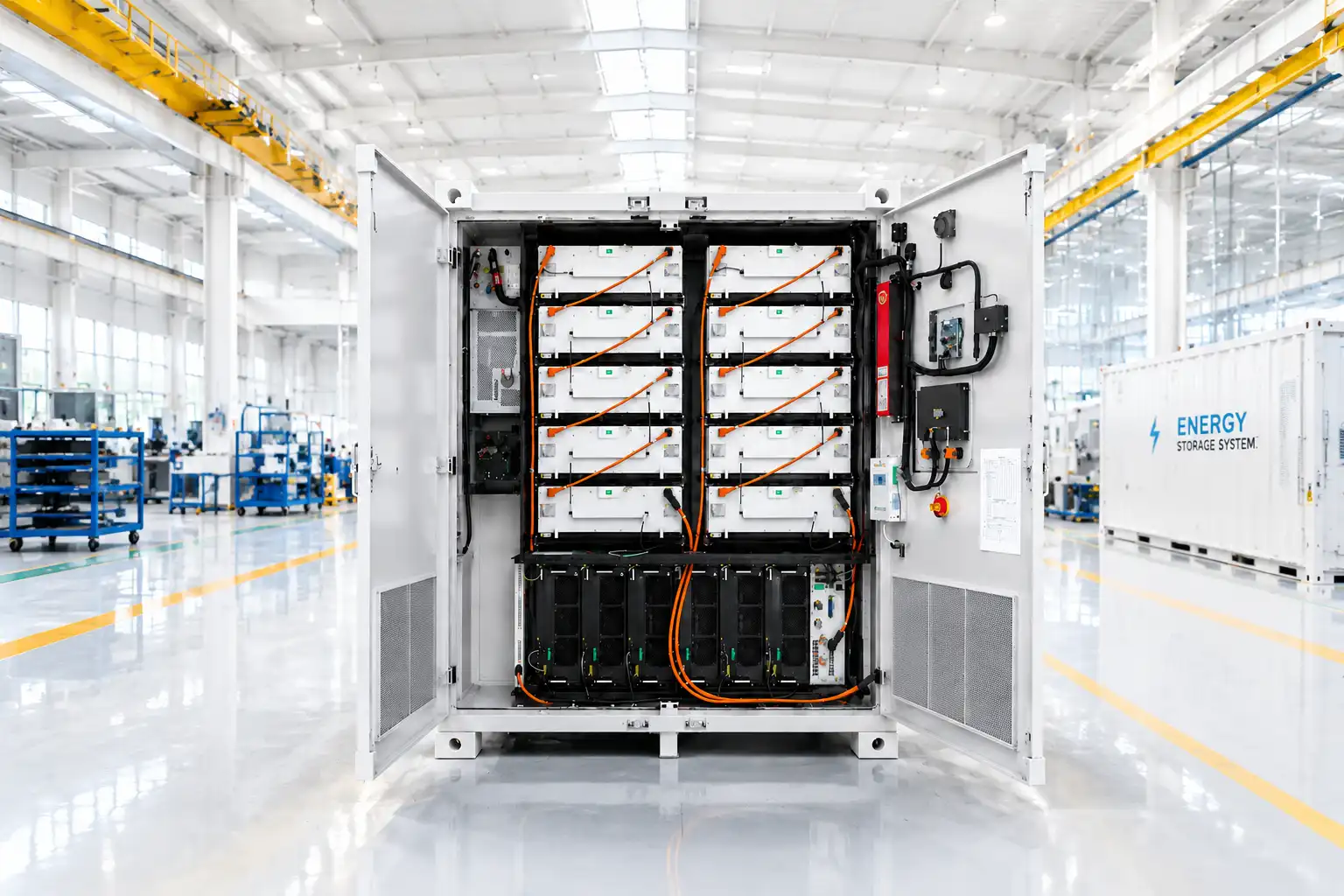
Global rankings help buyers understand the wider industry, but a C&I project requires a system that matches the site's electrical characteristics and commercial objectives.
HT InfinitePower focuses on commercial and industrial energy storage solutions. For these applications, system selection should begin with the site's load profile, grid connection, operating strategy, and required power and energy capacity.
A C&I BESS may be designed to support peak shaving, demand-charge management, photovoltaic self-consumption, backup-power strategies, or a combination of functions. The correct configuration depends on the project's technical and commercial conditions.
When evaluating a C&I BESS proposal, buyers should examine:
- Power and energy capacity: Confirm that the PCS power rating and usable battery energy meet the site's required output and discharge duration.
- Electrical compatibility: Check AC voltage, connection requirements, protection coordination, and compatibility with existing equipment.
- Thermal management: Assess the cooling method against ambient temperature, installation location, operating duty, and maintenance requirements.
- Energy management: Verify how the EMS will implement the intended operating strategy and coordinate with PV, generators, loads, and the grid where applicable.
- Safety and service: Review applicable certifications, protection design, commissioning arrangements, warranty conditions, and long-term technical support.
For more information, visit HT InfinitePower's industrial and commercial energy storage systems.
6. How to Choose a Battery Manufacturer or BESS Supplier
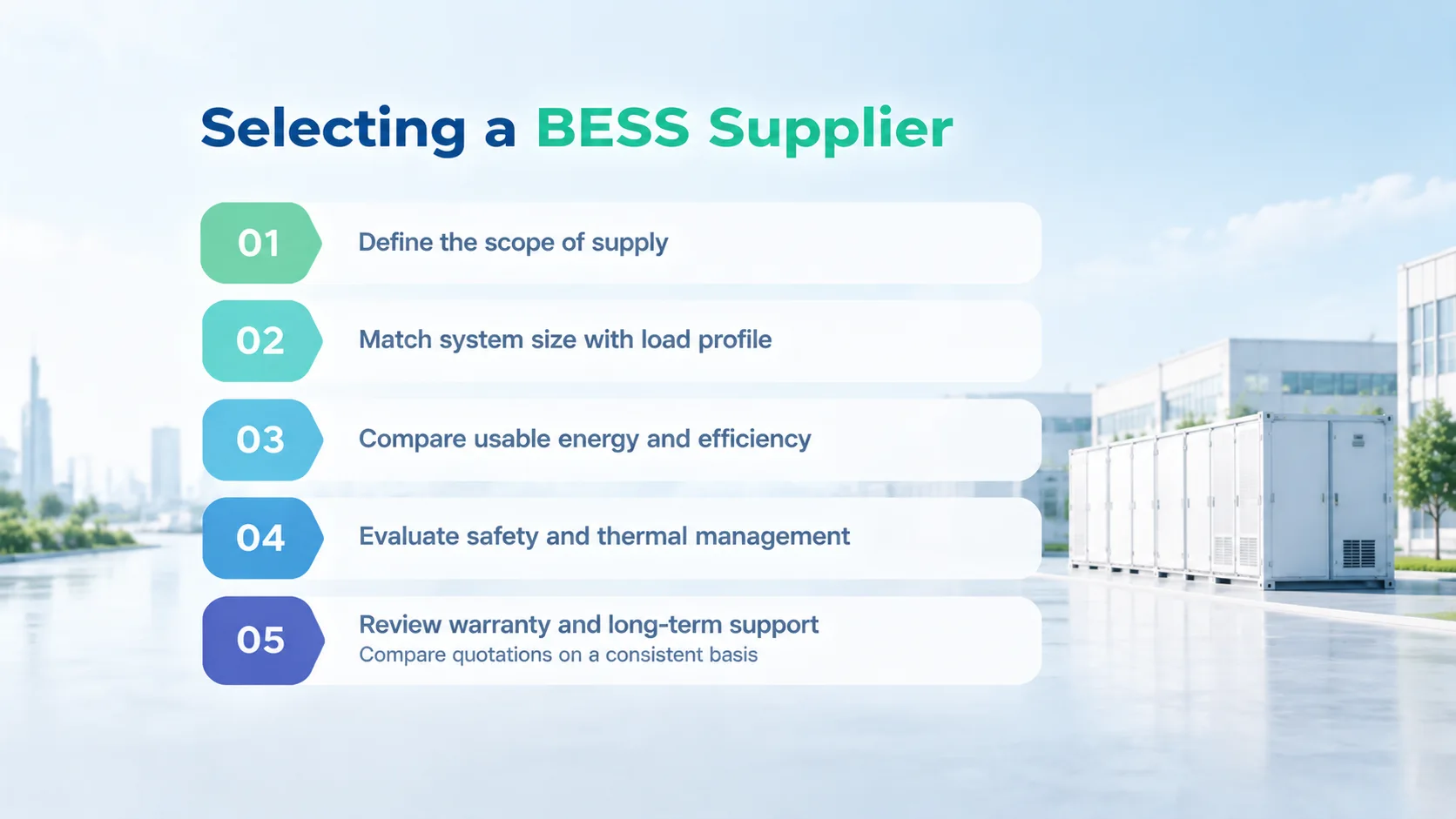
The appropriate supplier depends on the required scope of supply. A company supplying battery cells is evaluated differently from a supplier responsible for delivering and commissioning a complete storage installation.
Define the scope of supply
If the project requires battery cells or battery products for integration by another party, the evaluation should focus on product specifications, test evidence, traceability, supply consistency, and warranty arrangements.
If the project requires a complete BESS, the evaluation must also cover PCS selection, BMS and EMS functionality, thermal management, protection, integration engineering, commissioning, and service responsibilities.
A strong position in battery manufacturing does not automatically establish suitability as the integrator for every project.
Size the system around the load profile
For C&I installations, begin with interval load data and the intended operating strategy. Determine whether the main objective is peak shaving, time-of-use arbitrage, PV self-consumption, backup support, or a combination of functions.
Battery energy capacity is related to the required discharge duration, while PCS power must meet the required instantaneous output. These ratings should be evaluated together.
A larger battery is not automatically a better investment if the site's load profile, tariff structure, or operating strategy cannot make effective use of the additional capacity.
Compare usable energy and system efficiency
Nominal battery capacity and usable system energy are not interchangeable. Buyers should confirm the conditions under which usable energy is specified, including operating limits and the relevant measurement boundary.
System efficiency should also be compared using consistent definitions. Conversion losses and auxiliary consumption affect the amount of energy delivered to the site.
A cell-level performance figure should not be treated as equivalent to the round-trip efficiency of a complete AC-connected BESS.
Evaluate safety and thermal management
Safety assessment should cover the complete installation, not just the battery cells. Relevant considerations include protection design, monitoring, thermal management, fault response, applicable certifications, and site-specific installation requirements.
Ambient temperature, humidity, available space, ventilation, and maintenance access can all affect equipment selection and system configuration.
Review warranty and long-term support
Procurement should establish who is responsible for commissioning, troubleshooting, software support, spare parts, warranty claims, and maintenance.
Warranty terms should be reviewed alongside the operating conditions they assume. Cycle-life claims alone do not establish the warranted service life of a complete installation.
Compare quotations on a consistent basis
Supplier quotations should be compared against the same technical and commercial requirements. At a minimum, review rated power, usable energy, discharge duration, efficiency measurement, operating conditions, delivery scope, warranty provisions, and service obligations.
Shipment rankings can help identify established market participants, but the final decision should reflect the project's engineering requirements and risk profile.
Conclusion
The global battery and energy storage industries include companies with different roles across the value chain. CATL, Hithium, EVE Energy, BYD, and CALB led InfoLink's first-half 2026 global energy storage cell shipment ranking, while Samsung SDI, LG Energy Solution, Gotion High-Tech, REPT BATTERO, and Great Power also participate in the wider battery market.
For complete energy storage systems, InfoLink's shipment ranking and Wood Mackenzie's comprehensive integrator ranking offer different perspectives on market position and supplier capabilities. Their results should be interpreted according to their respective reporting periods and methodologies.
For buyers, a global ranking is a starting point for research, not a substitute for project-specific evaluation. The most appropriate battery manufacturer or BESS supplier is the one that meets the project's technical specifications, operating conditions, safety requirements, commercial objectives, and long-term service expectations.
For complete energy storage systems, InfoLink's shipment ranking and Wood Mackenzie's comprehensive integrator ranking offer different perspectives on market position and supplier capabilities. Their results should be interpreted according to their respective reporting periods and methodologies.
For buyers, a global ranking is a starting point for research, not a substitute for project-specific evaluation. The most appropriate battery manufacturer or BESS supplier is the one that meets the project's technical specifications, operating conditions, safety requirements, commercial objectives, and long-term service expectations.
FAQ
Who are the top battery manufacturers in 2026?
According to InfoLink Consulting's first-half 2026 global energy storage cell shipment ranking, the top five were CATL, Hithium, EVE Energy, BYD, and CALB. This ranking concerns energy storage cell shipments during the first half of 2026, not full-year shipments or all battery applications.
Is Samsung SDI one of the top five energy storage battery manufacturers in 2026?
Samsung SDI is an important battery manufacturer, but it was not among InfoLink's first-half 2026 global energy storage cell shipment top five. It remains relevant to the broader battery market and can be included in a manufacturer overview without assigning it an unsupported ranking.
What is the difference between a battery manufacturer and a BESS supplier?
A battery manufacturer produces cells or battery products. A BESS supplier or integrator coordinates batteries with the PCS, BMS, EMS, thermal management, protection, and other components needed for a complete storage installation. Some companies operate in both categories.
Who are the leading global BESS suppliers in 2026?
InfoLink's first-half 2026 global ESS shipment top five were BYD, Sungrow, Huawei, Tesla, and HyperStrong. Separately, Wood Mackenzie's 2026 comprehensive ranking, based on 2025 performance, placed Sungrow first, Tesla second, CATL third, and BYD fourth, with Envision and Trina Storage tied for fifth.
The two rankings use different methodologies and reporting periods, so they should not be treated as interchangeable.
Is the largest battery manufacturer always the best BESS supplier?
No. Shipment volume indicates market activity, but the most suitable supplier depends on the project's technical, safety, commercial, and service requirements. Battery and PCS sizing, usable energy, grid compatibility, thermal management, integration capability, and long-term support can be more decisive than a company's ranking.
What should C&I buyers prioritize when selecting an energy storage system?
C&I buyers should start with the site's load profile and operating strategy. They should then assess power and energy sizing, system efficiency, electrical compatibility, safety, warranty terms, integration responsibilities, and after-sales support. Comparing proposals against consistent technical and commercial assumptions makes supplier selection more meaningful.
Three-Phase Unbalanced Output Capability in BESS