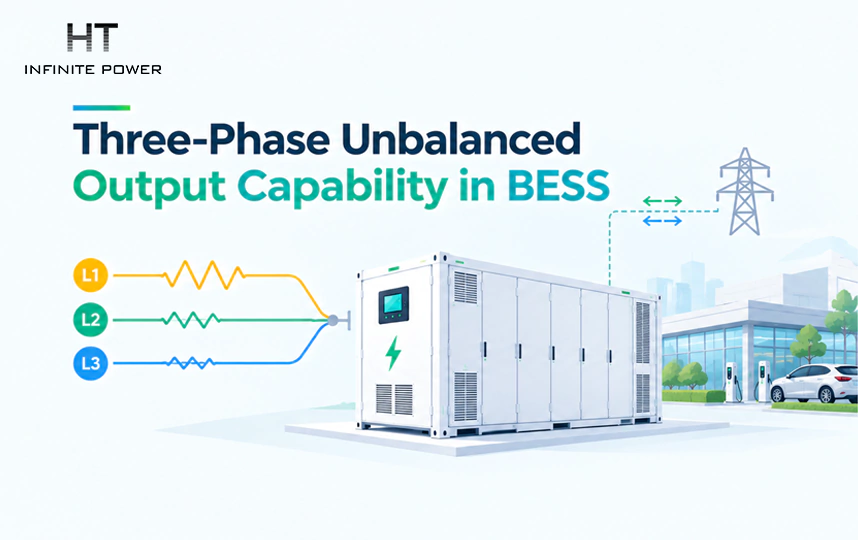
Three-Phase Unbalanced Output Capability in BESS
author: HT Infinite Power
2026-10-08
Introduction: The Three-Phase Power Challenge in Commercial BESS
Three-phase power systems are standard in commercial and industrial facilities, but the actual load is not always evenly distributed across the three phases.
In a typical 400 V commercial three-phase distribution system, many facilities contain a large number of single-phase loads. Shopping malls, supermarkets, office buildings, and EV charging stations, particularly those using AC slow chargers, can have significantly different power demands on the three phases.
When a battery energy storage system (BESS) is connected to such a site, the issue is not only the total load or the rated power of the PCS. The phase-by-phase distribution of power also affects how much of the BESS's rated PCS power can be practically used.
If a BESS cannot provide three-phase unbalanced output, its charging and discharging power may have to be restricted to avoid unwanted power flow between the site and the public grid. The extent of this limitation depends on the PCS topology, phase-level control capability, grid operating limits, protection settings, and the specific operating mode.
For commercial BESS projects, three-phase unbalanced output is therefore not simply an additional PCS feature. It can affect system utilization, grid interaction, and project economics where phase-level loads are significantly different.
1. Three-Phase Power Imbalance in Commercial Distribution Systems
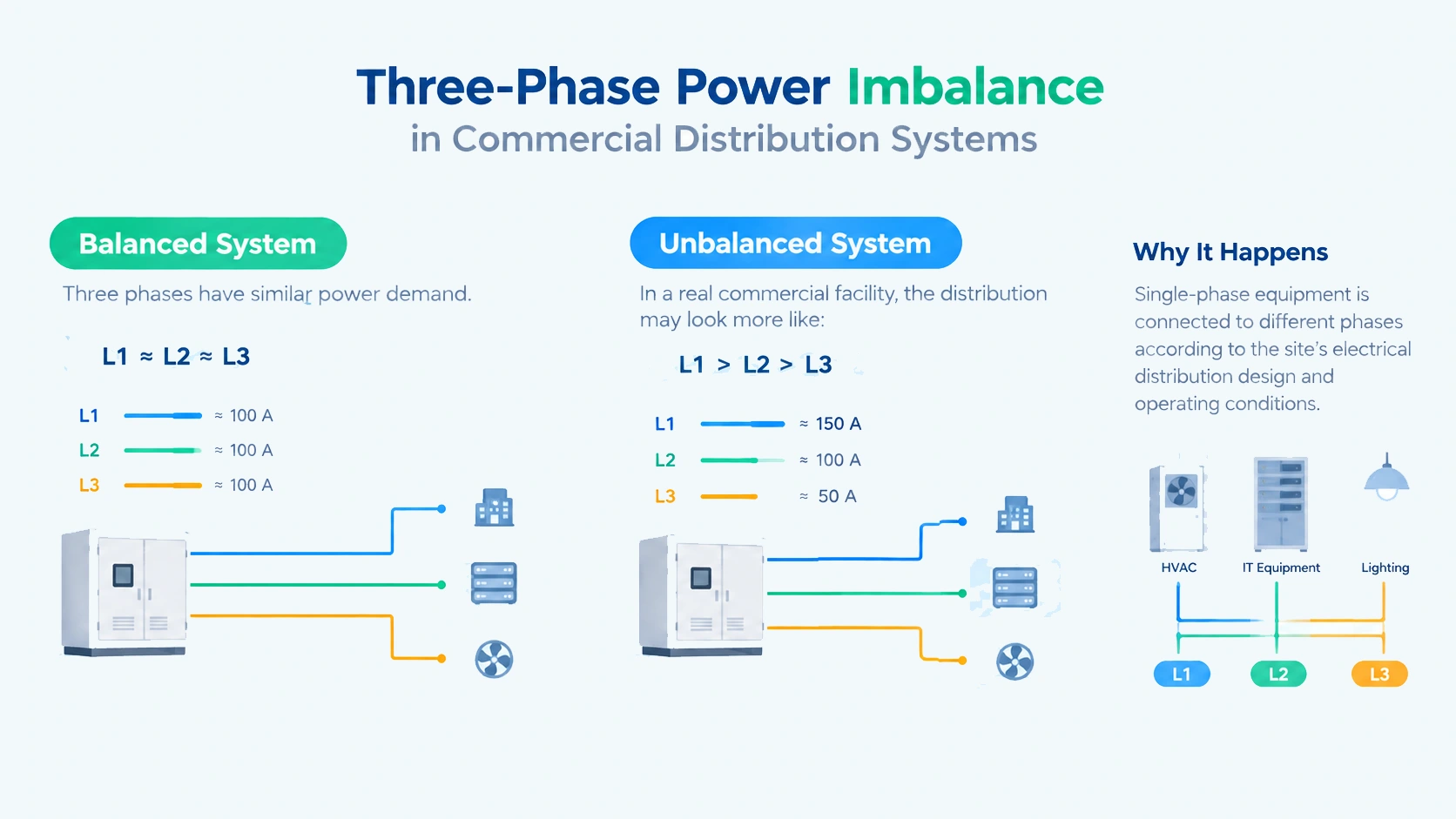
Three-phase imbalance can occur in several forms. In this article, the focus is specifically on unequal current among the three live phases caused by different load power on each phase.
In an ideally balanced system, the three phases have similar power demand:
L1 ≈ L2 ≈ L3
In a real commercial facility, the distribution may look more like:
L1 > L2 > L3
L1 ≈ L2 ≈ L3
In a real commercial facility, the distribution may look more like:
L1 > L2 > L3
This can happen because single-phase equipment is connected to different phases according to the site's electrical distribution design and operating conditions.
A three-phase connection therefore does not necessarily mean that the actual power demand is balanced across all three phases.
This situation is particularly common in facilities with many single-phase loads. A supermarket may have lighting, refrigeration-related equipment, sockets, and other loads distributed across different phases. An EV charging site may have multiple AC charging points connected to individual phases. Commercial buildings can also develop phase differences as equipment is added or operating patterns change.
The result is that the electrical system may have a substantial difference in current between L1, L2, and L3 even though the facility itself is connected to a three-phase supply.
For a BESS, this distinction matters because the storage system interacts with the grid at the three-phase point of connection. The PCS must respond not only to the total site power demand but also to how that demand is distributed among the phases.
2. How Phase Imbalance Limits BESS Charging and Discharging
The practical impact becomes clearer when a BESS is operated at a site with unequal phase loads.
2.1 How Phase-Level Load Limits Can Reduce BESS Discharge Power
Consider a site with the following instantaneous loads:
- L1: 80 kW
- L2: 50 kW
- L3: 30 kW
The total site load is 160 kW.
Suppose the BESS is discharging to reduce grid power consumption. If the PCS cannot independently control the power contribution to each phase, its output distribution may not match the site's phase-level demand.
The 30 kW load on L3, for example, may impose a practical constraint on how much additional power can be supplied to that phase without creating unwanted reverse power flow. Whether this actually limits the total BESS output depends on the PCS topology, phase-level current and power limits, grid import/export requirements, protection settings, and the active control strategy.
The important engineering point is that the BESS may have sufficient total rated power while still being unable to use all of that capacity under a particular phase-load condition.
A PCS with phase-level power control can respond differently, allocating power according to the actual site conditions rather than applying the same power contribution to every phase.
2.2 BESS Charging Can Also Be Constrained
The same principle applies during charging.
During a low electricity price period, a commercial BESS may be scheduled to charge from the grid so that sufficient stored energy is available for later peak shaving or energy arbitrage.
However, if the three phases have significantly different load conditions and the PCS cannot distribute charging power appropriately, the charging power may also have to be reduced.
This can have several consequences:
- The battery takes longer to reach the target SOC.
- The BESS may not reach its intended charging level before the low-price period ends.
- Less stored energy may be available during the subsequent peak period.
- The project may not fully capture the expected value of time-of-use price differences.
The extent of the limitation depends on the PCS design and the site's grid operating conditions. It is not an automatic consequence of every unbalanced load.
The issue is not simply whether the battery has enough kWh. The available charging and discharging power at the site also determines how effectively that stored energy can be used.
3. When BESS Output Further Increases Existing Phase Imbalance
A commercial facility may already have a certain degree of three-phase imbalance before a BESS is installed.
The storage system should therefore be evaluated against the existing electrical conditions rather than treated as an isolated power source.
If BESS output is not properly matched to the phase-level load, storage operation can further increase the difference between phase currents. This is particularly relevant when the existing distribution system is already close to its applicable electrical limits.
The electrical effects of imbalance depend on the system topology, grounding arrangement, transformer configuration, neutral configuration, and the source of the imbalance.
Negative- and Zero-Sequence Components
Unbalanced three-phase currents can be represented using symmetrical components, including positive-, negative-, and zero-sequence components.
Negative-sequence current is relevant to three-phase equipment because it represents an unbalanced component of the current system. Zero-sequence current can also become important where the system configuration provides a suitable return path through the neutral or grounding arrangement.
These effects should be evaluated according to the actual electrical architecture rather than inferred from the BESS rating alone.
Neutral Current and Transformer Conditions
In systems where the neutral conductor provides a return path for unbalanced single-phase loads, phase imbalance can increase neutral current.
Depending on the distribution architecture, significant imbalance can also affect neutral-point voltage conditions and transformer operation.
Excessive or poorly controlled imbalance may also complicate:
- protection coordination,
- relay operation,
- current measurement,
- energy metering,
- and power-quality management.
The important point is not that any phase imbalance will automatically damage a transformer or cause protection failure. Rather, an improperly controlled BESS can add another source of phase imbalance to an already unbalanced electrical system, so the existing electrical conditions and expected BESS operating modes should be evaluated together.
4. How Three-Phase Unbalanced Output Capability Solves the Problem
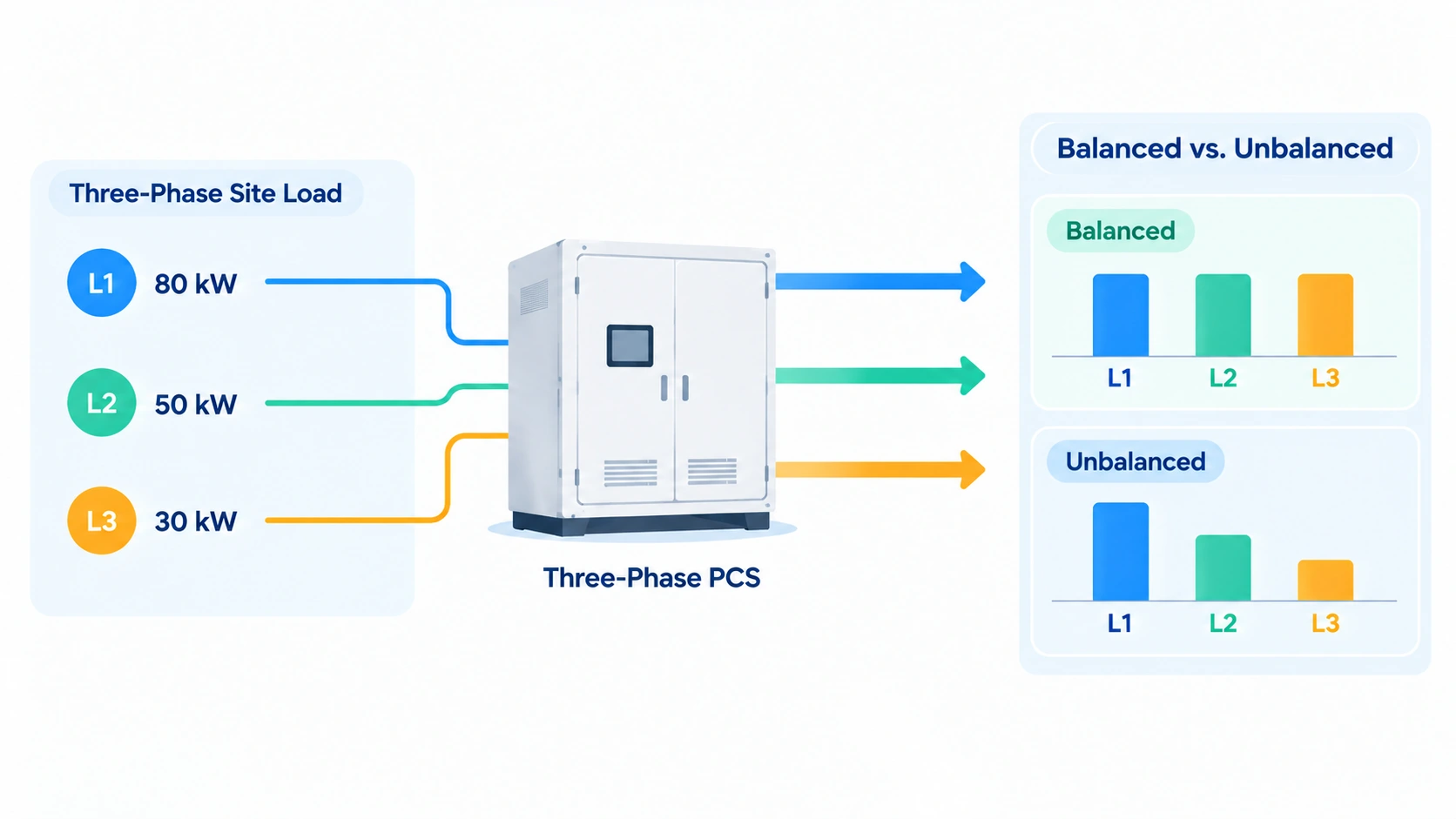
The purpose of unbalanced output capability is to allow the BESS to respond to the actual phase-level power requirements of the site.
Consider again:
- L1 load: 80 kW
- L2 load: 50 kW
- L3 load: 30 kW
A PCS with suitable phase-level control capability can distribute its active power output according to the actual operating conditions instead of being restricted to an identical power contribution on every phase.
Conceptually:
Balanced output: similar power contribution across the three phases
Unbalanced output: different power levels can be provided to the three phases according to site conditions
The actual output values are determined by the PCS control strategy, site load, grid requirements, protection limits, and operating mode.
This capability can help the BESS:
- supply more of the site's actual load,
- reduce unnecessary reverse power flow,
- make better use of available PCS capacity,
- respond more accurately to phase-level demand,
- and maintain better control of grid power exchange.
This is why the relevant question during BESS selection is not simply:
How many kW can the PCS provide?
How many kW can the PCS provide?
It is also:
How can those kW be distributed across the three phases under the actual operating conditions of the site?
For commercial applications with substantial single-phase loads, this distinction can be significant.
How EMS and PCS Coordinate Phase-Level Power
Three-phase unbalanced output is not solely a battery characteristic. It is part of the control relationship between the site, EMS or site controller, and PCS.
At a practical level:
- The EMS or site controller monitors site load and grid power exchange.
- Phase-level operating conditions can be considered when determining the BESS power command.
- The PCS executes the required active-power output within its phase-level current and power limits.
- Actual operation remains constrained by SOC, PCS rating, phase current limits, grid import/export limits, protection settings, and the selected operating mode.
The EMS therefore defines or coordinates the system-level operating target, while the PCS handles the electrical power conversion and phase-level control within its hardware and software limits.
The exact control architecture varies by system. The key point is that effective unbalanced operation requires coordination between the site load, control system, and PCS rather than simply adding more battery capacity.
5. What Engineers Should Check When Selecting a BESS
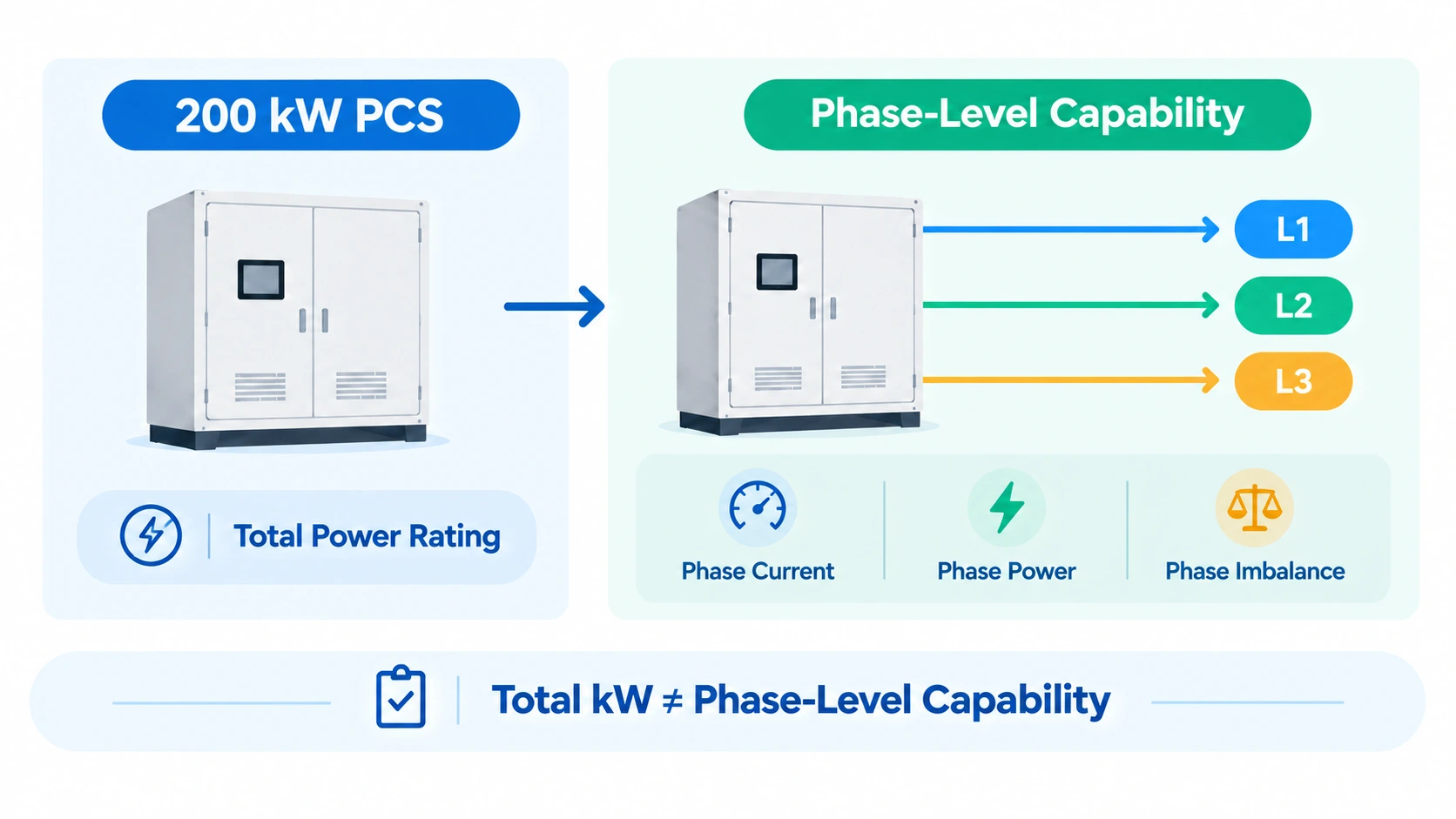
For a commercial BESS connected to a three-phase distribution system, the PCS should be evaluated against the actual electrical characteristics of the site.
PCS Power Rating
The total PCS power rating defines the system's rated active power capability, but it does not by itself describe phase-level power performance.
A 200 kW PCS, for example, should not automatically be assumed to provide 200 kW of fully usable site power under every phase-load condition. The actual usable output depends on the PCS design and the site's operating constraints.
Three-Phase Unbalanced Output Capability
Engineers should confirm whether the PCS supports controlled phase-level power distribution and under what operating conditions.
The relevant specification may include allowable phase imbalance, maximum phase current, control range, and operating limits.
What Does “Unbalanced Output” Mean in a PCS Datasheet?
A supplier statement such as “supports unbalanced output” is not sufficient by itself for project evaluation.
Where applicable, engineers and buyers should ask the PCS supplier to clarify:
- maximum phase current;
- maximum phase power;
- whether phase power can be controlled independently;
- allowable phase imbalance;
- the percentage of rated PCS power available under unbalanced operation;
- whether unbalanced operation is supported during both charging and discharging;
- applicable voltage range;
- operating-mode limitations;
- grid-connected operating conditions;
- whether a neutral connection is required.
These specifications can vary substantially between PCS designs. The exact values and operating limits should come from the PCS manufacturer and be checked against the electrical design of the project.
Grid Import and Export Limits
Many commercial projects have defined limits on grid import or require anti-backflow control.
These limits directly affect how much power the BESS can exchange with the grid and how its phase-level output should be controlled.
Existing Phase Imbalance
The site's three-phase load should be measured before final BESS sizing and PCS selection.
A system with heavily unbalanced loads should not be evaluated using only the facility's total kW demand. Phase-level load data can reveal operating constraints that are not visible from the total site load.
Transformer and Protection Requirements
The BESS must also be evaluated together with the existing transformer, switchgear, protection devices, metering equipment, and point-of-common-coupling requirements.
The operating conditions created by BESS charging and discharging should be included in the electrical study, particularly where the site already has significant phase imbalance.
Ultimately, BESS selection should consider both the total power rating and the phase-level power capability of the PCS.
Conclusion
Three-phase unbalanced output capability can affect how effectively a commercial BESS uses its available PCS power at a site with unequal phase loads.
In a commercial three-phase distribution system, single-phase loads can create significant differences between the phases. If the PCS cannot respond to those differences, BESS charging and discharging may be constrained by phase-level electrical conditions, grid power-flow requirements, or other system limits.
The resulting impact can include reduced usable PCS capacity, slower battery charging, less stored energy available during peak periods, and lower overall system utilization.
For BESS system design, the engineering decision is therefore not based only on the total kW and kWh ratings. Engineers should also evaluate the phase-level load profile, PCS control capability, maximum phase current, grid import and export limits, protection requirements, and the operating conditions under which the system will actually run.
For commercial energy storage projects with substantial single-phase loads, understanding these phase-level conditions helps determine whether three-phase unbalanced output capability is a meaningful requirement for the BESS.
FAQ
What is three-phase unbalanced output in a BESS?
Three-phase unbalanced output means that a BESS PCS can provide different levels of active power to the three phases according to site conditions, rather than being restricted to the same power contribution on every phase. This can allow the storage system to better match sites with unequal phase loads.
Why can phase imbalance limit BESS discharge power?
If the PCS cannot adjust its phase-level output to match the site load, one phase may reach its allowable operating condition before the others. Depending on the PCS topology, grid power-flow requirements, current limits, and protection settings, the overall BESS discharge command may then need to be reduced.
Can phase imbalance also limit BESS charging?
Yes. Unequal phase conditions can restrict charging power when the PCS or grid connection cannot accommodate the required phase-level current or power distribution. This can prevent the battery from reaching its target SOC during a limited low-price period.
Does every commercial BESS need unbalanced output capability?
Not necessarily. The importance of this capability depends on the site's phase-level load distribution, grid connection, PCS design, and operating requirements. It is particularly relevant for facilities with substantial single-phase loads or significant existing phase imbalance.
What is the difference between balanced and unbalanced PCS output?
From a BESS perspective, balanced output means the PCS provides similar power contributions across the three phases. Unbalanced output allows the PCS to provide different power levels to the phases according to site conditions and within its specified operating limits.
How do I know whether my site needs a BESS with unbalanced output?
Review phase-level load data rather than looking only at total site kW demand. If the facility has significant single-phase loads, substantial differences between phase currents or power demand, or specific grid power-flow constraints, unbalanced PCS output may provide greater operational flexibility. The final requirement should be determined from the site's electrical measurements, grid requirements, and BESS design.
kWh to Ah Calculator for Batteries and Energy Storage
Related Article