Power Quality Compensation vs Peak Shaving in BESS
2026-01-07

People often say “the battery will fix everything” and mean different things. In one corner sits power-quality (PQ) compensation—fast, waveform-level work: canceling harmonics, stabilizing voltage, correcting unbalance. In the other sits peak shaving—time-shifting energy to cut demand charges or avoid costly grid upgrades. Both can be services a battery provides, but they are distinct in objective, control logic, and impact on battery life. Below I unpack the difference in plain engineering terms, give concrete examples, show the timing and control contrasts, and finish with practical design and KPI guidance so you can decide what to prioritize on a site-by-site basis.
Quick definitions and the problem each solves
Power-quality compensation is about waveform health. It fixes or mitigates short-term deviations that harm equipment or violate grid rules: harmonics (distorted current/voltage), voltage flicker, poor power factor, and phase unbalance. The goal: reduce THD, hold voltage within tight tolerances, and stop sensitive processes tripping.
Peak shaving is about energy economics and capacity management. It reduces the billed or contracted peak (kW) by discharging the battery during the few minutes or hours that determine demand charges or grid interconnection capacity. The goal: shave the measured peak, minimize demand-charge exposure, deferrals of network upgrades.
Both services matter, but they are different animals—one CPU-fast and waveform-sensitive, the other schedule-driven and energy-centric.
The technical mechanisms — what the BESS actually does
PQ compensation: waveform control, harmonics, reactive support, unbalance correction
When a BESS performs PQ functions it behaves like an active power electronics lab: fast inner current controllers act in the millisecond-to-subsecond band to inject compensating currents. Common functions:
- Harmonic compensation: the inverter injects current components that cancel non-fundamental frequencies produced by loads (variable-frequency drives, arc furnaces). The inverter implements selective harmonic compensation or active filtering. The result: lower THD at the PCC and reduced heating in transformers/cables.
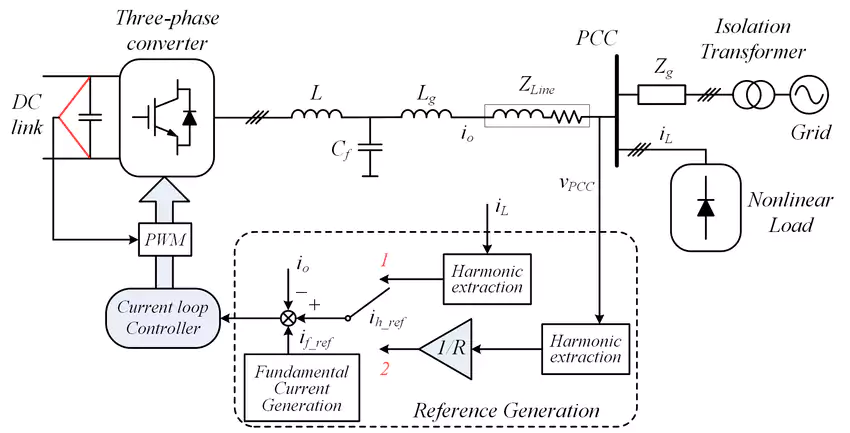
- Reactive power & voltage regulation: by controlling the phase of injected current (Q control), a BESS can provide dynamic VAR support, arrest voltage dips and contribute to voltage stability. This is similar to a STATCOM function but with the energy buffer advantage.
- Unbalance correction: three-phase, phase-aware control lets the inverter redistribute currents to reduce negative-sequence components, easing motor heating and improving supply quality.
Key hardware implication: PQ work demands tight current control bandwidth, high sampling rates, and sometimes per-phase control granularity. These actions typically do not discharge large amounts of stored energy (they manipulate instantaneous current), but they require the inverter to be responsive and rated for short bursts.
A compact formula engineers use for reactive sizing:
Q=P⋅(tanϕ1−tanϕ2)
where φ1 and φ2 are power factor angles before and after correction; this shows reactive injection (kVAr) required to shift PF.

Peak shaving: energy scheduling, ramp control, and demand-window logic
Peak shaving uses the battery as an energy buffer over pre-defined billing windows (e.g., 15–60 minute intervals). The logic is:
- Detect an impending rolling peak (predictive or threshold based).
- Dispatch stored energy to reduce site net power so the measured peak falls below a target.
- Recharge during off-peak or from onsite generation.
This requires EMS with forecasting, state-of-charge (SOC) management, and priority rules to avoid recharging into a new peak. Peak shaving stresses the battery in energy terms—kWh throughput—and thus impacts cycle life directly.
Timing, control stacks and priority conflicts
The two services operate on different time scales and control layers:
- PQ compensation: inner control loops, millisecond-to-seconds. Response must be immediate. Priority is safety and equipment protection. PQ actions are typically non-energy intensive but may require high instantaneous current.
- Peak shaving: minutes-to-hours. Response is planned; EMS schedules dispatch windows and manages SOC. Energy throughput dominates.
Conflict arises when both services are required simultaneously. Example: an industrial site needs reactive support during a peak-shaving window. If the battery is already near SOC lower bound to shave demand, it may not have headroom to supply reactive currents (which are often sourced from instantaneous power capability but still draw on inverter capacity and margin). Practical control stacks therefore include priority arbitration: usually PQ and safety functions override economic dispatch. A good system reserves a SOC margin for PQ contingencies (say 5–15%) and employs fast curtailment rules to avoid violating grid codes.
Real-world examples

Factory with heavy motor starts — PQ first
An automotive stamping shop suffers voltage dips and motor overheating due to repetitive large-start currents. Here, a BESS configured for PQ compensation (fast current injection, negative sequence mitigation) prevents nuisance trips and reduces transformer heating. Battery cycling is minimal; the inverter absorbs and supplies instantaneous power to shape the waveform. Economics: avoided production stoppages and reduced maintenance—not direct demand-charge saving.
Supermarket or cold storage — peak shaving first
A supermarket faces monthly demand penalties from a brief evening refrigeration surge. A 215 kWh battery scheduled to discharge during the 30–60 minute billing window reduces the measured peak, yielding predictable bill savings. PQ issues are secondary unless multiple compressors cause flicker; then a hybrid control (fast PQ during compressor starts, scheduled energy dispatch for peak windows) is needed.
How to size and operate a BESS when you need both services
Designers often must trade off: do you buy extra inverter headroom for PQ bursts, or larger energy capacity for shaving? Practical steps:
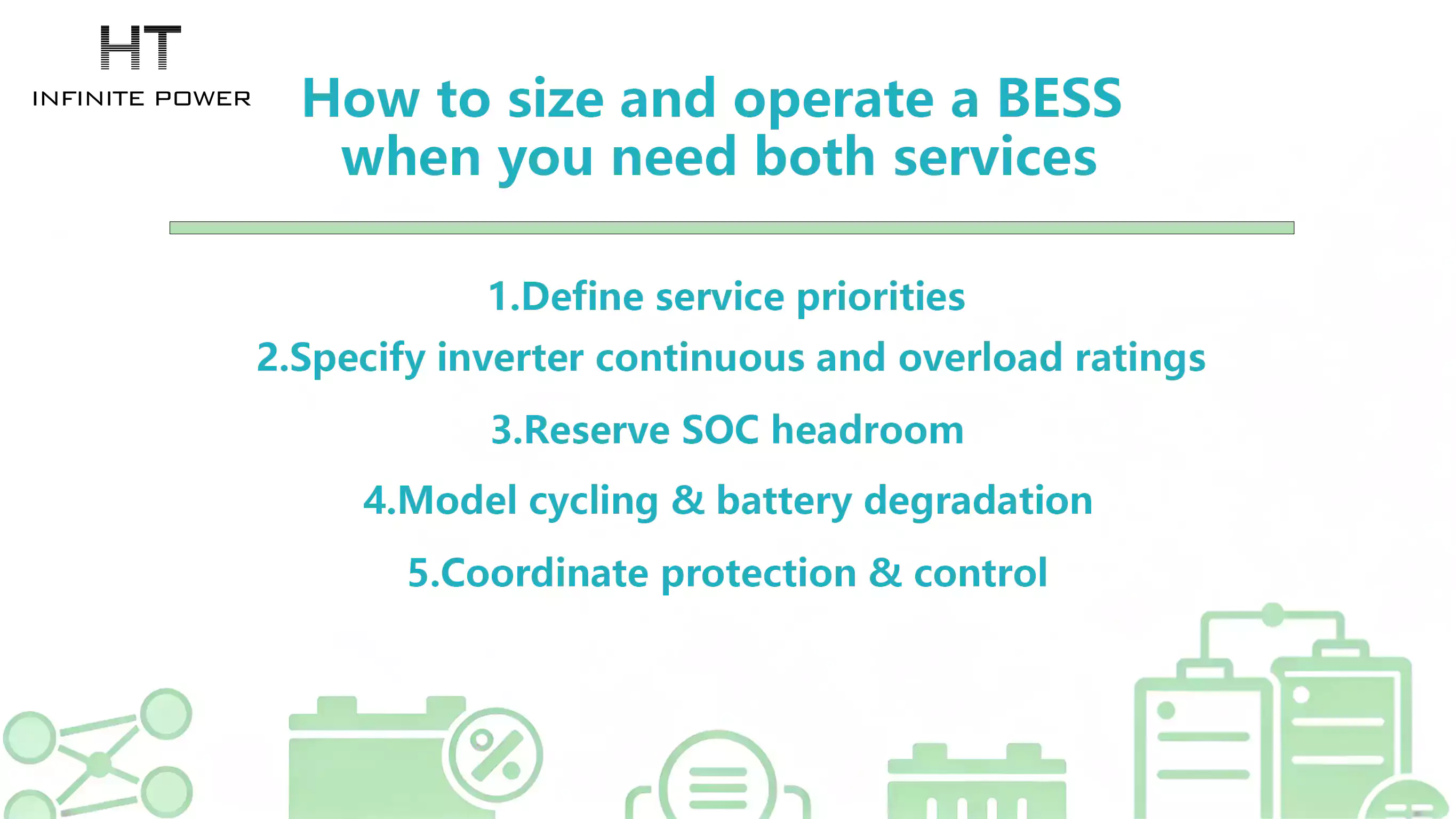
- Define service priorities: rank safety/PQ, contractual obligations (demand charge reduction), and revenue stacking. Always put protective PQ services first in rules.
- Specify inverter continuous and overload ratings: PQ events are current-intensive but short. Ensure the inverter supports required short-term overload and has thermal margins.
- Reserve SOC headroom: set operational SOC bands with an emergency PQ reserve (e.g., keep 10–15% SOC that EMS cannot dispatch for economics).
- Model cycling & battery degradation: include expected PQ duty and shaving cycles to forecast capacity fade and replacement costs.
- Coordinate protection & control: harmonics compensation can affect relay behavior—test FAT/SAT sequences with protection settings.
A simple lifecycle check: if PQ actions cause additional current throughput equivalent to X% of annual cycling, include that in LCOS and warranty negotiation.
KPIs, measurement and contract language to use with vendors
Measure and contract the outcomes you care about:
- For PQ: THD @ PCC (%), voltage deviation (±V), Voltage Unbalance Factor (VUF %), number of nuisance trips per year.
- For peak shaving: kW peak reduction, kWh shifted per billing period, cycles/month, and net $/month saved.
- For lifecycle: cycles to end-of-warranty, calendar fade rates, and warranty remedies for capacity shortfall.
- Contract clause suggestion: “Vendor guarantees inverter transient response and THD reduction to X% under Y load spectrum during FAT/SAT; remedies include pro-rata replacement or performance payments.”
Conclusion — practical rules of thumb
- If you deal with manufacturing process stability or sensitive equipment, prioritize PQ compensation. The value is often operational continuity, not tariff savings.
- If the site’s main problem is monthly demand charges, prioritize peak shaving and schedule PQ functions as a secondary service.
- Design for both when you can: choose an inverter with fast current control and sufficient overload capability, and set SOC reserves so PQ functions never starve economic dispatch.
- Always test in the field: PQ dynamics are site-specific. FAT/SAT with harmonic injection, motor starts and real protective relays is non-negotiable.
Power quality compensation and peak shaving are complementary, not interchangeable—but they demand different architectures, different control timing, and different commercial thinking. Treat PQ as a protective, priority service and peak shaving as the economic engine; when the control stack respects both, the battery becomes both guardian and bookkeeper for the site.
Lithium Battery Electrolytes: A Breakthrough to −110 °C in Extreme Cold
Power Quality Challenges in Grid-Connected BESS