PCS vs. PV Inverter: What Actually Sets Them Apart?
2026-04-09
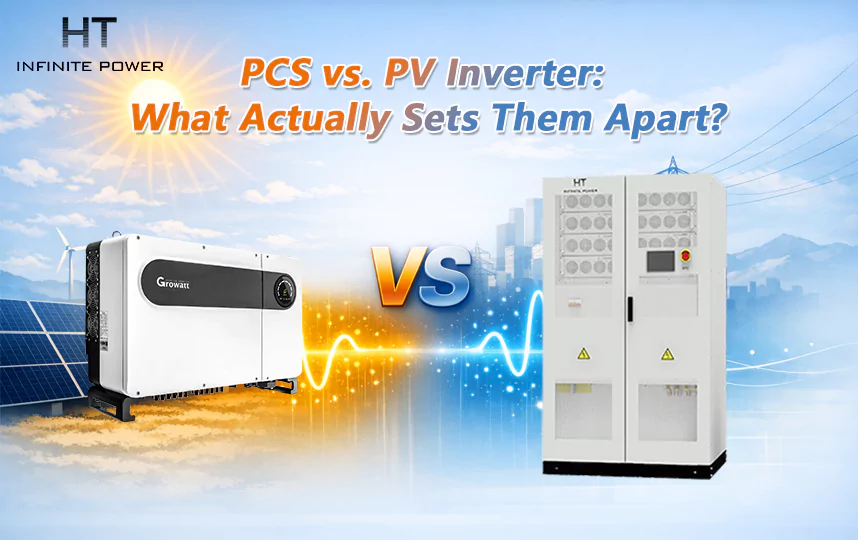
In solar and energy storage projects, PCS and PV inverters are often mentioned together, sometimes almost as if they were interchangeable pieces of equipment. On the surface, it’s not hard to see why. Both sit at the intersection of DC and AC. Both are essential to making renewable energy usable. And both are deeply embedded in modern power systems.
But once you move beyond that surface-level similarity, the differences start to matter—quickly.
A PV inverter is built to do one job extremely well: convert solar-generated DC electricity into usable AC power. A PCS (Power Conversion System), by contrast, operates in a much wider context. It doesn’t just convert energy—it actively manages how energy moves between the grid, the battery, and the load.
That shift—from conversion to coordination—is where everything changes.
One is about generation. The other is about control.
Where the inverter’s job begins—and ends
A PV inverter lives on the generation side of the system. Solar panels produce DC electricity, but buildings and grids run on AC. The inverter steps in to bridge that gap, converting DC into AC with as little loss as possible while keeping everything synchronized with grid requirements.
From a system perspective, the energy flow is straightforward. Electricity moves from the panels, through the inverter, and into either the load or the grid. There’s no real ambiguity about direction or timing. If the sun is shining, energy flows.
What the inverter does not do is decide whether that energy should be stored, delayed, or redirected. It simply converts and delivers.
Why PCS has to think in both directions
A PCS operates in a very different environment. It sits between the battery and the AC system, and its role is inherently bidirectional.
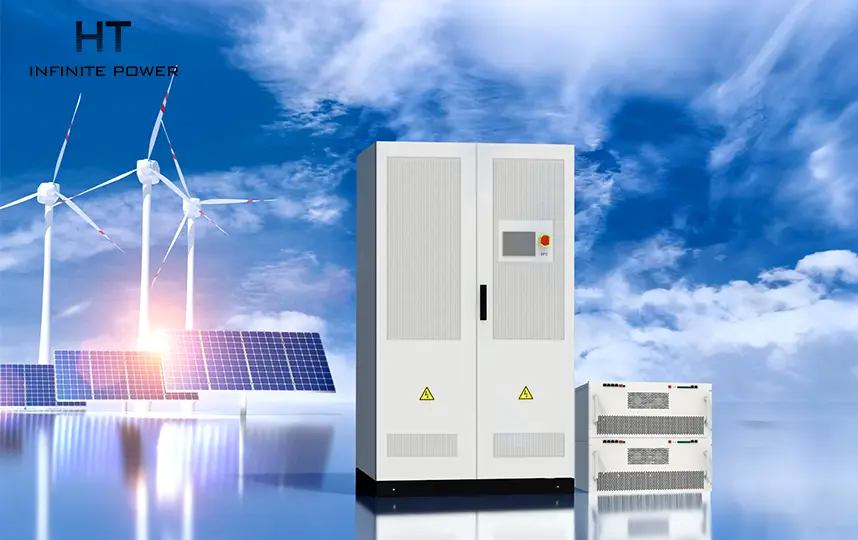
When the system has excess energy—whether from solar or the grid—the PCS converts AC into DC and stores it in the battery. When energy is needed, it reverses the process, converting stored DC back into AC for use.
But that’s only part of the story.
The PCS is also responsible for deciding when each of those actions should happen. Should the battery charge now or wait? Should it discharge to support the load or hold energy for later? Those decisions depend on factors like electricity pricing, load demand, battery state of charge, and system strategy.
In that sense, the PCS behaves less like a converter and more like an operator quietly managing energy behind the scenes.
The working logic is not just different—it’s built for different problems
MPPT: extracting as much as possible from solar
Inside a PV inverter, one of the most important functions is MPPT—Maximum Power Point Tracking. Solar output isn’t constant. It shifts with sunlight intensity, temperature, and shading conditions. MPPT continuously adjusts the operating point of the PV array to ensure it produces as much power as possible at any given moment.
That’s the inverter’s core challenge: how to extract maximum energy from a variable source and convert it efficiently.
It’s a real-time optimization problem, but it’s still focused on a single direction of flow.
PCS: balancing energy across time, not just power
A PCS deals with a different kind of complexity. Instead of optimizing instantaneous generation, it has to balance energy across time.
Charging and discharging are not just electrical processes—they are strategic decisions. Charging too early might mean missing a better price window later. Discharging too aggressively might reduce available backup capacity.
At the same time, the PCS must coordinate closely with the battery management system (BMS). It needs to respect voltage limits, temperature constraints, and state-of-charge boundaries to avoid overcharging or deep discharging, both of which can shorten battery life or create safety risks.
So while a PV inverter is constantly chasing the best operating point for generation, a PCS is constantly negotiating trade-offs between efficiency, timing, and system constraints.
Applications look similar on paper—but behave very differently in practice
Where PV inverters dominate
Anywhere there is solar generation, there will be a PV inverter. Residential rooftops, commercial buildings, agricultural installations, and utility-scale solar plants all rely on inverters to make solar energy usable.
In these scenarios, the primary objective is clear: convert as much solar energy as possible and deliver it efficiently.
There’s no requirement to “hold” energy or shift it in time. What’s generated is either consumed or exported.
Where PCS becomes essential
PCS units appear when storage enters the equation. Home battery systems, commercial and industrial storage projects, grid-scale battery installations, and microgrids all depend on PCS to function properly.
In these systems, energy is no longer just produced—it is scheduled, stored, and dispatched.
Take a commercial facility as an example. Electricity prices may vary significantly throughout the day. A PCS allows the system to charge batteries during low-price periods and discharge during peak hours, reducing overall energy costs. In a grid application, it may absorb excess renewable generation and release it later to stabilize supply.
The presence of storage changes the question from “how much energy do we produce?” to “when should we use it?”—and that’s exactly the question PCS is designed to answer.
Efficiency matters in both—but it’s measured differently
One-way efficiency vs. round-trip reality
For PV inverters, efficiency is usually discussed as a single conversion metric: how much of the DC input is successfully converted into AC output. High efficiency directly translates into more usable solar energy.
With PCS, the picture is more layered. Since energy flows in two directions, efficiency has to be considered across a full cycle.
A simplified way to express this is:
Round-trip efficiency = charging efficiency × discharging efficiency
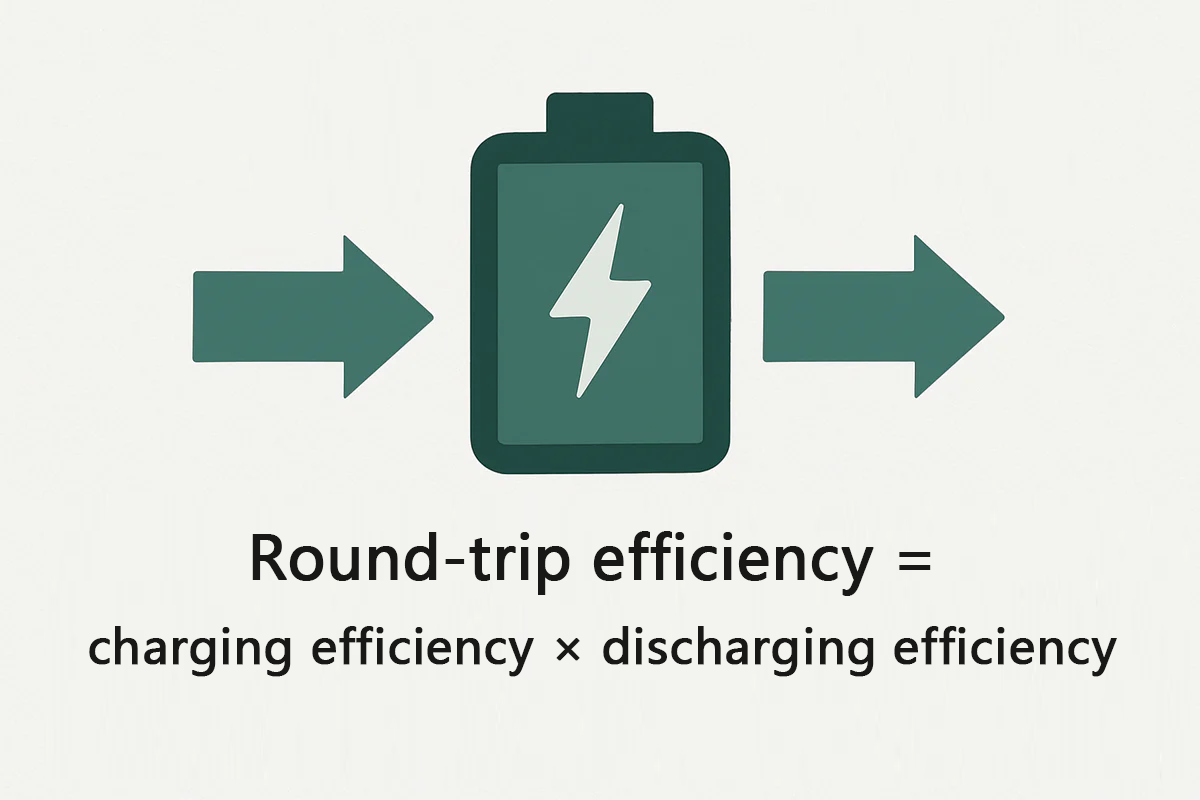
Even small losses in each stage can add up over time, especially in systems that cycle frequently. That’s why PCS efficiency is often evaluated not just at peak performance, but across different load conditions and operating modes.
Why efficiency isn’t the only priority for PCS
In storage systems, efficiency is important—but it’s not everything.
Response speed, for instance, can be critical in applications like grid frequency regulation. The ability to ramp up or down within milliseconds may matter more than squeezing out an extra fraction of a percent in efficiency.
Similarly, system stability, harmonic control, and integration with EMS platforms can all influence real-world performance. A PCS that looks excellent on paper may still underperform if it cannot coordinate effectively with the rest of the system.
Key parameters reflect fundamentally different priorities
What engineers look for in a PV inverter
When selecting a PV inverter, the focus is typically on:
- Conversion efficiency
- MPPT range and accuracy
- Number of MPPT channels
- Input voltage range
- Grid compatibility and standards
These parameters are all tied to one goal: maximizing solar energy utilization.
What really matters in a PCS
For PCS, the evaluation criteria shift:
- Bidirectional conversion efficiency
- Charge/discharge rate (C-rate capability)
- Battery compatibility
- Response time and control precision
- Communication with BMS and EMS
- Stability under frequent cycling
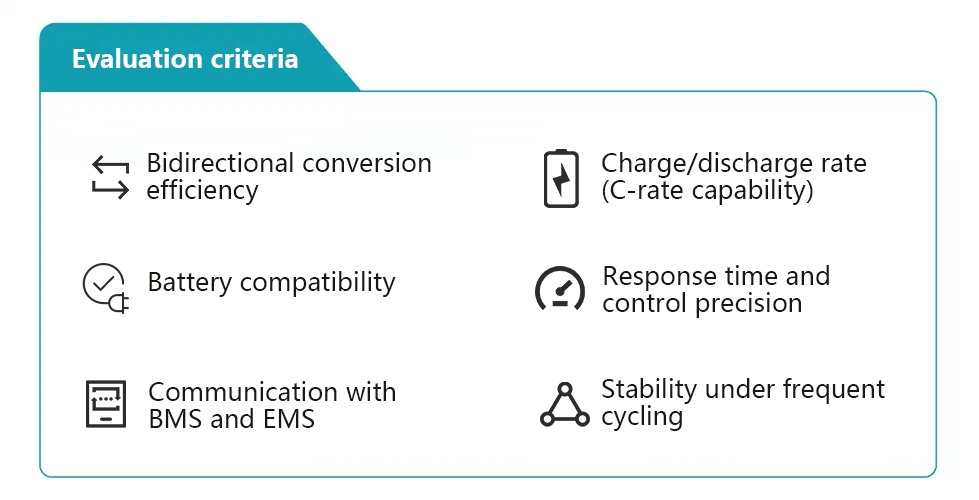
These are not just electrical specifications—they define how well the storage system can perform over time, under varying conditions, and across different use cases.
A quick scenario that makes the difference obvious
Imagine a site with only solar panels.
During the day, electricity is generated, converted by the inverter, and used or exported. At night, generation stops. The system is simple, predictable, and entirely dependent on sunlight.
Now add a battery and a PCS.
Suddenly, the system gains flexibility. Excess energy at noon doesn’t have to be wasted or exported at low value—it can be stored. That stored energy can then be used in the evening, during peak demand, or even held as backup.
The physical components haven’t changed dramatically. But the behavior of the system has.
That shift—from real-time generation to time-shifted energy use—is exactly where PCS proves its value.
Final thoughts: not competitors, but partners
It’s tempting to compare PCS and PV inverters as if one might replace the other. In reality, they solve different problems.
A PV inverter enables solar generation by converting DC into usable AC power. A PCS enables energy flexibility by managing how and when energy is stored and used.
In modern energy systems, especially those combining solar and storage, both are often essential. One handles the production of energy. The other ensures that energy can be used intelligently.
Understanding that distinction isn’t just technical—it’s foundational to designing systems that are not only efficient, but also economically and operationally effective.
What Is Dual Power Supply and Dual Circuit Supply in Energy Storage Systems?
What Is a Communication Protocol in an Energy Storage System?