System Integrators vs Cell & Module Manufacturers: Cost, Customization and Global Delivery
2025-10-11
The energy-storage landscape keeps shifting: large-scale deployments, rising policy constraints on where components originate, and increasing customer demand for turnkey responsibility have pushed the conversation from “who makes the best cell” to “who delivers the whole project reliably.” This article breaks down the competing strategies — system integration on one hand, and single-focus cell/material manufacturing on the other — using recent industry developments and a concrete case study to show where each model wins and where it stumbles.
Quick market snapshot — why this debate matters now
Deployment surge and demand drivers (2024–2025)
Global grid-scale storage installations expanded rapidly in recent quarters, driven by higher solar and wind penetration, merchant energy arbitrage opportunities, and utilities seeking transmission-level flexibility. Markets that led installations in 2024 showed both concentrated project pipelines and emerging constraints on delivery timelines. Those structural pressures make integration and local compliance central procurement considerations rather than afterthoughts.

Policy and domestic-content pressures reshaping procurement
Tax credits, bonus credits and procurement rules that reward local content have re-weighted supplier selection. Developers chasing incentives or domestic bonus credits often prioritize suppliers able to demonstrate compliant manufacturing footprints, traceable bill-of-materials and local servicing options. That reality elevates integration capability into a commercial asset, not just a technical preference.
Case study:HiTHIUM — product strategy and market positioning
Large-capacity cell development and product lines
HiTHIUM has publicly promoted very large cell formats — notable examples include commercialized 587Ah and 1175Ah LFP cell products — and positions those cells as enablers for 2- to 4-hour systems and beyond. The company’s literature highlights manufacturing advances and automated process controls that claim high yield and long cycle life for these cells. Those product choices reflect a strategic bet: larger cells reduce cell-count per pack, simplify mechanical designs, and can lower balance-of-system complexity at the pack level.
From cell to pack to system: an integration playbook
HiTHIUM’s messaging weaves together cell innovation with pack and containerized system offerings tailored to markets like North America (including a 6.25 MWh solution aimed at 4-hour applications). That vertical string — cell → pack (∞Pack) → container/system → localized service — demonstrates how a combined cell+integrator approach seeks both technical differentiation and better control over project delivery timelines.

Does higher integration lower cost? A layered analysis
Integration can lower costs, but the answer depends on where you measure cost and which project archetype you examine.
Manufacturing economies vs specialization gains
- Integration wins when: cell packing, thermal design, and system controls match a repeatable platform deployed at scale. Fewer interfaces mean lower engineering hours per project and fewer field change orders. Single-source warranties reduce contingency costs and accelerate commissioning in complex grids.
- Specialization wins when: cell volumes hit high-volume manufacturing economics and module/cell yields improve faster than integration-driven savings. A top-tier cell maker that supplies multiple integrators can amortize R&D and upstream material bargaining advantages across many systems, driving down per-kWh cell cost.
Hidden costs: certification, local adaptation, and service loops
Certifications (UL, IEC, local grid codes), re-engineering for cold or hot climates, and warranty service logistics add “hidden” costs that integration can internalize. Conversely, integrators carrying these responsibilities face higher working capital, inventory risk, and the operational complexity of running both factories and project teams.
Quick LCOE illustration (worked example)
A simple worked example clarifies how integration-driven design choices influence delivered energy costs. Use the levelized cost per kWh delivered (LCOE_storage) formula:
LCOE_storage = (Total lifetime cost) / (Total energy delivered over life)
LCOE_storage = (Total lifetime cost) / (Total energy delivered over life)
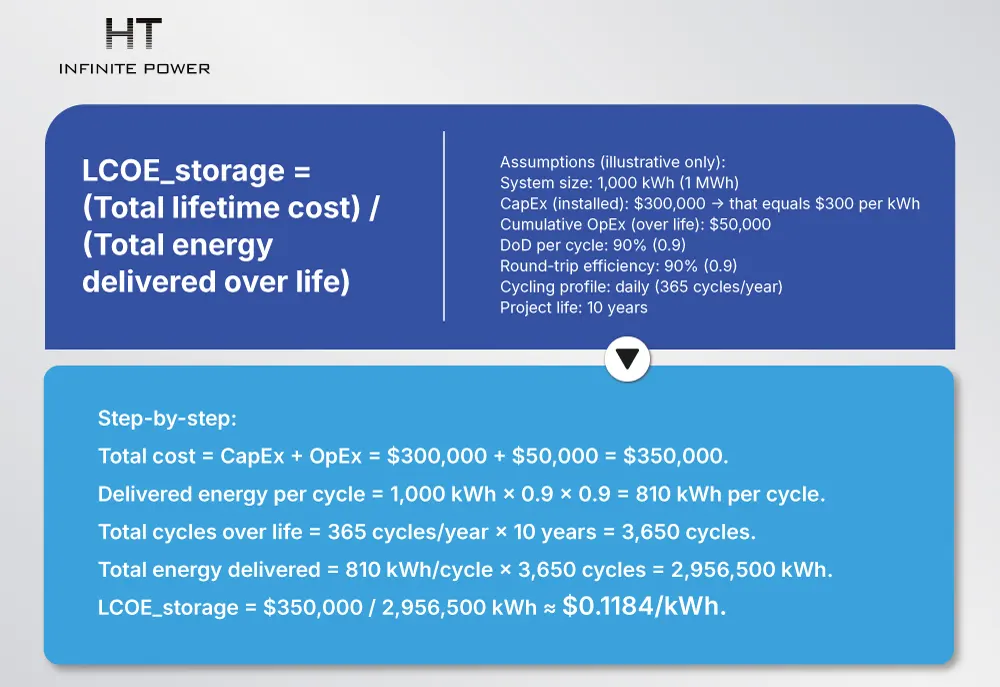
Assumptions (illustrative only):
System size: 1,000 kWh (1 MWh)
CapEx (installed): $300,000 → that equals $300 per kWh
Cumulative OpEx (over life): $50,000
DoD per cycle: 90% (0.9)
Round-trip efficiency: 90% (0.9)
Cycling profile: daily (365 cycles/year)
Project life: 10 years
System size: 1,000 kWh (1 MWh)
CapEx (installed): $300,000 → that equals $300 per kWh
Cumulative OpEx (over life): $50,000
DoD per cycle: 90% (0.9)
Round-trip efficiency: 90% (0.9)
Cycling profile: daily (365 cycles/year)
Project life: 10 years
Step-by-step:
Total cost = CapEx + OpEx = $300,000 + $50,000 = $350,000.
Delivered energy per cycle = 1,000 kWh × 0.9 × 0.9 = 810 kWh per cycle.
Total cycles over life = 365 cycles/year × 10 years = 3,650 cycles.
Total energy delivered = 810 kWh/cycle × 3,650 cycles = 2,956,500 kWh.
LCOE_storage = $350,000 / 2,956,500 kWh ≈ $0.1184/kWh.
Total cost = CapEx + OpEx = $300,000 + $50,000 = $350,000.
Delivered energy per cycle = 1,000 kWh × 0.9 × 0.9 = 810 kWh per cycle.
Total cycles over life = 365 cycles/year × 10 years = 3,650 cycles.
Total energy delivered = 810 kWh/cycle × 3,650 cycles = 2,956,500 kWh.
LCOE_storage = $350,000 / 2,956,500 kWh ≈ $0.1184/kWh.
Result: around $0.12 per kWh delivered under these assumptions. Changing any variable — CapEx down via integration efficiencies, higher efficiency, fewer cycles, or greater degradation — moves the LCOE materially. Use the same formula to compare options: lower CapEx via scale or higher delivered energy through efficiency improvements both reduce LCOE. (Numbers above compose a simplified illustration; procurement teams should run project-specific models.)
Overseas delivery and customization — what buyers actually need
Local regulations, certifications and “domestic content” effects
Incentives and tax credits that reward domestic content require either local manufacturing or verifiable local value addition. For example, recent domestic content bonus credits in the U.S. offer financial upside to projects that certify a specified percentage of manufactured components as domestic — a factor that can tip supplier selection toward vendors with local footprints or validated partner networks. Procurement teams that ignore these rules risk missing incentive thresholds and incurring unexpected costs.
Logistics, commissioning and on-site engineering capabilities
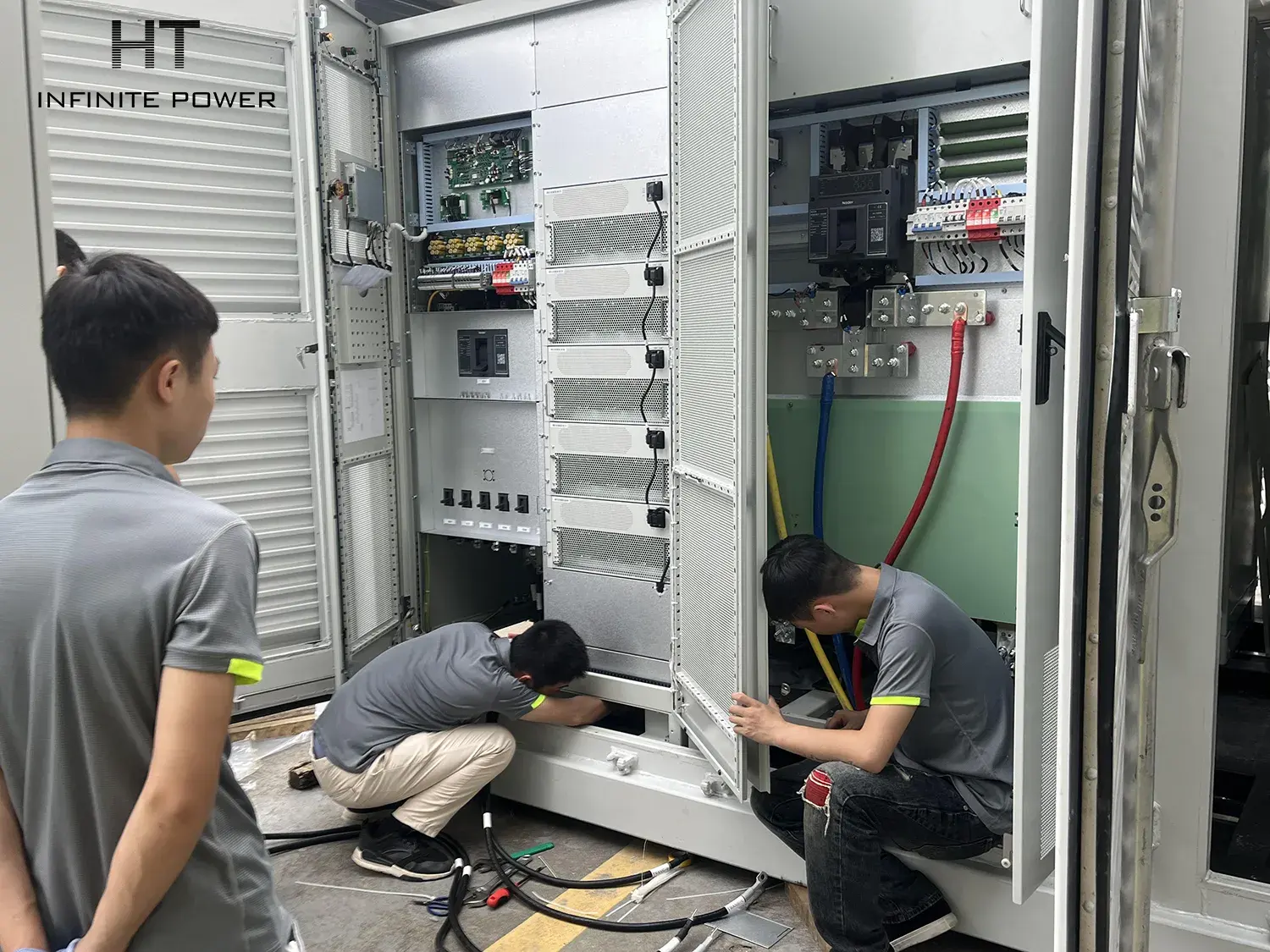
Large-cell formats reduce pack counts, but they do not eliminate the need for local commissioning expertise, mechanical installation, civil works, and secondary systems (fire suppression, HVAC, grid protection). Integrators offering turnkey services can shorten the critical path from shipment to revenue, particularly when domestic permitting or grid interconnection timelines create time-sensitive windows. On the other hand, relying on cell manufacturers alone forces owners to manage multiple vendors and the integration burden — a worthy tradeoff when the owner has in-house EPC expertise and wants to squeeze marginal cost from components.
Strategic playbook: when to prefer an integrator vs a cell supplier
Project size and complexity matrix
Small to medium projects (residential to <5 MWh) with standardized scopes: favor specialized cell suppliers paired with experienced EPCs when pure cost per kWh matters and local integration teams exist.
Large grid projects (tens to hundreds of MWh) with aggressive delivery timelines or complex permitting: prefer system integrators who can own commissioning, warranty and supply-chain compliance.
Cross-border projects requiring local content or rapid commissioning: integrators with local entities or validated partner ecosystems reduce political, customs, and logistics risk.
Large grid projects (tens to hundreds of MWh) with aggressive delivery timelines or complex permitting: prefer system integrators who can own commissioning, warranty and supply-chain compliance.
Cross-border projects requiring local content or rapid commissioning: integrators with local entities or validated partner ecosystems reduce political, customs, and logistics risk.
Risk appetite, timelines and O&M expectations
Risk-averse owners who value single-point accountability — fewer contracts, one warranty, one escalation path — will lean toward integrators. Where the owner or investor insists on lowest component cost and can accept multi-vendor coordination risk, buying cells directly (or via long-term supply contracts) remains viable.
Recommendations for procurement teams, integrators and cell makers
For procurement teams (developers & utilities):
- Map incentive and domestic content rules early; treat compliance as a selection criterion, not an afterthought.
- Quantify end-to-end risk: include certification rework, shipping delays, and O&M contingencies in the financial model.
- Run at least two procurement scenarios: (A) turnkey integrator; (B) component buy + local EPC. Compare LCOE and schedule risk.
For system integrators:
- Maintain modular product families to balance repeatability (lower cost) with customization (local adaptation).
- Invest selectively in cell R&D or partnerships if larger-format cells clearly reduce pack/system cost and simplify balance-of-system designs.
For cell/material manufacturers:
Keep aggressive cost roadmaps and open interfaces for integrators. A cooperative OEM model — supply cells while providing integration guidance and co-warranty options — unlocks volume growth without the burden of full project delivery.
Keep aggressive cost roadmaps and open interfaces for integrators. A cooperative OEM model — supply cells while providing integration guidance and co-warranty options — unlocks volume growth without the burden of full project delivery.
Conclusion — practical decision guide by project archetype
No universal winner appears. Instead, align supplier choice to project variables: regulatory constraints, required delivery speed, owner capability to manage multi-vendor projects, and whether top-line cost or single-vendor accountability holds greater value. Integrators dominate where local compliance, fast commissioning and single-point SLA matter. Cell and materials makers dominate where scale economics, commodity price leadership and chemistry innovation drive margin. Use the LCOE framework above to test the tradeoffs quantitatively for each project.
FAQ
Q1: Does higher integration always reduce LCOE?
A: Not always. Integration lowers transaction and coordination costs but carries manufacturing and inventory risk. Compare total lifecycle costs — CapEx, OpEx, certification and schedule risk — to determine whether integration yields net LCOE reduction.
A: Not always. Integration lowers transaction and coordination costs but carries manufacturing and inventory risk. Compare total lifecycle costs — CapEx, OpEx, certification and schedule risk — to determine whether integration yields net LCOE reduction.
Q2: Are large cells (e.g., 587Ah, 1175Ah) reliably better for grid projects?
A: Large cells reduce the number of cell connections and simplify mechanical design, yet they demand specialized manufacturing controls and introduce replacement/transport constraints. HiTHIUM’s rollout of 587Ah and 1175Ah cells shows one practical path toward large-format adoption but does not eliminate tradeoffs.
A: Large cells reduce the number of cell connections and simplify mechanical design, yet they demand specialized manufacturing controls and introduce replacement/transport constraints. HiTHIUM’s rollout of 587Ah and 1175Ah cells shows one practical path toward large-format adoption but does not eliminate tradeoffs.
Q3: How does domestic content policy change procurement?
A: Policies that reward domestic manufacturing can favor integrators with local assembly or cell makers with onshore facilities. Verify incentive rules early; failure to meet certification criteria can negate expected tax credits.
A: Policies that reward domestic manufacturing can favor integrators with local assembly or cell makers with onshore facilities. Verify incentive rules early; failure to meet certification criteria can negate expected tax credits.
Q4: For overseas projects, which matters more — cost or delivery speed?
A: Both matter, but in many contested markets delivery speed wins short-term contracts where delayed revenue or missed windows nullify lower per-kWh costs. Prioritize supplier capabilities that match your commercial deadlines.
A: Both matter, but in many contested markets delivery speed wins short-term contracts where delayed revenue or missed windows nullify lower per-kWh costs. Prioritize supplier capabilities that match your commercial deadlines.
Q5: Should smaller developers always avoid vertical integrators?
A: Not necessarily. Smaller developers facing complex permitting, scarce local EPCs, or stringent warranty expectations can benefit from a turnkey integrator that reduces managerial overhead and schedule risk.
A: Not necessarily. Smaller developers facing complex permitting, scarce local EPCs, or stringent warranty expectations can benefit from a turnkey integrator that reduces managerial overhead and schedule risk.
Europe's Energy Storage Boom: What It Means for Global Manufacturers
The Rise of Long-Duration Energy Storage: Why 4-Hour+ Systems Are Reshaping the Grid