The differences between PQ, VF, droop, and VSG control strategies of energy storage PCS
2025-09-25
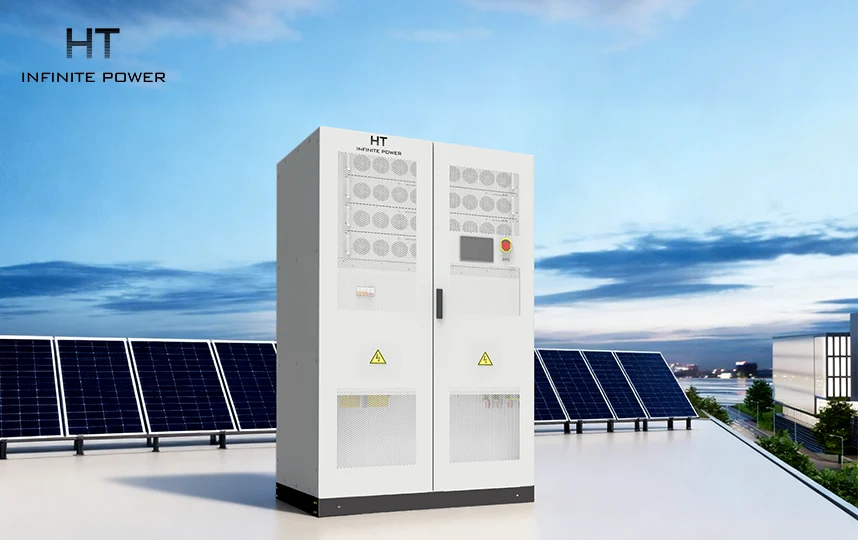
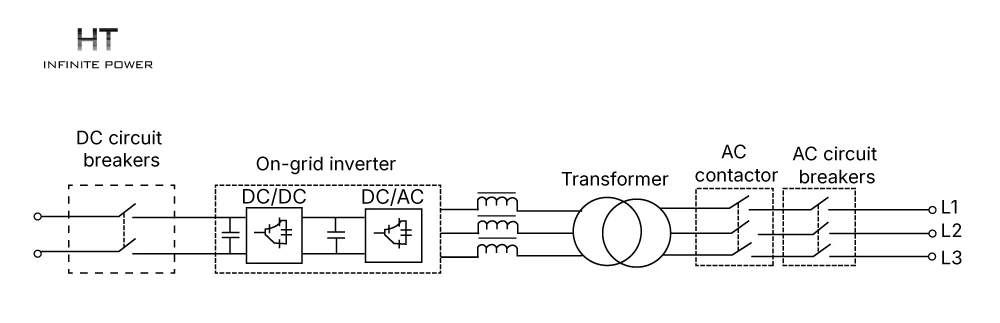
The energy storage converter PCS, also known as the bidirectional energy storage inverter, is the core component that realizes the bidirectional flow of electric energy between the energy storage system and the power grid. It is used to control the charging and discharging process of the battery and perform AC/DC conversion.
1. Operating Principle of the Energy Storage Converter
The operating principle of the PCS energy storage converter is primarily based on power electronics technology, achieving energy conversion and bidirectional flow by controlling the on/off switching of switching devices.
- Discharge mode: When the grid requires the energy storage system to discharge, the PCS energy storage converter converts the DC power in the energy storage battery into AC power and outputs it to the grid.
- Charge mode:When the grid requires the energy storage system to charge, the PCS energy storage converter converts the AC power in the grid into DC power and stores it in the energy storage battery.
During the charging and discharging process,the PCS energy storage converter also requires precise power control and energy management based on grid demand and the status of the energy storage battery to ensure stable operation and efficient utilization of the energy storage system.
2. Energy Storage Converter Operating Modes
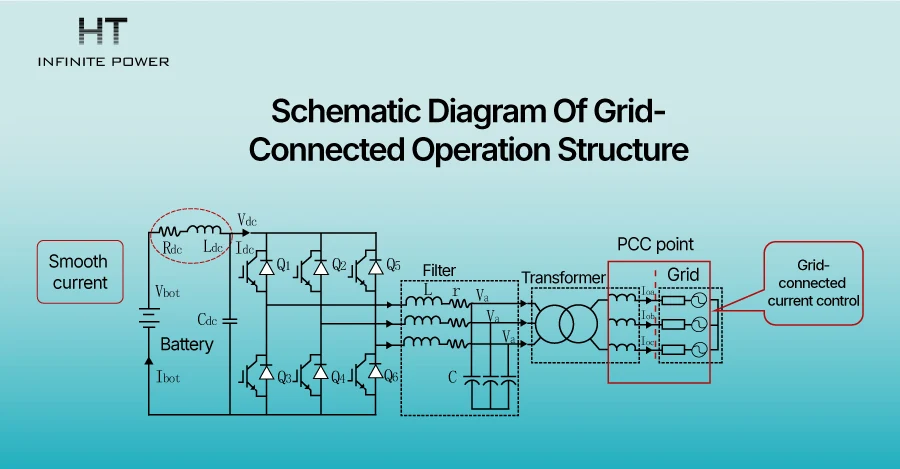
When the energy storage system is connected to the main grid, that is, the PCS operates in grid-connected mode, the energy storage system is typically considered a PQ node, and its PCS often employs a simple and easy-to-implement PQ control strategy (with power control as the goal).
When the energy storage system is disconnected from the grid, that is, the PCS operates in off-grid mode, common control methods include master-slave control and droop control. Master-slave control (VF control, providing voltage and frequency references) uses active power and frequency droop curves, as well as voltage and reactive power droop curves. There are three modes: grid-connected mode, off-grid mode, and hybrid mode.
2.1 Grid-Connected Mode
In grid-connected mode, the PCS performs bidirectional energy conversion between the battery bank and the grid, and also exhibits the characteristics of an inverter. Key features include: Anti-islanding protection: In the event of a grid outage, the PCS automatically stops supplying power to the grid, preventing the islanding effect.
Grid synchronization: The PCS automatically tracks the phase and frequency of the grid voltage to ensure synchronized operation with the grid. Low voltage ride-through: During brief grid voltage drops, the PCS maintains operation, ensuring power system stability.
Specific applications are as follows: Off-peak charging: During periods of low grid load, the PCS converts AC power from the grid to DC power to charge the battery. During this period, the PCS utilizes its battery charge and discharge management capabilities to ensure efficient and safe charging.
Peak discharge: During periods of peak grid load, the PCS inverts DC power from the battery to AC power and feeds it back to the public grid, alleviating grid pressure.
Power quality regulation: During periods of poor power quality, the PCS can feed or absorb active power to the grid while also providing reactive power compensation to improve power quality.
2.2 Off-grid Mode
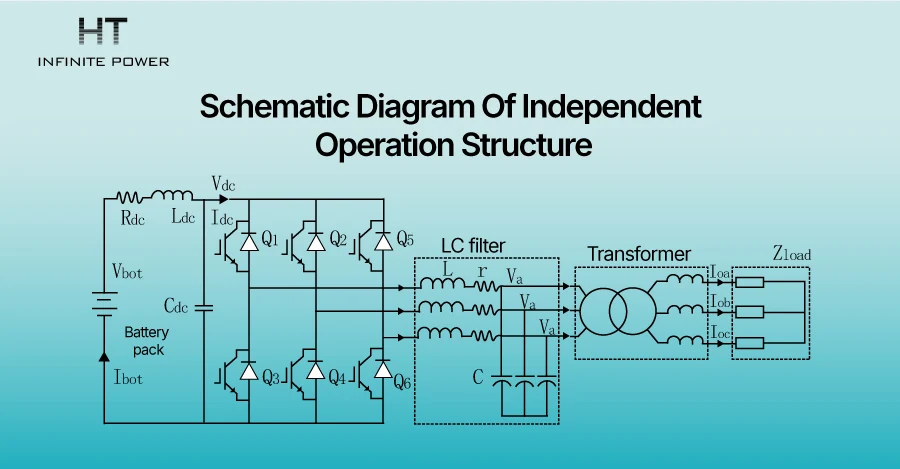
Off-grid mode, also known as island operation mode, refers to situations where the PCS can disconnect from the main grid and independently supply power to local loads.
The main functions of this mode include:
Independent power supply: When the grid cannot provide stable electricity, the PCS can, according to preset requirements, independently supply AC power that meets the grid power quality requirements to local loads.
Emergency power supply: In case of grid failure or power outage caused by natural disasters, the PCS can quickly switch to off-grid mode to ensure continuous power supply for critical loads.
The main functions of this mode include:
Independent power supply: When the grid cannot provide stable electricity, the PCS can, according to preset requirements, independently supply AC power that meets the grid power quality requirements to local loads.
Emergency power supply: In case of grid failure or power outage caused by natural disasters, the PCS can quickly switch to off-grid mode to ensure continuous power supply for critical loads.
2.3 Hybrid Mode
Hybrid mode is an advanced operating mode for energy storage systems, enabling flexible switching between grid-connected and off-grid modes to ensure system reliability and flexibility.
Microgrid Operation: The energy storage system is located within the microgrid. Under normal circumstances, the microgrid is connected to the public grid, and the PCS operates in grid-connected mode.
If the microgrid is disconnected from the public grid, the PCS immediately switches to off-grid mode, providing the primary power source for the microgrid. Versatile Applications: Hybrid mode not only provides filtering, grid stabilization, and power quality control, but also enables self-healing and power restoration in the event of a fault.
Common application scenarios for hybrid mode include: Power Regulation: By frequently switching operating modes, grid frequency and voltage are adjusted to maintain power system stability. Self-Healing: In the event of a grid fault, the energy storage system automatically switches to off-grid mode to quickly restore power supply.
3. Grid-Following and Grid-Building Control
To understand the differences between the four control strategies, we must first establish a high-level classification framework. This framework simplifies complex control problems into a straightforward binary relationship: "leader" and "follower." These two roles, grid-building and grid-following, define the basic interaction between the inverter and the grid.
- Grid-Following Control: A "Faithful Follower" of the Grid. The core of grid-following control is like a "faithful follower" or "controlled current source" of the grid. The primary task of a grid-following inverter is to adapt to and follow an existing, stable grid. Using its internal phase-locked loop (PLL) circuitry, it precisely detects and locks onto the external grid's voltage waveform like a radar, thereby synchronizing its frequency and phase. Once synchronized, it injects or absorbs specified amounts of active power (P) and reactive power (Q) into or out of the grid, based on instructions from the higher-level dispatching system or internal preset values.
- Grid-Building Control: An Active Builder of the Grid. At its core, grid-building control acts as an active grid builder or controlled voltage source. Unlike passive grid-following, grid-building inverters proactively establish and maintain an independent AC grid. They do not rely on an external grid, but instead autonomously generate a stable voltage waveform that defines the system's voltage amplitude and frequency. This enables independent operation without the support of the main grid, such as in islanding, microgrid, or grid black start scenarios.
The following figure compares the capabilities of the four major control strategies. The following details their principles, functions, and differences based on their capabilities.
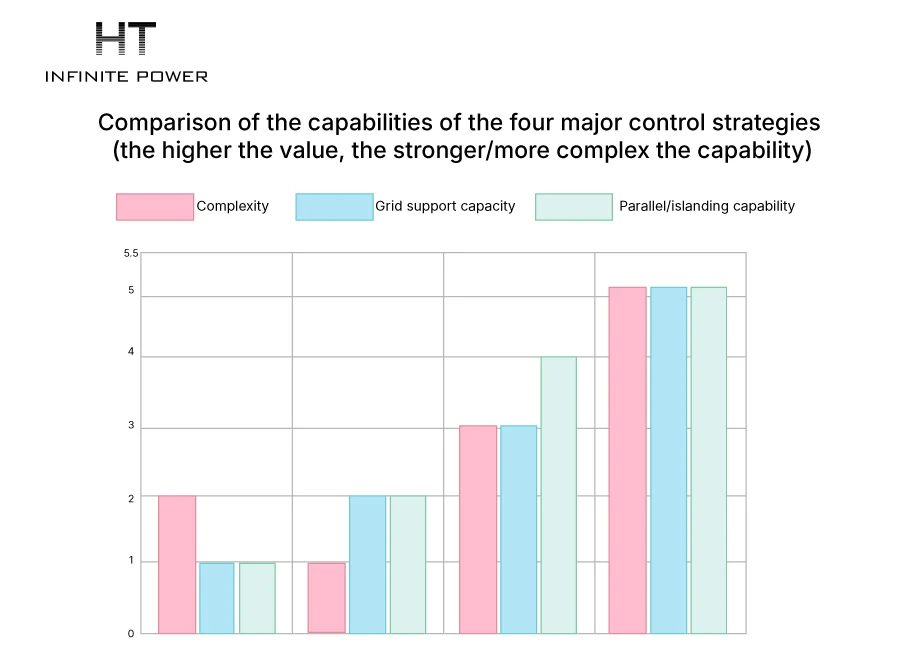
4. Comparison of different control strategies
| PQ | V/F | Droop | VSG | |
|---|---|---|---|---|
| Control Type | Grid-following(GFL) | Grid-forming(GFM) | Grid-forming(GFM) | Grid-forming(GFM) |
| Control Object | Output current(controlP/Q) | OutPut voltage(V/Fconstant) | Output voltage (V/ldroop) | Output voltage(simulating generator) |
| Core Principles | d-g decoupling, current loop |
Internal fixed voltage reference | P-l/Q-V droop curve | Synchronous machinevirtual equation |
| Inertial support | None | None | None | Yes (core advantage) |
| Island Capabilities | None | Yes (standalone) | Yes (multiple machines in parallel) | Yes (multiple machines in parallel) |
| Parallel capability | Only connected to themain power grid | None | Autonomous parallel | Autonomous parallel |
| Complexity | Lower | Lower | medium | Highest |
| Typical scenarios | Grid connection/control |
Single machine off.grid/UPS
|
Multi-machine parallelconnection in isolated microgrid |
Weak power grid/highproportion ofnew energy |
4.1 PQ Control:
Typical Grid-Following Control Principle: The core of this control strategy lies in current decoupling control in the d-q rotating coordinate system.
First, a phase-locked loop (PLL) is used to lock the phase of the grid voltage.
Then, the three-phase AC power is transformed into the d-q synchronous rotating coordinate system. In this case, active power P is primarily related to the d-axis current, and reactive power Q is primarily related to the q-axis current. By using two independent PI controllers to adjust the d-axis and q-axis current components, independent and rapid control of active and reactive power is achieved.
4.2 V/F Control:
Basic Grid-Based Control Principle: The principle of V/F control is very straightforward.
The controller internally generates an ideal sine wave with fixed amplitude and frequency as a voltage reference signal. Then, through a dual closed-loop control system consisting of voltage and current, the actual voltage at the inverter output terminals is measured in real time and compared with the internal reference signal. The PI regulator drives the PWM module, forcing the output voltage to accurately track this internal reference. Essentially, this is a "voltage source" characteristic—the inverter itself sets the voltage amplitude and frequency reference, effectively acting as an independent "mini-grid."
4.3 Droop Control:
Advanced Grid Configuration Control Principle: Droop control builds on VF control by incorporating "frequency-active power droop" (f-P droop) and "voltage-reactive power droop" (V-Q droop) characteristics.
For example, when the active power output of a converter exceeds its rated value, the control system proportionally reduces its frequency setpoint, prompting other converters to take on more power, ultimately achieving automatic power balancing among multiple converters.
Advantages: It enables power distribution among multiple converters in parallel without requiring a communication link, offering high reliability and suitability for distributed microgrids (such as industrial park and village microgrids).
Limitations: It exhibits inherent steady-state errors, meaning that system frequency and voltage deviate from their nominal values as load changes. Power distribution accuracy is affected by line impedance mismatch. Dynamic response is relatively slow, and the system only provides damping, not inertial support.
4.4 VSG Control:
Advanced grid-forming control principle: VSG control builds on droop control by introducing an inertia factor (simulating the rotor inertia of a synchronous machine) and a damping factor (suppressing frequency fluctuations). It also achieves dynamic active power response through "virtual power angle" adjustment.
For example, when the grid frequency suddenly drops, the VSG, like a synchronous machine, releases stored energy (utilizing inertia) to suppress the frequency drop.
Global Energy Storage Expansion: Opportunities in Emerging Markets (Middle East, Southeast Asia, Africa)
What is the black start technology of energy storage system and its function and principle