Calcium-Based Batteries: The Next Generation of Low-Cost, High-Energy-Density Storage Technology
2026-01-17

Driven by the growing demand for grid-scale energy storage and renewable energy applications, the development of novel battery systems has become a major research focus. Multivalent metal batteries—such as calcium, zinc, and magnesium—are considered highly promising energy storage solutions due to their potential for high energy density, abundant resources, and low cost. Against the backdrop of uneven lithium resource distribution and price volatility, calcium-based batteries (CaBs) demonstrate a clear cost advantage, making them a key representative of multivalent metal battery research.
However, the development of calcium-based batteries still faces several challenges:
On one hand, the reversible deposition and stripping of metallic calcium can only be achieved in specific non-aqueous electrolytes. During the deposition process, a passivation layer tends to form on the surface, leading to relatively low Coulombic efficiency.
On the other hand, the electrolyte for calcium-based batteries must possess an electrochemical stability window exceeding 4 V and enable effective solvation of calcium ions through relatively weak Coulombic interactions. This is critical for improving kinetics and reducing desolvation energy barriers at the cathode interface.
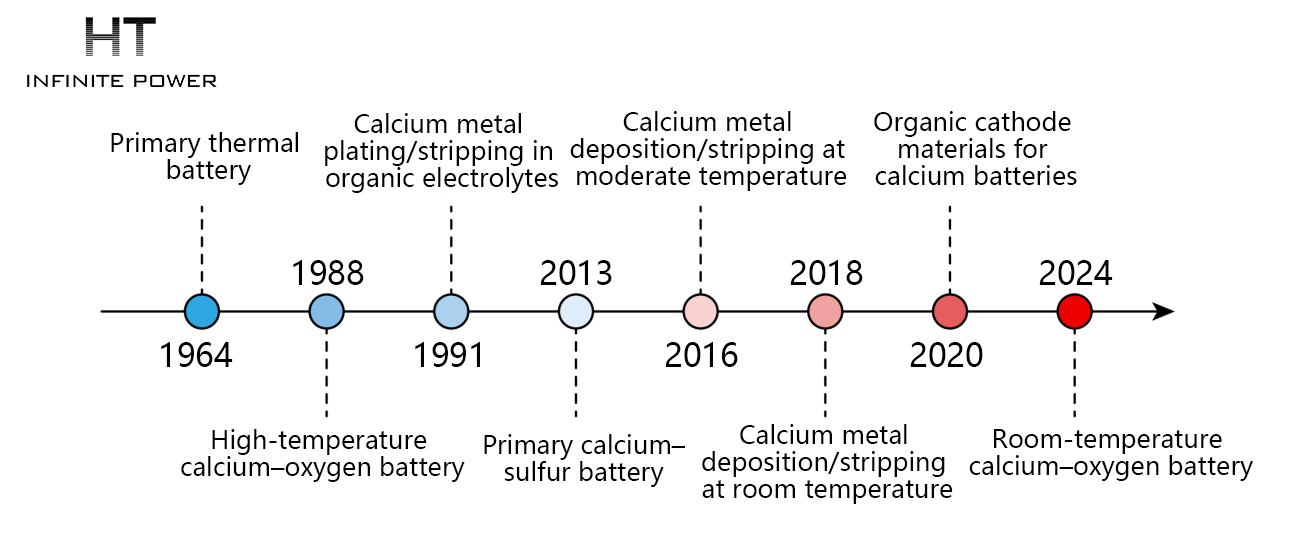
In recent years, researchers have made significant progress in the design of electrode materials and electrolytes for calcium-based batteries. (Figure 1)
1. Anode Materials
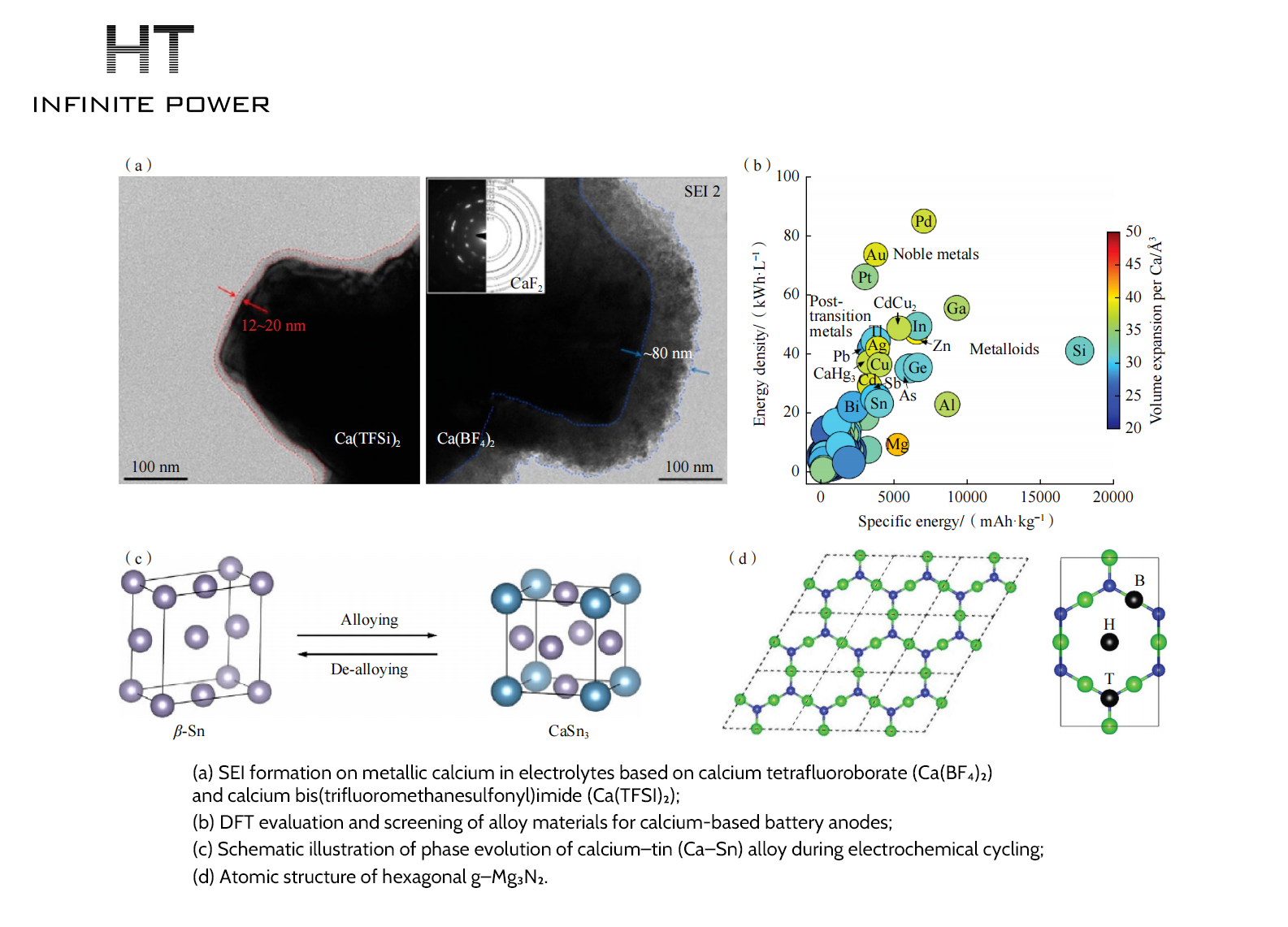
Metallic calcium anodes offer high volumetric and gravimetric capacities, making them the highest-capacity anode material for calcium-based batteries. However, achieving efficient and reversible calcium deposition and stripping remains challenging. Early studies found that metallic calcium is difficult to deposit and strip in organic electrolytes, primarily due to the formation of a passivating solid electrolyte interphase (SEI) composed of non-conductive calcium compounds such as CaCO₃ and Ca(OH)₂, which severely limits anode activity. Optimizing this SEI structure is therefore critical for enabling reversible calcium deposition and stripping (Figure 2(a)).
Alloy-based anodes, in contrast, exhibit superior electrochemical stability compared with metallic calcium. They can effectively reduce surface passivation, mitigate dendrite growth, and improve cycling life, making them highly promising anode candidates for calcium-based batteries. By evaluating alloy calciation voltage, volume expansion, and specific capacity through density functional theory (DFT), elements such as tin (Sn), silicon (Si), antimony (Sb), germanium (Ge), and aluminum (Al) have been identified as the most promising candidates (Figure 2(b)). Among these, the calcium–tin (Ca–Sn) alloy offers a particularly high theoretical capacity. Wang et al. reported that a tin anode can be fully calciated to Ca₇Sn₆, but with a high volume expansion of 136.8%, whereas the CaSn₃ alloy exhibits only a 7.3% volume change, helping to relieve structural stress and ensure long cycling stability (Figure 2(c)). Future work will need to focus on structural optimization of alloy anodes—such as nanostructuring and porous design—and interface engineering, including SEI design, to enhance cycling stability and practical application potential.
Electrode materials based on calcium-ion intercalation/deintercalation mechanisms typically exhibit smaller volume changes during charge and discharge, which helps maintain interface and structural stability, thereby significantly improving cycling performance. Carbon-based materials have been widely used in lithium-ion and sodium-ion battery systems. For example, g–Mg₃N₂ has a theoretical capacity of up to 1594 mAh·g⁻¹ and excellent structural stability, which contributes to enhanced electrode cycling performance (Figure 2(d)).
2. Electrolytes
Electrolytes are a core component of calcium-based batteries, requiring both high calcium-ion conductivity and strong electrochemical stability. Optimizing electrolyte formulations is an effective strategy for improving the performance of calcium-based batteries, with research mainly focusing on the selection and optimization of salts, solvents, and additives.
Currently, commonly studied electrolyte salts include calcium perchlorate (Ca(ClO₄)₂), calcium tetrafluoroborate (Ca(BF₄)₂), calcium bis(trifluoromethanesulfonyl)imide (Ca(TFSI)₂), calcium nitrate (Ca(NO₃)₂), and calcium borohydride (Ca(BH₄)₂). Typical solvents include ethylene carbonate (EC), propylene carbonate (PC), methyl ethyl carbonate (MEC), dimethyl carbonate (DMC), tetrahydrofuran (THF), and dimethoxyethane (DME). On one hand, combining different solvents with electrolyte salts can fully exploit the synergistic effects of each component to optimize the solvation environment of Ca²⁺ ions. On the other hand, the anion structure of the electrolyte salt can be tuned to further optimize Ca²⁺ solvation. However, these electrolytes typically exhibit a narrow electrochemical stability window, limiting their compatibility with high-potential cathode materials and constraining practical applications.
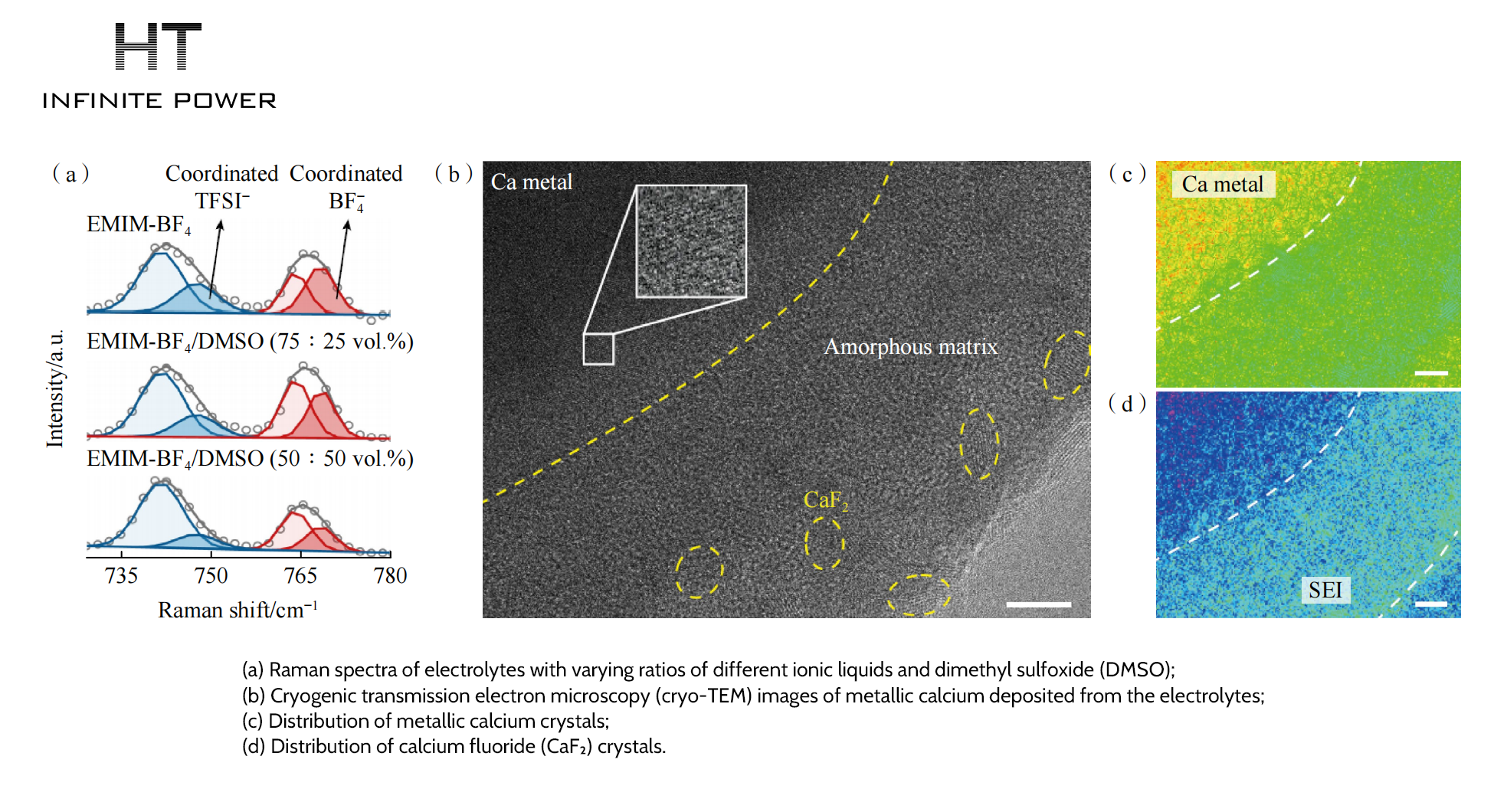
In addition, the strong interactions between calcium ions and anions significantly increase the desolvation energy barrier, exacerbating polarization and limiting further improvement in electrochemical performance. Introducing organic solvents such as dimethyl sulfoxide (DMSO) into ionic-liquid-based electrolytes can address these challenges. DMSO reduces electrolyte viscosity, enhancing ionic transport, and also participates in constructing the solvation shell around Ca²⁺, partially replacing anions that interact strongly with calcium ions. This reduces the proportion of anions in the solvation shell, effectively decreasing the size of solvated calcium ions. Compared with electrolytes with low or no DMSO content, an electrolyte containing 50 vol% DMSO shows significantly weakened vibrational peaks for Ca²⁺–BF₄⁻ (769 cm⁻¹) and Ca²⁺–TFSI⁻ (748 cm⁻¹), indicating a reorganization of calcium-ion coordination and a reduced number of contact ion pairs (Figure 3(a)).
Furthermore, this electrolyte system can form a uniform and stable solid electrolyte interphase (SEI) on the metallic calcium surface. Cryogenic transmission electron microscopy (cryo-TEM) characterization reveals CaF₂ nanocrystals approximately 3 nm in diameter, uniformly dispersed within the organic component matrix of the SEI (Figures 3(b)–3(d)). This unique SEI structure offers low interfacial resistance and excellent calcium-ion conductivity, effectively suppressing side reactions and enhancing electrochemical stability.
3. Cathode Materials
Cathode materials are one of the key components that determine the energy density and cycling performance of calcium-based batteries. Current research primarily focuses on cathodes based on intercalation and conversion mechanisms.
3.1 Intercalation-Type Cathode Materials
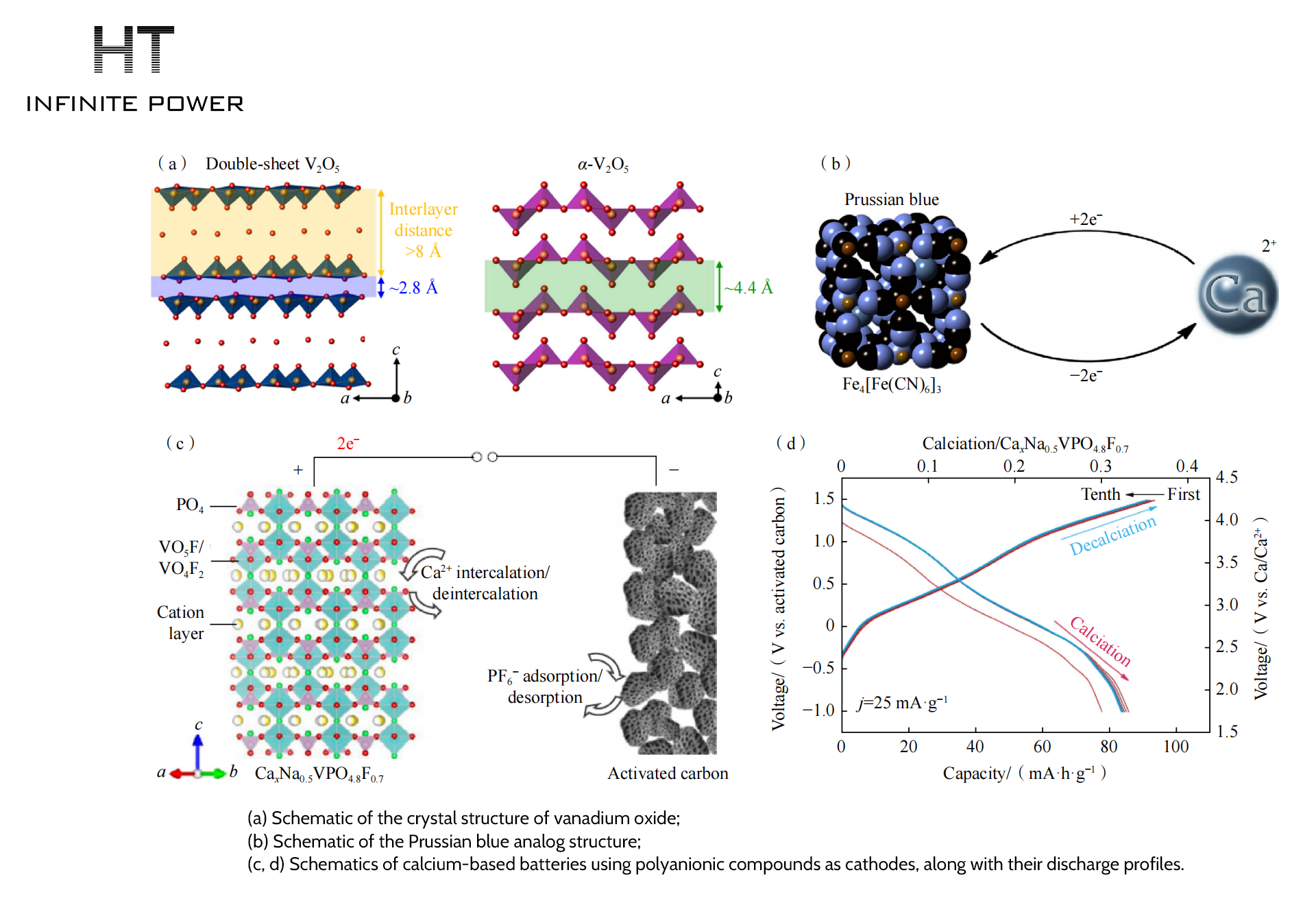
Intercalation-type cathode materials possess open framework structures capable of accommodating metal-ion insertion, including layered compounds, Prussian blue analogues, and polyanionic compounds.
Layered compounds, due to their weak interlayer van der Waals forces, can effectively host the insertion and extraction of calcium ions. For example, vanadium pentoxide (V₂O₅) has an interlayer spacing of approximately 8 Å, offering a calcium storage capacity of 204 mAh·g⁻¹ and a capacity retention of 86% after 350 cycles (Figure 4(a)).
Prussian blue analogues are a class of metal–organic framework materials with open and tunable crystal structures. Their large channels and voids facilitate ion insertion and extraction, making them widely used in sodium-ion and potassium-ion batteries, while also showing potential as cathode materials for calcium-based batteries (Figure 4(b)).
Polyanionic compounds, composed of transition metal polyhedra and multi-anionic groups, include structures such as NASICON (sodium super ionic conductor), olivine, and orthorhombic frameworks. Because the ionic radius of Ca²⁺ is close to that of Na⁺, sodium-based polyanionic compounds can be directly used—or modified—for calcium-based battery cathodes. Introducing fluorine can further enhance inductive effects, significantly improving cycling stability. For instance, Na₀.₅VPO₄.₈F₀.₇ retains over 90% of its capacity after 500 cycles (Figures 4(c)–4(d)).
3.2 Conversion-Type Cathode Materials
Conversion-type cathodes have attracted wide attention due to their ultra-high theoretical capacities and excellent power densities. Conversion reactions involve the breaking and reformation of chemical bonds, accompanied by the formation of new phases. This not only significantly increases the utilization of electroactive materials but also removes the strict constraints of the host lattice, providing greater flexibility in material design. Current research on conversion-type cathodes mainly focuses on organic compounds, sulfur, and oxygen-based systems.
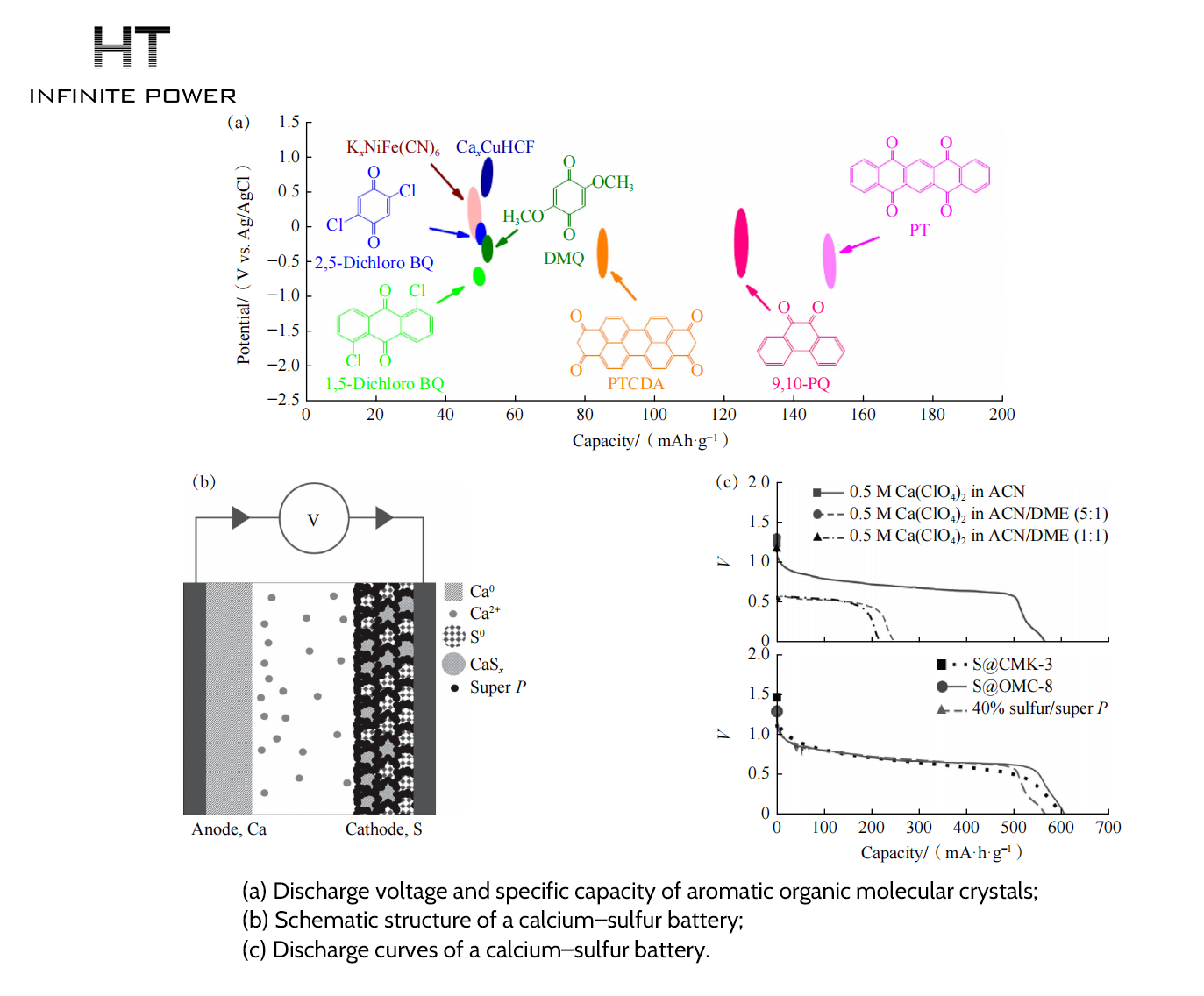
Organic Compounds: Organic electrode materials have become an important research direction for calcium-based battery cathodes due to their flexibility, mild synthesis conditions, and rich structural and chemical tunability. These materials can achieve high specific capacities at relatively high insertion voltages. Based on the nature of charge storage, they can be categorized into three types: n-type (e.g., carbonyl compounds), p-type (e.g., imine compounds), and bipolar-type (e.g., nitroso compounds) (Figure 5(a)). Current research on organic cathodes is mainly focused on aqueous calcium-ion batteries.
Sulfur: Calcium–sulfur (Ca–S) batteries offer a theoretical capacity of up to 1672 mAh·g⁻¹, while also being low-cost and environmentally friendly. Sulfur/mesoporous carbon cathodes can deliver discharge capacities of around 600 mAh·g⁻¹ (Figures 5(b)–5(c)), whereas sulfur/Ketjen black cathodes can achieve approximately 760 mAh·g⁻¹.
Oxygen: Calcium–oxygen (Ca–O₂) batteries possess the highest theoretical energy density among calcium-based batteries. Ye et al. developed a rechargeable Ca–O₂ battery capable of stable cycling at room temperature. By optimizing both the electrolyte system and electrode structure, they effectively enhanced the battery’s reversibility and cycling stability (Figure 6(a)).
At room temperature, this battery utilizes a unique two-electron electrochemical mechanism, enabling reversible formation and decomposition of discharge products, thereby establishing a theoretical foundation for practical Ca–O₂ battery design (Figure 6(b)). Operating at a high current density of 1000 mA·g⁻¹ and a high specific capacity of 500 mAh·g⁻¹, the Ca–O₂ battery achieved 700 stable cycles at room temperature, demonstrating excellent cycle life (Figure 6(c)).
This work overcomes key limitations of traditional Ca–O₂ batteries, including room-temperature reversibility, electrolyte stability, and cycle life, and lays an important foundation for the development of next-generation high-performance calcium-based energy storage technologies.

4. Application Exploration of Calcium-Based Batteries
Calcium-based batteries, with their abundant calcium resources, low cost, high theoretical energy density, and good safety profile, show broad application potential across multiple energy storage fields.
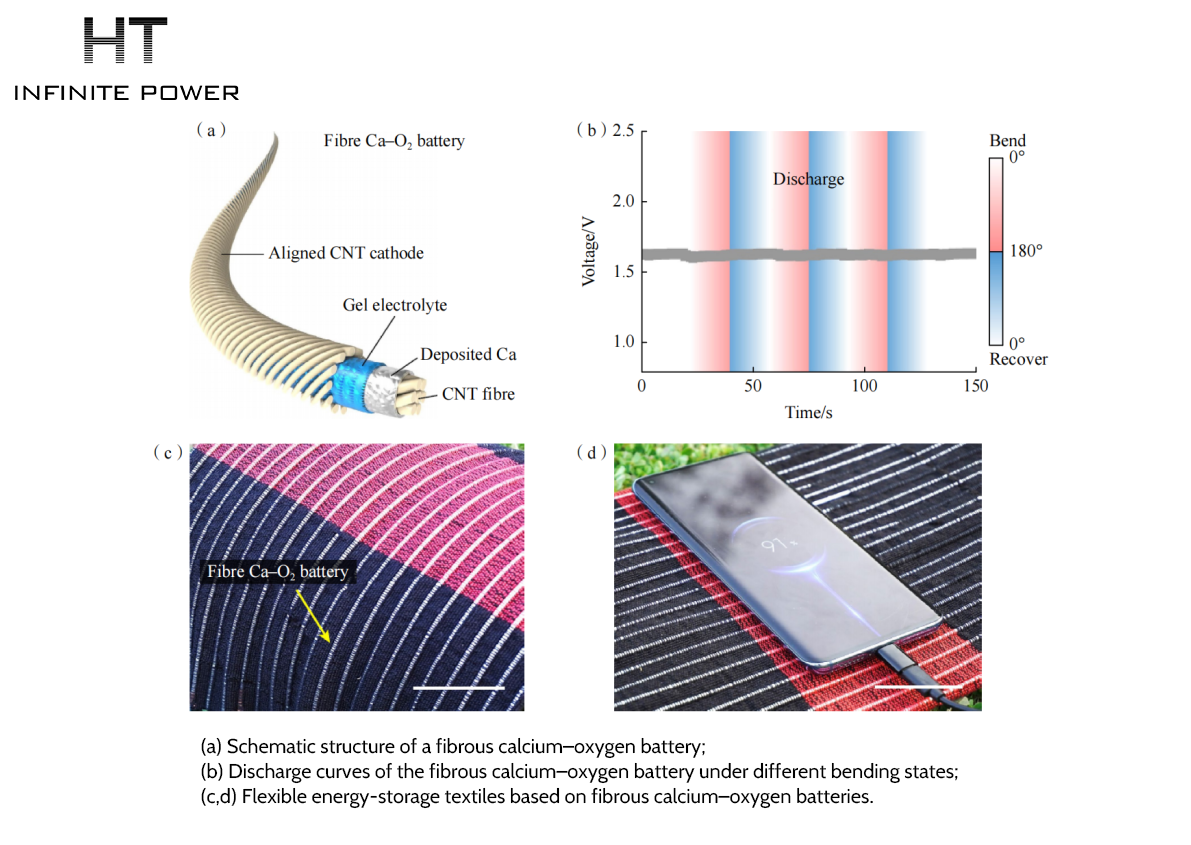
In flexible electronics and wearable devices, calcium-based batteries combined with flexible electrode materials such as carbon nanotubes and graphene can be developed into lightweight, high-safety flexible energy storage devices for applications including electronic skin, smart textiles, and biosensors. Ye et al. were the first to apply a Ca–O₂ battery in wearable energy storage systems, constructing a novel flexible fiber battery. The battery employs a coaxial design, comprising a metallic calcium/carbon nanotube fiber anode, an oriented carbon nanotube thin-film air cathode, and a gel electrolyte layer (Figure 7(a)). This fiber battery operates stably under bending angles from 0° to 180° (Figure 7(b)). Furthermore, the fiber batteries can be woven into breathable, highly flexible energy storage textiles to power electronic devices such as smartphones (Figures 7(c)–7(d)).
In low-cost, large-scale energy storage systems, calcium’s wide availability and low extraction cost make it highly sustainable, particularly suitable for cost-sensitive applications such as renewable energy storage for wind and solar power, as well as grid frequency regulation.
Additionally, calcium-based batteries demonstrate unique advantages in energy supply under extreme conditions. For missions involving spacecraft, high-altitude electric platforms, and extraterrestrial probes, energy systems must often withstand severe temperature fluctuations and complex electromagnetic environments. Calcium-based batteries, offering high energy density and robust safety, represent a strong candidate technology for future deep-space exploration and energy supply in extreme environments.
5. Conclusions and Outlook
Although significant progress has been made in calcium-based battery research, practical applications still face several challenges. The high charge density and large ionic radius of calcium result in slow diffusion kinetics within electrode materials, limiting the rate performance of the batteries. Issues such as passivation of metallic calcium anodes and the stability of electrolytes still require further optimization. In addition, the specific capacity and cycling life of cathode materials have room for improvement.
Future research could focus on the following areas:
Development of novel high-stability electrolytes to optimize the solvation structure of calcium ions and improve interfacial kinetics;
Design of nanostructured electrode materials to expand ion diffusion channels and mitigate volume expansion;
Exploration of synergistic effects between multivalent and monovalent ions to enhance the redox potential and capacity of electrode materials;
Development of high-performance flexible calcium-based batteries tailored for flexible electronics and wearable devices.
Design of nanostructured electrode materials to expand ion diffusion channels and mitigate volume expansion;
Exploration of synergistic effects between multivalent and monovalent ions to enhance the redox potential and capacity of electrode materials;
Development of high-performance flexible calcium-based batteries tailored for flexible electronics and wearable devices.
What Is Grid-Forming vs Grid-Following Control?
What is a Solid-State Transformer (SST)?