The Key to Enhancing Battery Pack Performance: Consistency Management
2025-12-15
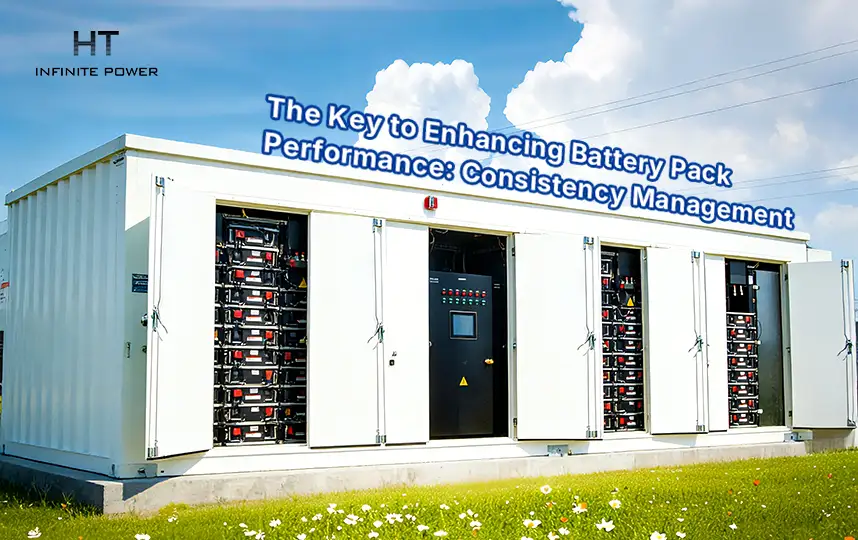
During the large-scale application of lithium iron phosphate (LFP) batteries, the issue of voltage inconsistency has become a critical challenge that limits their performance, safety, and service life. With the rapid development of new-energy storage systems and electric vehicles, LFP batteries have been widely adopted due to their high safety, long cycle life, and cost advantages. However, once assembled into battery packs, the voltage differences among individual cells become increasingly prominent.
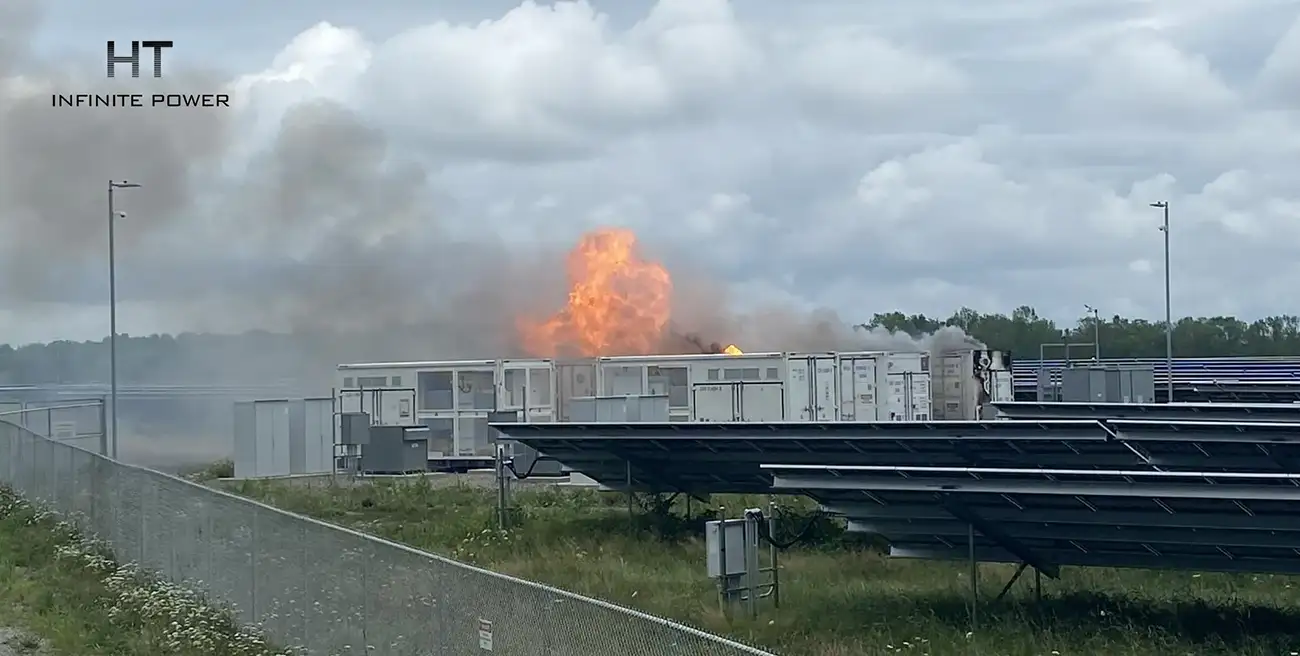
This inconsistency is mainly reflected in the dispersion of key parameters such as cell voltage, internal resistance, and capacity. When cells are connected in series or parallel, these differences gradually amplify with charge–discharge cycling and environmental fluctuations, ultimately leading to a decline in overall pack performance and, in severe cases, posing safety risks such as thermal runaway.
Factors and Root Cause Analysis
Differences in manufacturing processes and material characteristics:
In LFP batteries, the reaction rate of the cathode differs from that of the anode—the cathode reacts faster—resulting in the accumulation of potential differences during charge and discharge. In addition, small variations introduced during manufacturing, such as electrode thickness and electrolyte distribution, further intensify inconsistencies in internal resistance and capacity. For example, uneven electrolyte concentration affects ion migration rates, creating localized voltage differences.
Impact of aging and operating environment:
After long-term cycling, issues such as electrolyte evaporation and crystallization of cathode materials accelerate battery aging, increasing internal resistance and causing faster voltage decay. Meanwhile, high or low ambient temperatures exacerbate the non-uniformity of electrochemical reactions, further enlarging voltage differences.
Operating conditions and external connection issues:
During charge and discharge, uneven current distribution within the battery pack may cause partial overcharge or over-discharge of certain cells. In addition, factors such as poor solder joints and inconsistent connection resistance can lead to localized temperature rise and voltage fluctuations. For instance, abnormal resistance at a weak solder joint can significantly increase voltage differences between parallel modules.
Impact of Voltage Inconsistency
Performance Degradation
Excessive voltage differences reduce the usable capacity of the battery pack. For example, during the end of charge or discharge, high-voltage cells may trigger protection mechanisms, forcing the entire pack to stop operating prematurely and lowering overall energy utilization.
Shortened Cycle Life
Inconsistency accelerates over-charging or over-discharging in certain cells, causing them to age significantly faster than others and ultimately shortening the overall service life. Studies show that battery packs with poor soldering issues may experience a cycle-life reduction of more than 30%.
Safety Risks
Voltage imbalance can cause localized overheating, and in extreme cases, thermal runaway. Research indicates that when the cell-to-cell voltage difference exceeds 0.1 V, the safety risks of the battery pack increase substantially.
Bucket Effect (Law of the Wooden Barrel)
In energy storage systems, the bucket effect means that the weakest cell determines the charging and discharging performance of the entire battery cluster, ultimately limiting its overall performance.
Bucket Effect Caused by Capacity Differences
In general, battery cells undergo capacity grading during factory production. However, exceptions may occur—such as mixed capacity batches at shipment or capacity degradation caused by issues arising during later use.
As shown in the illustration below, when one cell in a battery pack has an abnormal capacity that differs significantly from the others, the cell with the lower capacity will reach its charge or discharge limit first during actual operation. At this point, the total usable capacity of the entire battery cluster becomes constrained by this weak cell.
Let Q represent the rated capacity of a normal cell, Q1 the total available capacity of the battery pack, and Q2 the capacity of the abnormal cell.
As shown in the illustration below, when one cell in a battery pack has an abnormal capacity that differs significantly from the others, the cell with the lower capacity will reach its charge or discharge limit first during actual operation. At this point, the total usable capacity of the entire battery cluster becomes constrained by this weak cell.
Let Q represent the rated capacity of a normal cell, Q1 the total available capacity of the battery pack, and Q2 the capacity of the abnormal cell.
Ideally, Q1 = Q.
In reality, however, Q1 = Q2, and Q > Q2.
In reality, however, Q1 = Q2, and Q > Q2.
Voltage Consistency–Induced “Barrel Effect”
In most cases, voltage inconsistency develops during battery usage, such as through differences in self-discharge among cells.
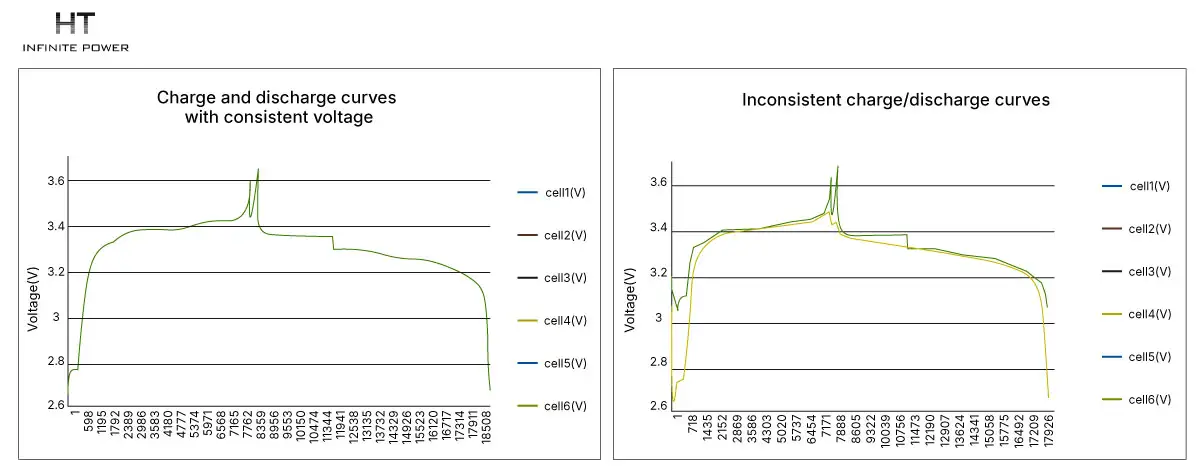
For a battery cluster with good voltage consistency, individual cell voltages reach both the charge-cutoff and discharge-cutoff thresholds almost simultaneously.
However, in a battery cluster with poor voltage consistency, the following situations occur:
However, in a battery cluster with poor voltage consistency, the following situations occur:
During discharge:
Cells with lower remaining capacity reach the discharge-cutoff voltage earlier, causing the entire battery cluster to stop discharging prematurely.
During charging:
Cells with higher remaining capacity reach the charge-cutoff voltage earlier, forcing the entire battery cluster to stop charging in advance.
In this condition, the usable capacity of the cluster is determined by the cells with the highest and lowest remaining capacity. The relationship can be expressed as:
Q₁ = Q − (Q_high − Q_low)
Where:
Q₁ = Effective capacity of the battery cluster
Q = Ideal rated capacity
Q_high = Remaining capacity of the highest-capacity cell
Q_low = Remaining capacity of the lowest-capacity cell
Q = Ideal rated capacity
Q_high = Remaining capacity of the highest-capacity cell
Q_low = Remaining capacity of the lowest-capacity cell
Manifestations and Causes of Voltage Imbalance Faults
| Voltage Deviation Fault | Cause Analysis | Impact |
|---|---|---|
| Capacity Deviation | Mixed cell grading | Affects capacity |
| Abnormal welding of cell connection busbars | Affects capacity | |
| Voltage Consistency Deviation | Inconsistent BMU power consumption | Abnormal capacity consumption |
| Abnormal BMU sampling | Abnormal capacity consumption | |
| Large voltage difference after module replacement | Affects capacity | |
| Low initial SOC | Affects capacity | |
| High self-discharge rate | Affects capacity | |
| False Alarm | Voltage circuit false triggering | Abnormal voltage measurement |
When a welded cell in a battery has issues such as a cold or incomplete weld, it can cause problems during both parallel and series connections. In parallel configurations, the faulty cell cannot fully charge or discharge due to polarization voltage, resulting in reduced cell capacity. In series configurations, the cold weld can lead to larger polarization voltage during charging and discharging, also reducing capacity.
The voltage difference faults described above are mainly caused by issues in the manufacturing process or production techniques.
Active Balancing
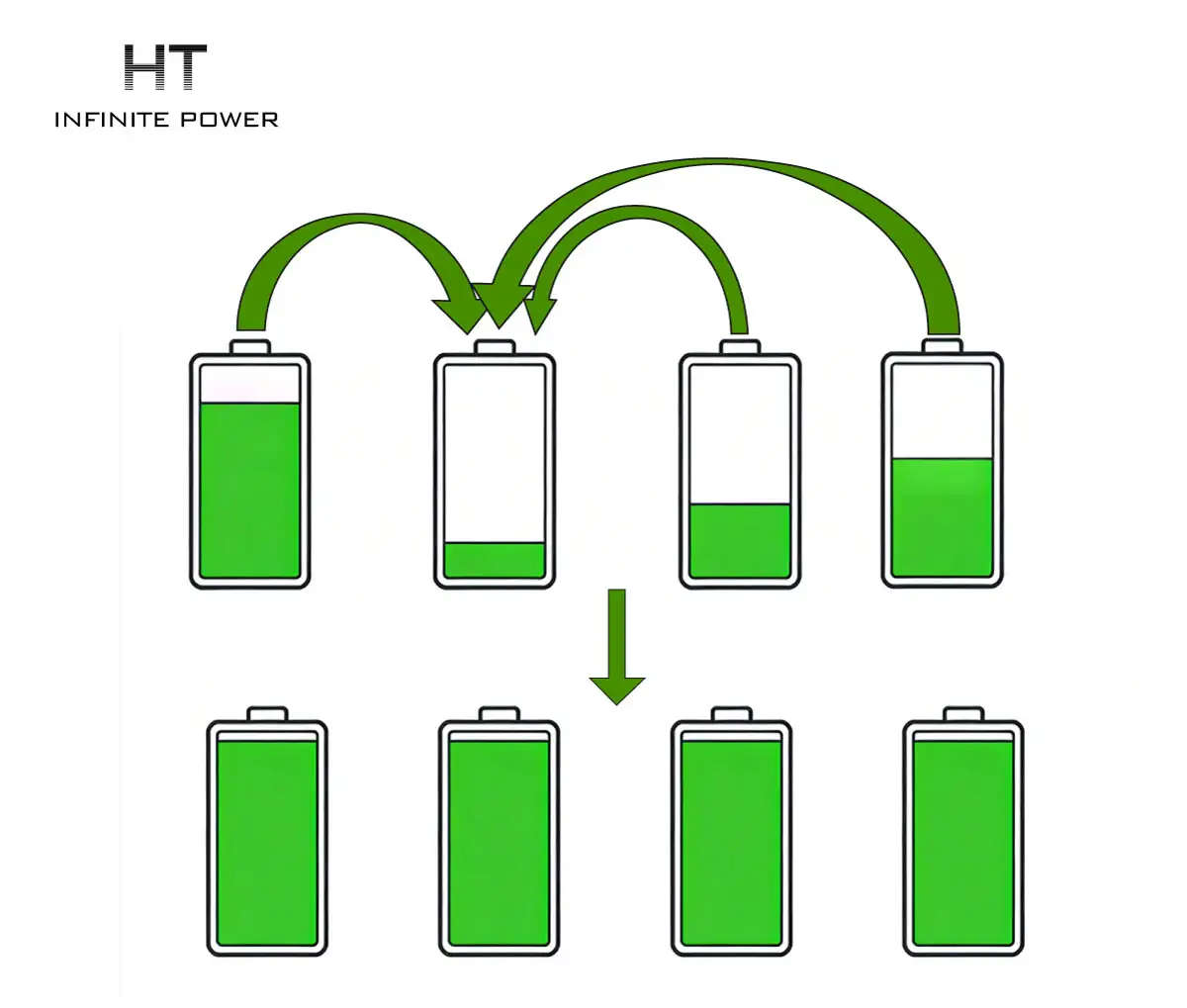
When there is a voltage mismatch between cells, active balancing transfers energy from higher-capacity cells to lower-capacity cells to maximize overall capacity. However, if the active balancing system is unstable, it can actually increase operational risks and raise the likelihood of faults.
Passive Balancing
Passive balancing is a method that dissipates excess energy. It works by discharging the cells with higher voltage through resistive or switching circuits, thereby reducing their voltage to maintain consistency across the pack. However, this method can only discharge the higher-voltage cells and does nothing to increase the voltage of the lower-voltage cells. As a result, it cannot fundamentally solve long-term voltage imbalance. When the imbalance reaches a certain level, manual intervention—such as recharging individual cells or replacing the module—is required.
Compared with active balancing, passive balancing is generally more stable and has a lower failure rate, even though it is less effective in restoring overall cell consistency.

When replacing modules, it is generally best to do so during the early stages of operation. Over time, even originally healthy modules experience capacity degradation, and installing new modules later may lead to voltage inconsistencies within the pack. When replacing modules, it is preferable to do so after fully charging the battery and to install fully charged modules, ensuring consistent system voltage.
What is VSG technology and its applications in energy storage?
Energy Storage Battery PACK: Understanding the Core of Energy Storage Technology