
Peak Sun Hours: How to Calculate Solar Energy Potential
author: HT Infinite Power
2026-10-21
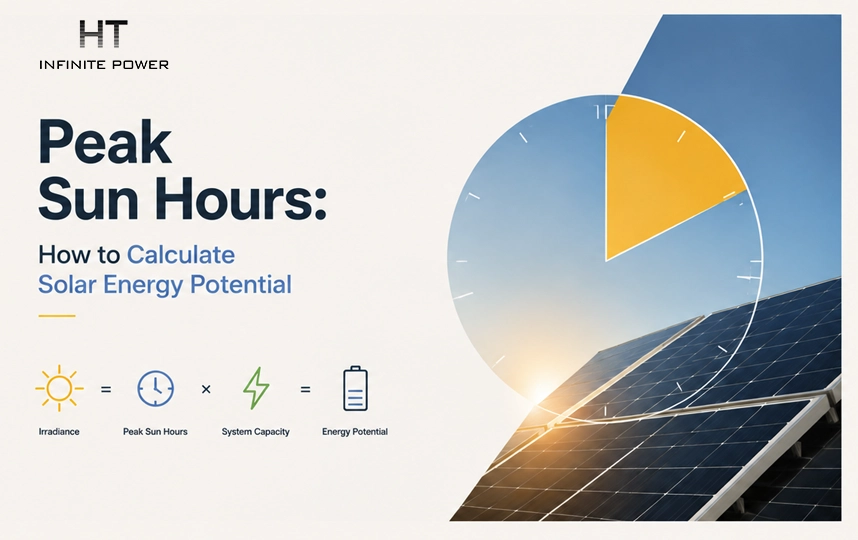
Peak sun hours provide a practical way to translate solar irradiation data into a preliminary estimate of photovoltaic (PV) energy production. They express the solar energy received over a period as an equivalent number of hours at a reference irradiance of 1,000 W/m².
For an initial assessment, peak sun hours can be combined with a PV system's rated capacity to estimate daily electricity generation. However, they describe the total solar energy received, not the timing of generation or the actual electrical output of an array. These distinctions matter when estimating system performance, matching solar generation to a facility's electricity demand, or determining how much surplus energy may be available to charge a battery.
What Are Peak Sun Hours?
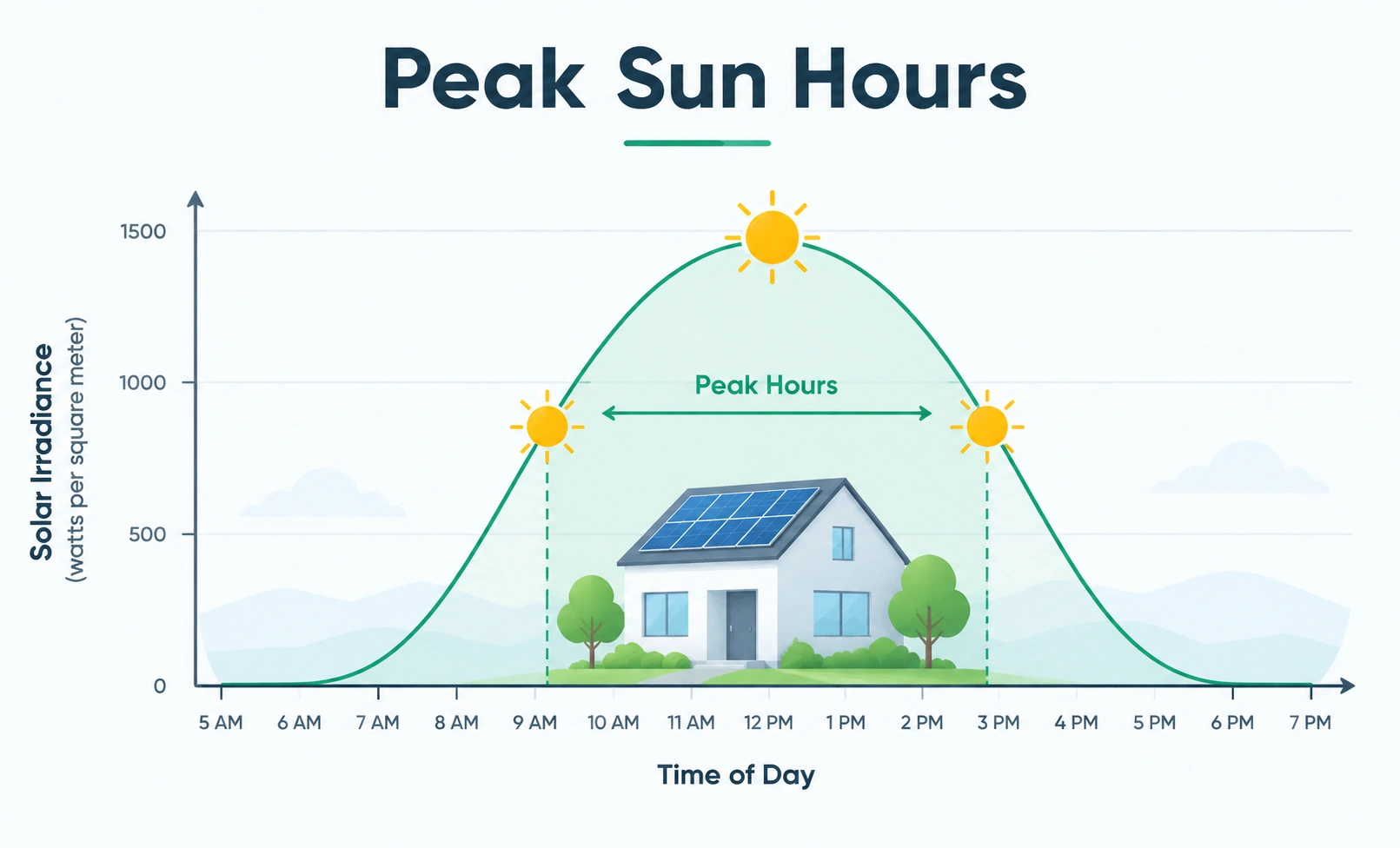
A peak sun hour is equivalent to one hour of solar irradiance at 1 kilowatt per square meter (1 kW/m²). This reference level provides a convenient way to express accumulated solar irradiation as an equivalent duration.
Suppose a location receives 5 kWh of solar energy per square meter over a day. That daily irradiation is equivalent to receiving 1 kW/m² for five hours. The location therefore receives five peak sun hours for that day, provided the irradiation value refers to the surface being evaluated.
Peak sun hours do not mean that the sun was visible for exactly five hours. A site might receive sunlight over a much longer period, with irradiance rising and falling as the sun moves across the sky and clouds pass overhead. Peak sun hours compress these changing conditions into a single measure of equivalent solar energy.
This distinction matters because daylight duration alone does not indicate how much solar energy reaches a PV array. Two locations with similar daylight hours can have different solar resources because of differences in latitude, season, atmospheric conditions, and local weather. The U.S. Department of Energy explains these factors in its guide to solar radiation basics.
How to Calculate Peak Sun Hours
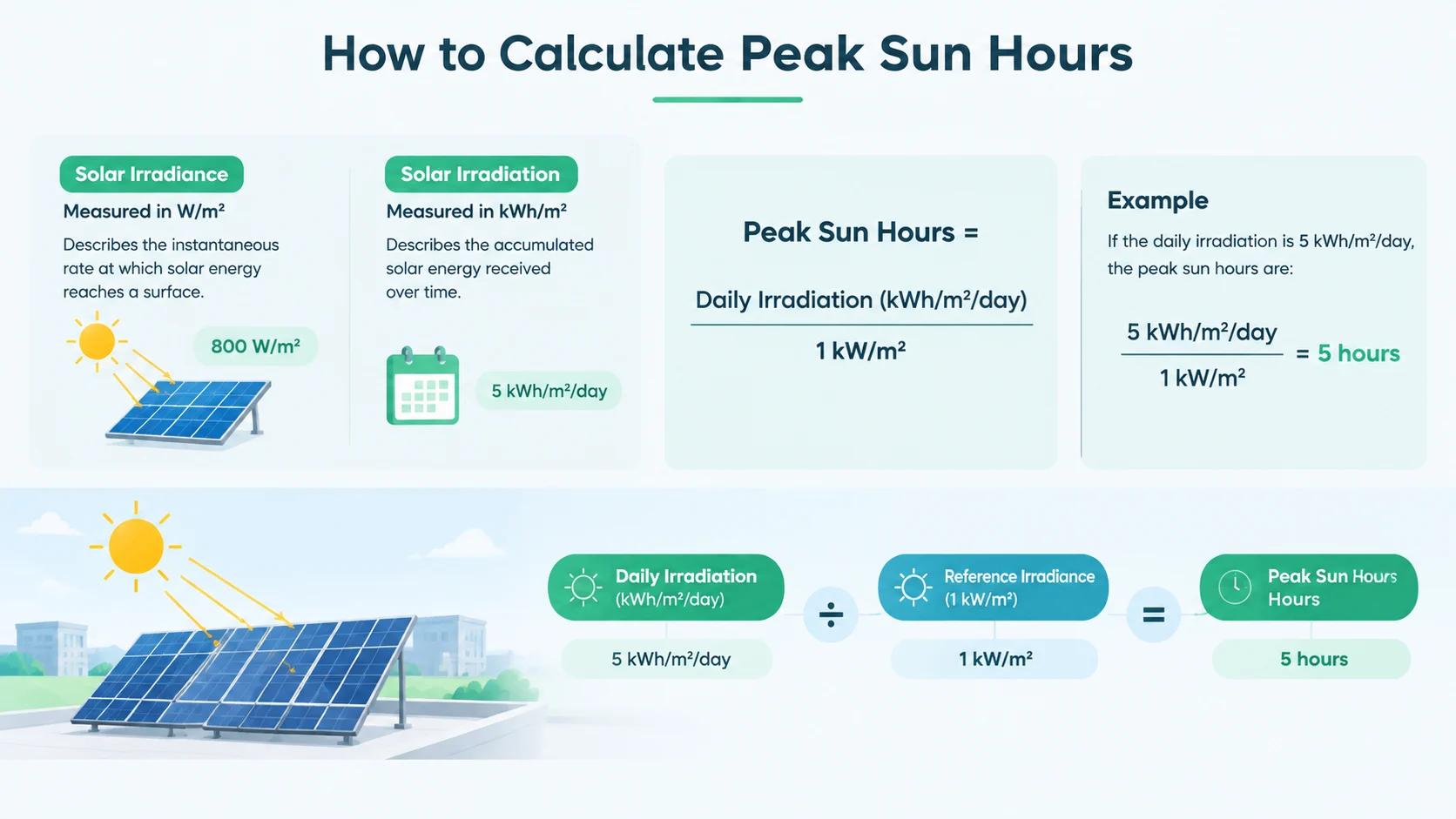
The calculation starts with daily solar irradiation, which measures the total solar energy received per unit area over a specified period.
Solar irradiance and solar irradiation describe different quantities:
- Solar irradiance, measured in watts per square meter (W/m²), describes the instantaneous rate at which solar energy reaches a surface.
- Solar irradiation, measured in kilowatt-hours per square meter (kWh/m²), describes the accumulated solar energy received over time.
For example, an irradiance reading of 800 W/m² describes the solar power arriving at a surface at a particular moment. A daily irradiation value of 5 kWh/m²/day describes the total solar energy accumulated over the day.
The relationship between daily irradiation and peak sun hours is:
Peak Sun Hours (h / day) = Daily Solar Irradiation (kWh / m² / day) 1 kW / m²
The denominator is the reference irradiance of 1 kW/m², equivalent to 1,000 W/m². Dividing daily irradiation by this reference value produces an equivalent duration in hours.
Worked Example: Converting Daily Irradiation into Peak Sun Hours
Assume a site receives daily solar irradiation of 5 kWh/m²/day on the surface being evaluated.
PSH = 5 kWh / m² / day 1 kW / m² = 5 h / day
The result is 5 peak sun hours per day.
The calculation does not require five consecutive hours at 1,000 W/m². The same daily irradiation could result from many different irradiance levels throughout the day. Peak sun hours represent the integrated solar energy resource, not the actual pattern of sunlight.
One important consideration is the measurement surface. Solar irradiation data may refer to a horizontal surface or to the plane of a PV array. These values are not necessarily equal because array orientation, tilt, and the sun's position affect the radiation received.
For estimating production from a particular fixed-tilt array, irradiation on the plane of the array (POA) is generally the more directly relevant input. Sandia's PV Performance Modeling Collaborative guide to POA irradiance explains how array orientation, direct and diffuse radiation, and ground-reflected radiation contribute to the incident solar resource.
How to Find Peak Sun Hours for Your Location
To find peak sun hours by location, first obtain solar irradiation data for the geographic area and surface relevant to your calculation. You can then convert the irradiation value into peak sun hours using the equation above.
Several established resources can help:
- National Solar Radiation Database (NSRDB): This database provides solar radiation and meteorological data across supported geographic areas. Its datasets include measurements or estimates of global horizontal irradiance (GHI), direct normal irradiance (DNI), and diffuse horizontal irradiance (DHI), with access through its data viewer, downloads, and APIs. Check the coverage and temporal resolution of the selected dataset before using it.
- NREL PVWatts Calculator: PVWatts estimates electricity production from grid-connected PV systems using location and system inputs. It is useful when you want to move beyond a solar-resource figure and estimate system energy output. Its results can include monthly solar radiation and predicted PV production, helping you assess seasonal variation.
- PV Performance Modeling Collaborative: This technical resource explains the relationship between solar resource data, plane-of-array irradiance, system configuration, and modeled PV output.
When selecting data, distinguish between horizontal irradiation and irradiation on the actual or proposed array plane. GHI describes solar radiation received by a horizontal surface, whereas POA irradiation corresponds to the orientation and tilt of the PV array. If the available dataset provides only horizontal irradiation, a suitable transposition model may be needed to estimate POA irradiation.
The time period matters as well. A single daily value is useful for an initial calculation, but it does not represent the full range of conditions at a site. Compare monthly averages to identify seasonal differences and use representative long-term weather data when assessing annual production. For a project-specific energy estimate, a modeling tool such as PVWatts is generally more appropriate than manually extrapolating from one day's irradiation.
Estimating Daily Solar Energy Production
Once peak sun hours are known, they can be combined with PV system rated capacity to produce a first-order estimate of daily electricity generation.
The simplified relationship is:
Estimated Daily PV Energy (kWh) = PV Rated Capacity (kW) × Peak Sun Hours (h / day)
Consider a hypothetical PV system with a rated DC capacity of 10 kW at a site receiving five peak sun hours per day.
10 kW × 5 h = 50 kWh / day
The simplified estimate is 50 kWh of electricity per day.
The units explain why the calculation works: kilowatts measure power, while hours measure time. Multiplying power by time gives energy in kilowatt-hours.
However, this estimate assumes that the available solar resource can be converted into electricity at the array's rated power for the equivalent duration. A real PV system does not maintain rated output throughout every period of sunlight. Module temperature, irradiance levels, shading, inverter behavior, wiring losses, soiling, and other operating conditions affect the result.
The 50 kWh/day figure is therefore a simplified estimate, not a guaranteed actual energy yield.
Accounting for System Losses
A more practical preliminary estimate can include a performance ratio (PR):
EAC ≈ PDC × HPOA × PR
Where:
EAC is estimated AC electricity production in kWh.
PDC is the PV array's rated DC capacity in kW.
HPOA is daily peak sun hours calculated from irradiation on the array plane.
PR is the assumed performance ratio, relating actual system energy yield to the reference yield implied by the solar resource and rated capacity.
For illustration, if the 10 kW DC array receives five peak sun hours and an assumed performance ratio of 0.80 is used, the estimate becomes:
10 kW × 5 h × 0.80 = 40 kWh/day
The estimated AC production is 40 kWh per day under these assumptions.
The value of 0.80 is an illustrative assumption, not a universal industry standard or a prediction for a particular installation. A defensible value should reflect the system configuration, temperature, inverter and electrical losses, shading, soiling, availability, and the definition of the rated capacity and output being evaluated.
Performance ratio is also not simply the sum of individual equipment loss percentages. Its precise definition depends on the metric and system boundary. Sandia's PV Performance Modeling Collaborative defines the AC performance ratio using measured AC energy yield and reference yield derived from plane-of-array irradiation.
For an initial screening, the capacity-times-peak-sun-hours calculation is useful. For an investment decision or a project energy guarantee, a location-specific PV production model is more appropriate. NREL PVWatts incorporates solar resource and system inputs to estimate production rather than treating peak sun hours as a complete model of system performance.
Why Similar Peak Sun Hours Can Produce Different Results
Peak sun hours reduce a day's solar resource to one number. Their limitation is that this compression removes information about when the energy arrived and the conditions under which the PV system received it.
Daily Energy Totals Do Not Reveal Hourly Output
Imagine two days that each deliver 5 kWh/m² of solar irradiation to the same PV array. Both have five peak sun hours, but their generation profiles may be very different.
On the first day, the sky is clear. Irradiance rises through the morning, reaches a midday maximum, and declines through the afternoon. On the second day, intermittent cloud cover reduces midday irradiance, while brighter conditions in the morning and late afternoon contribute to the daily total.
Even with similar total irradiation, the systems may experience different hourly power output. The exact difference depends on the timing and intensity of irradiance, module temperature, cloud conditions, and system response.
Detailed PV models therefore use time-dependent inputs to estimate changing system output. For example, PVWatts can provide hourly output estimates when configured for hourly results, rather than relying only on daily solar energy totals.
This matters whenever electricity must be available at a particular time. A daily estimate can indicate how much energy a system might produce, but it cannot establish whether that energy will be available during a facility's morning production shift, afternoon peak demand, or evening operating hours.
A facility with high morning electricity demand, for example, may receive less immediate benefit from a PV array whose strongest output occurs around midday. The daily energy total alone does not reveal that mismatch.
Seasonality Changes the Meaning of an Average
Peak sun hours vary with season because the sun's path, day length, cloud patterns, and solar angle change throughout the year. A site may have a relatively high annual average while still experiencing substantially lower solar availability during certain months.
An annual average is useful for comparing broad solar resource potential, but it can conceal periods when PV generation is insufficient for the intended use. Conversely, designing around a particularly poor day could lead to an unnecessarily conservative estimate if the objective is to assess annual energy production.
The appropriate time scale depends on the question. Daily estimates support quick production calculations, monthly estimates expose seasonal variation, and annual estimates help evaluate long-term production potential. For commercial projects, monthly or hourly solar resource data is generally more informative than a single annual peak-sun-hour figure.
Long-term weather datasets also help distinguish typical production from unusually sunny or cloudy periods. The NSRDB provides historical solar resource data for supported locations, while PV production models can use representative weather data to estimate expected output over longer periods.
Weather, Orientation, and Temperature Affect Actual Output
Clouds can reduce direct sunlight and alter the diffuse radiation reaching the array. Atmospheric conditions also affect how much solar energy reaches the ground. The U.S. Department of Energy explains these variations in its guide to solar radiation basics.
Orientation and tilt influence how much irradiation a PV array receives. A horizontal solar resource figure should not automatically be treated as the irradiation available to a tilted rooftop array. Where possible, use solar resource data calculated for the actual or proposed array orientation.
Temperature adds another layer. PV modules are rated under defined standard test conditions, including a cell temperature of 25°C and irradiance of 1,000 W/m². In operation, cell temperatures often differ from those conditions, affecting electrical output.
As a result, two days with similar irradiation can produce different amounts of electricity even when the same array is installed at the same site. Shading, soiling, electrical losses, inverter limitations, and equipment availability can further widen the gap between a simplified solar-resource estimate and measured AC generation. Peak sun hours account for none of these factors by themselves.
Why Peak Sun Hours Are Not Enough for Solar-Plus-Storage
For a PV-only installation, peak sun hours help estimate the energy resource available to the array. For a solar-plus-storage project, a different question follows: how much of the PV electricity can actually be used to charge the battery?
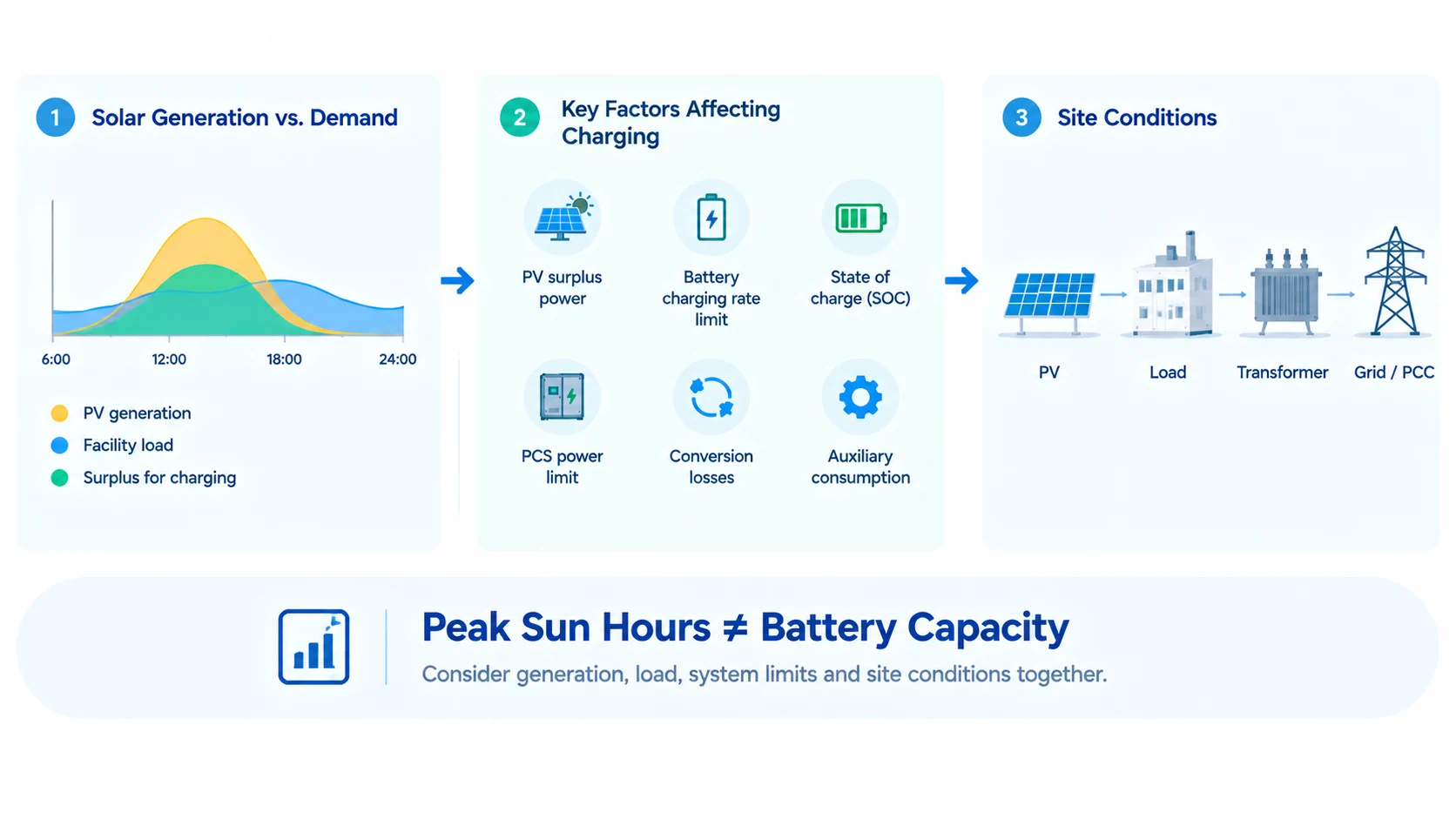
Daily PV generation and battery charging energy are not equivalent.
A facility may consume most of its solar generation as it is produced. In that case, only a portion of the PV output remains available as surplus for charging. Another facility may have low daytime demand and substantial midday generation, creating more opportunities to charge a battery. Both sites could have the same PV capacity and peak sun hours, yet their battery-charging opportunities would differ significantly.
The battery's operating conditions matter too. Charging is constrained by available surplus power, the battery's permitted charging rate, its state of charge, and the power-conversion system's limits. Conversion losses and energy consumed by other system components also affect how much energy is ultimately stored.
To assess a commercial solar-plus-storage project, peak sun hours should therefore be considered alongside hourly or sub-hourly PV generation estimates, facility load profiles, system power limits, battery operating conditions, and electricity tariffs.
These inputs support a time-based energy balance. At each interval, estimated PV generation is compared with facility demand and the constraints of the electrical system. The analysis can then indicate when charging is possible and how much energy might be stored.
Peak sun hours provide the solar-resource context, but they cannot independently determine battery capacity, PCS rating, savings, or project profitability. Those decisions require information about the timing of energy production and consumption, as well as the system's operating objectives.
How to Use Peak Sun Hours in a Practical Solar Assessment
A useful assessment begins with a clear definition of what the estimate is intended to represent. Is the goal to compare solar resources between locations, estimate daily PV production, forecast annual electricity generation, or evaluate the solar contribution to a facility's energy demand? Each question requires a different level of detail.
For an initial estimate, obtain daily solar irradiation for the relevant location and surface, convert it into peak sun hours, and multiply by the PV array's rated capacity. If an illustrative performance factor is applied, state the assumption and explain that actual system performance may differ.
For project planning, use representative weather data, account for the array's orientation and system configuration, and examine monthly or hourly generation where timing affects the result. Compare the resulting production profile with actual site consumption if the system is intended to serve a commercial facility or charge a battery.
The distinction is fundamental: peak sun hours quantify the solar energy resource in a convenient form, but they do not describe every step between incoming sunlight and usable electricity.
Conclusion
Peak sun hours are a useful starting point for estimating photovoltaic energy production because they connect daily solar irradiation with PV system capacity through a straightforward calculation. For the hypothetical 10 kW system receiving five peak sun hours, the simplified estimate is 50 kWh per day before accounting for real-world performance differences.
The metric's value is also its limitation: it reduces changing solar conditions to a single daily energy figure. That is sufficient for an initial estimate, but not for understanding the timing of generation, predicting actual system output, or determining how much energy a commercial facility can use or store.
Frequently Asked Questions
Are peak sun hours the same as hours of sunshine?
No. Sunshine duration measures how long sunshine is observed under a defined measurement criterion. Peak sun hours express accumulated solar irradiation as an equivalent number of hours at 1 kW/m². A day with ten hours of daylight can have substantially fewer than ten peak sun hours.
Can peak sun hours predict exactly how much electricity solar panels will generate?
No. Peak sun hours support a simplified estimate based on PV capacity and solar resource. Actual production also depends on module temperature, array orientation, shading, inverter behavior, and system losses. More detailed modeling is needed for a project-specific forecast.
Should I use horizontal or tilted-surface irradiation?
Use the irradiation measurement that matches the purpose of the calculation. Horizontal irradiation is useful for general solar-resource assessment. For estimating production from a fixed tilted array, plane-of-array irradiation is generally more directly relevant because it reflects the array's orientation and tilt.
How do I find peak sun hours for my location?
Obtain daily solar irradiation data for your location from a suitable solar-resource database. The National Solar Radiation Database provides historical solar radiation data for supported locations. For a more direct estimate of PV energy production, use the PVWatts Calculator. Check monthly variations and ensure that the selected irradiation data matches the surface relevant to your calculation.
Can peak sun hours tell me how much battery storage I need?
No. Peak sun hours help estimate the solar energy resource, but battery sizing also depends on the site's load profile, surplus PV generation, required discharge duration, charging and discharging limits, and operating objectives. Hourly energy analysis is needed to understand when solar energy is available for charging and when stored energy will be required.
Energy Storage System Integration: Two Architectures, Two Equipment Configurations
Related Article