AIDC Energy Storage Enters a Strategic Era: Lithium, Semi-Solid, and Sodium Batteries Advance on Three Parallel Fronts
author: HT infinitepower
2026-06-26
The Quiet Engineering Crisis Behind AI’s Explosive Growth
If you spend enough time inside an AI data center, you eventually notice something that doesn’t show up in glossy presentations about model breakthroughs or GPU clusters. It’s the sound — or rather, the tension — of a power system running at the edge of what it was designed to handle. The industry has spent years talking about compute, cooling, and chip supply. But the real bottleneck, the one that determines whether an AIDC facility survives its own ambition, is energy.
AI workloads don’t behave like traditional IT loads. They surge, collapse, pulse, and spike with a violence that would have been unthinkable in the era of CPU-based data centers. A single rack can now draw more than 100 kW, and when a GPU cluster wakes up, the power swing can hit 180% of nominal load in milliseconds. Under those conditions, the old idea of a UPS quietly waiting for an outage feels almost quaint. AIDC doesn’t need backup power. It needs a power system that can fight alongside the compute stack in real time.
This is the backdrop against which the storage industry is undergoing a structural shift. For years, lithium iron phosphate (LFP) dominated grid-scale storage. But AIDC has forced the industry into a three-front evolution: large-format LFP cells pushing toward higher capacity, semi-solid batteries redefining safety expectations, and sodium-ion batteries stepping into the spotlight with high-rate performance and all-climate resilience. These aren’t competing routes. They’re converging into a new architecture shaped by the physics of AI.
Why AIDC Power Behavior Forces a Rethink
Engineers who come from traditional data center backgrounds often underestimate how different AIDC loads really are. A conventional rack behaves like a well-mannered consumer: predictable, steady, and rarely surprising. AIDC racks behave more like industrial machinery. They slam the grid with sudden current demands, then drop off just as abruptly. The electrical stress is continuous, not exceptional.
This is why the old “backup-only” mindset collapses. AIDC storage must respond in milliseconds, absorb violent load swings, and stabilize voltage before the GPU cluster even notices something changed. The battery is no longer a safety net. It’s part of the active power-conditioning layer, sitting in the loop with the transformers, busbars, and power electronics.
Once you accept that, the question shifts from “Which battery has the best datasheet?” to “Which combination of chemistries can survive the electrical reality of AI?”
Lithium, Semi-Solid, and Sodium: Three Technologies, Three Different Jobs
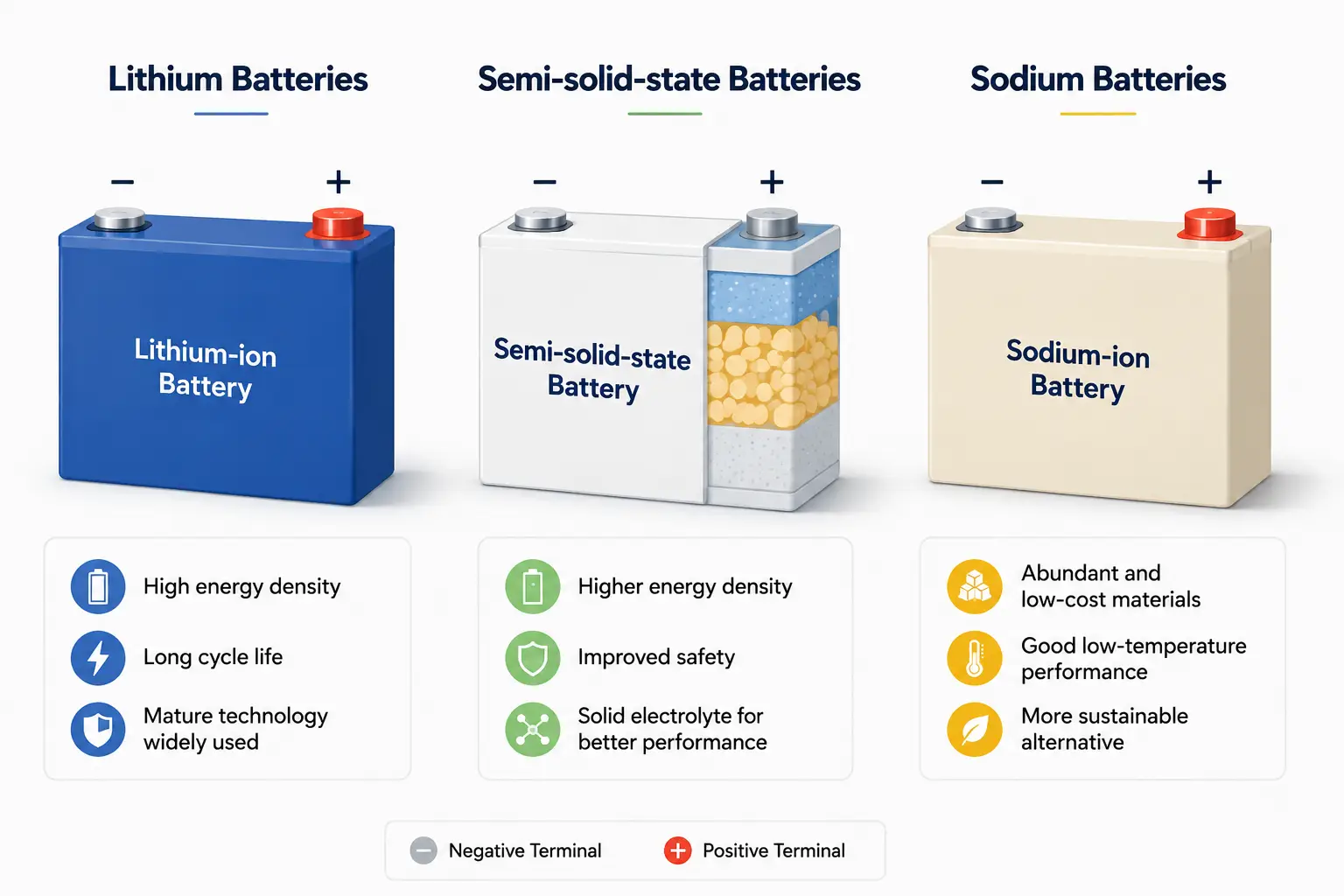
Lithium Iron Phosphate: The Backbone That Carries the Weight
LFP has earned its reputation the hard way — through years of field operation, predictable degradation curves, and a supply chain that knows how to scale. Large-format cells like CATL’s 587 Ah units have pushed LFP into a new class of industrial maturity. For long-duration, steady
state support, nothing beats it on cost or reliability.
But AIDC exposes LFP’s limits. It can carry the base load, but it struggles with the violent, millisecond-scale pulses that GPU clusters generate. It’s the backbone, not the sprinter.
Semi-Solid Batteries: Engineering for the Scenarios Where Failure Is Not an Option
If you’ve ever seen a thermal event inside a high-density compute hall, you understand why semi-solid batteries matter. AIDC facilities have zero tolerance for fire risk. The density of equipment, the heat load, the airflow patterns — everything conspires to make even a minor incident potentially catastrophic.
Semi-solid batteries change the equation. By reducing the amount of free liquid electrolyte, they dramatically cut the pathways for thermal runaway. Systems built around 755 Ah semi-solid cells, like those in Shuangdeng’s Power Warden 4.0, can withstand needle punctures and overcharging without ignition. That’s not a marketing claim; it’s a fundamental shift in failure behavior.
These batteries belong in the places where the consequences of failure are unacceptable: core GPU halls, urban edge facilities, and mission critical compute zones.
Sodium-Ion Batteries: The Specialist Built for AI’s Pulse-Driven Reality
Sodium-ion batteries are often misunderstood because people fixate on energy density. But AIDC doesn’t care about energy density as much as it cares about rate capability and thermal resilience.
This is where sodium-ion shines. CATL’s sodium-ion cells can deliver 6C-plus discharge with millisecond-level response. That makes them ideal for absorbing GPU load spikes — the kind that would push LFP into thermal stress. And in cold climates, sodium-ion behaves almost unnaturally well, retaining more than 90% capacity at –40°C. For northern data centers, that’s not a bonus. It’s a lifeline.
The economics are shifting too. With cell costs already around 0.47 RMB/Wh and large-scale orders underway, sodium-ion is on track to reach cost parity with LFP by 2026 or 2027.
AIDC’s Dual-Profile Power Demand and the Rise of Hybrid Architectures
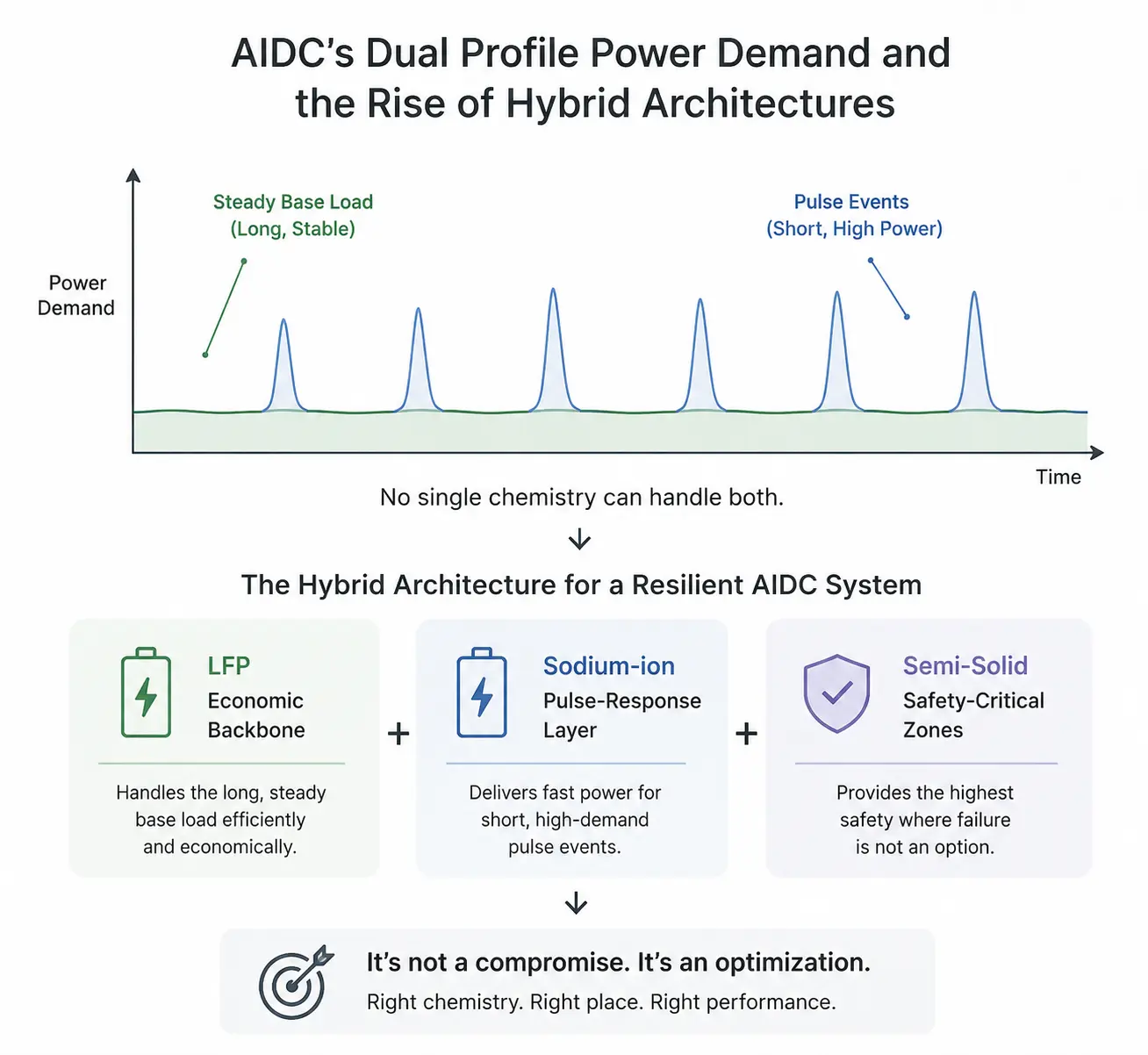
Once you map out AIDC’s power behavior, the logic becomes obvious. The load profile splits into two distinct regimes:
- a long, steady base load that barely moves,
- and short, violent pulses that hit without warning.
No single chemistry can handle both. LFP is perfect for the base load. Sodium-ion is built for the pulses. Semi-solid is the only chemistry that can guarantee safety in the zones where a failure would be catastrophic.
This is why the industry is moving toward hybrid architectures. Not because it’s fashionable, but because the physics demands it. The most resilient AIDC systems emerging today use:
- LFP for the economic backbone,
- sodium-ion for the pulse-response layer,
- semi-solid for the safety-critical zones.
It’s not a compromise. It’s an optimization.
Engineering Implications: What Changes When You Design for AI Instead of IT
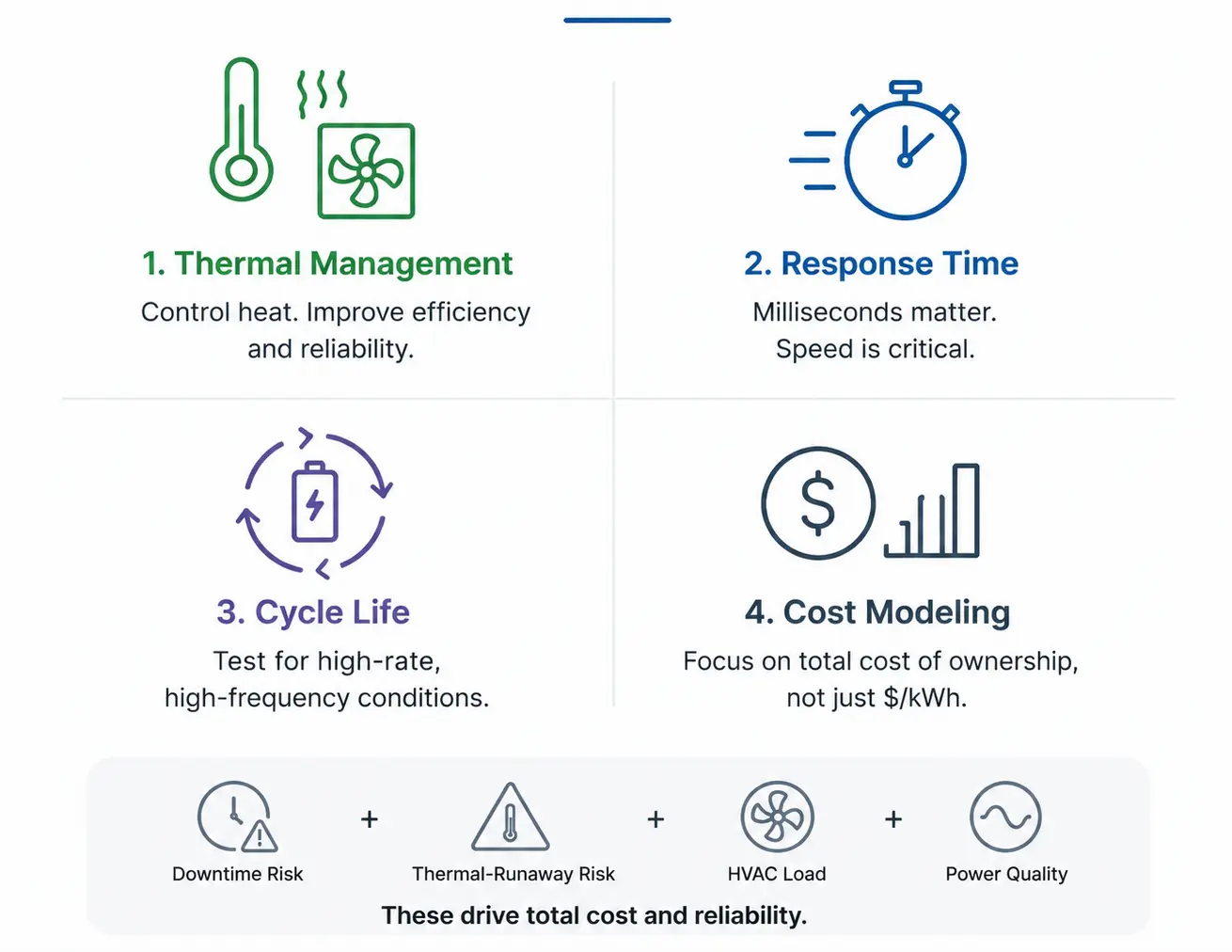
Designing power systems for AIDC forces engineers to rethink several assumptions.
Thermal management becomes a first-order design variable, not an afterthought. High-rate cycling generates heat in ways that traditional battery rooms never had to deal with. Sodium-ion’s cold-climate resilience and semi-solid’s thermal stability reduce the burden on HVAC systems and improve overall reliability.
Response time becomes as important as capacity. A battery that reacts in 20 milliseconds is effectively useless in a system where the load spike happens in five.
Cycle life must be evaluated under high-rate, high-frequency conditions. A battery that lasts 10,000 cycles at 0.5C may degrade very differently at 4C.
And cost modeling shifts from $/kWh to total cost of ownership — including downtime risk, thermal-runaway probability, HVAC load, and power-quality stability.
The Future: No Single Winner, Only the Right Combination
The question “Which battery is best for AIDC?” misses the point. The future isn’t about choosing a winner. It’s about assembling the right combination of chemistries for the right job.
LFP will continue to dominate long-duration, cost-sensitive deployments. Semi-solid will secure the zones where safety is non-negotiable. Sodium-ion will expand rapidly in pulse-heavy and cold-climate environments.
This three-route evolution is not a sign of fragmentation. It’s a sign of maturity. As Liu Yong from the China Chemical and Physical Power Industry Association put it, the industry must advance lithium, solid-state, and sodium technologies in parallel to meet diverse requirements for energy density, safety, cycle life, and resource availability.
By 2026, AIDC storage is shifting from a year of emerging demand to a year of large-scale delivery. In a trillion-dollar market, the winners will be the companies that can integrate multiple chemistries into coherent, optimized systems — not the ones who cling to a single technology.
Conclusion
AI is forcing the energy-storage industry into a new strategic era. The demands of AIDC — millisecond response, high-rate discharge, absolute safety, and all-climate operation — are reshaping the technological landscape. Lithium, semi-solid, and sodium batteries are no longer competing technologies. They are complementary tools in a power system engineered for the extreme realities of AI.
The future of AI will be determined not only by GPUs and algorithms, but by the energy systems that keep them alive. And in that future, hybrid storage architectures will define the global standard for AIDC.
FAQ
Why does AIDC place such extreme stress on energy-storage systems?
Because GPU clusters behave nothing like traditional IT loads. Their power draw can swing from idle to full load in milliseconds, and those transitions create electrical stress that conventional UPS systems were never designed to absorb. Storage in AIDC isn’t a backup layer — it’s part of the active power
conditioning loop.
Is lithium iron phosphate still relevant for next-generation data centers?
Absolutely. LFP remains the most economical and mature chemistry for long
duration, steady-state support. What changes in AIDC is not its relevance, but its role. It becomes the backbone rather than the all-purpose solution.
Where do semi-solid batteries make the biggest difference?
In the places where failure is not an option. High-density GPU halls, urban edge facilities, and mission-critical compute zones all benefit from the dramatically lower thermal-runaway risk of semi-solid electrolytes. Their value is measured not just in performance, but in avoided catastrophe.
Why are sodium-ion batteries suddenly gaining traction in AIDC?
Because AIDC cares more about rate capability and thermal resilience than raw energy density. Sodium-ion’s ability to deliver high-rate discharge and maintain capacity in extreme cold makes it ideal for pulse-driven AI workloads and northern-region data centers.
Will one battery chemistry eventually dominate AIDC?
Unlikely. The power profile of AIDC is too complex for a single chemistry to handle. The future belongs to hybrid architectures where lithium carries the base load, sodium handles the pulses, and semi
solid protects the zones where safety is paramount.
What Feeder-Level Energy Storage Is and Why It Matters
Why More Commercial and Industrial Energy Storage Projects Are Choosing Hybrid Inverter Systems?