AGC vs. AVC Explained: Differences, Control Mechanisms, and the Role of Energy Storage
2025-11-24

The stable operation of a power system relies on two fundamental balances: active power balance and reactive power balance.
A deviation in active power disrupts system frequency, shortens equipment lifespan, and in severe cases may trigger system collapse.
A mismatch in reactive power causes voltage deviations at grid nodes, reduces power quality, and increases line losses.
A deviation in active power disrupts system frequency, shortens equipment lifespan, and in severe cases may trigger system collapse.
A mismatch in reactive power causes voltage deviations at grid nodes, reduces power quality, and increases line losses.
AGC and AVC are responsible for the automatic control of “active power–frequency” and “reactive power–voltage,” respectively, and together form essential tools for grid dispatching.
Energy storage systems, with their millisecond-level response and bidirectional active/reactive control capability, effectively compensate for the limitations of traditional regulation resources and have become a key technical support for AGC/AVC operations.
1. Core Technical Differences Between AGC and AVC
(1). AGC: Focused on Active Power–Frequency Regulation
The primary objective of AGC is to keep grid frequency near its nominal value (50 Hz in China, with an allowable deviation of ±0.2 Hz) while ensuring interconnection line flows stay within scheduled limits.
Its technical essence lies in dynamically adjusting active power output on the generation side to offset fluctuations from load changes and renewable output.
When grid frequency drops below the nominal value, AGC commands generators to increase active power; when frequency rises, AGC reduces active output or instructs storage systems to charge. This forms a closed-loop “frequency deviation–active power regulation” control mechanism.
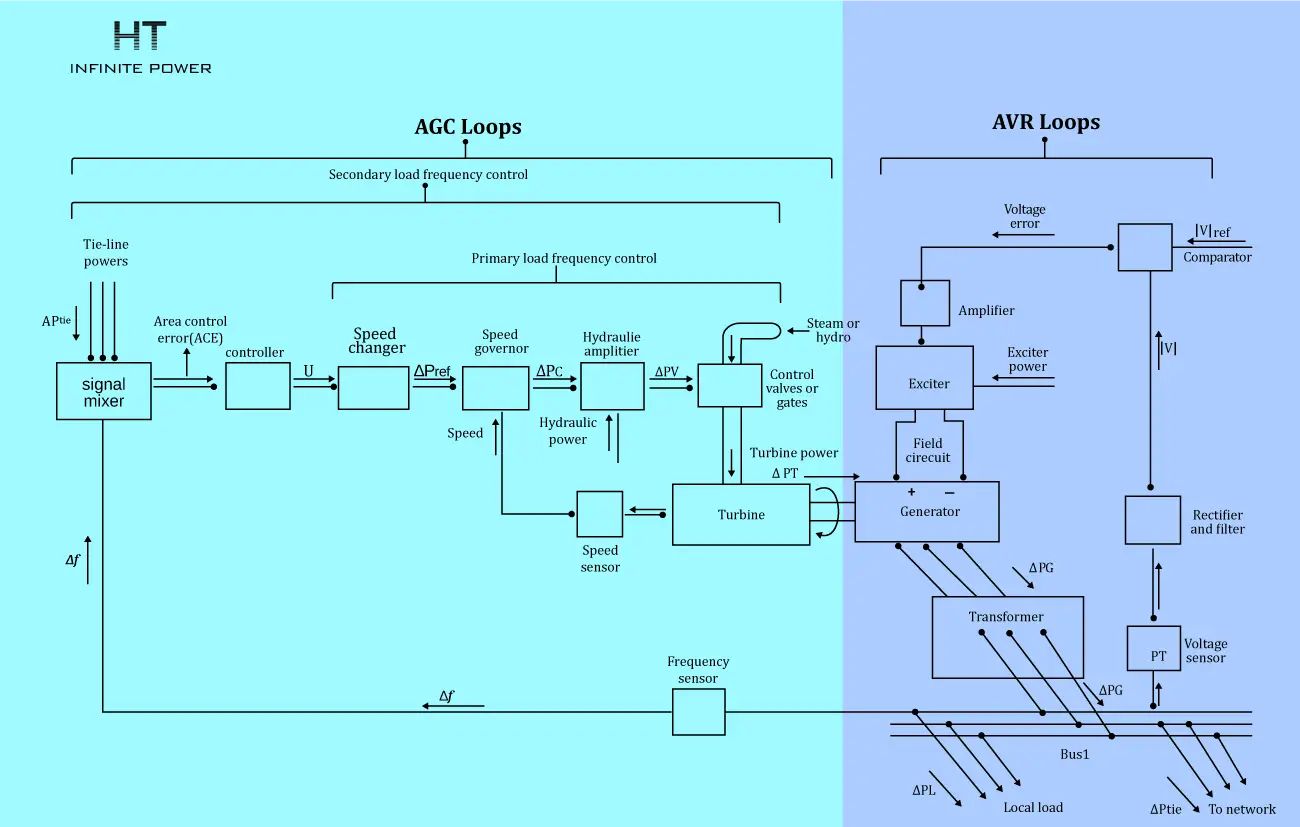
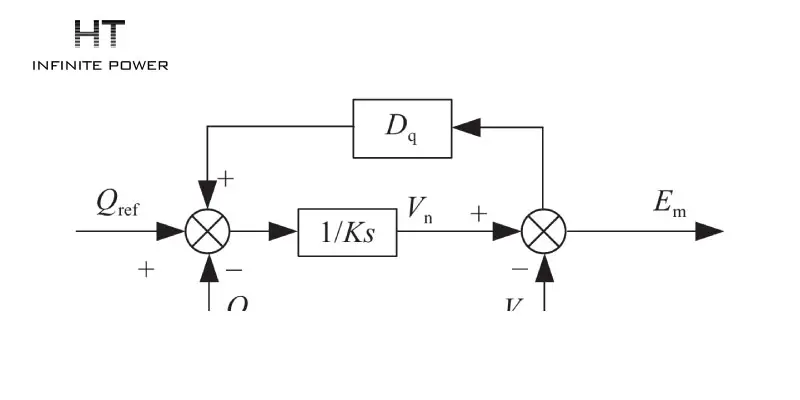
(2). AVC: Focused on Reactive Power–Voltage Regulation
The objective of AVC is to maintain grid node voltages within ±3% of their nominal values, ensuring equipment operates properly and reducing reactive losses along transmission lines.
Its technical mechanism involves adjusting reactive power sources to optimize reactive power distribution.
When node voltage exceeds the upper limit, AVC instructs reactive devices to absorb reactive power (e.g., capacitive SVG operation); when voltage falls below the lower limit, AVC increases reactive output (e.g., higher generator excitation or inductive SVG operation), forming a closed-loop “voltage deviation–reactive power regulation” control.
2. Performance Comparison
AGC and AVC differ significantly in response speed, control precision, and regulation mechanisms due to their respective targets and involved equipment. The table below presents the typical differences.
(Note: “as shown in the figure” preserved as original context.)
(Note: “as shown in the figure” preserved as original context.)
| Performance Indicator | AGC (Automatic Generation Control) | AVC (Automatic Voltage Control) |
|---|---|---|
| Response Speed | Traditional power sources (30–60 s), energy storage (10–100 ms) | SVG/SVC (10–50 ms), energy storage (10–100 ms), load tap changer transformer (5–30 s) |
| Control Accuracy | Frequency deviation ≤ ±0.05 Hz, active power regulation accuracy ±2% (National Standard GB/T 19963-2021) | Voltage deviation ≤ ±1% of set value, reactive power regulation accuracy ±5% |
| Regulation Range |
|
Regulation range per unit: SVG (±100% rated capacity), energy storage (±50% rated capacity, depending on PCS design) |
| Sustained Regulation Capability | Thermal power (continuous for several hours), energy storage (depends on SOC, typically 0.5–4 hours) | SVG (continuous operation), energy storage (short-term support, typically 10–30 minutes) |
3. Role of Energy Storage in AGC Regulation
(1). Millisecond-Level Response
Conventional thermal power units, limited by turbine-generator inertia, often require 30–60 seconds to respond to AGC commands, making them incapable of handling rapid renewable fluctuations.
Electrochemical energy storage, via PCS control, responds within 10–100 ms, quickly smoothing high-frequency disturbances and preventing large frequency deviations.
Electrochemical energy storage, via PCS control, responds within 10–100 ms, quickly smoothing high-frequency disturbances and preventing large frequency deviations.
(2). Providing Inertia Support
Renewable plants (PV and wind) connect through power electronics and lack the rotational inertia of synchronous generators, reducing system inertia and weakening frequency disturbance resistance.
Energy storage can emulate generator inertia through grid-forming control. During sudden load changes, it releases or absorbs power to restrain frequency dips or spikes.
4. Role of Energy Storage in AVC Regulation
(1). Dynamic Voltage Regulation
Fluctuating PV generation—especially distributed PV—can cause significant voltage swings in distribution networks.
Voltage rises at midday during PV peaks and drops at night when generation falls.
Voltage rises at midday during PV peaks and drops at night when generation falls.
Traditional AVC relies on OLTC transformers (slow) or SVGs (fixed capacity), limiting regulation flexibility.
Energy storage, operating in all four quadrants, adjusts both active and reactive power, enabling voltage profiles to be dynamically shaped.
Energy storage, operating in all four quadrants, adjusts both active and reactive power, enabling voltage profiles to be dynamically shaped.
(2). Fault Ride-Through and Voltage Support
Grid faults such as short circuits or lightning strikes often cause voltage sags. For sensitive loads, a sag beyond 10% may halt production lines and result in considerable economic loss.
Energy storage can inject reactive current immediately during fault events, supporting voltage and preventing the sag from deepening.
Energy storage can inject reactive current immediately during fault events, supporting voltage and preventing the sag from deepening.

5. Conclusion
AGC and AVC form the dual pillars of power system stability: AGC stabilizes frequency through active power control, while AVC stabilizes voltage through reactive power regulation.
With millisecond response times, bidirectional active/reactive adjustment, and high operational flexibility, energy storage strengthens AGC/AVC functions in multiple ways.
In AGC, storage enhances regulation speed and accuracy, lowers adjustment costs, and enables renewables to participate in frequency regulation.
In AVC, storage reduces voltage fluctuations and mitigates voltage sags.
In AVC, storage reduces voltage fluctuations and mitigates voltage sags.
Ultimately, energy storage serves as a flexible bridge between AGC and AVC needs, supporting system-wide stability
Analysis of the Core Factors Affecting the Operational Performance of Energy Storage Power Stations
Liquid Cooling: $100B Market for Data Centers & Storage