Wind solar hybrid power generation system and solutions
2025-01-07

Definition of wind solar hybrid system
Wind solar hybrid is a power generation application system that uses solar cells and wind turbines (which convert AC into DC) to store the generated electricity in a battery pack. When the user needs electricity, the inverter converts the DC stored in the battery pack into AC and sends it to the user's load through the transmission line. It is a system where two power generation devices, wind turbines and solar cell arrays, generate electricity together.
Composition of wind solar hybrid system
The wind solar hybrid system is mainly composed of wind turbines, solar photovoltaic panels, controllers, batteries, inverters, AC and DC loads, etc. See the attached figure for the system structure diagram. The system is a composite renewable energy power generation system that integrates multiple energy generation technologies such as wind energy, solar energy and batteries, as well as system intelligent control technology.

(1).Wind Power Generation System
The wind power generation part uses a wind turbine to convert wind energy into mechanical energy, which is then converted into electrical energy through a wind turbine generator. The controller then charges the battery and the inverter supplies power to the load.
(2).Photovoltaic Power Generation System
The photovoltaic power generation part uses the photovoltaic effect of solar panels to convert light energy into electrical energy, which is then used to charge the battery and the inverter converts direct current into alternating current to power the load;
(3).Inverter System for AC Power Conversion

The inverter system consists of several inverters, which convert the DC power in the battery into standard 220V AC power to ensure the normal use of AC load equipment. It also has an automatic voltage stabilization function, which can improve the power supply quality of the wind solar hybrid system;
(4).Energy Management and Control System

The control part continuously switches and adjusts the working state of the battery pack according to the changes in sunshine intensity, wind speed and load: on the one hand, the adjusted electric energy is directly sent to the DC or AC load. On the other hand, the excess electric energy is sent to the battery pack for storage. When the power generation cannot meet the load requirements, the controller sends the battery power to the load, ensuring the continuity and stability of the entire system operation;
(5).Battery System for Energy Regulation and Storage

The battery part is composed of multiple batteries, which play two roles in the system: energy regulation and load balancing. It converts the electrical energy output by the wind power generation system and the photovoltaic power generation system into chemical energy and stores it for use when the power supply is insufficient.
The wind solar hybrid system can operate in the following three modes according to the changes in wind power and solar radiation: the wind turbine alone supplies power to the load; the photovoltaic power generation system alone supplies power to the load; the wind turbine and the photovoltaic power generation system jointly supply power to the load.
Wind solar hybrid system has the following advantages over wind power generation or photovoltaic power generation alone:
●Stability and Reliability
By utilizing the complementarity of wind and solar energy, a relatively stable output can be obtained, and the system has higher stability and reliability;
●Reduced Battery Capacity
While ensuring the same power supply, the capacity of the energy storage battery can be greatly reduced
●Optimized Power Supply
Through reasonable design and matching, the wind solar hybrid system can basically supply power, and there is little or no need to start backup power sources such as diesel generator sets, which can achieve better social and economic benefits.
Application scenarios of wind solar hybrid system
Outdoor application
The power consumption of outdoor lighting projects in the world accounts for about 12% of the global power generation. In the context of increasingly tense energy and environmental protection in the world, its energy-saving work has increasingly attracted worldwide attention.

The basic principle is: solar energy and wind energy are intelligently charged to the battery through the controller in a complementary form, and various types of LED outdoor lamps are automatically turned on and off according to the light intensity at night. The intelligent controller has a wireless sensor network communication function and can realize three-remote management (telemetry, telecommunication, and remote control) with the background computer. The intelligent controller also has a powerful artificial intelligence function, and implements advanced computer three-remote management of the entire lighting project, focusing on the operation status inspection of lighting fixtures and fault and anti-theft alarms.
Road lighting
●Road lighting projects (expressways/main roads/secondary roads/branch roads);
●Community (broad sense) road lighting projects (community street lights/garden lights/lawn lights/underground lights/wall lights, etc.).
The new energy and new light source outdoor lighting projects that have been developed include: wind solar complementary LED intelligent street lights, wind solar complementary LED community road lighting projects, wind solar complementary LED landscape lighting projects, wind solar complementary LED intelligent tunnel lighting projects, intelligent LED street lights, etc.
Application of navigation marks

Navigation marks in some areas have applied solar power generation, especially lighthouse piles, but there are also some problems. The most prominent one is that solar power generation is insufficient under continuous bad weather conditions, which can easily cause battery over-discharge and light outage, affecting the performance of the battery or damage. The problem of insufficient solar power generation is particularly serious in winter and spring.
Bad weather conditions are often accompanied by strong winds. In other words, weather conditions where solar power generation is not ideal are often when wind energy is most abundant. In this case, a wind solar hybrid system with wind power generation as the main and photovoltaic power generation as the auxiliary can be used to replace the traditional solar power generation system.
The wind solar hybrid system has the characteristics of environmental protection, pollution-free, maintenance-free, easy installation and use, and meets the requirements of navigation mark energy application. When the solar energy configuration meets the energy supply in spring and summer, the wind solar hybrid system is not started; in winter and spring or continuous bad weather conditions, the wind solar hybrid system is started. It can be seen that the application of the wind solar hybrid system on navigation marks has seasonal and climatic characteristics. Facts have proved that its application is feasible and effective.
Monitoring power supply
Highway road cameras usually run 24 hours a day and use traditional mains power supply systems. Although the power is not large, it consumes a lot of electricity due to the large number of cameras. The use of traditional power supply systems is not conducive to energy saving. In addition, the cables of the camera power supply are often stolen, resulting in large losses, which greatly increases the cost of use and maintenance, and increases the operating costs of highway operating units.
The application of wind solar hybrid systems to provide power for road monitoring cameras is not only energy-saving, but also does not require the laying of cables, reducing the possibility of theft and effectively preventing theft. However, some areas may experience severe weather conditions, such as continuous haze weather, less sunshine, and wind power that does not reach the wind force, which will cause the phenomenon of unsustainable power supply. The original mains power lines can be used to automatically charge the batteries when solar and wind energy are insufficient to ensure that the system can work normally.
Communication applications
Many islands and mountainous areas are far away from the power grid, but because local tourism, fisheries, navigation and other industries have communication needs, communication base stations need to be established. The power load of these base stations will not be very large. If the city power supply is used, the cost of erecting poles and laying lines is very high. If the diesel engine is used for power supply, there are problems such as high diesel storage and transportation costs, difficult system maintenance and low reliability.
To solve the problem of long-term stable and reliable power supply, we can only rely on local natural resources. As inexhaustible renewable resources, solar energy and wind energy are quite abundant on islands. In addition, solar energy and wind energy have strong complementarity in time and region. The island wind solar hybrid system is an independent power supply system with good reliability and economy, which is suitable for powering communication base stations. Since the base station has base station maintenance personnel, the system can be equipped with diesel generators for use when solar and wind power generation is insufficient. This can reduce the capacity of solar cell arrays and wind turbines in the system, thereby reducing system costs and increasing system reliability.
Power station application
Wind solar complementary pumped storage power station uses wind and solar energy to generate electricity, directly drives pumps to pump water and store energy at irregular intervals without using batteries, and then uses the stored water energy to achieve stable power generation and supply. This energy development method combines the development of traditional new energy sources such as hydropower, wind power, and solar energy, and uses the differences in the temporal and spatial distribution of the three energy sources to achieve complementary development during the period. It is suitable for remote areas that are difficult to cover by the power grid, and is conducive to the protection of the ecological environment in energy development.
Analysis of the solution of wind solar hybrid system
The solution of wind solar hybrid system is mainly used for road lighting, agriculture, animal husbandry, planting, breeding, tourism, advertising, service industry, ports, mountainous areas, forest areas, railways, petroleum, military border outposts, communication relay stations, highway and railway signal stations, geological exploration and field investigation workstations and other power supply inconvenient areas.
The wind solar hybrid system mainly consists of a wind turbine, a solar cell array, an intelligent controller, a battery pack, a multi-function inverter, cables and supports and auxiliary parts to form a power generation system. Wind power is used to generate electricity at night and on rainy days when there is no sunlight, and solar power is used to generate electricity on sunny days. When there is both wind and sun, both work at the same time, realizing the all-weather power generation function, which is more economical, scientific and practical than using wind turbines and solar energy alone.
Wind solar hybrid system diagram:
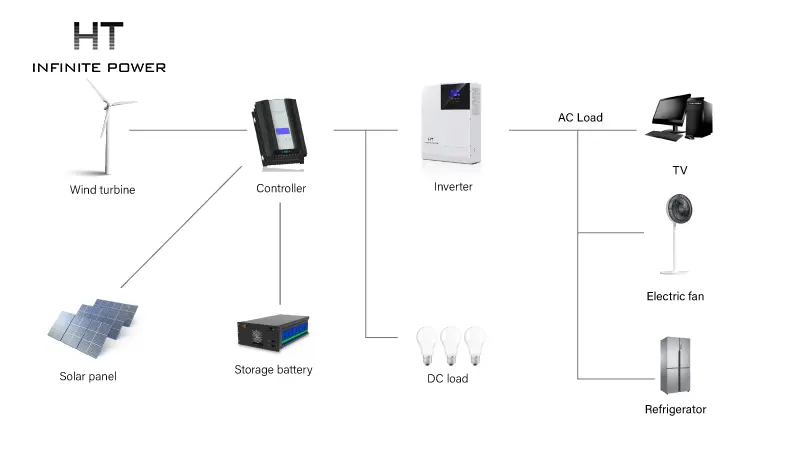
Wind turbines are devices that convert the mechanical energy of wind turbines into electrical energy. Wind turbines are divided into DC generators and AC generators.
(1) DC generator. Electrically excited DC generator.

This type of generator is divided into three types: self-excited, externally excited and compound excited. Small DC power generation systems are generally used in conjunction with batteries, and the device capacity is generally less than 1000 W. Permanent magnet DC generator. Compared with the electrically excited DC generator, this type of generator has a simpler structure. Its output voltage changes with wind speed. It is necessary to add a battery and a control system between the generator and the load, and adjust the output voltage by adjusting the duty cycle of the control system. Since DC generators are complex in structure and expensive, and DC generators are equipped with commutators and rectifiers, once a failure occurs, maintenance is very troublesome. Therefore, this type of wind turbine is rarely used in practical applications.
(2) AC generator.
AC generators are divided into synchronous generators and asynchronous generators. Synchronous generators operate at synchronous speed, which is determined by the number of poles and frequency of the synchronous generator, while asynchronous generators operate at a speed slightly higher than that of synchronous generators. There are mainly brushless claw-pole self-excited generators, rectifier self-excited AC generators, induction generators and permanent magnet generators. Three-phase permanent magnet synchronous generators are mainly used in small wind power generation systems. Three-phase permanent magnet synchronous generators are generally small in size, high in efficiency and cheap in price. The stator structure of the permanent magnet synchronous generator is the same as that of a general synchronous motor, and the rotor adopts a permanent magnet structure. Since there is no excitation winding, no excitation power is consumed, and thus it has a higher efficiency. In addition, since the permanent magnet synchronous generator omits the commutation device and brushes, it has high reliability, relatively small stator iron loss and mechanical loss, and a long service life.
(3) Solar panels
Solar photovoltaic panels mainly convert sunlight energy into electrical energy
(4) Battery
As an energy storage device in the wind solar hybrid system, the battery plays a very important role in the entire power generation system. First, because natural wind and light are unstable, when there is excess wind and light, the excess power of the load is stored. When the wind and light are poor, the energy storage device battery can be used as the power supply for the load; secondly, the battery has a filtering effect, which can make the power generation system output power to the load more smoothly; in addition, wind power generation and photovoltaic power generation are easily affected by climate and environment, and the amount of electricity generated is different at different times, and there are also great differences. As the "hub" between them, the battery can connect them well, and can integrate solar energy and wind energy to achieve the complementary effect between the two.
(5) Wind solar hybrid controller
The wind solar hybrid controller consists of two parts: the main circuit board and the control circuit board.
The main circuit board controls the entire system and is the core of the control. Its peripheral circuits include voltage and current sampling circuits, power tube drive circuits, protection circuits, communication circuits, auxiliary power supply circuits, etc. The main circuit is composed of two buck circuits with independent output terminals connected in parallel, one is the main circuit of the photovoltaic power generation system, and the other is the main circuit of the wind power generation system.
Summary of wind solar hybrid system

Both wind and solar resources are uncertain. Due to the uncertainty of resources, the electricity generated by wind power generation and solar power generation systems is unbalanced and cannot be directly used to power the load. In order to provide a stable power supply to the load, the battery, the "hub", must be used to provide a stable power supply to the load. The intelligent wind solar hybrid system composed of batteries, solar panels, wind turbines and controllers can well connect the complementarity of wind energy and solar energy in time and region.
Introduction to the most comprehensive energy storage solutions
What are sodium-ion batteries and it's advantages
Related Article