Lithium battery knowledge | Why do lithium batteries need blue film?
2025-05-09

The main reason for wrapping the blue film (blue film) on the outside of lithium-ion batteries involves multiple functional requirements and process considerations. The following is a detailed explanation:
1. Insulation protection and anti-short circuit design:
The outer shell of square shell batteries is usually made of metal (such as aluminum alloy). Direct contact may cause short circuits between batteries or external components. The blue film acts as an insulating layer to effectively isolate the metal surface and prevent accidental conduction.

● Enhanced safety:
In scenarios where battery packs are densely arranged, the blue film reduces the risk of short circuits caused by outer shell contact and improves overall safety.
● Insulation between cells:
Prevents the aluminum shell (conductor) from contacting adjacent cells or structural parts during module stacking, causing short circuits; directly affects module safety.
● Shell edge passivation:
There may be burrs on the stamping/welding edges of the aluminum shell, and the blue film coverage can avoid puncturing the adjacent insulation layer. The voltage resistance level can usually withstand voltages above 1000V, matching the requirements of high-voltage battery systems.
2. Anti-corrosion and sealed environmental protection:
The blue film can isolate corrosive environmental factors such as moisture, salt spray, acidic and alkaline substances, delay the oxidation and rust of the metal shell, and extend the battery life.

● Sealing assistance:
Some blue film materials have waterproof and dustproof properties, and cooperate with the battery packaging process to further improve the sealing.
3. Mechanical protection against physical damage:
During transportation, assembly or use, the blue film can reduce the damage to the battery shell caused by scratches and collisions, prevent electrolyte leakage from corroding the shell, and avoid exposure of the internal structure or electrolyte leakage due to shell damage.
● Buffering effect:
Some blue films are elastic and can absorb slight impacts to protect the structural stability of the internal electrodes and diaphragms of the battery.
4. Thermal management assists heat dissipation optimization:
Some blue film materials add thermal conductive particles (such as ceramics and graphite) to help evenly distribute the battery surface temperature and avoid local overheating. The temperature resistance is above 150 degrees Celsius, which can delay the spread of fire in the early stage of thermal runaway. At the same time, dark colors (such as blue) may be more conducive to heat radiation.
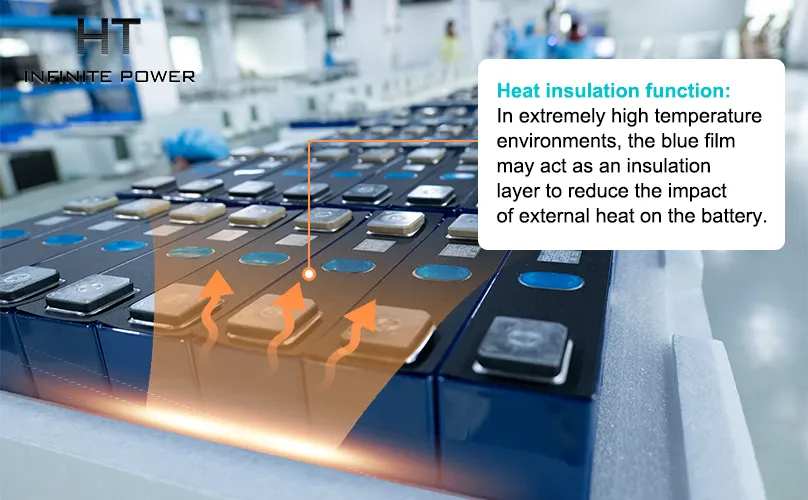
● Heat insulation function:
In extremely high temperature environments, the blue film may act as an insulation layer to reduce the impact of external heat on the battery.
5. Identification and management model distinction:
Blue is often used to identify specific battery models, capacities or voltage levels, which facilitates quick identification during sorting and maintenance on the production line.
● Brand identification:
Manufacturers use unified colors (such as CATL's iconic blue film) to strengthen their brand image and prevent counterfeiting.
● Traceability information:
Some blue films are printed with QR codes or batch numbers, and the color can be combined to quickly trace production data.
6. Process and cost optimization and automated adaptation:
Blue film has high contrast in the visual inspection system, which is convenient for machine vision positioning, detection of coating integrity, and improved production efficiency.
● Material cost:
Insulation film materials such as blue PET (polyester) are mature and low-cost, balancing performance and economic benefits.
7. Flame retardant performance for special functional requirements:
Some blue films are added with flame retardants to delay the spread of fire when exposed to high temperatures, meeting battery safety standards.
● Anti-ultraviolet:
Blue pigments may have better UV resistance, delay film aging, and are suitable for outdoor energy storage scenarios.
Summary

The blue film of square shell battery is not just a simple packaging, but a key component that integrates insulation, protection, thermal management, identification and other functions.
Its color selection (blue) may be due to technical considerations (such as heat dissipation, detection adaptation), or it may be part of the manufacturer's brand strategy.
In actual applications, the specific characteristics of the blue film will vary depending on the battery purpose (such as power battery, energy storage battery) and manufacturer design.
Integrated and Split Energy Storage Systems Explained and Compared
How to choose a suitable installation location for industrial and commercial energy storage systems?