What Qualifies as "Smart" Energy Storage?
2026-03-11
What actually makes an energy storage system “smart”?
From an asset perspective, the answer is surprisingly simple. There is only one meaningful benchmark:
Over a 20-year operating life, can it convert volatile electricity prices and inevitable asset degradation into predictable, verifiable, and financeable returns?
Over a 20-year operating life, can it convert volatile electricity prices and inevitable asset degradation into predictable, verifiable, and financeable returns?
If it cannot do that, it may be technologically advanced—but it is not truly smart.
In Europe and the United States, where electricity markets are more mature and revenue stacking mechanisms are better established, this question has already moved beyond theory. The industry has accumulated practical experience in optimizing storage performance not just technically, but financially.
One of the more insightful recent contributions comes from Fluence, the second-largest energy storage integrator in the United States with an order backlog of $5.3 billion. In its report, Why Smart Storage Is Smart Business, the company reframes the discussion around internal rate of return (IRR), examining how operational strategy, market participation, and system optimization directly influence long-term asset value.
The report was further interpreted by a globally recognized expert in power markets and virtual power plants, who analyzed developments in Germany, the United States, and the United Kingdom before turning to a more fundamental question for China’s market:
How does energy storage evolve from a piece of equipment into a high-quality infrastructure asset?
It is a discussion worth careful reading for anyone working in the storage industry.
Within the industry, conversations about “smarter storage” often resemble a semantic exercise.
Some equate it with a more expensive energy management system (EMS).
Others associate it with more advanced battery cells.
Still others treat it as shorthand for “making more money,” without clearly articulating the mechanism behind it.
Others associate it with more advanced battery cells.
Still others treat it as shorthand for “making more money,” without clearly articulating the mechanism behind it.
But if we strip storage back to first principles—as an investment—and then reduce that investment to what it ultimately represents—a long-term cash-flow engine—the definition of “smart” becomes much stricter.
Smart storage is storage that reduces uncertainty.
More precisely, it is storage capable of transforming uncertain cash flows into revenue streams that are more predictable, more measurable, and more bankable.
This is why Why Smart Storage Is Smart Business deserves close attention. By framing the conversation through IRR, it connects the critical variables that determine whether storage behaves merely as hardware—or as infrastructure-grade capital.
Where does revenue originate?
Where does it leak?
Why does it leak?
What mechanisms can prevent that leakage?
And why can even a one- or two-percentage-point difference in IRR compound into a structural gap over a twenty-year project lifecycle?
Viewed through this lens, “smart” is no longer a marketing label.
It becomes a measurable attribute of asset performance.
1. Finally, a Clear Answer to What Makes Storage “Smart”
The opening line of Fluence’s report goes straight to the core question:
Why do people build energy storage projects?
The most direct answer is simple: to generate returns.
The most direct answer is simple: to generate returns.
In Fluence’s framing, storage is first and foremost a financial asset—and only secondarily an electrochemical system.
What determines those returns is not a single moment of peak performance. It is whether the system can continue to deliver stable, auditable, and financeable long-term cash flows in a dynamic market—where revenue structures shift, asset performance gradually degrades, and market rules continue to evolve.
In other words, investors are not asking whether the system can operate today. They are asking whether, ten, twenty, or even thirty years from now, it can deliver cash flow with the same reliability as a utility bill.
(1). Revenue Is Not a Line — It Is a Stack
The report makes this point explicit by categorizing storage revenues into three primary streams:
- Energy arbitrage — charging when prices are low and discharging when prices are high
- Ancillary services — fast-response services such as frequency regulation and reserves
- Capacity or reliability mechanisms — compensation for guaranteed availability during peak demand periods
Rather than treating revenue as a single continuous curve, the report emphasizes that storage earnings are built from a layered “revenue stack,” each layer governed by different market dynamics and risk profiles.
Using a 2024 example from the CAISO SP15 node in California, the report provides a particularly clear visual illustration: revenue composition fluctuates significantly across time, and reliance on a single income source exposes the asset to structural volatility.
The implication is straightforward.
If storage is to be considered “smart,” it must not only access multiple revenue streams—it must dynamically optimize across them as market conditions change.
If storage is to be considered “smart,” it must not only access multiple revenue streams—it must dynamically optimize across them as market conditions change.
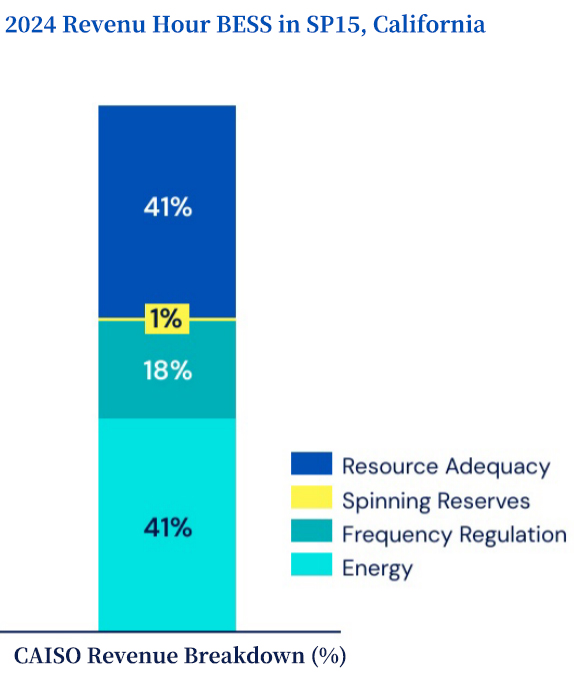
For a four-hour battery system, annual revenue is far from being driven purely by price spreads. In the example cited, Resource Adequacy and energy shifting each account for roughly 41% of total annual revenue, frequency regulation contributes about 18%, and spinning reserves represent approximately 1%.
The significance of these figures does not lie in whether they represent every project, nor in which category appears most attractive. Their real value is that they dismantle a common misconception.
In a mature market with diversified mechanisms, storage returns resemble a portfolio—not a single bet. No one strategy needs to dominate entirely. In fact, diversification across revenue streams is precisely what allows storage assets to manage uncertainty more effectively.
A smart storage system, therefore, is not one that excels at one isolated function, but one that can continuously optimize across multiple value streams as market conditions evolve.
(2) IRR Is the Ultimate KPI — and It Is Highly Sensitive to Small Losses
The report repeatedly underscores a critical point: capturing revenue in the present is only half of the equation.
The true measure of success is whether a project can reliably deliver value over decades. That is why internal rate of return (IRR) becomes the ultimate benchmark.
And IRR is extraordinarily sensitive to small inefficiencies.
Minor performance losses, marginal forecasting errors, incremental downtime, suboptimal dispatch decisions—each may seem insignificant in isolation. But compounded over a 20-year lifecycle, even a one- or two-percentage-point deviation in IRR can create a material gap in project value.
This is where the definition of “smart” shifts from hardware capability to operational intelligence.
Because in long-duration infrastructure assets, the difference between average and optimized performance is not marginal—it is structural.
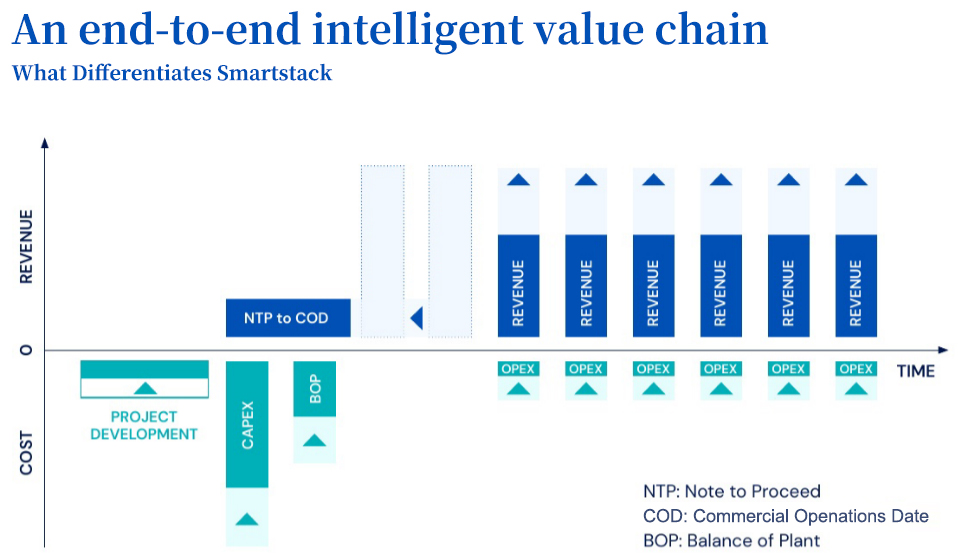
Yet the sensitivity of IRR to long-term performance is often underestimated—especially from an engineering perspective.
A one- or two-percentage-point drop in availability.
A similar reduction in dispatchable energy.
Or small but persistent state-of-charge (SOC) inaccuracies that force operators to hold conservative buffers and undersell capacity.
Individually, these deviations may appear minor. Over the lifespan of an asset, however, they compound. What seems negligible in a single year can accumulate into a material erosion of value—eventually widening into a financing gap that lenders and investors cannot ignore.
This is the uncomfortable truth: IRR magnifies small inefficiencies.
(3). Where Does the Money Leak?
The report dissects what it calls the “hidden IRR killers” with striking clarity—and a certain degree of severity.
The most typical categories include:
The most typical categories include:
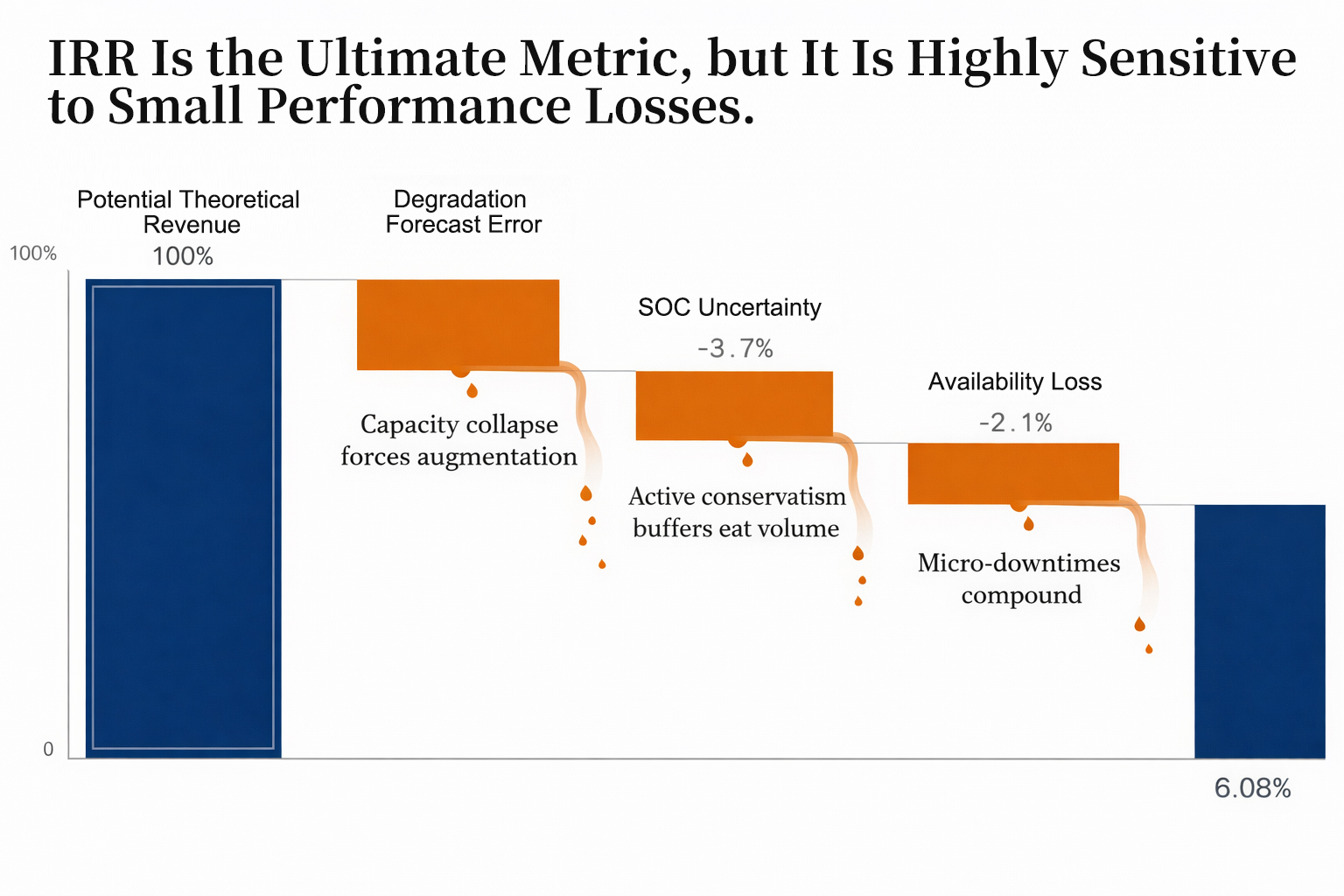
Degradation Forecast Errors
Battery cells do not age uniformly, and long-term degradation under real operating conditions is inherently difficult to predict. When forecasts prove inaccurate, revenue assumptions can unravel as capacity declines faster than expected. In some cases, this forces early augmentation or strategy adjustments—both of which directly affect projected returns.
SOC Uncertainty and “Active Conservatism”
State of charge (SOC) is derived from voltage and current measurements—both subject to error. To avoid market penalties or underperformance risks, operators often maintain conservative buffers. The result is systematic underutilization: dispatchable energy and trading opportunities are consistently left on the table. In effect, revenue is sacrificed not by the market, but by precaution.
Availability and Deliverable Power Losses
Minor outages, recalibrations, dispatch errors, or small periods of reduced power capability can result in revenue losses during critical market windows. Individually, these incidents appear trivial. Collectively, they accumulate.
Each of these losses may seem marginal in isolation. Over a twenty-year asset life, however, they compound—quietly and persistently eroding cash flow.
(4) “Smart” Is Not an AI Label — It Is an Engineering Closed Loop: Sense, Predict, Protect
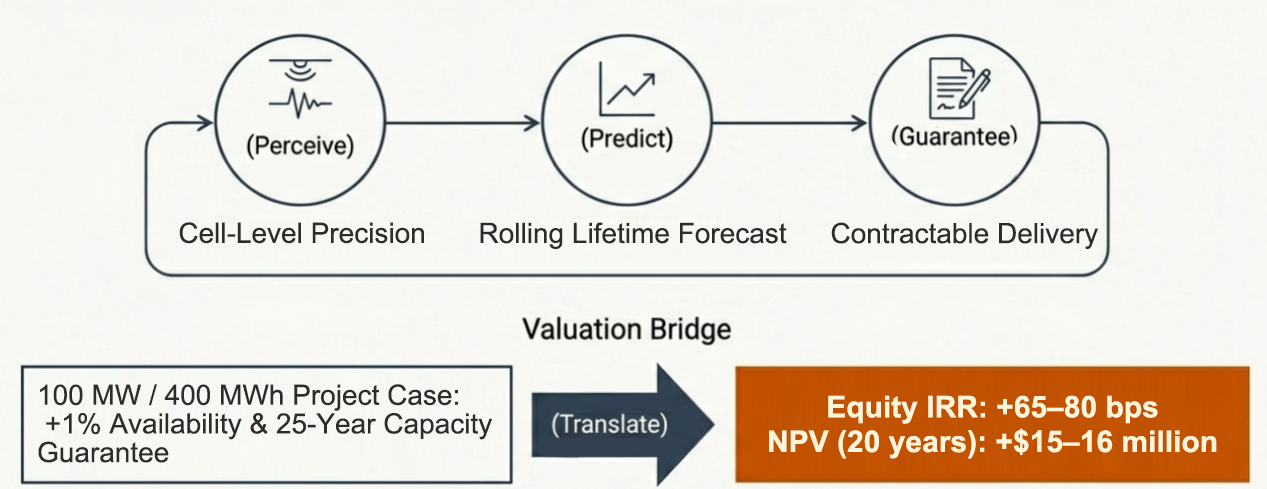
The report’s proposed solution is not centered on buzzwords. It rests on a structured, engineering-driven feedback loop built around three capabilities:
-
More precise sensing — tightening error margins in SOC, availability, efficiency, temperature, and other operating parameters
- More interpretable forecasting — turning degradation trends, availability projections, and maintenance windows into rolling, data-driven predictions
- More enforceable guarantees — converting performance metrics into contractually deliverable commitments
A concrete example is Fluence’s Smartstack framework, supported by its asset performance management platform, Nispera. The platform claims to leverage a global dataset exceeding 11 GWh of deployed storage assets to model degradation behavior. The objective is to shift operations from reactive maintenance—fixing assets after failure—to predictive maintenance combined with structured augmentation planning.
The real significance of such capability is not in the terminology. It lies in transforming degradation risk from something opaque and difficult to quantify into something that can be modeled, managed, and integrated into long-term asset planning.
(5) Translating “Technical Improvement” into Financial Language: Performance Guarantees as IRR Basis Points
One of the most insightful sections of the report is its direct translation of performance guarantees into incremental IRR gains.
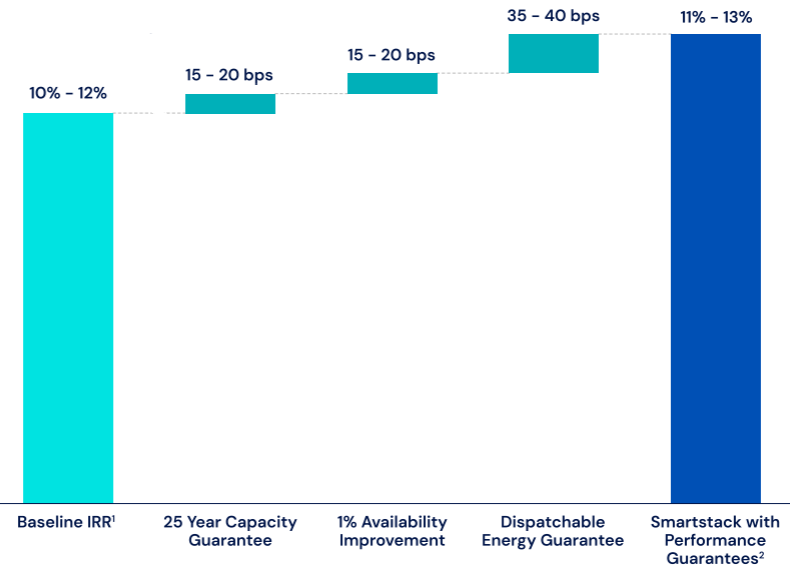
To illustrate, the report models a 100 MW / 400 MWh (four-hour) project.
Under baseline assumptions, the equity IRR is approximately 10%–12%. When layered with a 25-year capacity guarantee, a one-percentage-point improvement in availability, and a Dispatchable Energy Guarantee, projected equity IRR increases by roughly 65–80 basis points.
In relative terms, this represents an uplift of approximately 6%–8% over the baseline return. Over a 20-year horizon, that translates into an incremental net present value (NPV) on the order of $15–16 million.
The key takeaway is not whether one fully agrees with the exact figures.
It is the methodology.
The report demonstrates how “smart” capabilities can be translated into auditable, contractable, and monetizable inputs within a financing model. Instead of treating performance optimization as a technical upgrade, it reframes it as a financial variable—one that can be priced, underwritten, and reflected directly in IRR.
That is the moment when intelligence moves from marketing language into capital markets language.
If storage is treated as an asset rather than merely a piece of equipment, then “smart” does not mean “faster.”
It means “more precise in delivery.”
Precise delivery of availability.
Precise delivery of capacity retention.
Precise delivery of efficiency.
More importantly, it means delivering the required energy, at the required power level, exactly when it is needed—with certainty.
And once certainty becomes contractable, the issue shifts from engineering to finance. Ultimately, it returns to IRR as the common language through which performance is valued.
2. How the U.S., the U.K., and Germany Make Energy Storage “Smart”
When Fluence’s logic is placed in the context of real markets, the common ground between the U.S., the U.K., and Germany is not found in regulatory details, but in a shared underlying rule.
The more mature the market becomes, the more crowded simple price-spread arbitrage becomes. Returns gradually shift from “who enters first” to “who operates better.”
And in that sense, operational skill is much like driving: the most valuable capability is not speed, but an understanding of risks and constraints.
The real test is whether operators can keep the battery running steadily along a narrow path—
balancing penalties, availability requirements, asset lifetime, grid constraints, and constantly changing service prices—
so that the system neither fails nor sits idle, even as market conditions become more complex.
balancing penalties, availability requirements, asset lifetime, grid constraints, and constantly changing service prices—
so that the system neither fails nor sits idle, even as market conditions become more complex.
(1).United States: When Revenue Becomes Unstable, Strategy Becomes the Primary Productivity Driver
In the United States, the phrase “free market” often creates the illusion of simplicity.
The reality is closer to this:
The freer the market, the stricter the settlement.
The freer the market, the stricter the settlement.
Take California’s California Independent System Operator (CAISO). It is particularly suitable for discussing stacked value because it has unbundled capacity/reliability, energy, and ancillary services into clearly settled products.
This structure means that intelligence is not just about forecasting price. It is about forecasting—and fulfilling—an entire portfolio of obligations and constraints:
- Do you have sufficient state of charge when called?
- Can you respond at full power?
- Can you maintain performance metrics and pass settlement audits?
In that environment, “smart” means first avoiding penalties, and only then capturing upside. It is about not losing points before trying to gain extra ones.
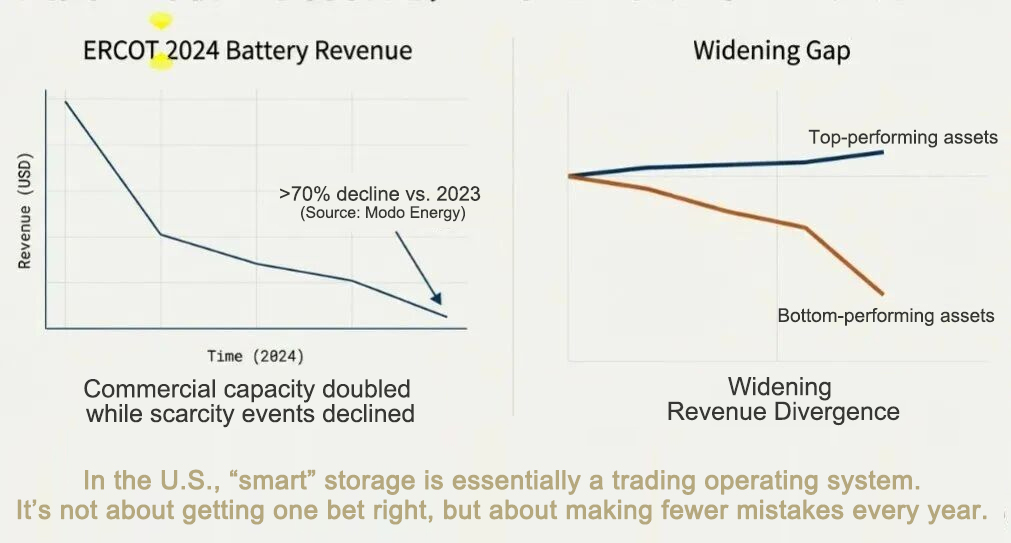
Texas offers a more exposed version of the same dynamic. In Electric Reliability Council of Texas (ERCOT), rapid capacity expansion and intensifying competition have led to revenue compression within remarkably short timeframes.
According to analysis from Modo Energy, battery storage revenues in ERCOT in 2024 declined by more than 70% compared to 2023, even as installed battery capacity continued its third consecutive year of near-doubling growth. Post-market reviews by Tyba Energy similarly point out that revenue declines were driven by shrinking ancillary service opportunities and fewer scarcity events, while the performance gap between top-quartile and median assets widened.
In other words, the market did not stop being profitable. It simply began behaving like a mature industry.
You can take the same battery and produce entirely different cash flows—depending on forecasting accuracy, bidding discipline, and dispatch precision.
In this context, being “smart” in the U.S. resembles a replicable trading operating system:
- Day-ahead and real-time price forecasting
- Volatility modeling
- Ancillary service price prediction
- Constraint-aware optimal charge/discharge scheduling
- Bid optimization
- Settlement reconciliation and penalty minimization
Its core is not about winning a single price spike.
It is about making fewer mistakes every day—because fewer mistakes, compounded over twenty years, become material financial outcomes.
(2).United Kingdom: When Services Evolve Rapidly, “Portfolio Optimization” Becomes the Only Long-Term Strategy
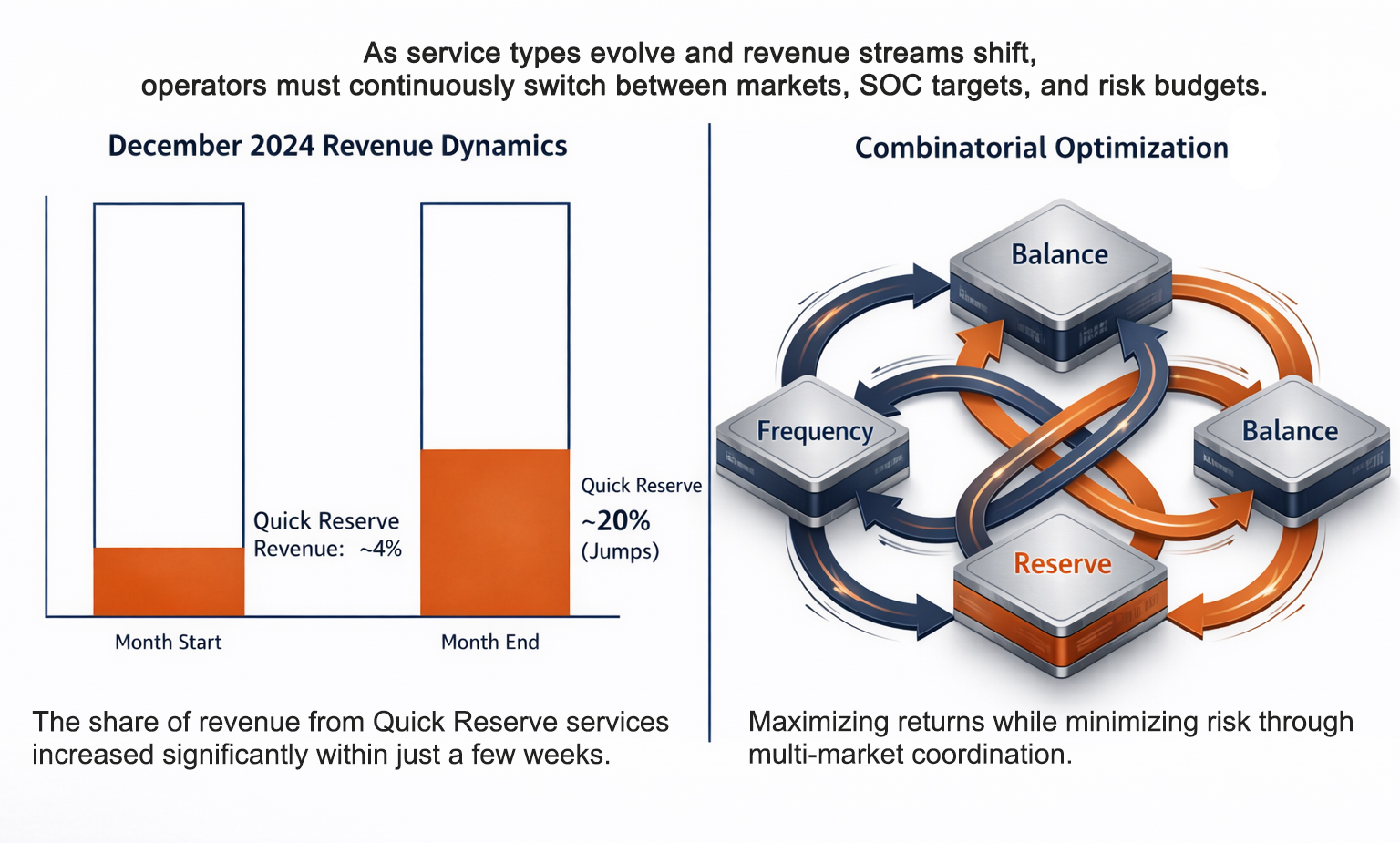
The UK energy storage market is characterized by rapid service turnover, long settlement chains, and clearly shifting revenue structures.
An analysis from Cornwall Insight published in March 2025 highlighted that since December 2024, UK BESS revenues experienced significant growth. This was primarily driven by Quick Reserve—a grid stability reserve service—whose revenue share increased to around 20%, compared with only about 4% at the beginning of December.
Industry reports also indicate that batteries dominated Quick Reserve bidding, temporarily boosting asset returns during this phase.
However, the lesson from the UK market is not about the windfall from any single new service, but the norm that follows:
As frequency response and other ancillary services become crowded, and as balancing mechanisms and wholesale market opportunities fluctuate with seasonal and policy changes, operators must practice portfolio optimization:
- Switching dispatch across multiple markets
- Adjusting state-of-charge (SOC) targets
- Rebalancing risk budgets
…all while documenting each decision in an auditable, explainable settlement review.
Without this disciplined approach, it is impossible to demonstrate to financiers that success is driven by skill, not luck.
(3).Germany: When Rules Are Clear and Capital Is Hot, “Grid Connection and Compliance” Become the First Moat
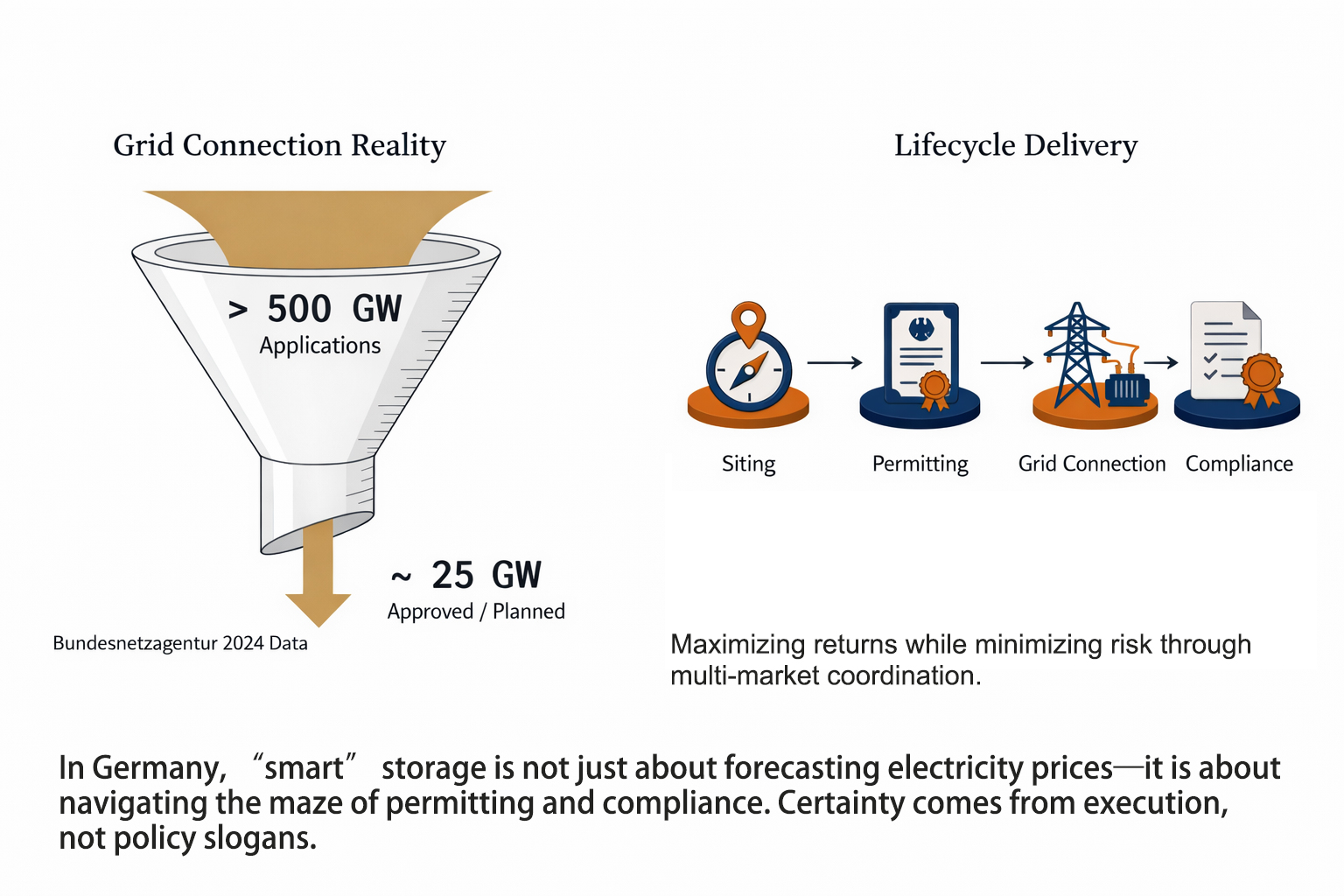
Germany’s story serves as a mirror: when market expectations stabilize, capital rushes first to grid connection applications.
The Bundesnetzagentur disclosed in November 2025 that in 2024, there were 9,710 applications for grid connection of battery storage at medium voltage and above, covering a planned capacity of roughly 400 GW and storage capacity of 661 GWh. That same year, about 25 GW / 46 GWh of projects were officially approved.
Meanwhile, multiple media and industry platforms reported that Germany’s large-scale battery storage connection requests exceeded 500 GW, attributing this surge to the “first-come, first-served” connection rules.
As a result, many projects treated the queue itself as an option to secure a slot, rather than all projects being immediately realizable.
For Chinese industry observers, the key takeaway is not that Germany is “hot,” but how that heat manifests.
- First, through the grid connection and permitting chain: hundreds of GW in queued applications face hard constraints from grid engineering, connection processes, and approval capacity.
- This demonstrates that in Germany, making storage “smart” is less about perfecting price forecasts and more about making the entire project chain—from site selection, permitting, grid connection, system services, to settlement compliance—truly deliverable.
German policy is also experimenting with ways to loosen “deliverable” bottlenecks:
- In 2025, the German parliament pushed legal revisions to grant more convenient planning status to batteries, thermal storage, and hydrogen storage in non-urban areas (commonly referred to in the industry as “privileged/prioritized” planning support), aiming to simplify site selection, approvals, and accelerate deployment.
At the same time, legal and regulatory discussions show a dual character of support and calibration:
- For example, some legal interpretations note that the “privileged” provisions were quickly revised, reflecting ongoing calibration between public interest, land use conflicts, and grid capacity.
For investors, this “support with calibration” is not a drawback; it is a reminder that true certainty comes not from slogans, but from rules that are enforceable, sustainable, and auditable.
(4).From Uncertainty to Certainty: Turning the Smart IRR Framework into a Practical Methodology
Synthesizing experiences from Germany, the U.S., and the U.K., the so-called “certainty-from-uncertainty model” doesn’t need to start as a research paper.
Instead, it’s a common language that both investment committees and financing teams can understand. The key is not model complexity, but consistency in assumptions, clarity of constraints, and visibility of tail risks.
A practical Smart IRR methodology can be structured as follows:
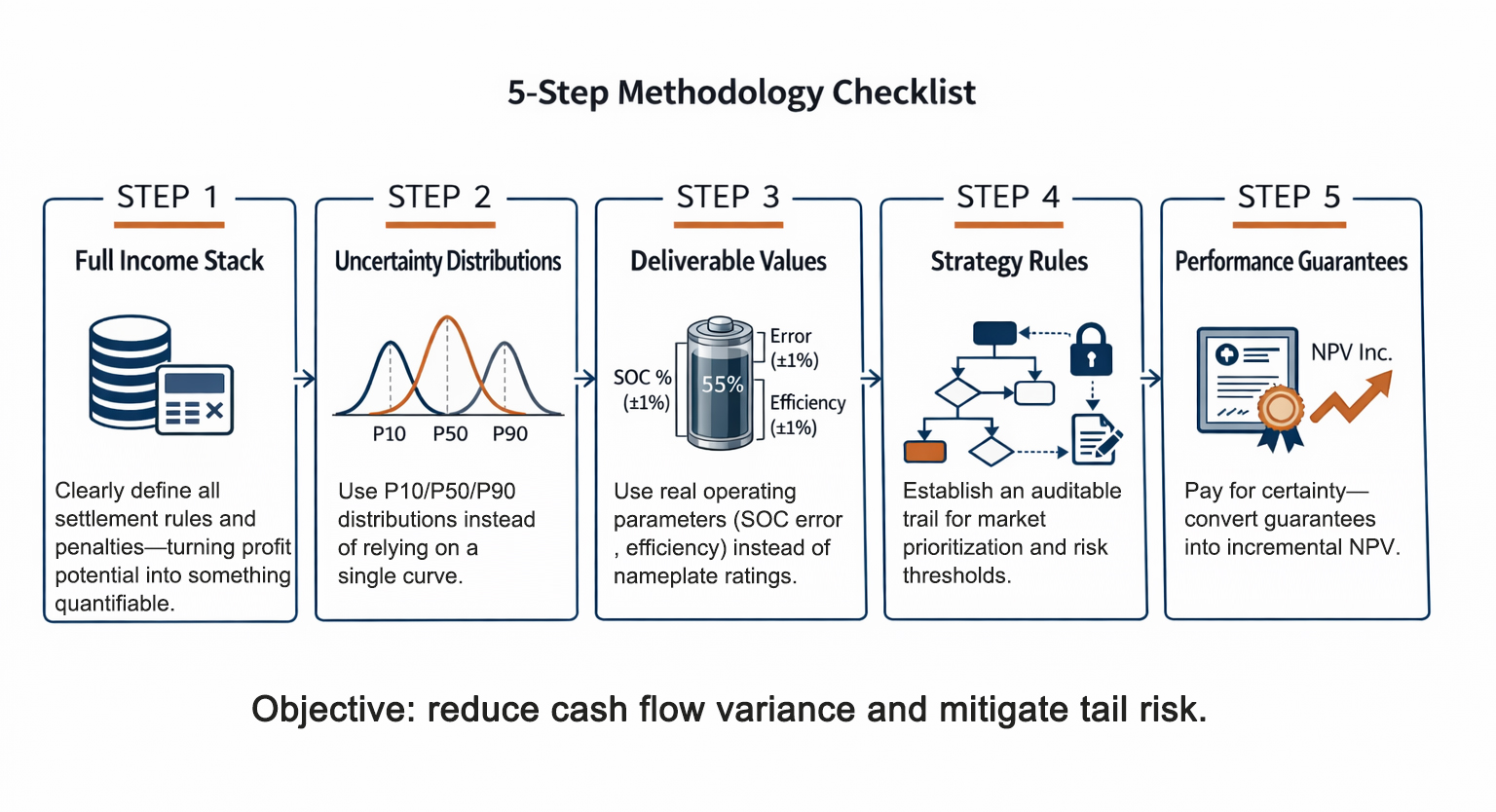
Fully map the revenue stack
- List energy arbitrage, ancillary services, capacity/reliability payments, and contractual/grid services. Clearly specify settlement rules and penalties so that “potential revenue” becomes “calculable revenue.”
Express uncertainty as distributions
- Use P10/P50/P90 or scenario trees for price projections instead of a single deterministic curve. Apply the same approach to call frequency, duration, and service prices.
Translate equipment into “deliverable value”
- Include SOC deviations, availability, efficiency, capacity retention, temperature management, and grid constraints in the model. Avoid self-deception by relying solely on nameplate ratings.
Codify strategy into a “replayable rule set”
- Market prioritization, SOC targets, risk thresholds, stop-loss logic, and maintenance windows must be verifiable against actual settlement results.
Convert guarantees into “bp purchases”
- Availability, capacity retention, and dispatchable energy guarantees are expressed as IRR basis point gains and NPV increments, creating a pricing language of “paying for certainty.”
Operate as a closed loop
- Establish a rolling cycle of forecast → execution → settlement → learning, updating the model as market conditions and asset status change, rather than treating it as a one-off exercise.
Once this framework is in place, “smart” is no longer an attitude—it becomes a statistical measure of cash flow convergence.
- Given the same market volatility, a smart asset reduces cash flow variance, mitigates tail risk, and lowers financing costs, all of which feed back to investors in the form of IRR.
- When constantly asking “who can guarantee minimum performance in storage operations,” that minimum is gradually adjusted for constraints and layered risk until even low-probability events are captured in the equations, making guarantees enforceable without overlap or compounding uncertainty.
3.China’s Fundamental Challenge
Under China’s mechanism-based electricity pricing and spot market volatility, how should storage returns actually be calculated—and more importantly, how should they be applied?
Shifting the lens to China, the challenge isn’t “whether opportunities exist,” but rather “can these opportunities be properly quantified?”
Mechanism-based tariffs, spot market pilots with continuous operation, ancillary service expansion, time-of-use retail, and province-level variations together form a dynamic chessboard.
Investors hesitate not because they doubt the systemic value of storage, but because rules are still in flux before cash flows are even written into Excel. When rules move, it’s often confidence, not revenue, that shifts first.
Therefore, when discussing storage investment returns in China, the question must be framed both financially and technically:
- Not “Will electricity prices rise next year?”
- But “Within the distribution of prices, can my debt remain secure? Within evolving regulations, can my revenue stack migrate accordingly? Within equipment degradation, can my deliverable energy remain stable?”
Once the problem is reframed this way, many so-called “uncertainties” are not incalculable—they simply lack a consistent arithmetic framework.
(1).Layering Revenue: Certainty, Semi-Certainty, Uncertainty
To guide rational investment decisions, the first step is to categorize revenue into three layers:
- Certainty – Contracted or mechanism-backed revenue; value is financeable.
- Semi-Certainty – Rule-stable but price-volatile revenue; value is predictable.
- Uncertainty – Spot market, congestion, or other opportunistic revenue; value is captured as upside optionality.
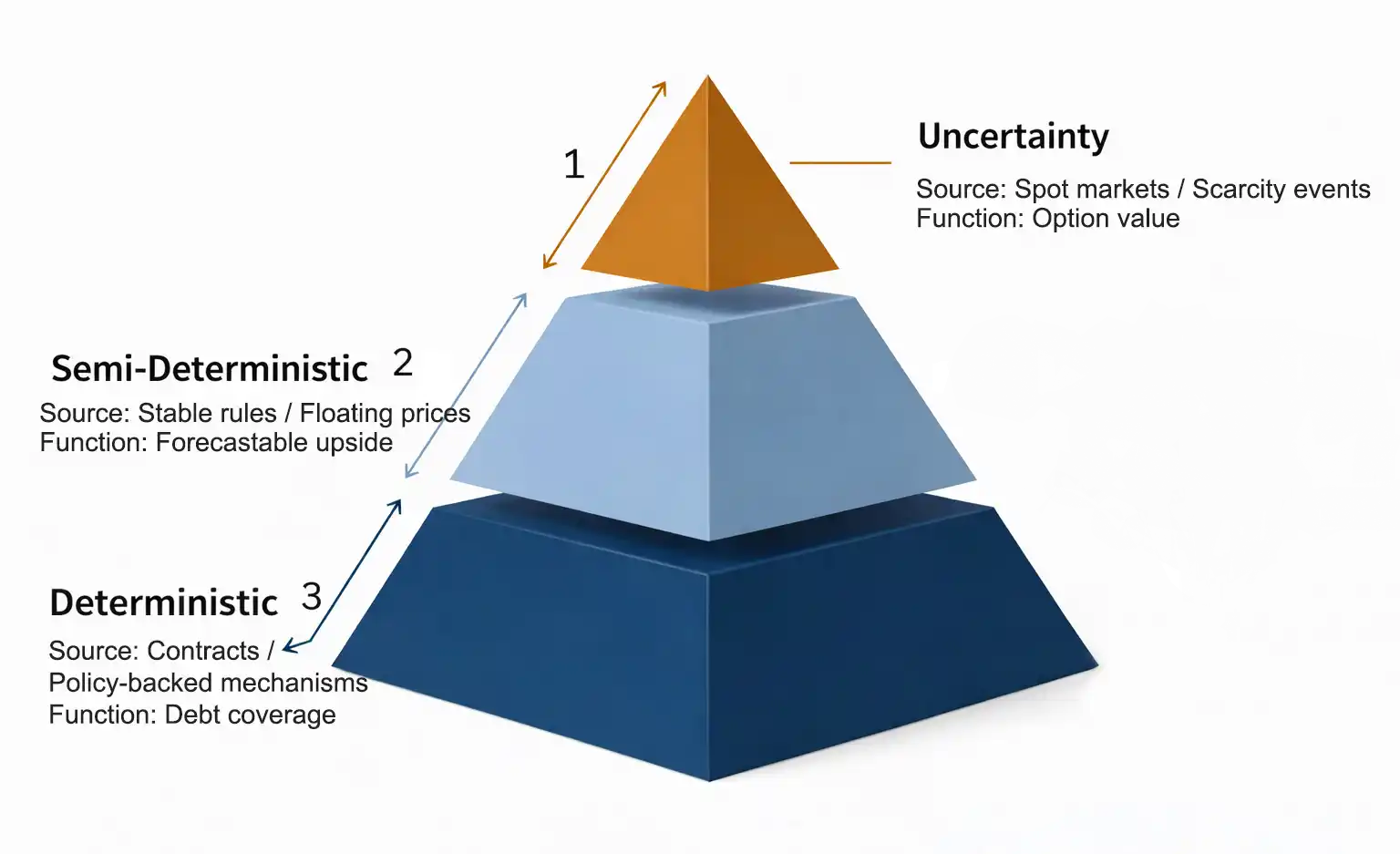
A truly sustainable structure relies on certainty to cover debt service, semi-certainty to deliver predictable incremental value, and uncertainty only as upside—not by “betting on a few favorable market events.”
(2). Translating ‘Uncertainty’ in Market Mechanisms into Computable Boundary Conditions
The challenge of the Chinese market is not complexity per se, but regional differences and evolving rules.
Rather than chasing a perfect nationwide model, it is more practical to build transferable, parameterized templates:
- Policy boundaries – price caps and floors, settlement cycles, deviation penalties, grid connection and dispatch constraints, eligibility for ancillary services.
- Market characteristics – peak-valley spreads, price volatility, frequency of scarcity events, correlation between load and renewable output.
- Asset characteristics – efficiency, thermal control, availability, degradation, and potential for capacity expansion.
By clearly defining these three parameter sets and aligning them with the revenue stack, one can derive ranges that are “uncertain but computable”: whether P90 revenue covers debt, whether P50 revenue supports acceptable IRR, and what contracts or hedges are needed at P10 to protect downside.
(3).Upgrading from “Can Charge/Discharge” to “Can Settle”: The Core Action for Maximizing Storage Value
Many projects underperform not because the batteries cannot charge or discharge, but because the operations team fails to close the loop between dispatch actions and settlement results.
A beautifully designed plan can be eaten away by deviation penalties; aggressive bidding strategies may be undermined by SOC errors that force excessive safety margins; frequent wins in ancillary services can still fall short if minor availability drops occur during critical windows.
The key lever to fully unlock storage value is surprisingly simple:
Let settlement results drive strategy. Track every dispatch, bid, deviation, and downtime with traceable revenue attribution, so you know exactly where money is leaking in the chain.
When these leakage points are systematically addressed and engineered out, “smart” storage finally becomes tangible.
The ultimate winners will reveal a clear truth:
A “smart asset” is not about sticking AI onto a battery; it’s about translating every technical detail into financial certainty within an uncertain market.
Once that certainty is auditable, contractible, and monetizable, financing costs decrease, investment boundaries expand, and true market-based operational capabilities are honed through each settlement cycle.
(4).From “Running Batteries” to “Assets That Deliver Cash Flow”
At this point, we return to a deceptively simple yet revolutionary assertion: energy storage is a financial asset.
Its significance lies in shifting industry discussions from “prettier technical specs” to “more predictable cash flows”, and transforming “smart” from a marketing term into verifiable engineering and contractual reality.
The shared lessons from Germany, the US, and the UK are clear:
As markets mature, volatility doesn’t disappear—it just manifests differently. Revenue doesn’t vanish—it shifts from averages to layered structures. Average returns may decline, but disparities between percentiles widen, embedding operational capability directly into asset returns.
- Germany’s grid-connection surge shows that interconnection rights themselves can become financial options.
- The UK’s rapid service rotation demonstrates that portfolio optimization must outpace regulatory changes.
- The US revenue downturn underscores that strategy and execution determine which percentile of returns an asset lands in.
China’s opportunity lies in being at a stage of “rules and installed capacity growing together.”
Rising renewable penetration creates a widening flexibility gap, while improvements in spot markets and ancillary services gradually convert system value into settleable price signals.
For investors, the real question is not predicting next year’s electricity price, but structuring a certainty-from-uncertainty model that translates the revenue stack into a financeable range.
For the industry, competition is no longer about “whose battery is cheapest,” but who can first close the loop between strategy, equipment, settlement, and risk management.
Because in the power markets of the next decade, cheapness is just the entry ticket—smartness drives compounding returns.
In a broader context, we shouldn’t forget that China is the only country with annual electricity consumption exceeding 10 trillion kWh.
Among this year’s unexpected incremental demand, driven by the tertiary sector and residential side, 48% comes from charging/swapping and 17% from software-driven data centers—numbers that are striking not merely as industry growth, but as “load rewrites” in the energy transition.
This means regulation resources must be monetized faster: peak-valley spreads widen, extreme peaks sharpen, and administrative scheduling alone will no longer suffice.
It is imperative to turn flexibility into measurable, tradable, and settleable “marketized capabilities” through ancillary services, demand response, virtual power plants, and energy storage.
High-Voltage Direct-Connected PCS in Battery Energy Storage Systems
What Is MVDC (Medium-Voltage DC) and Where Is It Used?