What is the Difference Between kW and kWh?
2025-07-23
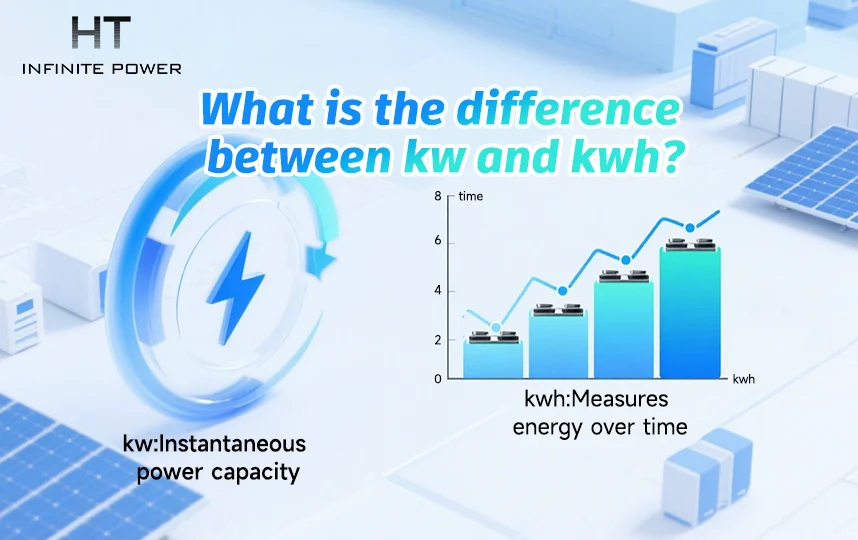
Selecting the right specifications for an industrial or commercial energy storage system hinges on understanding two foundational terms: kilowatts (kW) and kilowatt hours (kWh). Although these units appear similar, they represent distinct concepts—the former denotes instantaneous power capacity, while the latter measures energy over time. Misinterpreting these can lead to undersized inverters, insufficient backup duration, and unnecessary costs.
Common household items and their approximate kW ratings include:
- A microwave oven: about 1 kW
- A small air conditioner: 1.5 kW to 2 kW
- An electric kettle: roughly 2 kW
In industrial and commercial settings, power demands can be much higher. For instance, a large factory motor might be rated at 500 kW or more, representing a huge flow of electrical energy to keep heavy machinery running.
Understanding kW is critical for sizing energy storage systems, especially in commercial battery storage containers, where inverters must handle the peak power demands of connected equipment.
1.What is a kilowatt-hour (kWh)?
A kilowatt-hour, abbreviated as kWh, measures energy, not power. It represents the total amount of electricity used or produced over a period of time.
If you run a 1 kW appliance for one hour, you consume 1 kWh of energy. So, while kW is like the water pipe size, kWh is the volume of water that has actually passed through the pipe.
Energy companies charge consumers based on kWh because it reflects how much electricity you have actually used. For example:
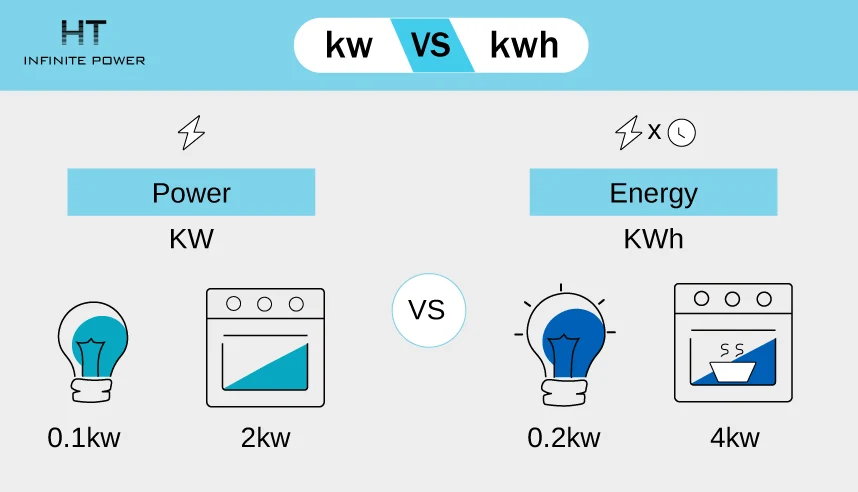
- Running a 100-watt light bulb for 10 hours = 1 kWh (0.1 kW × 10 hours)
- Charging an electric vehicle for 4 hours at 7 kW = 28 kWh
In commercial energy storage systems, kWh is the capacity of the battery bank — how much total energy it can store and supply before needing a recharge.

2.Key differences between kW and kWh explained
Many people confuse kW and kWh, but here’s the simple distinction:
- kW (kilowatt) measures how fast electricity flows — power at a given moment.
- kWh (kilowatt-hour) measures how much electricity is used or stored over time — energy quantity.
Think of it like driving a car:
- kW = speed (miles per hour)
- kWh = distance traveled (miles)
You might drive at 60 mph (kW) but the total miles (kWh) depends on how long you keep driving.
In battery storage, you need to know both:
In battery storage, you need to know both:
How many kW the system can deliver at once (important for running heavy equipment)
How many kWh it can store (important for how long it can keep running)
How many kWh it can store (important for how long it can keep running)
3. Why your electricity bill shows kWh, not kW
Utility bills charge you for energy consumption — total kWh used — not power. That’s because power fluctuates second by second, but billing is based on cumulative usage.
Even if you have a 3 kW solar system, what you pay for is how many kWh it generates over a month.
However, in commercial settings, some utilities also charge demand charges based on peak kW usage — the highest power you draw in a short period. This makes understanding both units crucial for cost savings.
4. How to convert kW to kWh – formulas and examples
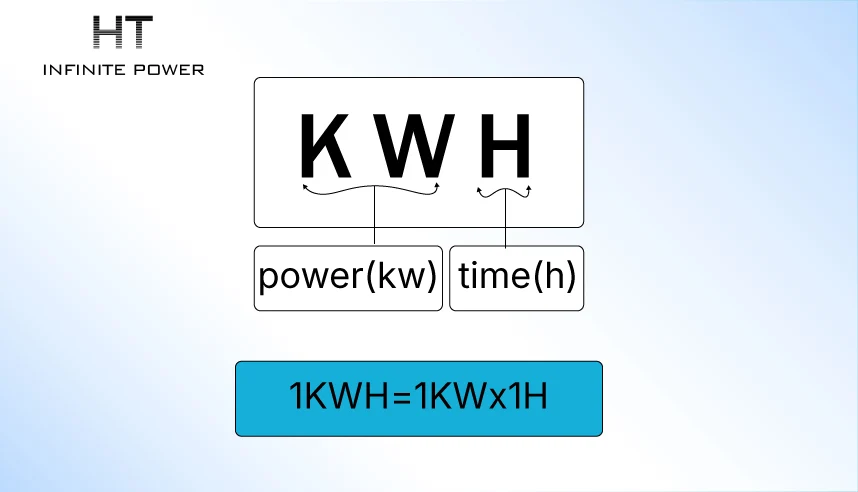
Converting between kW and kWh is straightforward:
kWh=kW×hours
Example:
A 5 kW battery inverter running for 3 hours delivers:
5 kW × 3 hours = 15 kWh of energy.
Reverse calculation:
If you need 30 kWh of energy and plan to run it for 6 hours, the required power is:
kW= hours/kWh = 6/30 =5 kW
5. How many kWh are in 1 MW?
Understanding how many kilowatt-hours (kWh) are in a megawatt (MW) is crucial when dealing with large-scale energy systems like commercial battery storage containers or solar farms.
- 1 MW equals 1,000 kW
- To convert MW to MWh (megawatt-hours), multiply by the number of hours: MWh=MW×hours
Since 1 MWh = 1,000 kWh, the conversion chain is:
1 MW×1 hour=1 MWh=1,000 kWh
1 MW×1 hour=1 MWh=1,000 kWh
So, running a 1 MW system for 1 hour delivers 1,000 kWh of energy.
Example:
A 5 MW commercial solar installation producing power for 6 hours a day will generate:
5 MW×6 hours=30 MWh=30,000 kWh
5 MW×6 hours=30 MWh=30,000 kWh
This figure is important when sizing commercial energy storage systems to store excess energy during the day and discharge at peak demand.
6. How many kW does a typical household use?
Household power demand varies by region, season, and appliance use, but here’s a rough idea of typical power (kW) ratings:
- Air conditioning unit: 2–5 kW
- Electric oven: 3–5 kW
- Refrigerator: 0.1–0.4 kW (running continuously but cycling on/off)
- Lighting (LED bulbs): 0.01–0.02 kW each
- Washing machine: 0.5–2 kW

Peak power demand for an average household is usually around 3 to 7 kW. This number helps when selecting an inverter or battery storage system that can support instantaneous loads.
7. How many kWh does an average home consume daily?
Average energy consumption depends on climate, appliances, and lifestyle but typically falls between:
- 20–30 kWh per day for a small to medium household
- Up to 40–50 kWh for larger homes with HVAC and electric vehicles
Knowing daily kWh consumption is essential for sizing home solar energy systems and residential battery storage packs.
8. How to calculate energy usage for commercial buildings
Commercial buildings have higher and more complex power demands:
- Office buildings: typically 15–50 kW peak demand per 1,000 sq ft
- Retail stores: 5–20 kW peak demand per 1,000 sq ft
- Warehouses: 3–10 kW peak demand per 1,000 sq ft
To estimate energy usage (kWh):
kWh=Average kW load×operating hours
Example:
A 20,000 sq ft retail store with 10 kW per 1,000 sq ft load over 10 hours:
(20×10) kW×10 hours=2,000 kWh/day
This guides battery system capacity choices.
Example:
A 20,000 sq ft retail store with 10 kW per 1,000 sq ft load over 10 hours:
(20×10) kW×10 hours=2,000 kWh/day
This guides battery system capacity choices.

9. What affects kW and kWh measurements in solar energy systems?
Solar panels generate power (kW) that varies with sunlight intensity. Over time, they produce energy (kWh).
Factors influencing output:
- Weather and cloud cover
- Panel orientation and tilt angle
- Temperature (higher temps reduce efficiency)
- Shading from buildings or trees

Energy storage containers sized for solar systems must consider these variables to optimize charging and discharging cycles.
10. Why is kW important for battery storage system sizing?
The power rating (kW) of a battery system defines the maximum load it can supply instantly. If your facility has large motors or HVAC systems, the battery inverter must handle peak kW demands.
For example:
- A factory motor startup may require 200 kW for a few seconds
- A retail store’s peak load could be 75 kW during opening hours
Undersized kW capacity can cause system failures; oversizing increases cost.
11. How do kW and kWh relate to electric vehicle charging?

EV chargers are rated in kW (power delivered). The amount of energy consumed (kWh) depends on charging time:
- A 7 kW Level 2 charger running for 4 hours delivers 28 kWh
- EV battery capacity is usually expressed in kWh (e.g., 60 kWh battery)
Understanding both helps commercial sites design energy storage that supports EV charging while managing grid demand.
12. How to size a commercial energy storage system: kW vs kWh considerations
- kW sizing: Match inverter rating to peak facility demand
- kWh sizing: Ensure sufficient battery capacity for backup duration or load shifting
Example:
A 500 kW inverter with a 2 MWh battery bank can supply full load for 4 hours. If the battery bank is only 500 kWh, full load lasts 1 hour.
13. Common misconceptions about kW and kWh
- Misconception 1: kW and kWh are interchangeable
- Reality: kW is power (rate), kWh is energy (amount over time)
- Misconception 2: A higher kW inverter means longer battery life
- Reality: Inverter size affects peak power, not total energy stored

14. Understanding peak demand and demand charges in kW and kWh terms
- Demand charges: Fees based on highest kW demand during billing period
- Energy charges: Fees based on total kWh consumed
Commercial battery storage systems help reduce demand charges by shaving peaks (kW) and shifting load (kWh).
15. How round-trip efficiency affects kWh in battery storage
Round-trip efficiency describes energy lost charging and discharging batteries, typically 85–95%. To get 1 kWh usable, you might need to store 1.1–1.2 kWh, affecting system sizing and cost.
16. How environmental factors influence kW and kWh performance
High temperatures can reduce battery capacity (kWh) and inverter output (kW). Proper cooling and site design maintain performance.
17. What is the difference between kW, MW, MWh, and GWh?
| Unit | Meaning | Equivalent |
|---|---|---|
| kW | Kilowatt (power) | 1,000 watts |
| MW | Megawatt (power) | 1,000 kW |
| kWh | Kilowatt-hour (energy) | Power × time in hours |
| MWh | Megawatt-hour (energy) | 1,000 kWh |
| GWh | Gigawatt-hour (energy) | 1,000,000 kWh |
Conclusion:
In summary, understanding the difference between kW and kWh is more than just a technical detail — it’s the key to unlocking smarter energy use and cost savings, whether you’re running a commercial battery storage system or simply managing your home’s electricity bill. With the right knowledge, you can size your systems more effectively, reduce peak demands, and make the most of your renewable energy investments.
Frequently Asked Questions (FAQs)
Q1: What is the main difference between kW and kWh?
The primary difference lies in what they measure. kW (kilowatt) measures power, which is the rate of energy usage or generation at any moment—think of it as how fast electricity flows. On the other hand, kWh (kilowatt-hour) measures energy, which is the total amount of electricity used or produced over time.
Imagine you're driving a car:
- kW is like your speedometer (miles per hour).
- kWh is like your odometer (total miles traveled).
For example, a 2 kW air conditioner running for 3 hours consumes:
2 kW×3 hours=6 kWh
Understanding this distinction helps in correctly sizing battery storage systems to meet both peak power demands and total energy requirements.
Q2: How do I calculate kWh from kW for my commercial battery storage system?
Calculating kWh from kW is straightforward with this formula:
kWh=kW×hours of operation
For example, if your commercial battery inverter can deliver 100 kW and you plan to use it for 5 hours, the total energy supplied is:
100 kW×5 hours=500 kWh
This calculation helps you understand how long your battery can support your facility's load before requiring recharge, which is essential for managing operational costs and reliability.
Q3: Why do commercial energy storage systems specify both kW and kWh?
Both ratings are crucial but serve different purposes:
- The kW rating indicates the maximum power the system can deliver instantly, which is vital during peak demand periods when heavy machinery or equipment starts up.
- The kWh rating represents the total energy capacity, showing how long the system can sustain your energy needs.
For instance, a system rated at 250 kW / 1,000 kWh can provide 250 kW of power at once and run for about 4 hours at full power before depleting its stored energy.
This dual rating ensures you choose a battery that fits both your peak load and energy consumption profile, avoiding underperformance or unnecessary overspending.
Q4: How can understanding kW vs kWh help reduce electricity bills?
Knowing the difference between kW and kWh enables smarter energy management:
- Reducing peak kW demand through energy storage or load shifting can lower demand charges, which often make up a significant portion of commercial electricity bills.
- Lowering total kWh consumption by improving energy efficiency decreases energy charges.
By integrating a properly sized battery storage system, businesses can store excess solar energy (kWh) and deploy it during peak hours to shave peak power usage (kW), resulting in substantial cost savings.
What Is Depth of Discharge (DOD) and How Does It Affect Battery Life?
What is AC and DC Power?
Related Article