What Is Second Life Battery Storage?
2025-07-03

When EV batteries decline below roughly 80% of their original capacity, they’re no longer fit for the road—but that’s far from the end of their journey. Second Life Battery Storage repurposes these batteries into stationary energy systems. Imagine giving a well-loved car a new engine for a lawnmower—same core parts, new purpose. In practice, this means lower upfront costs, reduced environmental impact, and bolstered grid resilience. In this guide, This guide explores the lifecycle stages, core technologies, real-life deployments, challenges, and future developments. Saddle up: you’re about to witness how retired cells electrify tomorrow’s energy landscape.
Understanding Battery Life Cycles
A lithium ion battery’s life cycle has several distinct phases. First, manufacturing: raw materials are refined and cells assembled. Second, automotive service: cells power millions of EV miles. Third, second life: experienced cells find new roles in homes, offices, and microgrids. Finally, end-of-life recycling: materials get recovered to feed new batteries. The second life phase can extend a pack’s useful life by 5–10 years. According to a UCLA microgrid trial (2023), repurposed packs delivered 30% more runtime than anticipated, highlighting the untapped potential aging EV batteries hold.
From EV Packs to Stationary Storage
When an EV pack drops to about 70–80% state-of-health (SOH), automakers retire it. Traditionally, these batteries would be shredded and recycled. Now, we intercept them: each module is disassembled, tested, and graded against IEC 62619 and OEM benchmarks. Grade A modules—those retaining over 80% capacity—are reconfigured into stationary arrays. A 60 kWh pack might still deliver 40 kWh of reliable storage, enough to power a typical household for several hours during evening peaks. This repackaging transforms end-of-life cells into energy anchors for buildings and communities.
Testing, Sorting & Refurbishment Processes
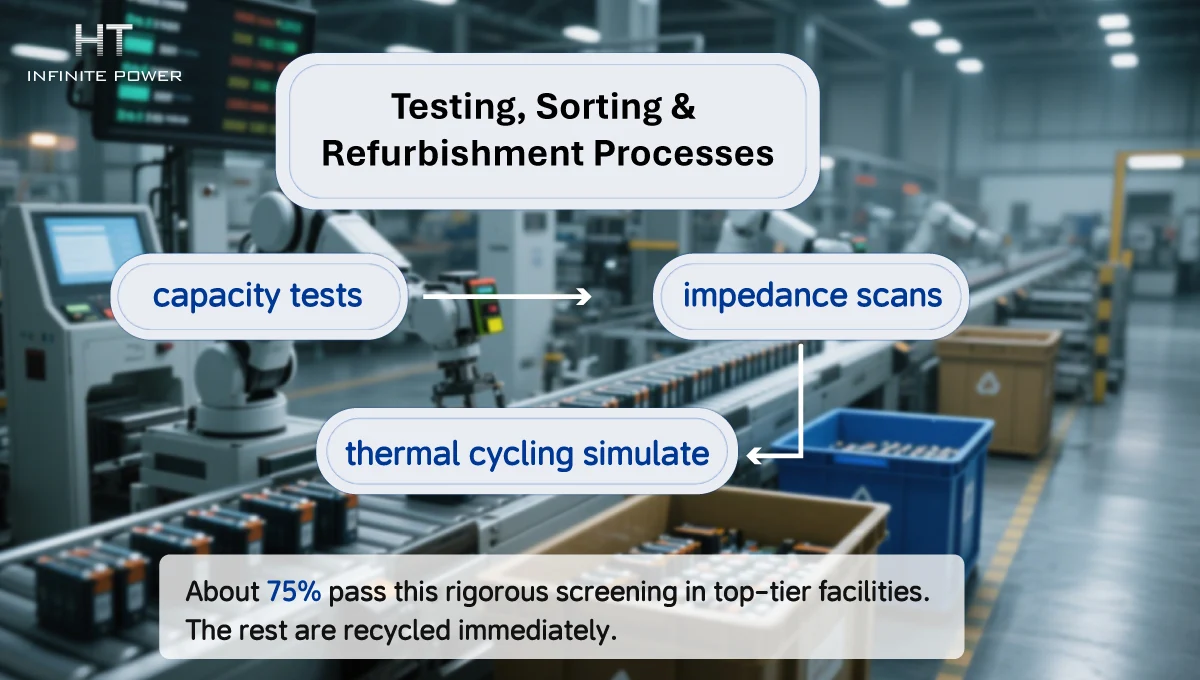
Before second life deployment, cells undergo thorough inspections: capacity tests, impedance scans, and thermal cycling simulate real-world stresses. About 75% pass this rigorous screening in top-tier facilities. The rest are recycled immediately. Next, refurbishment may include replacing malfunctioning BMS units, installing new cooling plates, and updating firmware to match stationary usage profiles. Finally, cells are organized into balanced strings, minimizing voltage variances. This meticulous approach ensures reliability comparable to new systems—often backed by 5-year performance warranties.
Core Technologies & Safety Standards
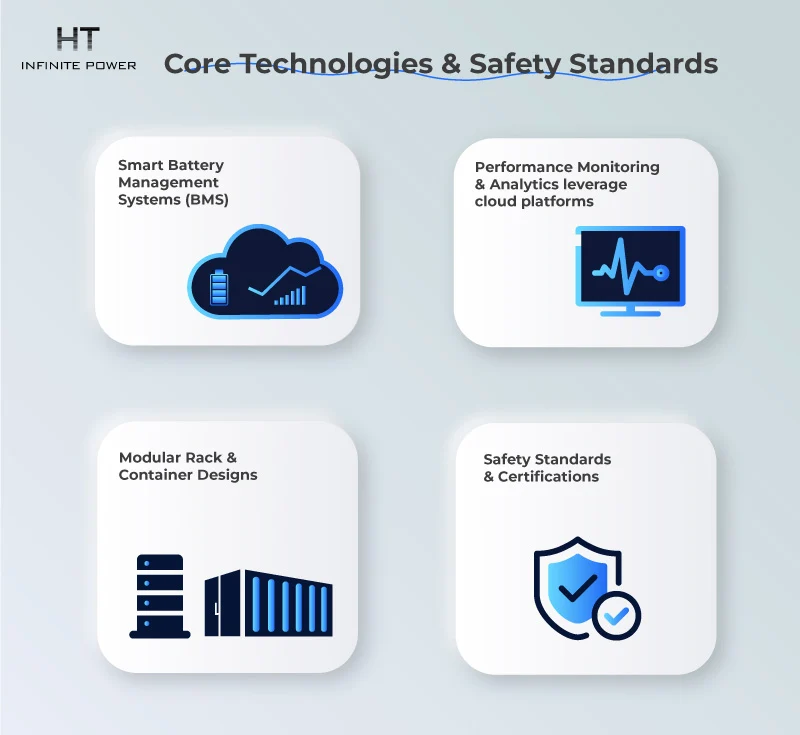
Reusing aged cells safely hinges on robust technology and compliance. Four pillars support this transformation:
1. Smart Battery Management Systems (BMS)
Monitor voltage, current, temperature, and SOH at the cell level. AI-driven BMS can forecast failures 30 days ahead, slashing unplanned downtime by nearly 50%.
2. Performance Monitoring & Analytics
Leverage cloud platforms. Operators view dashboards displaying cycle counts, depth-of-discharge trends, and thermal hotspots.
3. Modular Rack & Container Designs
Standardize hardware, cutting engineering time by 40%.
4. Safety Standards & Certifications (UL 9540A, IEC 62619, IEEE 1679.1)
Mandate rigorous testing protocols.
Key Benefits of Second Life Battery Storage

Why pivot to second life systems instead of fresh cells? Three standout advantages drive adoption:
- Cost Savings:
Refurbished packs cost 30–50% less than new modules. A 100 kWh system can achieve ROI in 4–6 years—two years quicker than new.
- Environmental Impact:
Extending battery life cuts lifecycle CO₂ emissions by up to 70% .
- Grid Resilience:
Deployed at the grid edge, second life banks island during outages, powering hospitals and telecoms for 36+ hours during storms.
Applications and Real World Examples
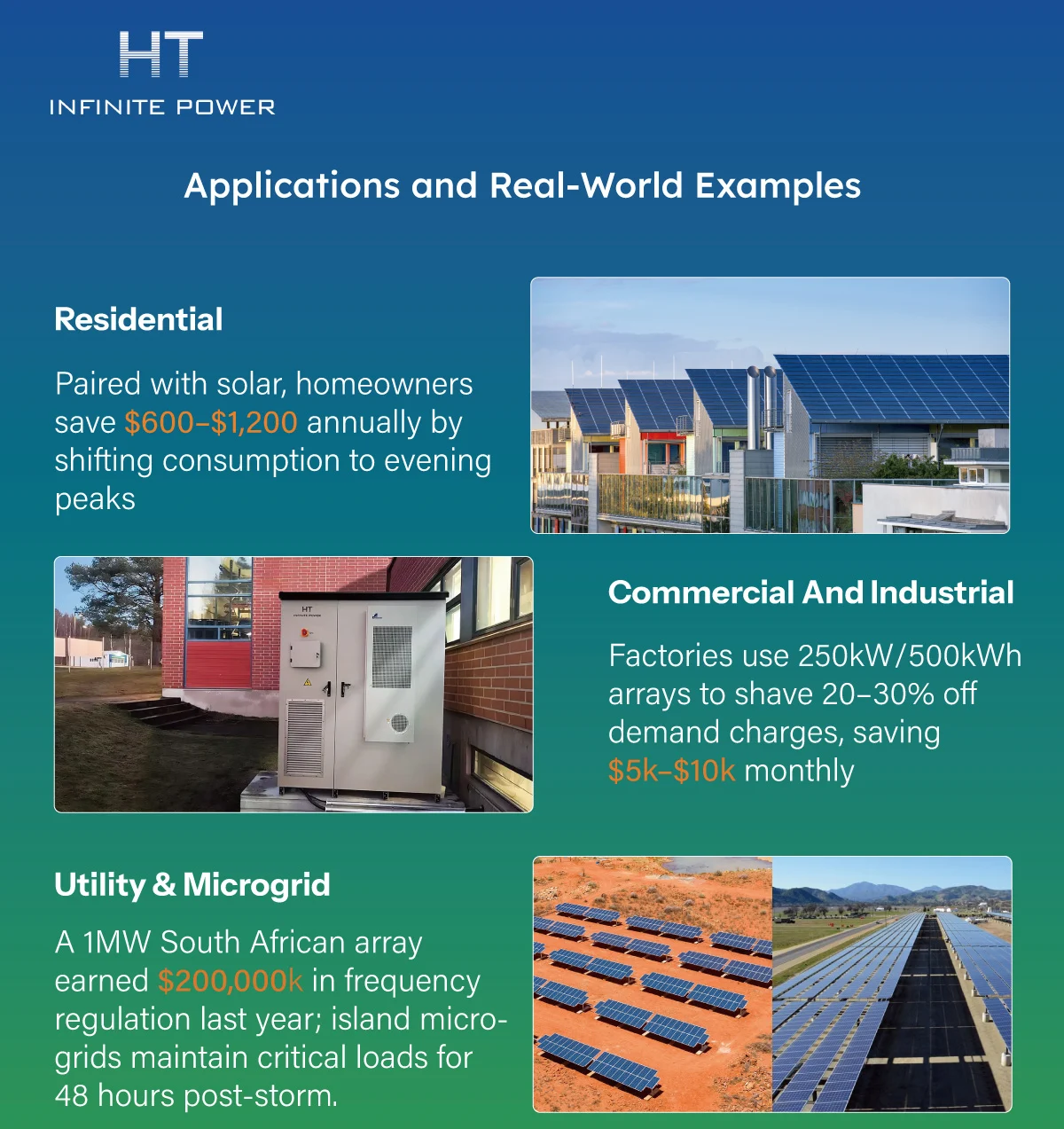
Second life systems adapt to diverse use cases:
Residential:
Paired with solar, homeowners save $600–$1,200 annually by shifting consumption to evening peaks.
C&I:
Factories use 250 kW/500 kWh arrays to shave 20–30% off demand charges, saving $5k–$10k monthly.
Utility & Microgrid:
A 1 MW South African array earned $200k in frequency regulation last year; island microgrids maintain critical loads for 48 hours post-storm.
Challenges and Compliance
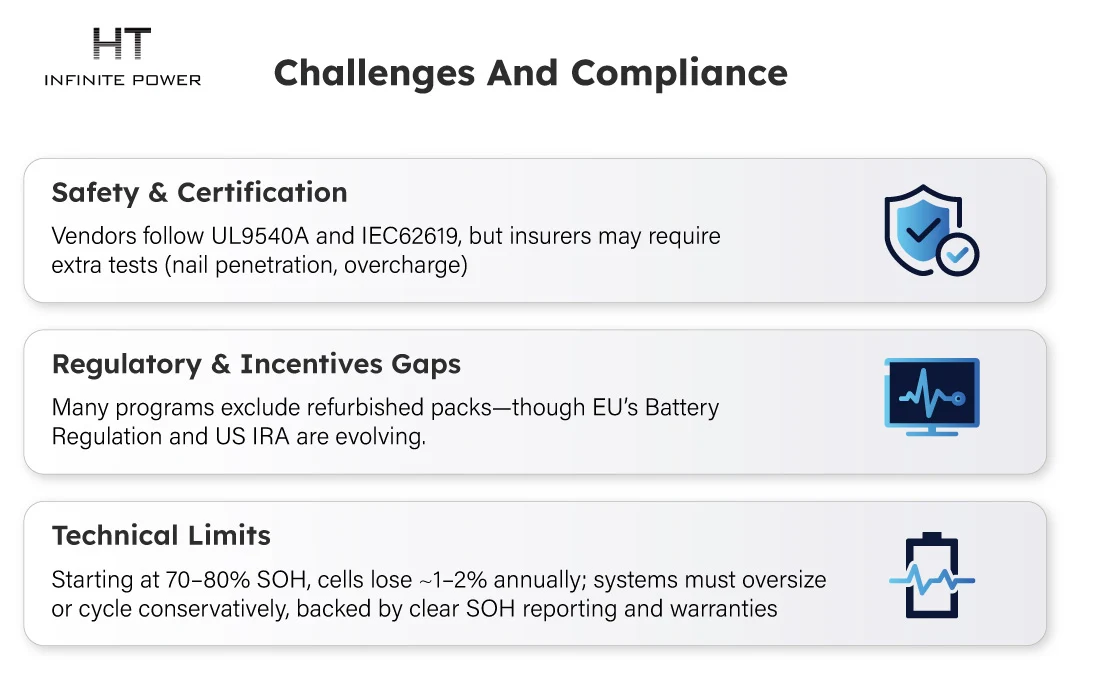
While promising, second life storage faces hurdles:
Safety & Certification:
Vendors follow UL 9540A and IEC 62619, but insurers may require extra tests (nail penetration, overcharge).
Regulatory & Incentives Gaps:
Many programs exclude refurbished packs—though EU’s Battery Regulation and US IRA are evolving.
Technical Limits:
Starting at 70–80% SOH, cells lose ~1–2% annually; systems must oversize or cycle conservatively, backed by clear SOH reporting and warranties.
Future Outlook
The second life market is set for rapid growth:
- Automated Recycling & Grading:
AI-driven robotics could cut refurbishment costs by 20%.
- Standards Development:
IEA forecasts 10% of stationary capacity will be second life by 2030, prompting ISO/IEC to formalize grading.
- Financial Models:
Performance-based leases tied to delivered kWh will de-risk investments, mainstreaming second life in storage portfolios.
Conclusion
Second-Life Battery Storage extends pack life, lowers costs, and boosts resilience. It’s a pragmatic bridge from automotive to stationary, advancing a circular, low-carbon energy future—one repurposed cell at a time.
What is Frequency Regulation in Energy Storage?
What Is Energy Arbitrage in Battery Storage?