The role, principle and algorithm of MPPT of photovoltaic inverter
2025-03-20

MPPT is a very core technology of inverter, and MPPT voltage is a very critical parameter when designing photovoltaic power stations.
In the figure above, the output voltage and current of the photovoltaic module follow the I-V curve and the P-V curve. If you want the inverter to output the maximum power, you need the DC voltage to run at the maximum point where the red dot is located. This point is the maximum power point.
1. What is MPPT?

If the maximum power point is 550V, the power is 200W at 550V. At this time, the power running at 520V is about 190W, and at 580V is about 185W, both of which are not as high as the power at 550V. If the inverter cannot track 550V, it will lose power generation, but it will not have other effects on the system.
Why do we need to keep tracking?
Because this curve changes with the light intensity, temperature and shading, the maximum power point also changes. The maximum power point voltage may be 560V in the morning, 520V at noon, and 550V in the afternoon. Therefore, the inverter needs to constantly find this maximum power point, that is, maximum power point tracking, so as to ensure that the energy of the solar panels can be maximized throughout the day without wasting solar energy resources.
Based on the above basic knowledge, let's learn more about MPPT.
MPPT, which is the abbreviation of Maximum Power Point Tracking, means that the inverter adjusts the output power of the photovoltaic array according to different external ambient temperature, light intensity and other characteristics, so that the photovoltaic array always outputs maximum power.
2. What is the role of MPPT?
Since solar cells are affected by external factors such as light intensity and environment, their output power varies. The more light intensity, the more electricity is generated. The inverter with MPPT maximum power tracking is to make full use of solar cells and make them run at the maximum power point. That is to say, under the condition of unchanged solar radiation, the output power after MPPT will be higher than that before MPPT, which is the role of MPPT.
For example, assuming that MPPT has not started tracking, the output voltage of the component is 500V. After MPPT starts tracking, it starts to adjust the resistance in the loop through the internal circuit structure to change the output voltage of the component and the output current at the same time until the output power is maximum (assuming it is 550V maximum). After that, it will continue to track. In this way, under the condition of unchanged solar radiation, the output power of the component at an output voltage of 550V will be higher than that at 500V. This is the role of MPPT.
3. Factors affecting MPPT of a single photovoltaic module
Generally speaking, the impact of irradiance and temperature changes on output power is most directly reflected in MPPT, that is, irradiance and temperature are important factors affecting MPPT.
When irradiance decreases, the output power of the photovoltaic module will decrease; when temperature increases, the output power of the photovoltaic module will decrease;
(1). The impact of irradiance on MPPT
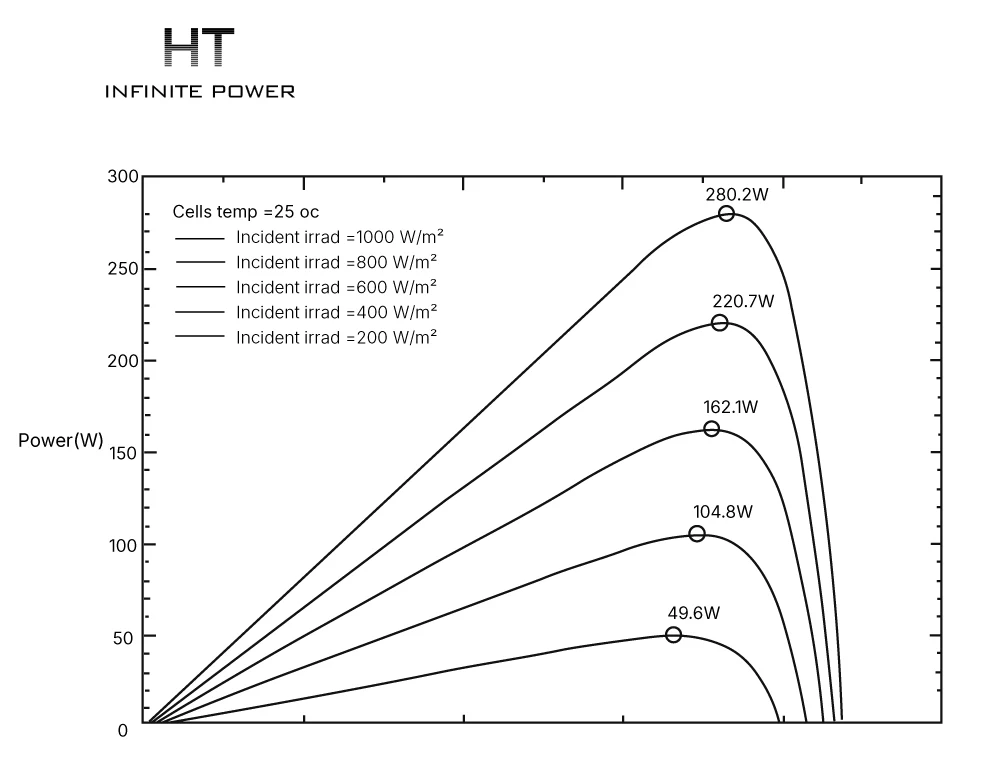
The maximum power point tracking (MPPT) of the inverter is to find the point with the maximum power in the above figure. As can be seen from the above figure, when the irradiance decreases, the maximum power point decreases almost proportionally, as shown in the following table.
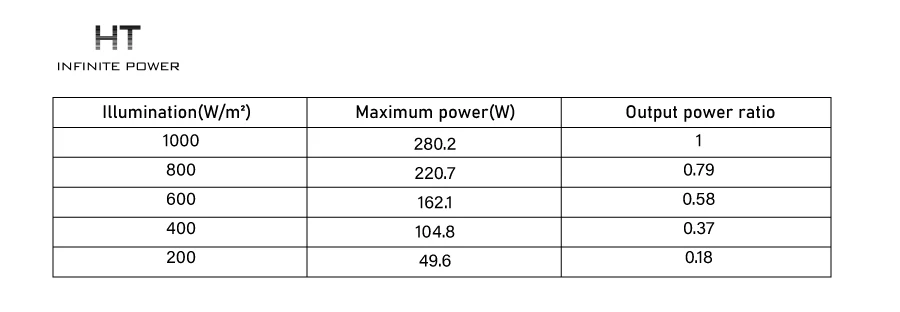
It can be seen from the above table that when the irradiance decreases proportionally, the MPPT voltage decreases slightly; since P=IU, when the irradiance decreases, P decreases proportionally, while U decreases slightly, so the current I should decrease proportionally.
(2). Impact of temperature on MPPT
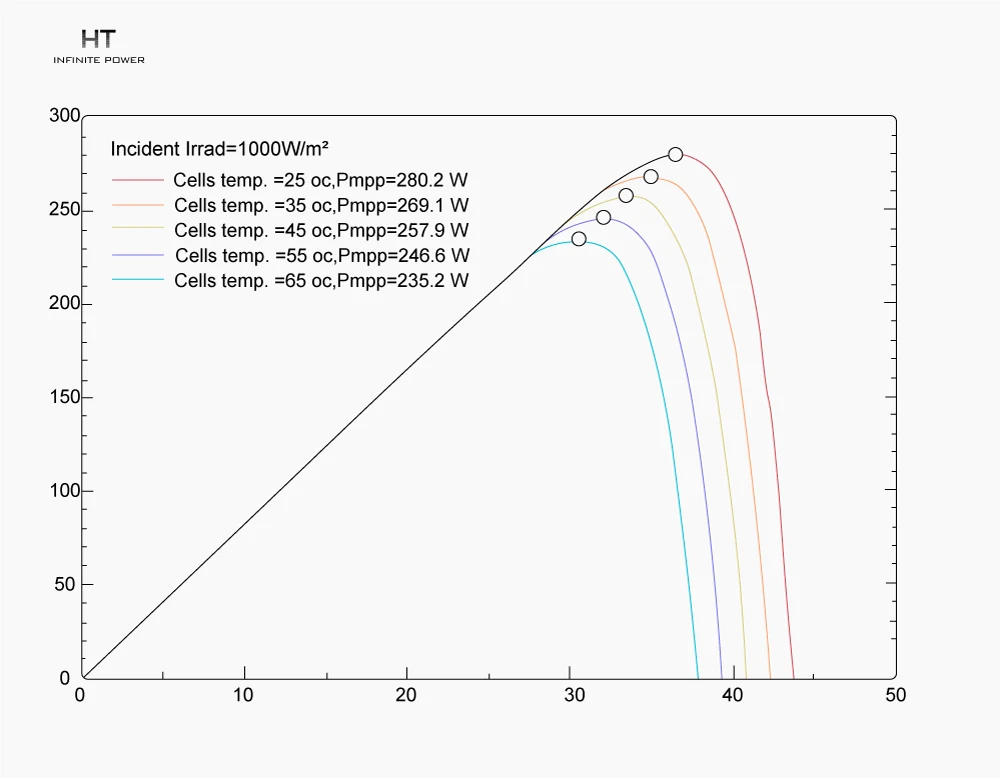
As can be seen from the above figure, when the temperature changes, the maximum power gradually decreases in proportion to the temperature coefficient, as shown in the following table.
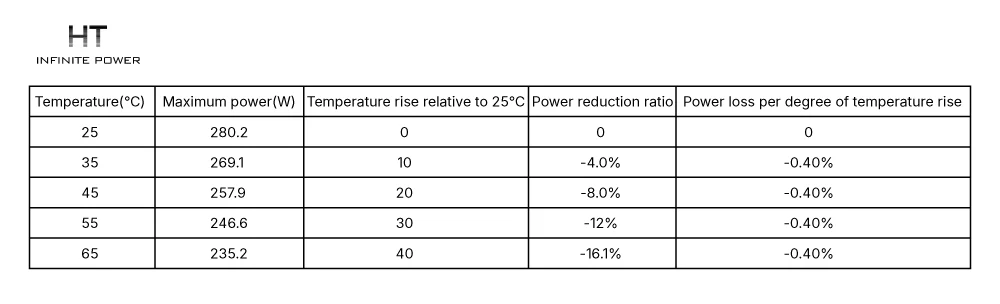
It can be seen from this that the current is mainly affected by the irradiance, and the voltage is mainly affected by the temperature.
4. MPPT of photovoltaic power generation unit and its principle and algorithm
(1). MPPT of photovoltaic power generation unit
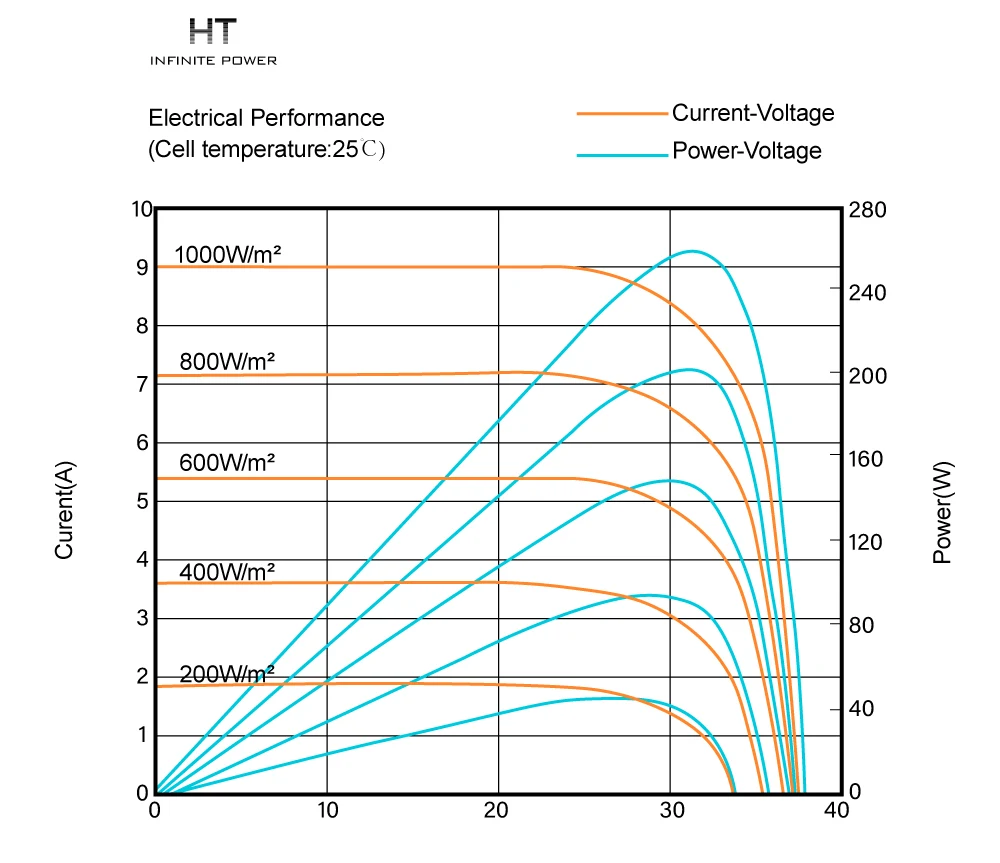
The two pictures above are MPPT tracking of a photovoltaic module. In actual projects, a 500kW inverter often needs to connect 80 to 90 photovoltaic strings.
During use, the photovoltaic array is easily disturbed by the surrounding environment (such as floating clouds, buildings, tree shade, etc.) and dust on the surface of the solar panel, resulting in a decrease in the output power of the photovoltaic array and a complex output characteristic curve. The output characteristic curve has multiple extreme points. If a power station has an air conditioning unit behind a certain string; a leaf covers a certain cell; and a shade of a tree blocks part of the component. Then there must be an output power deviation between different strings. Therefore, the output characteristic curve of the photovoltaic string connected to each inverter becomes complex and has multiple extreme points. How to find the highest point requires MPPT!
(2). Principle of Maximum Power Point Tracking
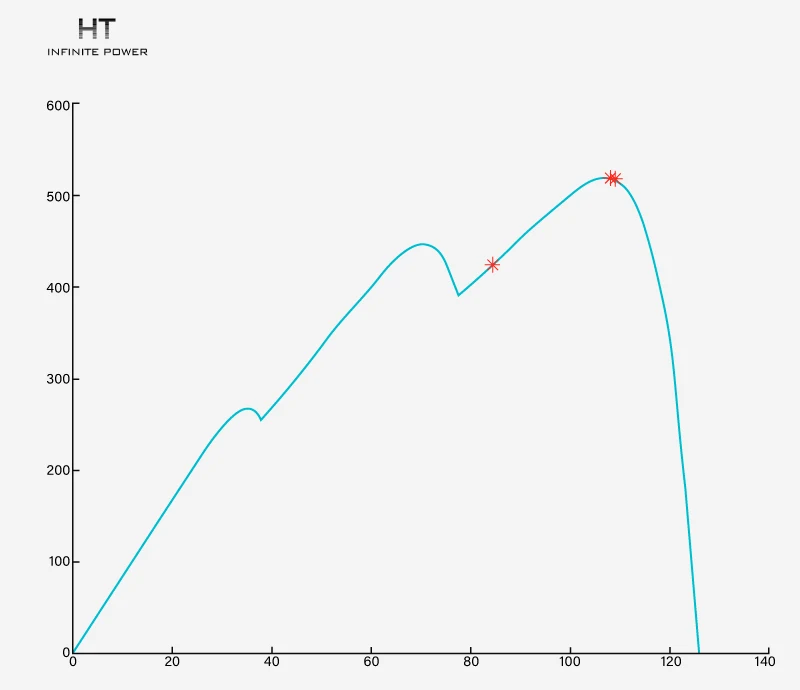
With the development of electronic technology, the current MPPT control of solar cell arrays is generally completed through DC/DC conversion circuits. Its principle block diagram is shown in the figure below.
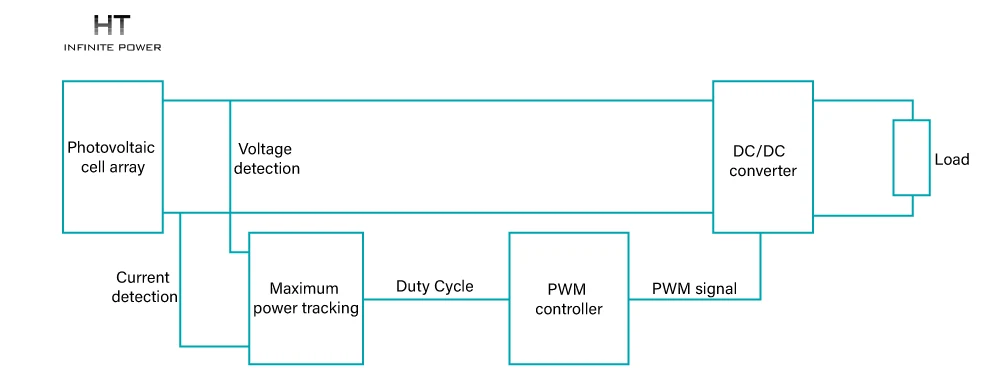
The photovoltaic cell array is connected to the load through a DC/DC circuit. The maximum power tracking device continuously detects the current and voltage changes of the photovoltaic array, and adjusts the duty cycle of the PWM drive signal of the DC/DC converter according to the changes.
For a linear circuit, when the load resistance is equal to the internal resistance of the power supply, the power supply has maximum power output. Although photovoltaic cells and DC/DC conversion circuits are both strongly nonlinear, they can be considered as linear circuits in a very short period of time. Therefore, as long as the equivalent resistance of the DC-DC conversion circuit is adjusted so that it is always equal to the internal resistance of the photovoltaic cell, the maximum output of the photovoltaic cell can be achieved, and the MPPT of the photovoltaic cell can be achieved.
(3). MPPT algorithm
At present, the maximum power point tracking (MPPT) technology of photovoltaic arrays has been studied in the industry, and various control methods have been developed. The commonly used ones are as follows: constant voltage tracking method (Constant Voltage Tracking, CVT for short), perturbation observation method (Perturbation And Observation method, P&O for short), incremental conductance method (Incremental Conductance method, INC for short), conductance increment method based on gradient variable step length, etc. (These algorithms can only be used under unobstructed conditions)
● MPPT algorithm for single peak power output
At present, under unobstructed conditions, the control methods of maximum power point tracking (MPPT) of photovoltaic arrays are commonly used as follows:
l Constant voltage tracking method (Constant Voltage Tracking, CVT for short)
l Perturbation observation method (Perturbation And Observation method, P&O for short)
l Incremental conductance method (Incremental Conductance method, INC for short)
l Conductance increment method based on gradient variable step length, etc.
● Multi-peak power output MPPT algorithm
Ordinary maximum power tracking algorithms, such as perturbation observation and conductance increment method, may fail under the cover of a cloud and cannot achieve true maximum power tracking. At present, some people in the world have proposed multi-peak MPPT algorithms, mainly including the following three types:
Compound MPPT algorithm combined with conventional algorithms
Fibonacci method
Short-circuit current pulse method
Summary:
At present, the industry has recognized the importance of multi-MPPT channels of inverters, and multi-MPPT string inverters have been widely recognized.
Ten development trends of new energy storage in 2025
Industrial and commercial energy storage systems, why are you recommended to choose "customization"?