What Is AIDC Energy Storage?
2026-01-30

Recently, a new concept has been gaining rapid traction in the energy storage industry—AIDC. It has been highlighted in the latest financial reports of several energy storage companies and has also become one of the most closely watched targets in the capital markets. But what exactly is AIDC, and where is it applied?
AIDC energy storage (Artificial Intelligence Data Center Energy Storage) refers to energy storage systems specifically designed for artificial intelligence data centers. Simply put, it is the “super battery” and “power stabilizer” built for the “super brains” that run large AI models and massive data workloads.
With the explosive growth of AI technologies such as ChatGPT and Sora, data centers are experiencing exponential increases in computing demand, leading to a sharp rise in energy consumption. Within the industry, there is a saying that “the endgame of AI is energy.” In this context, AIDC energy storage has become a critical piece of infrastructure—essential for ensuring stable computing power and reducing operational costs.
What Is AIDC Energy Storage?
Traditional Internet Data Centers (IDCs) mainly handle tasks such as data storage and web services, with relatively stable and predictable load profiles. In contrast, AIDC (Artificial Intelligence Data Centers), also known as intelligent computing centers, are designed for AI model training and inference, and exhibit several distinct characteristics:

High power density:
The power consumption per rack is far higher than that of traditional data centers, often reaching 5–10 times the level of conventional racks.
Severe load fluctuations:
AI training tasks generate significant instantaneous current surges when they are initiated.
24/7 high-load operation:
AIDC facilities require extremely high power reliability. Even millisecond-level power interruptions can result in the loss of AI training results worth millions of dollars.
AIDC energy storage systems have evolved specifically to address these challenges. They are not simply backup batteries, but integrated energy systems that combine high-rate discharge capability, liquid cooling thermal management, and intelligent energy management technologies.
Core Application Scenarios of AIDC Energy Storage
The application scenarios of AIDC energy storage mainly focus on power reliability, cost reduction, and capacity expansion:
1. Critical Backup Power (UPS / Backup) — “Lifeline Power”
This is the most fundamental and critical application scenario.
Pain point:
During AI model training, data volumes are massive and highly time-sensitive. If a grid outage occurs—even for just a few seconds—unsaved training progress may be completely lost, and restarting complex AI clusters can take a significant amount of time.
During AI model training, data volumes are massive and highly time-sensitive. If a grid outage occurs—even for just a few seconds—unsaved training progress may be completely lost, and restarting complex AI clusters can take a significant amount of time.
Function:
In the event of a grid failure, the energy storage system can achieve zero-millisecond or millisecond-level switching, providing high-power support to ensure servers remain online, or at least secure sufficient time for data saving and safe shutdown.
In the event of a grid failure, the energy storage system can achieve zero-millisecond or millisecond-level switching, providing high-power support to ensure servers remain online, or at least secure sufficient time for data saving and safe shutdown.
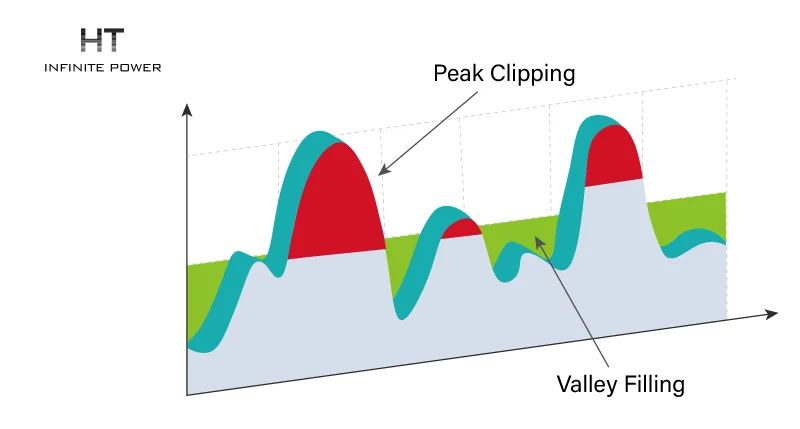
2. Peak Shaving and Valley Filling — “Cost-Saving Power”
Pain point:
Intelligent computing centers are extremely energy-intensive, with electricity costs accounting for 60%–70% of total operating expenses.
Intelligent computing centers are extremely energy-intensive, with electricity costs accounting for 60%–70% of total operating expenses.
Function:
Charge low, discharge high: Charging during off-peak hours when electricity prices are low, and discharging during peak hours to supply servers, significantly reducing electricity costs through price arbitrage.
Charge low, discharge high: Charging during off-peak hours when electricity prices are low, and discharging during peak hours to supply servers, significantly reducing electricity costs through price arbitrage.
Reducing demand charges: By supplying peak-period power through energy storage instead of the grid, the declared maximum demand can be lowered, thereby reducing basic demand charges.
3. Dynamic Capacity Expansion — “Borrowed Power”
Pain point:
Many legacy data centers seeking to upgrade to AIDC, or new centers experiencing rapid computing expansion, face insufficient utility transformer capacity. Grid upgrades and substation expansion are costly and time-consuming.
Many legacy data centers seeking to upgrade to AIDC, or new centers experiencing rapid computing expansion, face insufficient utility transformer capacity. Grid upgrades and substation expansion are costly and time-consuming.
Function:
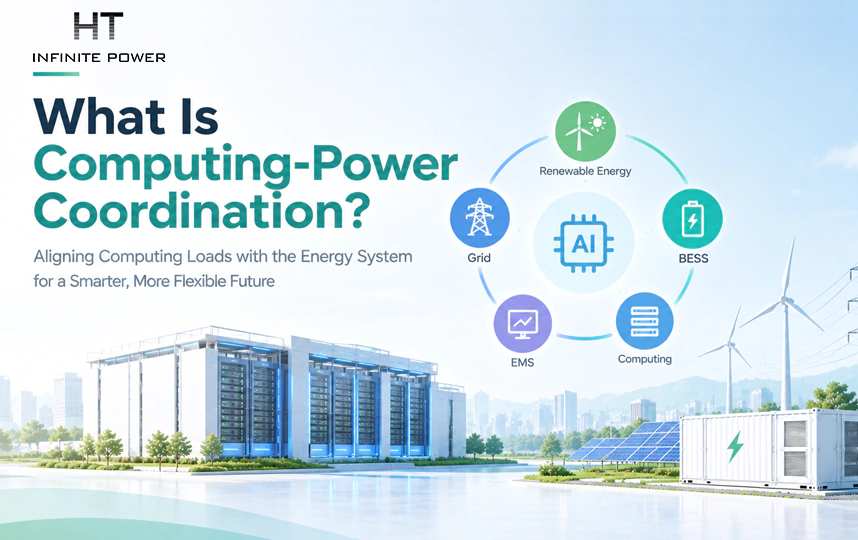
The energy storage system can function as a “virtual power plant.” When computing loads exceed the transformer’s capacity limit, the storage system automatically discharges to fill the gap, enabling higher computing power operation without modifying grid infrastructure.
The energy storage system can function as a “virtual power plant.” When computing loads exceed the transformer’s capacity limit, the storage system automatically discharges to fill the gap, enabling higher computing power operation without modifying grid infrastructure.
4. Power Smoothing — “Voltage Stabilizer”
Pain point:
AI chips (such as NVIDIA H100/B200) can experience instantaneous power spikes during training or inference. These sharp load fluctuations can stress the grid and even cause voltage instability.
AI chips (such as NVIDIA H100/B200) can experience instantaneous power spikes during training or inference. These sharp load fluctuations can stress the grid and even cause voltage instability.
Function:
With high-rate response capability, AIDC energy storage can rapidly absorb or release energy—like a sponge—smoothing power fluctuations and ensuring highly stable power quality.
With high-rate response capability, AIDC energy storage can rapidly absorb or release energy—like a sponge—smoothing power fluctuations and ensuring highly stable power quality.
5. Green Energy Integration
Pain point:
Global technology giants (such as Google, Microsoft, and Meta) have carbon neutrality targets, requiring data centers to increase the use of renewable energy.
Global technology giants (such as Google, Microsoft, and Meta) have carbon neutrality targets, requiring data centers to increase the use of renewable energy.
Function:
By working in conjunction with on-site or nearby solar and wind power systems, energy storage can store intermittent renewable energy for stable data center usage, increasing the share of green electricity and supporting ESG (Environmental, Social, and Governance) goals.
By working in conjunction with on-site or nearby solar and wind power systems, energy storage can store intermittent renewable energy for stable data center usage, increasing the share of green electricity and supporting ESG (Environmental, Social, and Governance) goals.
What Is AIDC Energy Storage Used For?
1.Power Stability:
Responds to sudden AI computing load surges, providing millisecond-level response to power fluctuations.
2.Green Energy Management:
Stores and optimizes the use of renewable energy such as solar and wind power, enabling “green energy to power computing.”

3.Peak Shaving and Valley Filling:
Reduces electricity costs and improves overall energy efficiency.
4.Backup Power Supply:
Provides emergency power to ensure business continuity.
Summary:
AIDC energy storage is the “energy heart” of the AI era—preventing AI systems from going dark while helping data centers reduce operating costs. It is an indispensable component of future computing infrastructure.
AI Data Centers and the Transformation of the Energy Storage Industry
What Is Superconducting Magnetic Energy Storage (SMES)?