Lithium-Ion Battery Lifespan in BESS: Cycle Life, Degradation, and Replacement
author: HT Infinite Power
2026-11-20

The lifespan of a lithium-ion battery is one of the factors that determines the long-term performance and economics of a battery energy storage system (BESS). As a battery ages, its ability to store and deliver energy gradually declines. This affects the system's usable capacity, operating duration, maintenance requirements, and eventually the need for battery augmentation or replacement.
However, battery lifespan is not defined by a single number. Cycle life, calendar life, operating conditions, and the performance requirements of the BESS all influence how long a battery remains suitable for its intended application.
For project developers, EPC contractors, and system integrators, the important question is not simply how many years a battery can operate. It is whether the battery can continue meeting the project's required power, energy, and availability targets throughout its service life.
This guide examines the factors that determine lithium-ion battery lifespan in BESS applications, how degradation affects system performance, how to make preliminary lifespan estimates, and when battery augmentation or replacement should be considered.
1. How Long Does a Lithium-Ion Battery Last in a BESS?
There is no universal lifespan for lithium-ion batteries used in energy storage systems. The expected service life depends on battery chemistry, cell design, operating conditions, charge and discharge patterns, and the manufacturer's performance guarantees.
It is also important to distinguish between battery cycle life, calendar life, and the service life of the complete BESS.
| Term | Meaning |
| Cycle Life | The number of charge and discharge cycles a battery can complete under specified test conditions before reaching a defined end-of-life criterion |
| Calendar Life | The time-related aging of a battery, including degradation that occurs even when the battery is not cycling |
| Battery Service Life | The period during which the battery can continue operating within the required performance and safety limits |
| BESS Project Life | The intended operating life of the complete energy storage project, which may include battery augmentation or replacement |
These terms describe different aspects of battery aging and should not be treated as interchangeable.
Cycle Life Is Not the Same as Service Life
A battery manufacturer's cycle-life specification is usually established under defined laboratory conditions. These conditions may include a particular depth of discharge (DoD), charge and discharge rate, temperature, voltage range, and end-of-life threshold.
For example, a battery rated for 6,000 cycles does not necessarily mean it will operate for 6,000 complete cycles under every project condition. Its actual performance depends on whether the field operating profile is comparable to the test conditions.
Calendar aging also continues during periods when the battery is idle. Therefore, a battery with a relatively low annual cycle count may still experience meaningful capacity degradation over time.
A cycle-life figure should consequently be evaluated together with calendar-life information and the manufacturer's warranty conditions.
Does Battery Chemistry Affect Lifespan?
Yes. Different lithium-ion chemistries have different electrochemical characteristics and aging behavior.
Two commonly used lithium-ion chemistries in energy storage applications are:
- Lithium Iron Phosphate (LFP): Widely used in stationary BESS applications. LFP cells generally offer good thermal stability and are commonly selected for systems that prioritize safety, long service life, and frequent cycling.
- Nickel Manganese Cobalt (NMC): Offers relatively high energy density and is used in applications where compact energy storage is important. Its thermal characteristics and degradation behavior differ from those of LFP.
Chemistry alone does not determine the lifespan of a battery system. Cell design, manufacturing quality, operating temperature, control strategy, and system integration also matter.
For a BESS project, battery selection should therefore be based on the complete operating requirements rather than cycle-life figures alone.
2. Cycle Life vs. Calendar Aging: What Determines Battery Lifespan?
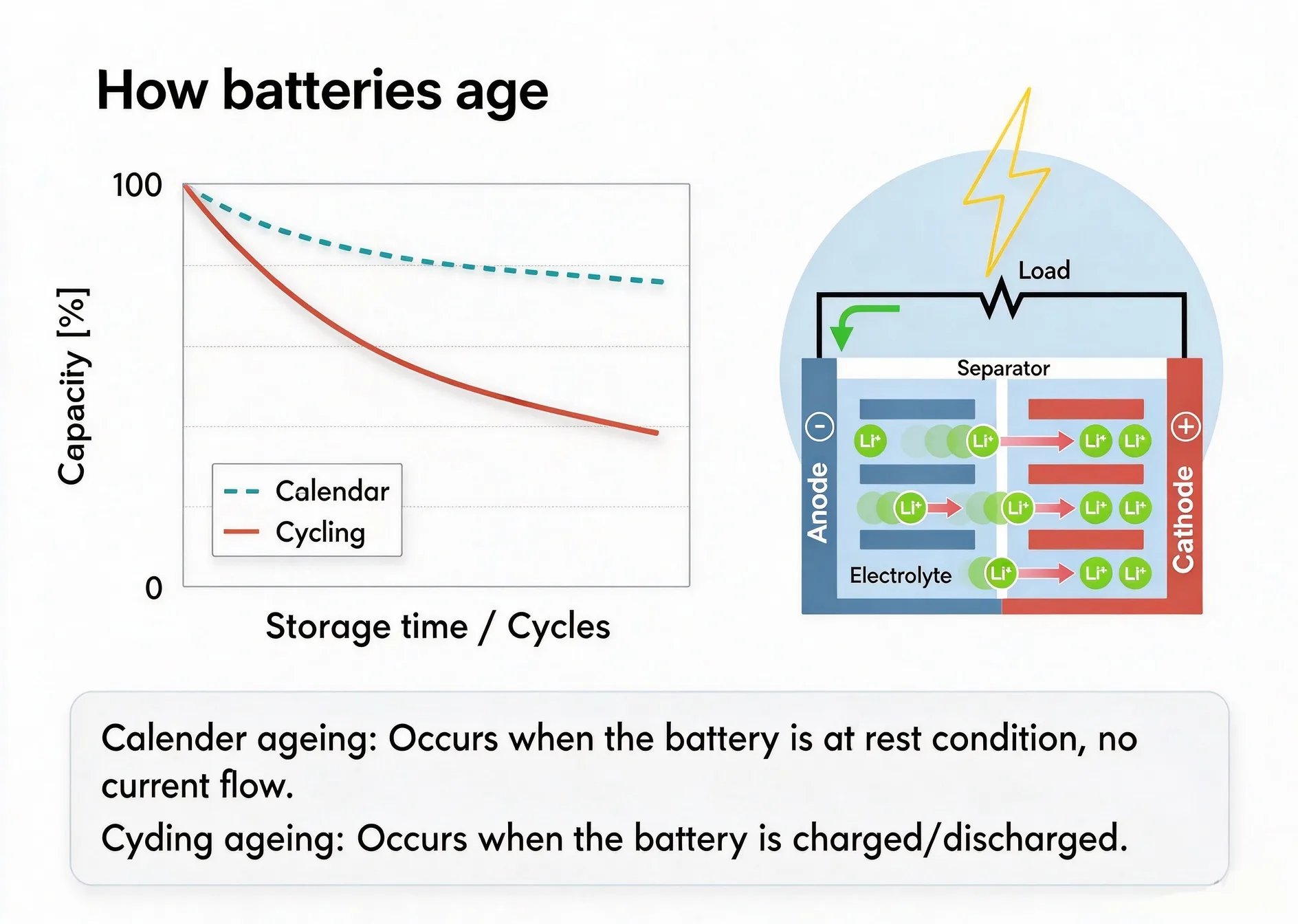
Lithium-ion battery degradation generally involves two overlapping processes: cycle aging and calendar aging.
Both occur during normal battery operation. Their relative contributions depend on how the battery is used and the conditions under which it is stored and operated.
Cycle Aging
Cycle aging refers to degradation associated with charging and discharging a battery.
During repeated cycling, electrochemical reactions gradually change the internal structure and condition of the battery. These changes can reduce the amount of lithium available for normal charge transfer, increase internal resistance, and lower the battery's ability to store and deliver energy.
The extent of cycle aging depends on the operating profile, particularly:
- Depth of discharge (DoD)
- Charge and discharge rates
- Operating temperature
- Charging and discharging voltage limits
- State-of-charge (SOC) range
A battery that repeatedly operates through a wide SOC range may experience a different aging pattern from one that performs shallow, partial cycles.
This is why cycle-life specifications must be interpreted in the context of their test conditions.
Calendar Aging
Calendar aging is the degradation that occurs as time passes, even when a battery is not actively charging or discharging.
It is influenced by factors such as:
- Storage temperature
- Average SOC during storage or standby
- Cell chemistry and design
- Time spent at elevated voltage or high SOC
For example, a battery that remains at a high SOC for extended periods may age differently from one that spends most of its standby time at a moderate SOC.
Calendar aging is particularly relevant to BESS projects with intermittent dispatch. A system may complete relatively few equivalent full cycles each year but still experience capacity loss over its operating life.
Why Both Aging Mechanisms Matter
Cycle aging and calendar aging occur simultaneously. They should not be treated as two independent degradation percentages that can simply be added together.
Their interaction depends on cell chemistry, operating conditions, and the degradation model used.
For project planning, this means that estimating lifespan from cycle count alone is insufficient. A reasonable assessment must consider both the expected cycling profile and the time-related aging of the battery.
3. What Factors Accelerate Lithium-Ion Battery Degradation?
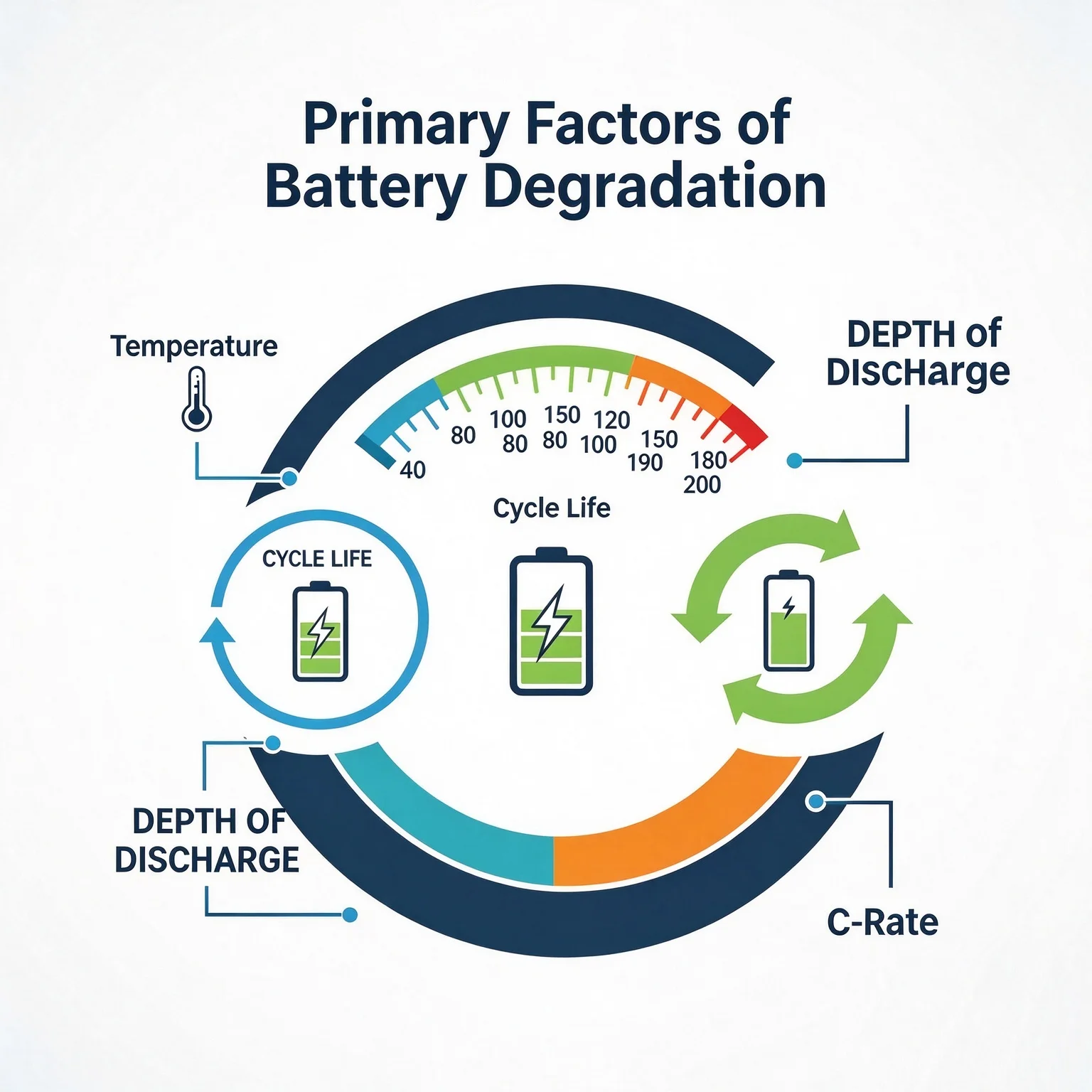
Although some degradation is unavoidable, certain operating conditions can accelerate the loss of battery capacity and performance.
Understanding these factors helps project teams assess whether a proposed operating profile is compatible with the battery's performance requirements.
3.1 Depth of Discharge (DoD)
Depth of discharge describes how much of the battery's available capacity is used during a discharge cycle.
For example, a 90% DoD means that 90% of the defined available capacity is discharged before the battery reaches its lower operating limit.
Deeper cycling generally places greater demands on the battery than shallower cycling, although the exact relationship depends on cell chemistry and design.
A system designed for daily energy shifting may therefore experience a different degradation profile from one used mainly for short-duration peak shaving.
3.2 Charge and Discharge Rate
The charge and discharge rate is commonly expressed as a C-rate.
For a battery with a nominal capacity of 1,000 Ah:
- 0.5C corresponds to a current of 500 A.
- 1C corresponds to a current of 1,000 A.
- 2C corresponds to a current of 2,000 A.
Higher charge or discharge rates can increase internal heat generation and electrochemical stress.
The acceptable operating rate depends on the cell's specifications, temperature, SOC, and system design. A cell's maximum permitted current should not automatically be treated as its recommended continuous operating current.
3.3 Operating Temperature
Temperature has a significant influence on lithium-ion battery aging.
Elevated temperatures can accelerate unwanted side reactions inside the cell, contributing to capacity loss and resistance growth.
Low temperatures also create operating challenges. Charging lithium-ion cells under unsuitable low-temperature conditions can increase the risk of lithium plating, depending on cell chemistry, SOC, and charging current.
For BESS applications, thermal management must therefore maintain the battery within the manufacturer's permitted operating range.
The relevant temperature is the cell temperature, not simply the ambient temperature measured outside the enclosure.
3.4 State of Charge (SOC)
SOC represents the battery's remaining charge relative to its defined capacity.
Operating or storing a battery at very high or very low SOC for extended periods can influence its aging behavior.
For example, a battery that remains near its upper voltage limit during long standby periods may experience different calendar aging from one that operates within a more moderate SOC range.
The appropriate SOC window depends on the battery chemistry, cell manufacturer's recommendations, and the operating requirements of the BESS.
3.5 Cell Consistency and Battery Management
Differences between cells can also affect the performance and aging of a battery system.
Variations in capacity, internal resistance, voltage, and temperature may lead to uneven operating conditions within a battery string or cluster.
The Battery Management System (BMS) monitors battery operating parameters and applies protection and control functions according to the system design. Cell balancing helps manage differences in cell voltage or SOC, but it cannot reverse chemical degradation or restore lost capacity.
If cell inconsistency becomes significant, the usable capacity of a battery string may be constrained by the cells that reach their voltage limits first.
This makes cell consistency, BMS design, and protection coordination important considerations when evaluating long-term BESS performance.
4. How Does Battery Degradation Affect BESS Performance?
Battery degradation affects more than the amount of energy a BESS can store. It can also influence discharge duration, power capability, efficiency, and the operating limits of the complete system.
The most important performance changes are capacity fade and internal resistance growth.
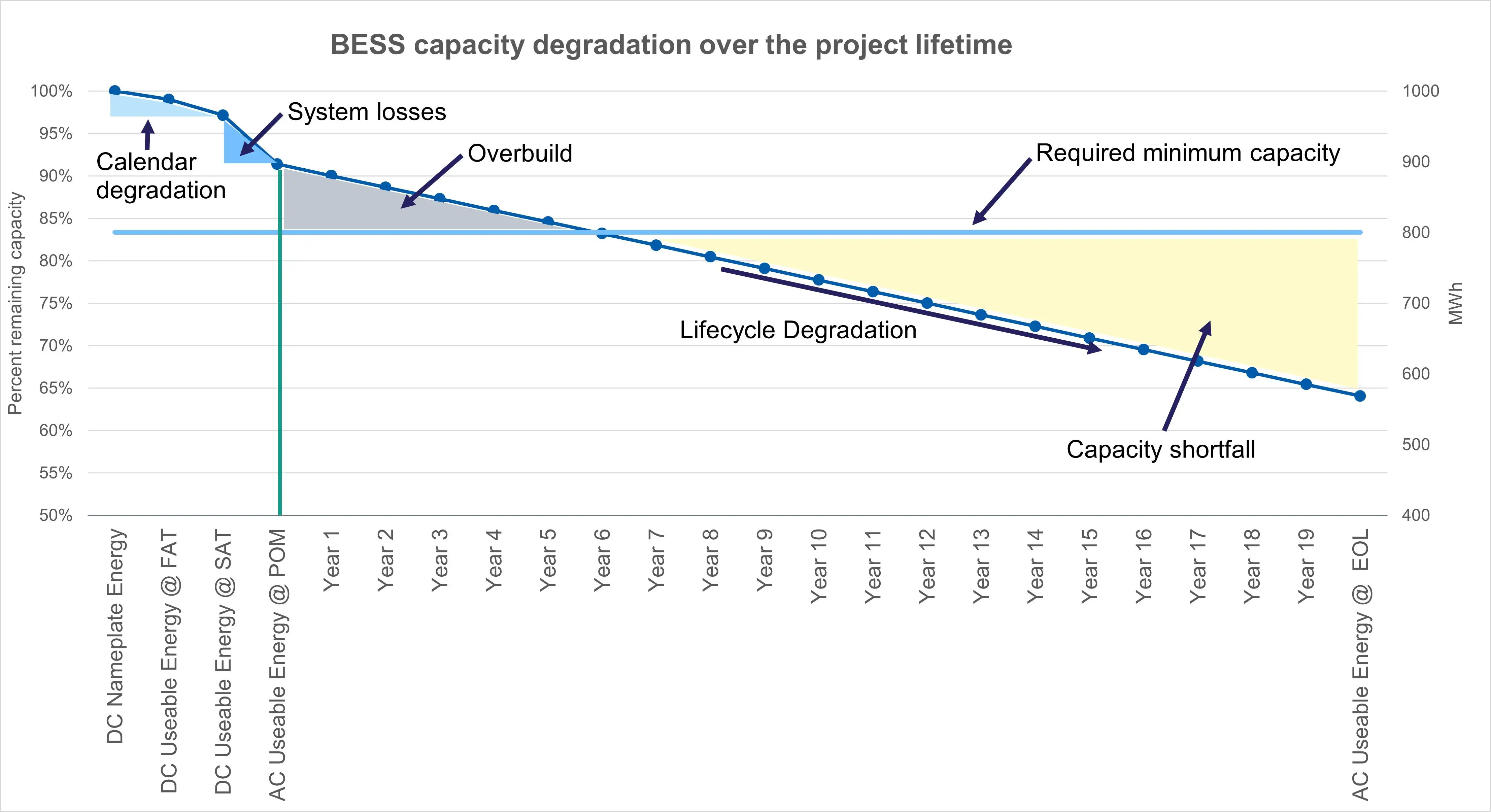
4.1 Capacity Fade
Capacity fade refers to the gradual reduction in the amount of charge or energy a battery can store compared with its original condition.
For a BESS, this means that the system may deliver less energy than it could when first commissioned.
For example, consider a battery system with an initial nominal energy capacity of 5 MWh.
If its measured capacity decreases to 90% of the reference capacity, the simplified remaining capacity is:
Eremaining=5×90
The system would retain approximately 4.5 MWh of nominal battery capacity under the assumptions of this example.
This is not necessarily the same as the energy that can be delivered to the AC grid. Actual usable and deliverable energy also depends on the permitted SOC window, conversion losses, auxiliary consumption, operating temperature, and system limits.
4.2 Internal Resistance Growth
As lithium-ion batteries age, their internal resistance generally increases.
Higher internal resistance can result in:
- Greater voltage drop under load
- Increased heat generation
- Reduced round-trip efficiency
- Lower available power under certain operating conditions
- Earlier activation of voltage or temperature protection limits
The impact depends on the battery's condition and the operating point.
A battery may still have substantial remaining capacity but be less capable of delivering high power for a sustained period.
This distinction is important for applications such as frequency regulation, peak shaving, and grid support, where power requirements may be as important as total energy capacity.
4.3 Capacity Fade Does Not Automatically Mean the Same Power Fade
Energy capacity and power capability are related, but they do not necessarily decline at the same rate.
Consider an illustrative BESS with an initial rating of 1 MW / 2 MWh.
Assume that its measured battery energy capacity later decreases to 90% of the original reference capacity:
Eremaining=2×90
Under idealized conditions, 1.8 MWh of energy corresponds to approximately 1.8 hours of discharge at 1 MW.
However, this calculation does not establish that the aged system can actually deliver 1 MW continuously for 1.8 hours.
The available power must also be evaluated against:
- The battery's maximum charge and discharge current
- DC voltage limits of the battery and PCS
- Internal resistance and voltage response under load
- Battery temperature and BMS operating limits
- PCS power and current ratings
- Permitted SOC range and system operating reserve
- Auxiliary consumption and conversion losses
The PCS may retain its original 1 MW nameplate rating while the battery becomes unable to sustain that output under certain operating conditions.
In other words, a system can retain its nominal PCS power rating without retaining its original energy-delivery capability or discharge duration.
4.4 Understanding Battery State of Health (SOH)
State of Health (SOH) is used to describe the condition of a battery relative to a defined reference state.
For capacity-based assessment, a simplified formula is:
SOHcapacity=Qmeasured÷Qreference×100
Where:
- Qmeasured is the measured battery capacity.
- Qreference is the reference capacity used for comparison.
For example, if a battery cell originally has a reference capacity of 314 Ah and its measured capacity decreases to 282.6 Ah:
SOHcapacity=282.6314×100
The cell's capacity-based SOH is therefore 90%.
However, SOH is not always calculated using capacity alone. Depending on the manufacturer and monitoring method, it may also incorporate internal resistance or other performance indicators.
When comparing SOH values, project teams should confirm the measurement method, reference conditions, and whether the reported value represents cell-level, module-level, or system-level performance.
5. How to Estimate Battery Lifespan in a BESS Project
Estimating battery lifespan requires more than dividing a manufacturer's cycle-life figure by the number of cycles expected each year.
A useful preliminary assessment should combine the battery's cycle-life data, the project's operating profile, calendar aging, and the manufacturer's warranty or performance guarantee.
5.1 Review the Manufacturer's Cycle-Life Conditions
Before using a cycle-life specification in a project calculation, check the conditions under which it was obtained.
Important details include:
- Battery chemistry and cell model
- Charge and discharge rates
- Depth of discharge
- Operating temperature
- Upper and lower voltage limits
- Charging and discharging protocol
- End-of-life capacity threshold
- Whether the test used continuous or intermittent cycling
For example, a cycle-life figure obtained under controlled laboratory conditions at a particular temperature and DoD should not be assumed to represent the same number of cycles under a different field operating profile.
The test conditions are part of the specification, not optional background information.
5.2 Calculate Annual Equivalent Full Cycles (EFC)
For projects with variable charge and discharge patterns, equivalent full cycles (EFC) provide a practical way to express cumulative battery throughput.
A simplified annual EFC calculation based on discharge energy is:
NEFC,annual=Eannualdischarge÷Ereferencecapacity
Where:
- Eannualdischarge is the cumulative discharge energy over one year.
- Ereferencecapacity is the defined reference energy capacity of the battery.
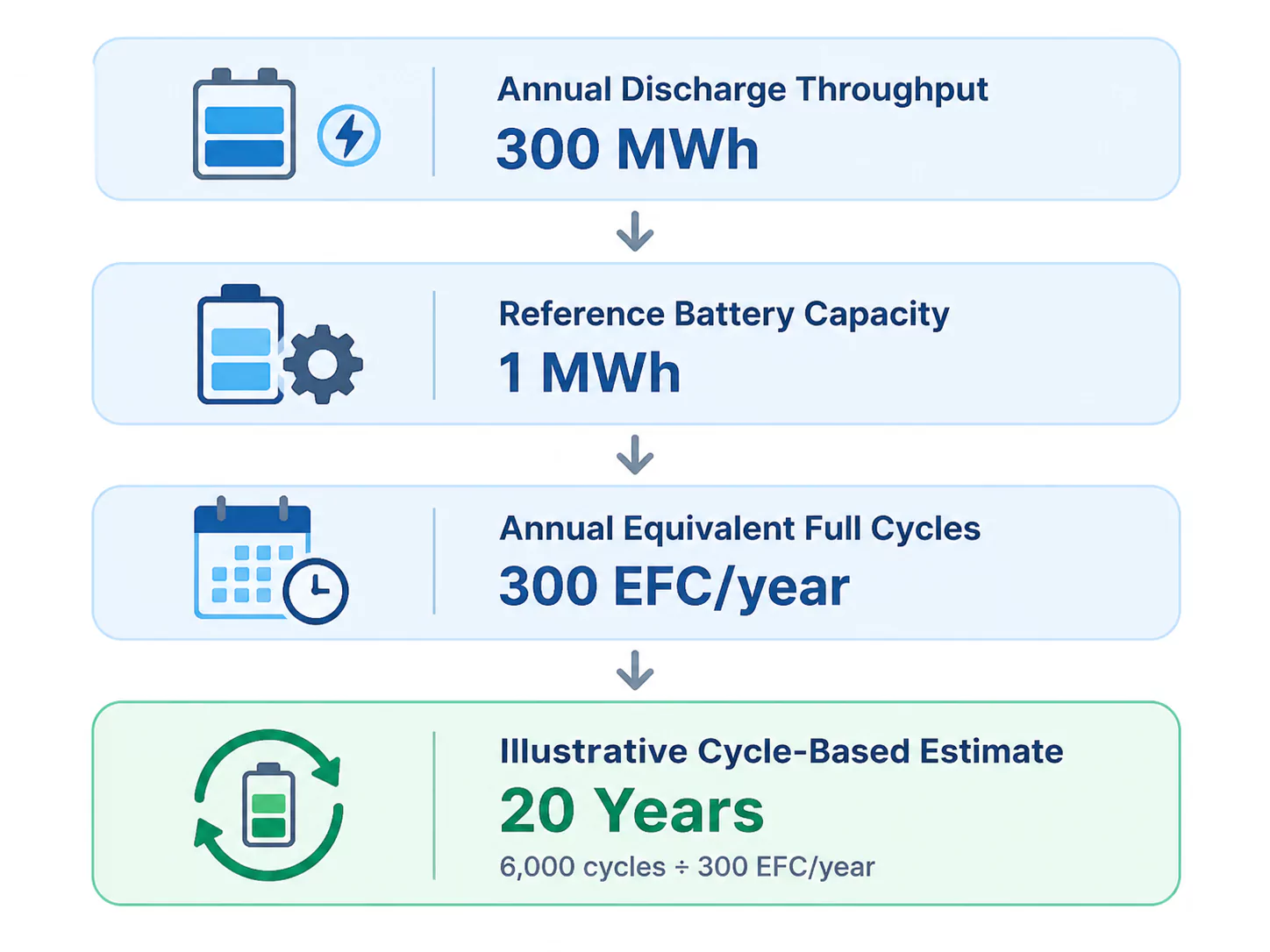
For example, consider a BESS with a reference battery energy capacity of 1 MWh and annual discharge throughput of 300 MWh.
NEFC,annual=3001=300
The system completes approximately 300 equivalent full discharge cycles per year.
This does not mean the battery performs exactly 300 separate full-depth cycles. It may complete a larger number of partial cycles that add up to the same cumulative discharge throughput.
The EFC calculation must use a consistent measurement basis. If the manufacturer's cycle-life data is based on cell-level or DC-side energy throughput, project calculations should not directly use AC-side delivered energy without accounting for conversion losses and other differences. The reference capacity and throughput convention should also be consistent.
5.3 Make a Preliminary Cycle-Based Lifespan Estimate
Once annual EFC is estimated, a simplified cycle-based calculation can be used to understand the potential cycling demand.
Assume:
- Manufacturer's stated cycle life: 6,000 cycles
- Estimated annual throughput: 300 EFC
The preliminary cycle-based estimate is:
Tcycle=6000÷300=20years
This calculation suggests that the projected annual cycling would accumulate 6,000 equivalent full cycles over approximately 20 years.
However, it does not establish that the battery will remain within its required performance limits for 20 years.
The result only describes the relationship between the assumed cycle-life figure and annual equivalent full cycles. It does not account for all other aging and operating constraints.
5.4 Evaluate the Actual Project Operating Profile
The same battery can experience different aging outcomes in different BESS applications.
For example:
- A peak-shaving system may perform one or more scheduled discharge events each day.
- A frequency-regulation system may experience frequent partial cycles and changing power levels.
- A renewable-energy shifting system may operate according to solar or wind generation patterns.
- A backup-oriented system may spend extended periods in standby and cycle infrequently.
These operating profiles differ in annual throughput, SOC distribution, power demand, and time spent at particular temperatures.
A lifespan assessment should therefore use the expected dispatch profile rather than assuming that every project completes the same number of full cycles per day.
5.5 Check the Warranty and Performance Guarantee
The manufacturer's warranty and performance guarantee define the contractual conditions under which battery performance is assessed.
Relevant items include:
- Warranty duration
- Maximum permitted cumulative energy throughput
- Permitted operating temperature
- SOC and DoD limits
- Charge and discharge power limits
- Capacity retention requirements
- Operating and maintenance obligations
- Conditions for performance testing and warranty claims
A project may have a 15- or 20-year design life, but this does not automatically mean that the original battery capacity is guaranteed for the entire period.
The guaranteed performance profile should be checked against the project's expected operating conditions.
5.6 Why Cycle-Based Lifespan Estimates Are Not Enough
A cycle-based calculation is useful for preliminary planning, but it should not be treated as a complete battery-life prediction.
There are several reasons.
First, calendar aging continues independently of cycling. Even if annual EFC remains low, the battery continues to age over time.
Second, cycle-life test conditions may differ from field conditions. Temperature, SOC range, DoD, charge rate, and discharge rate can all influence the actual degradation pattern.
Third, capacity fade and resistance growth do not necessarily follow the same trend. A battery may retain sufficient energy capacity but experience limitations in power delivery.
Fourth, the BESS may reach its operational end-of-life criterion before the battery reaches the manufacturer's cycle-life limit. For example, a project may require a minimum discharge duration or usable energy level that the aged system can no longer provide.
A more complete assessment should use manufacturer degradation models or performance data under the expected operating conditions, together with calendar-aging assumptions and project-specific operating requirements.
For long-term projects, battery augmentation and replacement should also be considered in the financial and technical planning.
6. How Can BESS Operators Manage Battery Degradation?
Battery degradation cannot be eliminated. However, appropriate system design, thermal management, and operating strategies can help keep degradation within the expected range.
The objective is not simply to maximize battery life. It is to balance battery aging, energy availability, power requirements, and project revenue.
6.1 Maintain Appropriate Battery Temperature
Thermal management should keep battery cells within the operating temperature range specified by the manufacturer.
Depending on system design, this may involve air cooling, liquid cooling, or another thermal management arrangement.
For large-capacity BESS installations, temperature consistency across battery modules and clusters is also important. Uneven temperature distribution can cause different parts of the battery system to age at different rates.
Temperature monitoring should therefore consider representative cell or module measurements rather than relying only on enclosure ambient temperature.
6.2 Define an Appropriate SOC Operating Window
The BMS and EMS should coordinate battery operation within the permitted SOC range.
For example, a project does not necessarily need to use the full available SOC range for every operating cycle. A narrower operating window may be appropriate when the application allows it and the battery manufacturer's recommendations support that strategy.
However, reducing the usable SOC range also reduces the energy available for dispatch.
The operating window should therefore be selected according to the project's energy requirements, expected revenue, and battery performance objectives.
6.3 Match Charge and Discharge Rates to Battery Capability
The battery's operating current should remain within the limits defined by the cell and system manufacturers.
This includes considering continuous and peak power separately.
A system designed for frequent high-power operation should be evaluated using the battery's permitted current under the relevant SOC and temperature conditions, not just its nominal energy capacity.
PCS settings, BMS limits, and EMS dispatch commands should be coordinated to prevent the battery from being repeatedly operated beyond its intended conditions.
6.4 Use BMS Monitoring and Cell Balancing
The BMS monitors key battery parameters, including cell voltage, temperature, current, and SOC.
Depending on the design, it may also provide cell balancing, alarm management, contactor control, and protective shutdown functions.
Cell balancing helps manage differences between cells, particularly as small variations accumulate during operation.
However, balancing should not be confused with capacity restoration. It cannot reverse aging or recover capacity that has already been lost through electrochemical degradation.
6.5 Coordinate EMS Dispatch With Battery Condition
The Energy Management System (EMS) determines how the BESS charges and discharges in response to project requirements, grid conditions, electricity prices, and other control objectives.
Dispatch strategies should account for battery operating limits and the expected degradation profile.
For example, an EMS may need to balance daily peak-shaving requirements against the additional cycling demand created by other grid services.
As the battery ages, the dispatch strategy may also need to be adjusted to reflect its reduced available energy or power capability.
This is particularly important when the project has a fixed discharge-duration requirement or contractual energy-delivery obligations.
7. When Should a BESS Battery Be Augmented or Replaced?
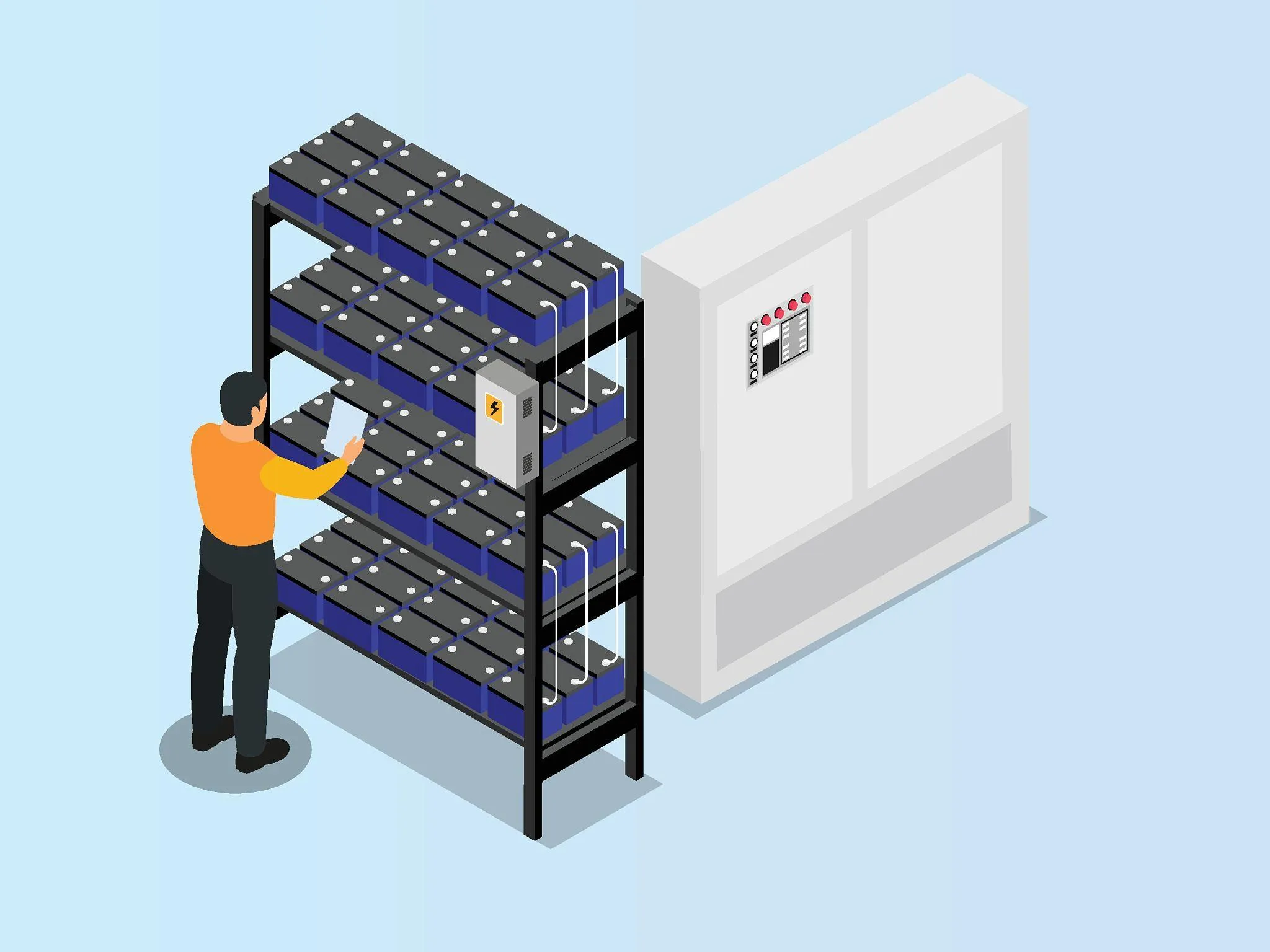
Battery augmentation and replacement are two different approaches to managing declining battery capacity.
The appropriate choice depends on the remaining battery performance, project requirements, system architecture, available installation space, and economic considerations.
A battery does not necessarily need to be replaced as soon as its capacity begins to decline. The key question is whether it can still meet the required operating conditions.
7.1 What Is Battery Augmentation?
Battery augmentation means adding new battery capacity to an existing energy storage system to compensate for capacity degradation or to increase the system's available energy.
For example, if an originally installed BESS no longer provides the energy capacity required by the project, additional battery modules or clusters may be installed to restore part of the lost capacity.
Augmentation may help extend the useful operating life of a project without replacing the entire battery installation.
However, adding new battery capacity is not simply a matter of connecting additional battery racks or containers to the existing DC bus.
The feasibility of augmentation depends on the original system architecture and the compatibility of the new battery equipment.
7.2 What Must Be Checked Before Adding New Battery Clusters?
When new battery clusters are connected to an existing BESS, several electrical and control-related conditions must be evaluated.
1. Voltage compatibility
The operating voltage range of the new battery clusters must be compatible with the existing DC system.
The minimum and maximum cluster voltages should be checked against the DC bus, PCS operating range, and protection settings.
2. SOC and terminal voltage compatibility
Differences in SOC and terminal voltage between new and existing clusters can create unequal current distribution or potentially high equalization currents when they are connected in parallel.
The permitted voltage and SOC differences must follow the battery manufacturer's connection and commissioning requirements.
3. Internal resistance and aging differences
New battery clusters may have lower internal resistance and different dynamic characteristics from older clusters.
When connected in parallel, these differences can affect current sharing. The resulting current distribution should be evaluated under relevant operating conditions.
4. BMS and EMS compatibility
The new battery equipment must communicate correctly with the existing BMS and EMS architecture.
This includes monitoring, alarm handling, protection coordination, SOC estimation, operating limits, and system-level power control.
5. PCS and DC-side compatibility
The additional battery capacity must remain within the PCS's permitted DC voltage and current range.
The DC bus, combiner, cables, busbars, contactors, fuses, and other protection components must also be checked for the increased electrical loading.
6. System architecture and available capacity
Not every BESS is designed for straightforward battery expansion.
Some systems allow additional battery clusters to be connected through dedicated parallel branches. Others may require changes to DC-side equipment, control configuration, or power-conversion architecture.
In certain designs, additional DC/DC conversion equipment or a separate PCS arrangement may be required.
Before planning augmentation, project teams should review the original battery configuration, cluster connections, DC combiner design, and PCS interface.
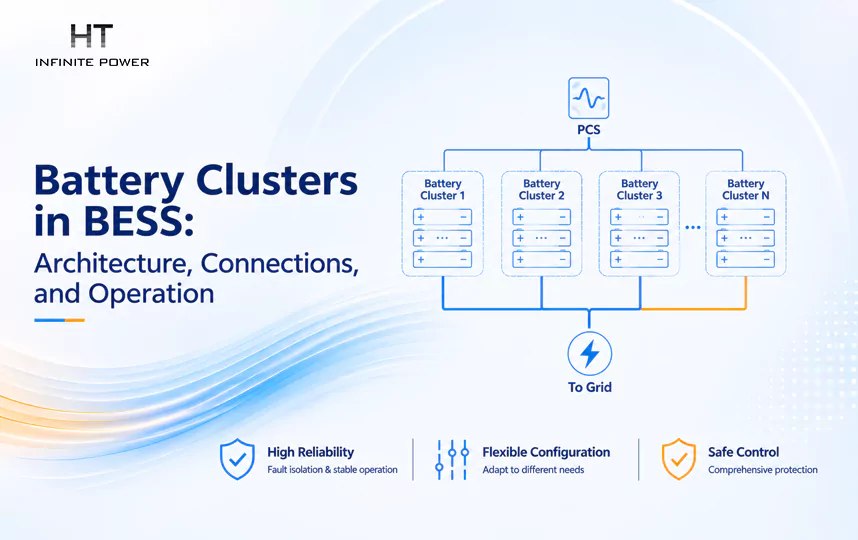
The way multiple battery clusters are connected also affects how a system can be expanded or isolated. For a more detailed explanation, see our guide to [Battery Clusters in BESS: Architecture, Connections, and Operation].
7.3 When Is Battery Replacement Necessary?
Battery replacement may be necessary when the existing battery system can no longer meet the project's technical or safety requirements.
Common reasons include:
- Available energy has fallen below the required operating level.
- The battery can no longer maintain the required discharge duration.
- Internal resistance growth limits the required power output.
- Battery faults or safety concerns make continued operation unsuitable.
- Augmentation is technically impractical or economically unattractive.
- The existing battery has reached the end of its contractual or operational service life.
Replacement may involve replacing individual modules, complete battery clusters, or the entire battery installation, depending on the system architecture and the condition of the equipment.
7.4 How to Decide Between Augmentation and Replacement
The decision should be based on the technical condition of the battery and the remaining economic value of the project.
| Evaluation Factor | Battery Augmentation | Battery Replacement |
| Main Objective | Restore or increase available energy capacity | Restore battery performance or address end-of-life conditions |
| Existing Battery | Retained if still suitable for operation | Partly or fully removed, depending on scope |
| System Compatibility | Requires compatibility between new and existing equipment | Requires compatibility with the existing or redesigned system |
| Installation Scope | May require additional battery branches and control integration | May involve more extensive electrical and mechanical work |
| Main Technical Concern | Voltage, SOC, resistance, current sharing, BMS and PCS compatibility | Replacement design, system integration, commissioning, and disposal |
| Economic Consideration | Cost of additional capacity versus remaining project value | Replacement cost versus continued operation or project renewal |
Neither approach is automatically better.
Augmentation may be appropriate when the existing battery remains safe and operationally useful, and the system architecture supports the addition of new capacity.
Replacement may be more suitable when the existing battery has significant degradation, recurring faults, or compatibility limitations that make further augmentation impractical.
The decision should also consider installation downtime, available space, future maintenance, warranty coverage, and the expected remaining project life.
7.5 Is 80% SOH Always the Battery End-of-Life Point?
No. An 80% SOH threshold is commonly used as a reference in some battery applications, but it is not a universal end-of-life definition for every BESS project.
The actual end-of-life criterion depends on the project requirements, battery warranty, operating strategy, and applicable technical specifications.
For example, a system designed to provide a fixed amount of energy for a specific duration may reach its operational limit when available energy falls below that requirement, even if its measured SOH is higher than 80%.
Conversely, a system with less demanding energy requirements may remain useful at a lower capacity level, provided that power capability, safety, and other operating requirements remain acceptable.
The end-of-life decision should therefore be based on the battery's measured condition and the system's ability to meet its intended duty, rather than a single SOH percentage.
Conclusion
Lithium-ion battery lifespan in a BESS is determined by the combined effects of cycle aging, calendar aging, operating conditions, and system-level requirements.
Cycle-life specifications provide useful reference data, but they cannot independently predict the service life of a complete energy storage installation. Project teams must also evaluate annual energy throughput, SOC and temperature profiles, power requirements, warranty conditions, and the effects of degradation on usable energy and system operation.
As a BESS ages, battery augmentation or replacement may become necessary. The right approach depends not only on the remaining battery capacity but also on electrical compatibility, system architecture, safety, and the project's long-term performance requirements.
For BESS developers and system integrators, battery lifespan should therefore be considered from the early design and procurement stages. A system designed with appropriate operating limits, monitoring, thermal management, and future expansion considerations is better positioned to maintain its intended performance throughout the project lifecycle.
Frequently Asked Questions
How Long Do Lithium-Ion Batteries Last in a BESS?
There is no single lifespan applicable to all lithium-ion BESS installations. Actual service life depends on battery chemistry, cycle-life performance, calendar aging, operating temperature, SOC range, and the project's charge and discharge profile.
The manufacturer's cycle-life data and warranty conditions should be evaluated together with the expected operating conditions.
Does a Battery Lose Capacity Even When It Is Not Used?
Yes. Lithium-ion batteries experience calendar aging even when they are not actively charging or discharging.
Storage temperature, SOC, cell chemistry, and the duration of standby periods all influence this process.
What Is the Difference Between Cycle Life and Calendar Life?
Cycle life describes how many charge and discharge cycles a battery can complete under specified conditions before reaching a defined performance threshold.
Calendar life describes time-related aging, which occurs regardless of whether the battery is cycling.
Both affect the actual service life of a BESS battery.
Can a BESS Battery Continue Operating After Reaching 80% SOH?
Potentially, yes. An 80% SOH value is not a universal shutdown threshold.
Whether the battery can continue operating depends on the project's minimum energy and power requirements, safety condition, warranty terms, and operating limits.
Can New Battery Clusters Be Connected to an Existing BESS?
In some systems, yes. However, compatibility must be verified before connecting new clusters.
Important considerations include DC voltage, SOC, internal resistance, current sharing, BMS and EMS communication, PCS limits, and DC-side protection.
The original system architecture must also support the proposed expansion.
Is Battery Augmentation Better Than Full Battery Replacement?
Not necessarily. Augmentation may be more practical when the existing battery remains in suitable condition and the system supports additional capacity.
Replacement may be more appropriate when the existing battery has significant degradation, safety concerns, or compatibility limitations.
The decision should consider technical feasibility, project economics, downtime, and remaining service life.
Battery Clusters in BESS: Architecture, Connections, and Operation
Related Article