Centralized vs. String PCS Architecture in BESS: Key Differences and Selection
author: HT Infinite Power
2026-11-12
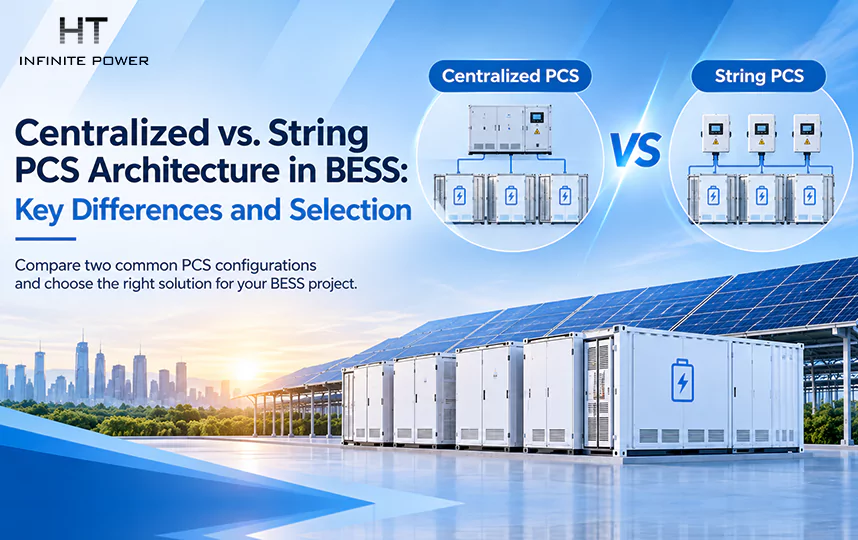
Choosing the right power conversion system (PCS) architecture is an important part of battery energy storage system (BESS) design. It affects how battery clusters are connected, how power is controlled, how faults are isolated, and how the system is integrated on the AC and DC sides.
Two common configurations are centralized PCS and string PCS architectures. In a centralized configuration, multiple battery clusters share a common DC collection system and connect to a centralized PCS power block. In a string configuration, each battery cluster has an independent PCS channel, with the PCS outputs combined on the AC side.
Neither architecture is universally better. The right choice depends on battery configuration, project capacity, operating requirements, site conditions, electrical design, and lifecycle economics.
This article compares the two architectures from an engineering and system-integration perspective and explains what EPC contractors and BESS developers should consider when selecting a PCS configuration.
1. What Are Centralized and String PCS Architectures in BESS?
The main difference between centralized and string PCS architectures is where power conversion takes place and how battery clusters are connected.
It is important to define the comparison at the PCS power-block level. A large BESS plant may contain several centralized PCS power blocks rather than relying on a single PCS for the entire site.
Centralized PCS Architecture
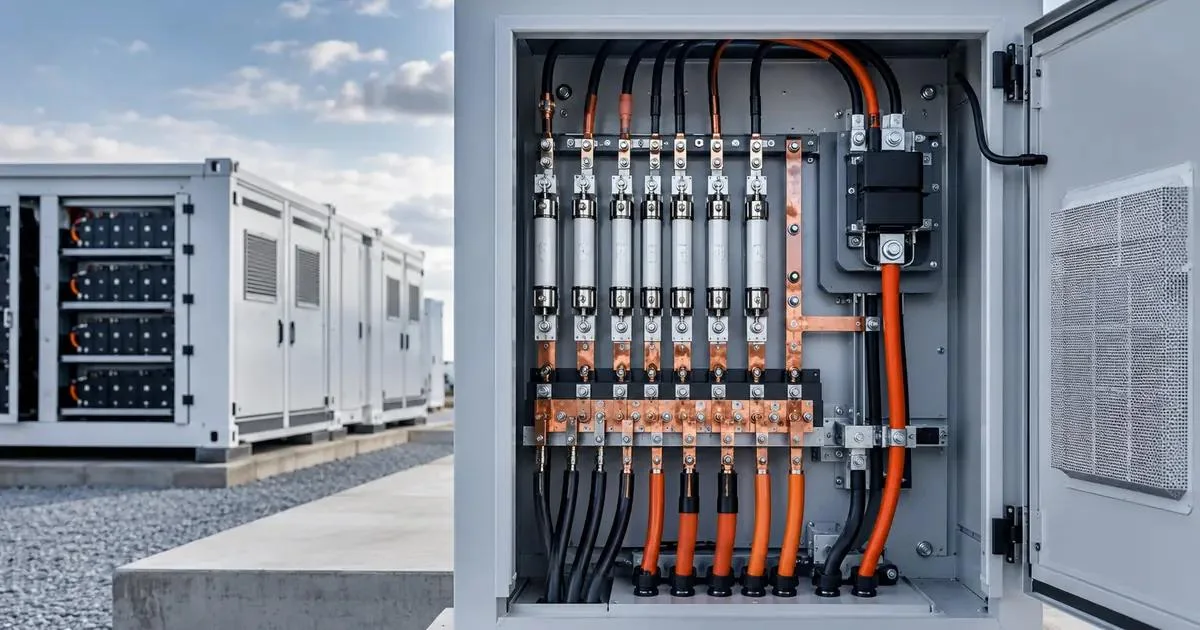
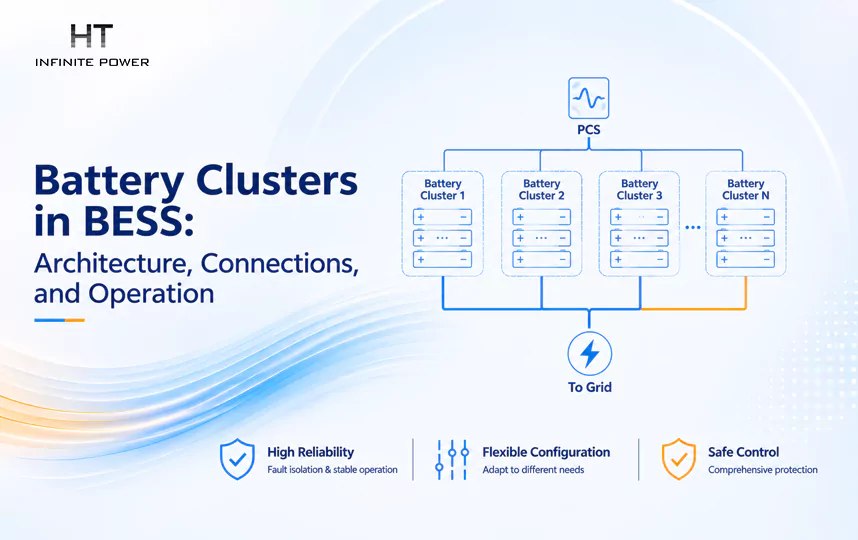
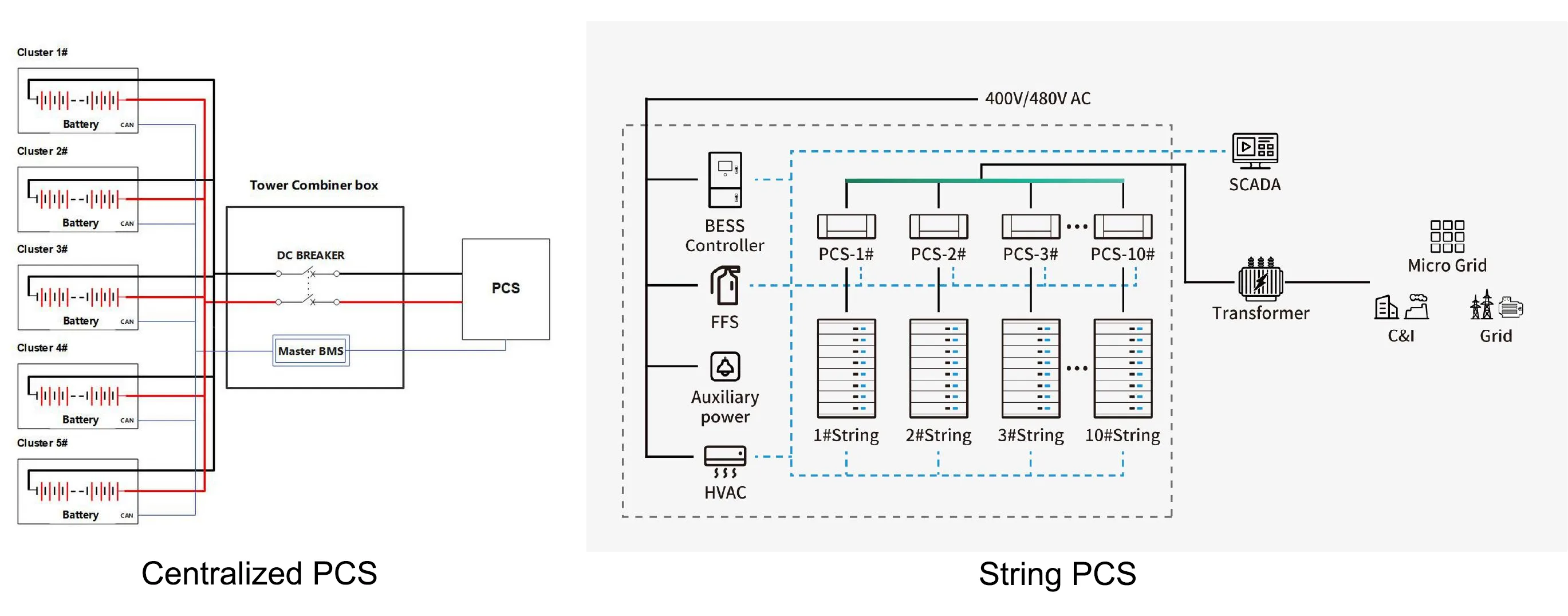
In a centralized PCS configuration, multiple battery clusters are connected in parallel through a common DC collection system. A DC combiner cabinet or equivalent collection and protection equipment is typically used to bring the battery-side connections together before they feed a centralized PCS.
The PCS then converts the combined DC power into AC power for connection to the site's AC distribution system or grid interface.
This configuration can be understood as a one-to-many arrangement: multiple battery clusters share one centralized PCS power block.
Its main characteristics include:
- Multiple battery clusters connected to a common DC bus.
- Centralized DC-to-AC power conversion.
- DC combiner or equivalent DC collection equipment.
- Shared power conversion and control at the PCS power-block level.
Centralized PCS systems can simplify the overall conversion structure by reducing the number of PCS units. They are often considered where the battery clusters have compatible electrical characteristics and the project benefits from a relatively concentrated power conversion arrangement.
However, connecting multiple battery clusters to a shared DC bus places greater importance on battery consistency, current distribution, and DC-side protection.
String PCS Architecture
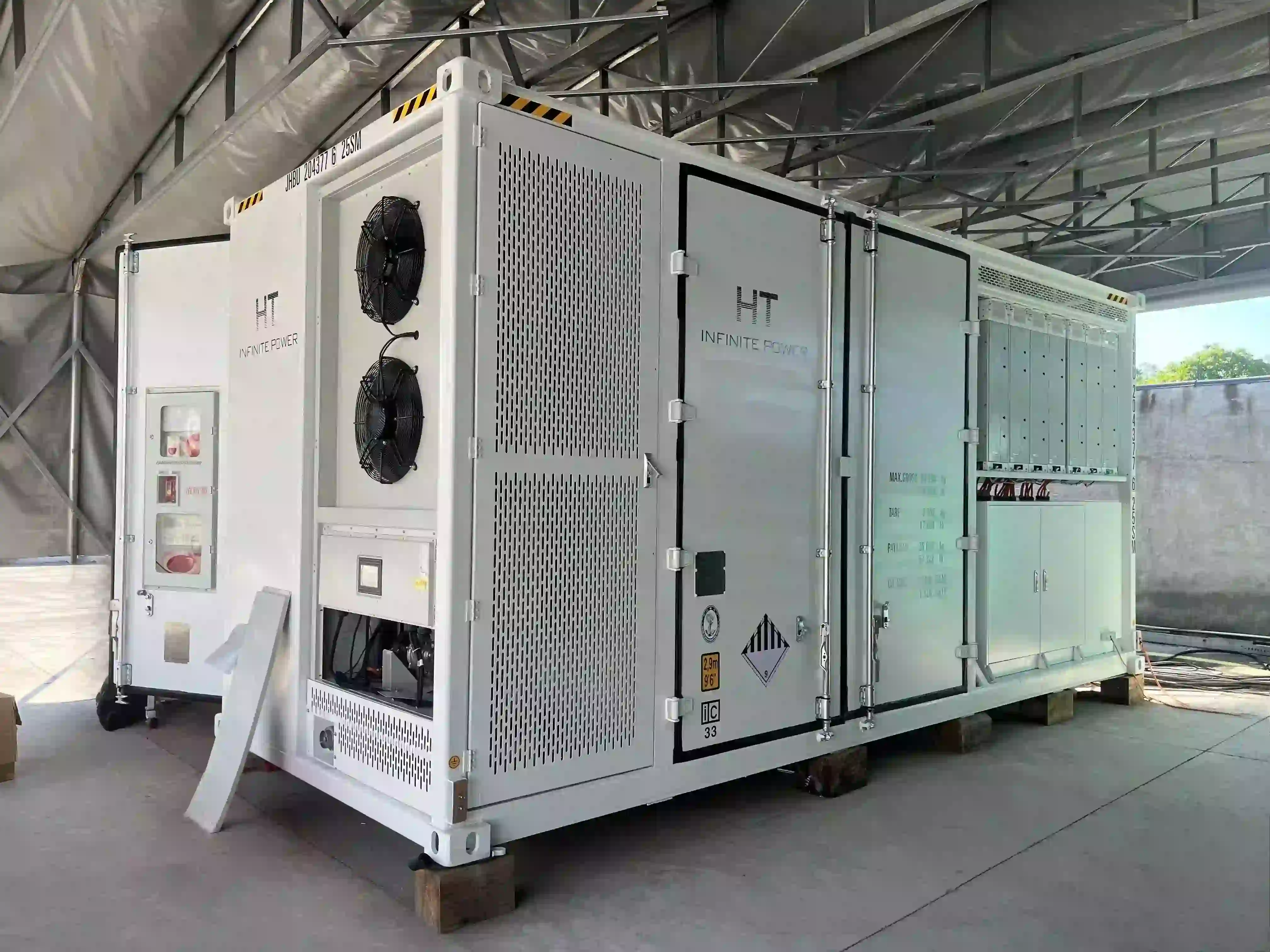
In a string PCS configuration, each battery cluster is connected to an independent PCS channel. Instead of combining multiple battery clusters on a common DC bus before power conversion, each cluster has its own DC-to-AC conversion path.
The outputs of the individual PCS units are then collected on the AC side and connected to the site's electrical system.
This can be understood as a one-to-one arrangement: one battery cluster corresponds to one independent PCS channel.
Its main characteristics include:
- Each battery cluster has an independent PCS.
- DC-to-AC conversion takes place separately for each cluster.
- Battery clusters are not directly paralleled on a common DC bus within the same PCS power block.
- PCS outputs are combined on the AC side.
The PCS units may be installed in separate enclosures or integrated into a larger equipment assembly. Their physical location does not determine whether the architecture is centralized or string-based. The defining factor is whether each battery cluster has an independent PCS power conversion path.
This arrangement provides more granular control over individual battery clusters and can make it easier to isolate a specific cluster or PCS channel when a fault occurs.
One distinction is worth noting: a system in which each battery cluster has its own DC/DC converter but all clusters share a centralized DC/AC PCS is a different multi-stage architecture. It should not be confused with the one-cluster-one-PCS configuration discussed here.
2. Centralized vs. String PCS: Key Differences
The two architectures differ in their DC-side connections, power conversion structure, control granularity, and equipment requirements.
| Comparison | Centralized PCS | String PCS |
| Battery-to-PCS relationship | Multiple clusters share a PCS power block | One cluster connects to one independent PCS |
| DC-side configuration Common | DC collection system Independent | DC input path for each cluster |
| Power conversion | Centralized | Distributed across multiple PCS units |
| Power aggregation | Primarily on the DC side before conversion | Primarily on the AC side after conversion |
| DC combiner equipment | Typically required | Generally not required for combining separate clusters before the PCS |
| Battery control granularity | More centralized at the PCS power-block level | More granular at the cluster level |
| Fault isolation | May affect a larger shared DC power block, depending on protection design | Individual PCS channels can generally be isolated separately |
| PCS quantity | Fewer, larger PCS units | More, smaller PCS units |
| Integration focus | DC-side collection and coordination | AC-side collection and coordination |
| Cost structure | Concentrated PCS equipment and DC-side integration | More PCS units, with different DC- and AC-side BoS requirements |
The table describes typical configurations rather than fixed rules for every BESS product. Actual equipment arrangements depend on the PCS design, battery topology, protection scheme, and project requirements.
3. How Do the Two Architectures Affect BESS Performance?
The architectural differences are not limited to equipment connections. They also influence how the system responds to battery variation, equipment faults, changing operating conditions, and partial-load operation.
Battery Consistency and DC Circulating Current
Battery consistency is an important consideration when multiple battery clusters are connected in parallel on a common DC bus.
Even when battery clusters use the same cell type and nominal capacity, their actual operating conditions may differ. Variations in state of charge (SOC), internal resistance, temperature, terminal voltage, and cable or connection impedance can affect how current is distributed between parallel branches.
When clusters with different voltage levels are connected to the same DC bus, current may flow between them under certain operating conditions. This phenomenon is commonly described as circulating current.
The magnitude and impact depend on the electrical design and operating conditions. It is not inevitable that every centralized BESS will experience significant circulating current, but the possibility needs to be considered during system design.
A centralized architecture therefore places particular importance on:
- Consistency between battery clusters.
- Matching of battery voltage and operating ranges.
- DC cable and connection impedance.
- Branch-level current monitoring and protection.
- Battery balancing and coordinated operating strategies.
String PCS architecture changes the connection relationship. Because each battery cluster has an independent PCS channel, separate clusters are not directly connected in parallel on the DC side within the same power block.
This reduces the potential for direct DC-side interaction between clusters through a shared bus. Each PCS can also regulate its connected battery cluster within its own operating limits.
However, independent PCS channels do not eliminate the need for battery management. The BMS must still monitor cell and cluster conditions, enforce charging and discharging limits, and protect the battery against abnormal operation.
Fault Isolation and System Availability
Fault isolation is another important difference.
In a centralized PCS configuration, multiple battery clusters share a common power conversion path. A fault involving the centralized PCS or a shared DC-side component may affect a larger portion of the associated power block.
The actual impact depends on the protection arrangement. Properly designed DC branch protection and isolation devices can help prevent a fault in one battery branch from spreading to other branches.
In a string PCS configuration, each battery cluster has an independent PCS channel. If one cluster or PCS develops a fault, that channel may be disconnected while other channels continue operating.
This provides more granular fault isolation and can reduce the amount of battery capacity affected by an individual channel fault.
However, this does not automatically guarantee higher overall system availability. The AC collection system, transformer, switchgear, plant-level controller, communication network, and grid connection may still contain shared components that affect multiple PCS channels.
There is also a maintenance consideration. String architectures use more PCS units, which means more individual components to monitor, maintain, and potentially replace.
For EPC contractors and operators, the relevant question is not simply how many PCS units are installed. It is how faults are detected, isolated, and recovered, and how much system capacity remains available during maintenance or equipment failure.
Power Control and Operational Flexibility
Centralized PCS architecture coordinates the power conversion of multiple battery clusters through a shared PCS power block.
This can be suitable when the battery clusters have similar operating characteristics and are expected to operate under broadly coordinated charging and discharging conditions.
The control arrangement is relatively concentrated. However, the ability to independently manage the power contribution of each battery cluster may be more limited, depending on the system's DC-side design and available control equipment.
String PCS architecture provides a more granular control structure. Each PCS can regulate the power exchanged with its connected battery cluster within the limits imposed by the BMS and the PCS itself.
This can be useful when battery clusters have different operating conditions or when the project requires more flexible power allocation.
For example, if one battery cluster reaches a charging or discharging limit before the others, its PCS channel can adjust its output independently. Other clusters may continue operating within their own permitted ranges.
The plant-level EMS remains responsible for coordinating the overall system. Independent PCS channels do not mean that each battery cluster operates as a completely separate energy storage system.
The EMS must coordinate active and reactive power commands, operating limits, grid requirements, and system-level objectives across the available PCS units.
System Efficiency and Conversion Losses
Neither centralized nor string PCS architecture is inherently more efficient in every application.
A centralized system may benefit from using fewer, larger PCS units. Depending on the PCS design and operating profile, this can reduce the number of conversion units and associated auxiliary loads.
A string configuration uses more PCS units, but individual units may be operated according to the availability and power requirements of their connected battery clusters. This can provide operational flexibility under certain load conditions.
Actual system efficiency depends on several factors:
- PCS conversion efficiency across different load levels.
- DC and AC cable length and conductor sizing.
- Transformer and switchgear losses.
- Auxiliary power consumption.
- Number of PCS units operating at a given time.
- Battery operating voltage and current range.
- Charging and discharging profile.
For example, a PCS may achieve its highest conversion efficiency near a particular load range. If a project frequently operates at low power, the efficiency of the selected PCS and its part-load performance may matter more than its rated peak efficiency.
Similarly, a distributed architecture may reduce some DC-side electrical losses while introducing different AC-side collection and integration requirements.
A meaningful comparison should therefore evaluate the complete power path, rather than comparing only the rated efficiency figures of individual PCS products.
4. Cost, Efficiency, and Lifecycle Considerations
The initial equipment price is only one part of the economic comparison. The selected architecture affects PCS quantity, electrical balance of system (BoS), installation work, maintenance requirements, and potential downtime.
Initial Equipment and Installation Costs
Centralized PCS architecture generally requires fewer PCS units because multiple battery clusters share a common power conversion system.
This can reduce the number of PCS units and simplify some aspects of equipment procurement. However, the DC-side collection system, including combiner cabinets, DC protection, and associated cabling, must be included in the cost calculation.
String PCS architecture requires more PCS units. This may increase PCS-related equipment costs, particularly when several independent conversion channels are needed to achieve the required system power.
At the same time, it may reduce the need for DC combiner equipment and some shared DC-side collection components. Additional AC-side switchgear, cabling, protection, and collection arrangements may be required.
Consequently, it is not accurate to conclude that string PCS is always more expensive or that centralized PCS is always cheaper.
A project-level cost comparison should include:
- PCS equipment and associated accessories.
- DC combiner cabinets and protection devices.
- DC and AC cables and installation materials.
- AC switchgear and collection equipment.
- Transformers and medium-voltage integration.
- Equipment foundations, enclosures, and installation work.
- Commissioning and control-system integration.
The final cost depends on the project capacity, equipment ratings, electrical layout, local installation conditions, and supplier configuration.
System Efficiency and Energy Losses
Efficiency should be evaluated over the expected operating profile rather than from a single maximum-efficiency value.
For projects that frequently operate near rated power, the performance of the selected PCS at high load may be a major consideration. For applications involving frequent partial-load operation, the part-load efficiency curve and the number of active PCS units may become more important.
The electrical layout also affects losses. Centralized systems may involve longer or more heavily loaded DC connections, depending on battery placement and PCS location. String systems may have more AC-side collection connections.
The best configuration is the one that achieves the required system-level performance after accounting for conversion losses, cable losses, transformer losses, and auxiliary consumption.
EPC contractors should request efficiency curves and system-level loss calculations based on the project's expected operating conditions. Comparing isolated product specifications is not sufficient to establish which architecture will deliver more usable energy over its lifetime.
Maintenance, Availability, and Lifecycle Costs
Maintenance costs depend on more than the number of PCS units.
A centralized configuration has fewer PCS units, which can simplify some maintenance activities. However, a fault in a shared PCS or common DC-side component may affect a larger portion of the associated power block.
String PCS provides more individual conversion channels. This can make it possible to isolate and service a single channel while keeping other channels in operation, provided the AC-side design and control strategy support continued operation.
The trade-off is a larger number of PCS units and associated components requiring inspection, monitoring, and maintenance.
Lifecycle cost analysis should consider:
- Expected PCS service life and replacement requirements.
- Availability of spare parts.
- Maintenance access and replacement procedures.
- Fault detection and isolation capabilities.
- Expected downtime and energy not delivered.
- Auxiliary consumption over the operating life.
- Warranty conditions and service support.
A configuration with a lower initial purchase price may not necessarily deliver the lowest lifecycle cost. Equally, a more modular architecture should not be assumed to produce higher financial returns without evaluating the actual operating conditions and maintenance strategy.
5. How to Choose Between Centralized and String PCS for a BESS Project
The selection should begin with the project's electrical and operational requirements, rather than a general preference for one architecture.
When Centralized PCS May Be Suitable
Centralized PCS can be a suitable option when:
- Battery clusters have compatible voltage ranges and operating characteristics.
- The project uses a relatively uniform battery configuration.
- The DC-side collection and protection design can be implemented effectively.
- A concentrated power conversion arrangement is preferred.
- The project benefits from using fewer, larger PCS units.
- The electrical layout supports practical DC-side cable routing and installation.
For projects with consistent battery configurations and coordinated operating requirements, centralized PCS may provide a straightforward system structure.
However, the engineering team should verify DC current distribution, battery compatibility, branch protection, and the impact of a centralized PCS fault on the overall power block.
When String PCS May Be a Better Choice
String PCS may be more appropriate when:
- More granular control of individual battery clusters is required.
- Battery clusters have different operating conditions or availability.
- The project places importance on independent PCS channel operation.
- More flexible fault isolation is a design priority.
- The AC-side collection arrangement is practical for the site.
- The project may benefit from a modular power conversion structure.
For example, a project with multiple battery clusters operating under different conditions may benefit from independent PCS channels. If one cluster reaches its operating limit or needs to be isolated for maintenance, the remaining channels may continue operating within the system's design limits.
Nevertheless, the additional PCS units and AC-side integration requirements should be evaluated against the potential operational benefits.
What EPC Contractors and System Integrators Should Evaluate
Before selecting an architecture, EPC contractors and system integrators should assess the following factors.
1. Battery configuration and operating range
Check battery voltage range, cluster capacity, current limits, SOC operating window, and consistency between clusters. These parameters influence whether a shared DC connection is appropriate.
2. PCS power and voltage compatibility
Verify that the PCS input voltage range, maximum DC current, power rating, and operating limits match the battery configuration. The AC output voltage and grid connection requirements must also be considered.
3. DC- and AC-side electrical design
Compare the required DC collection, combiner equipment, branch protection, AC switchgear, cabling, and transformer arrangements. The complete electrical design should be assessed rather than looking at PCS equipment alone.
4. Protection and fault isolation
Review how battery, PCS, DC bus, and AC-side faults are detected and isolated. Confirm which parts of the system may be affected by a single equipment failure.
5. EMS and communication integration
Check whether the EMS can coordinate the selected PCS configuration, including active power, reactive power, charging and discharging limits, alarms, and operating status. For string architectures, the integration design should account for the larger number of PCS communication channels.
6. Site layout and installation conditions
Consider equipment footprint, cable routing, maintenance access, ventilation or cooling requirements, and the location of transformers and switchgear. The preferred architecture should be practical to install and maintain at the actual project site.
7. Lifecycle economics
Compare initial equipment costs, installation costs, expected energy losses, maintenance requirements, spare parts, and potential downtime. The evaluation should reflect the project's actual operating profile and revenue model.
Ultimately, the choice between centralized and string PCS should be based on the complete BESS design. The architecture must work with the battery configuration, electrical infrastructure, control strategy, and operating requirements as one integrated system.
Conclusion
Centralized and string PCS architectures provide different approaches to connecting battery clusters and managing power conversion in a BESS.
Centralized PCS combines multiple battery clusters through a shared DC collection system before power conversion. It can reduce the number of PCS units, but requires careful attention to battery consistency, DC current distribution, and shared-component protection.
String PCS assigns an independent PCS channel to each battery cluster and combines the outputs on the AC side. It offers more granular power control and fault isolation, but requires more PCS units and a different AC-side integration arrangement.
For EPC contractors, developers, and system integrators, the decision should not be based on equipment count or rated efficiency alone. Battery compatibility, electrical design, fault isolation, operating profile, installation cost, and lifecycle performance all need to be considered.
The most suitable PCS architecture is the one that meets the project's technical and economic requirements while maintaining a practical balance between system performance, integration complexity, and long-term operation.
Frequently Asked Questions
What is the main difference between centralized PCS and string PCS?
The main difference is how battery clusters connect to the PCS. In a centralized architecture, multiple battery clusters share a common DC collection system and feed a centralized PCS power block. In a string architecture, each battery cluster connects to an independent PCS channel, and the outputs are combined on the AC side.
Does string PCS eliminate DC circulating current?
String PCS avoids directly connecting multiple battery clusters in parallel on a common DC bus within the same PCS power block. This reduces the potential for direct DC-side circulating current between those clusters. However, it does not eliminate every possible current imbalance or electrical interaction elsewhere in the system.
Is string PCS more reliable than centralized PCS?
Not necessarily. String PCS provides more granular fault isolation because individual battery clusters have independent PCS channels. However, it also introduces more PCS units and associated components. Overall reliability and availability depend on equipment quality, protection design, common AC-side components, control systems, and maintenance arrangements.
Is centralized PCS cheaper than string PCS?
Centralized PCS may require fewer PCS units, while string PCS may require more conversion equipment. However, string architecture can reduce some DC-side collection equipment, while centralized architecture may require more DC-side combiner and protection equipment. The actual cost difference depends on the complete system design and project conditions.
Can centralized and string PCS architectures both be used in large-scale BESS projects?
Yes. Both architectures can be used in large-scale BESS projects. The appropriate configuration depends on battery design, power conversion requirements, grid connection conditions, control strategy, site layout, and lifecycle economics. A large plant may also consist of multiple PCS power blocks rather than a single centralized unit.
UPS Systems Explained: Working Principles, Types, and Key Components
BESS Communication Protocols: How Energy Storage Systems Communicate Internally and Externally
Related Article