Mining’s New Power Backbone: The Rise of On-Site Energy Storage
author: HT infinitepower
2026-07-02
Mining has always been a negotiation with the environment. You negotiate with geology, with weather, with logistics—and with electricity. Anyone who has worked at a remote mine knows that power is never just “there.” It arrives through long feeders, across mountains or deserts, often pushed to their limits by distance and terrain. And yet the mine itself behaves like a creature with sudden impulses: a shovel demands a surge, a crusher snaps into its cycle, a hoist accelerates under load. The grid tries to keep up, but it wasn’t built for this kind of choreography.
This mismatch—between what the mine needs and what the grid can deliver—is exactly where on-site energy storage has quietly stepped in. Not as a futuristic concept, not as a sustainability checkbox, but as a practical engineering tool that changes how mines think about electricity.
Where Mining Power Really Breaks Down
If you ask a utility engineer what makes mining loads difficult, they won’t talk about average demand. They’ll talk about the shape of the load curve. Mining loads don’t rise; they jump. They don’t drift; they pulse. A shovel’s dig cycle is a repeating shockwave. A crusher’s torque profile is a rhythmic punch. A hoist’s acceleration is a sudden spike that lasts just long enough to annoy every upstream device.
And when the mine sits at the end of a feeder, every fluctuation becomes exaggerated. Voltage dips travel farther. Harmonics linger longer. Transformers run hotter. The grid feels every heartbeat of the mine.
Why traditional reinforcement doesn’t solve the real problem
You can upgrade a transformer. You can thicken a cable. You can add a capacitor bank. But none of these respond in milliseconds. None of them anticipate a shovel’s next cycle. None of them smooth the jagged edges of mining loads. They increase capacity, but they don’t add agility.
Mining doesn’t just need more power. It needs power that behaves differently.
Storage as a Local Shock Absorber
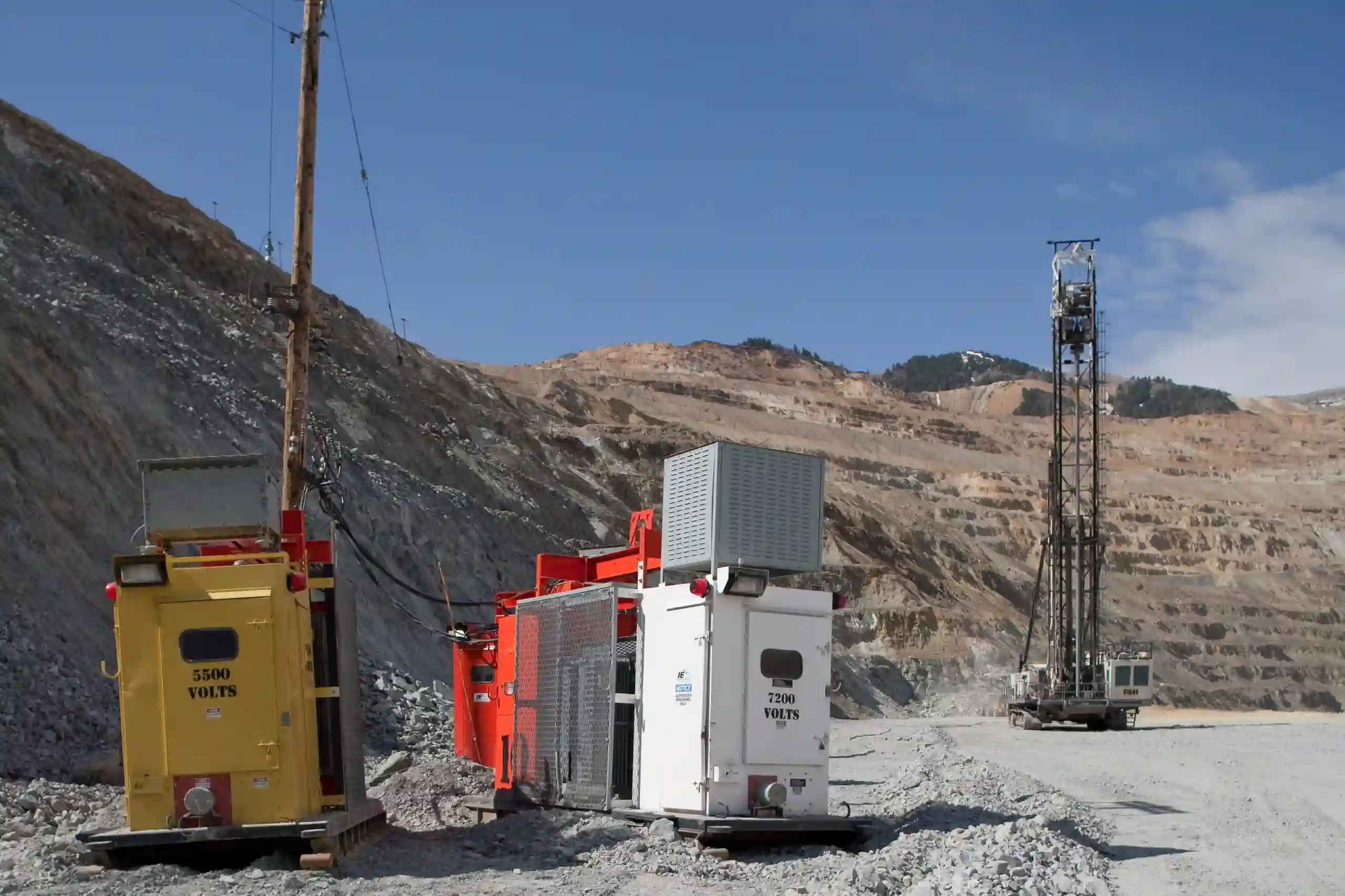
When storage enters the picture, the mine’s electrical behavior changes in a way that’s almost physical. The grid stops feeling every pulse. The transformer stops flinching at every spike. The feeder stops sagging under sudden demand.
Storage sits close to the load—physically and electrically. It sees the shovel’s cycle before the grid does. It knows the crusher’s rhythm. It understands the hoist’s acceleration profile. And because it reacts instantly, it becomes a shock absorber for the entire electrical system.
This isn’t peak shaving in the traditional sense. It’s load conditioning. It’s smoothing. It’s giving the grid time to breathe.
A moment worth describing
Imagine a shovel beginning a dig cycle. The current jumps. Without storage, the voltage dips, the transformer strains, and the feeder feels the impact. With storage, the battery discharges for a few seconds—just enough to flatten the spike. The grid barely notices.
That tiny moment repeats thousands of times a day. And each time, storage prevents a small problem from becoming a big one.
Electrified Haul Fleets Change the Math
Battery-electric haul trucks are rewriting the power profile of mines. A single truck charger can draw several megawatts. A cluster of chargers can overwhelm a feeder that was originally designed for lighting, pumps, and a few motors.
Charging events aren’t polite. They don’t spread themselves evenly across the day. Trucks return from haul cycles in groups. Charging demand arrives in waves.
Why charging clusters need storage
Storage absorbs these waves. It turns unpredictable charging into a predictable grid load. The mine can electrify its fleet without waiting for a utility upgrade that might take years—or might never come.
This is one of the clearest examples of storage enabling electrification instead of being a side effect of it.
Renewables Add Variability Mines Can’t Ignore
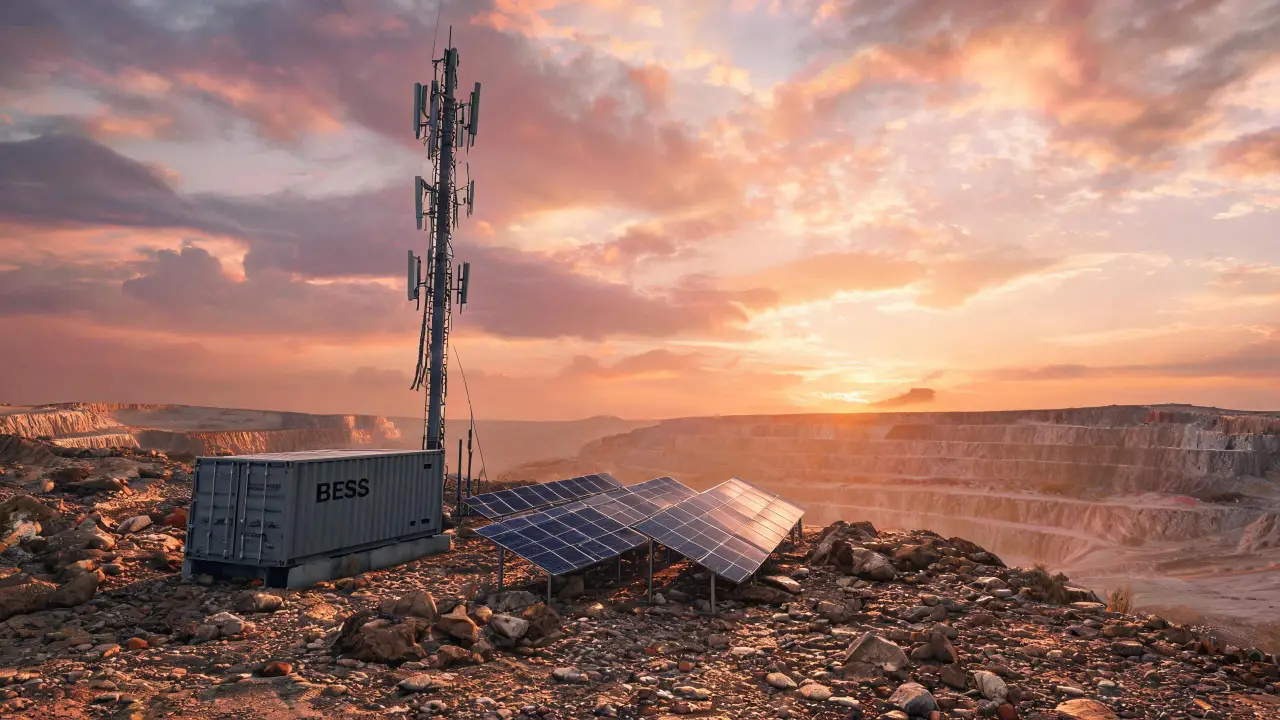
Mining companies are adding solar and wind for reasons that are both economic and political. But renewables introduce their own volatility. Solar output can swing sharply with passing clouds. Wind can fluctuate minute by minute. A mine already dealing with volatile loads cannot absorb renewable variability without help.
Storage becomes the stabilizer that makes renewables usable.
During peak solar hours, storage absorbs excess generation. When clouds reduce output, storage fills the gap. The mine sees a stable profile even when the renewable source is anything but stable.
A subtle but important point
Without storage, mines often curtail renewable energy because equipment cannot accept sudden surges. With storage, that surplus becomes usable. Diesel generators run less. Fuel costs drop. Emissions fall. And the mine’s power system becomes more predictable, not less.
Resilience: The Value Mines Don’t Advertise but Depend On
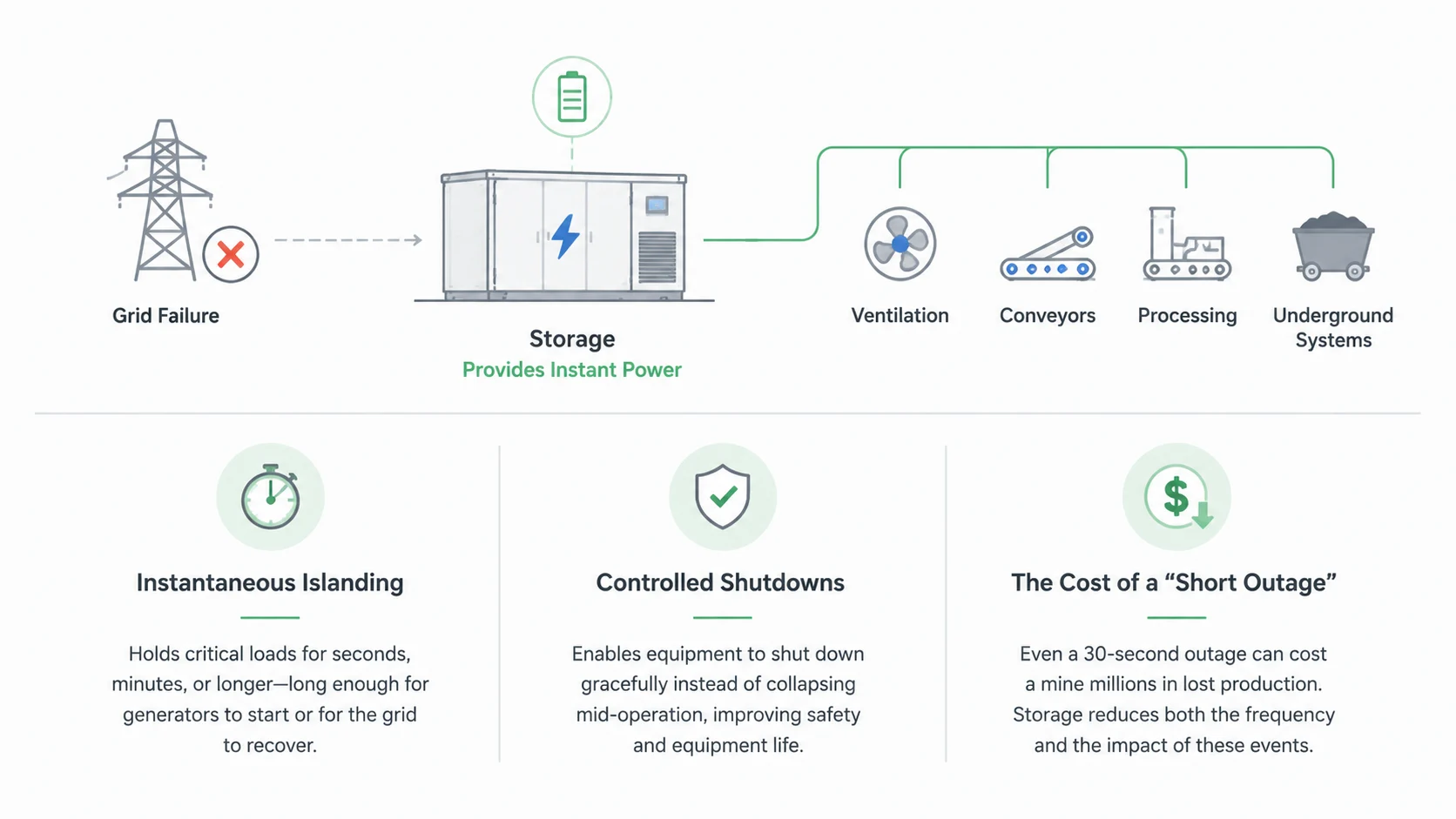
Power outages in mining environments are not just inconvenient—they are dangerous. Ventilation systems stop. Conveyors freeze mid-load. Processing lines halt in unstable states. Underground operations lose critical support systems.
Storage provides a layer of resilience that traditional systems cannot match.
Instantaneous islanding
When the grid fails, storage can hold the mine’s critical loads for seconds, minutes, or longer—long enough for generators to start or for the grid to recover. This isn’t backup power; it’s continuity.
Controlled shutdowns
If a full outage is unavoidable, storage allows equipment to shut down gracefully instead of collapsing mid-operation. That difference matters for both safety and equipment life.
The cost of a “short outage”
Even a 30-second outage can cost a mine millions in lost production. Storage reduces both the frequency and the impact of these events.
The Intelligence Layer Behind Modern Mining Storage
Today’s mining-grade storage systems are not just batteries. They are control systems with energy attached. They include:
- Grid-forming inverters that can establish voltage and frequency
- EMS platforms that learn load patterns and anticipate spikes
- Fast-response PCS designed for megawatt-scale events
- Harmonic suppression for sensitive automation equipment
- Thermal and fire management built for harsh environments
These systems don’t just react—they predict. They don’t just stabilize—they optimize. They become part of the mine’s electrical personality.
Why Mines Are Adopting Storage Faster Than Other Industries
Mining has a unique combination of pressures:
- High-power volatility
- Remote locations
- Electrification of heavy equipment
- Renewable integration
- High cost of outages
- Long equipment lifecycles
Storage addresses all of these simultaneously. It’s rare for a single technology to solve so many operational challenges at once.
A Shift in How Mines Think About Power
As storage becomes more common, mines are moving from a “grid-dependent” mindset to a “grid-augmented” one. Instead of relying solely on upstream infrastructure, they build their own stability layer on-site.
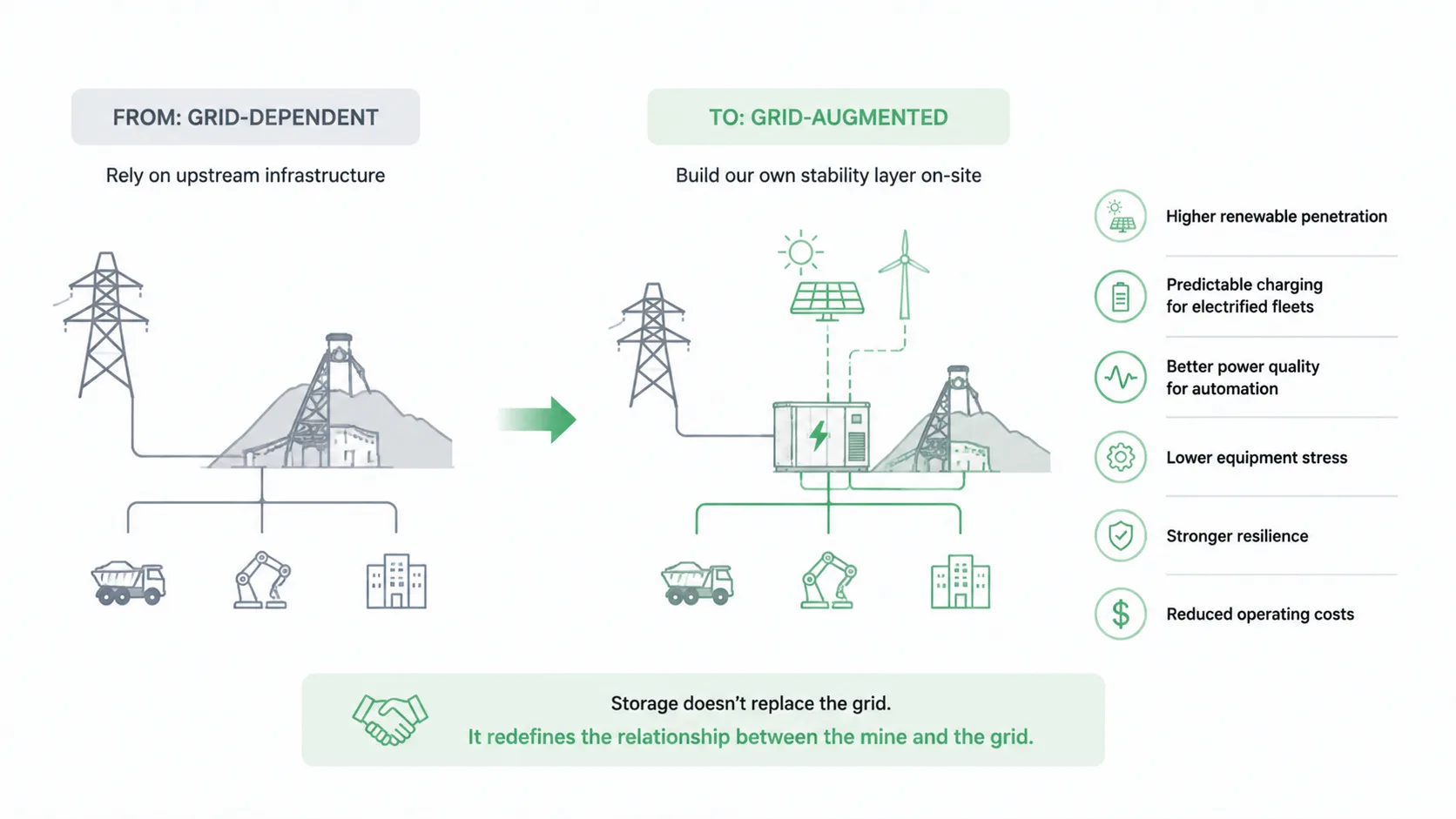
This shift enables:
- Higher renewable penetration
- Predictable charging for electrified fleets
- Better power quality for automation
- Lower equipment stress
- Stronger resilience
- Reduced operating costs
Storage doesn’t replace the grid. It redefines the relationship between the mine and the grid.
Closing Thoughts
On-site energy storage is becoming the new backbone of mining power systems not because it is trendy, but because it solves problems the grid cannot solve quickly or economically. It adds flexibility where the grid is rigid. It adds intelligence where the grid is simple. It adds resilience where the grid is fragile.
Its impact will reach every mine that depends on stable, efficient, and safe electricity—from remote open-pit operations to underground complexes and processing plants. In an industry where power reliability directly shapes productivity and safety, storage is not just a technology upgrade. It is a strategic shift in how mines power their future.
Its impact will reach every mine that depends on stable, efficient, and safe electricity—from remote open-pit operations to underground complexes and processing plants. In an industry where power reliability directly shapes productivity and safety, storage is not just a technology upgrade. It is a strategic shift in how mines power their future.
FAQ
1.Why are mining loads so hard for the grid to handle?
Mining equipment produces abrupt, high-power impulses—shovels, crushers, hoists. These spikes travel through long feeders and cause voltage dips the grid cannot correct fast enough.
2.How does on-site storage stabilize a mine’s electrical environment?
Storage reacts in milliseconds, smoothing sudden load jumps before they reach transformers or upstream lines. It acts as a local shock absorber for the entire mine.
3.Why is storage essential for battery-electric haul truck charging?
Truck charging arrives in megawatt-scale bursts. Storage absorbs these bursts and presents a steady, predictable load to the grid, preventing feeder overloads.
4.Does storage make solar and wind practical for mining operations?
Yes. Storage captures excess solar, fills gaps during cloud cover, and smooths wind variability—turning unstable generation into reliable power for critical equipment.
5.How does storage improve safety during outages or power disturbances?
During interruptions, storage keeps ventilation, pumps, and communication systems running long enough for controlled shutdowns or generator startup, reducing operational risk.
Beyond Energy Storage: How New-Generation Storage Is Reshaping the Energy Landscape
What Feeder-Level Energy Storage Is and Why It Matters