Lithium Battery Electrolytes: A Breakthrough to −110 °C in Extreme Cold
2026-01-09

The sudden loss of power in electric vehicles during harsh winters, smartphones shutting down instantly at −30 °C, and polar research equipment grinding to a halt due to battery failure all point to the same underlying issue: the Achilles’ heel of lithium batteries—poor low-temperature performance. At the heart of this limitation lies the electrolyte, often described as the “blood” of a lithium battery.
As one of the four core materials in lithium batteries, the electrolyte is responsible for transporting lithium ions between the electrodes. It directly determines charging and discharging efficiency, cycle life, and environmental adaptability. From everyday consumer electronics to large-scale energy storage systems, and from room-temperature operation to extreme cold environments, advancements in electrolyte technology have consistently shaped the evolution of the entire lithium battery industry.
This article combines fundamental industry knowledge with the latest technological breakthroughs to provide a comprehensive analysis of the role of electrolytes in lithium batteries, as well as emerging innovation trends that are redefining their performance limits in ultra-low-temperature conditions.
As one of the four core materials in lithium batteries, the electrolyte is responsible for transporting lithium ions between the electrodes. It directly determines charging and discharging efficiency, cycle life, and environmental adaptability. From everyday consumer electronics to large-scale energy storage systems, and from room-temperature operation to extreme cold environments, advancements in electrolyte technology have consistently shaped the evolution of the entire lithium battery industry.
This article combines fundamental industry knowledge with the latest technological breakthroughs to provide a comprehensive analysis of the role of electrolytes in lithium batteries, as well as emerging innovation trends that are redefining their performance limits in ultra-low-temperature conditions.
I.Electrolyte Fundamentals: the “Energy Transport Medium” of Lithium Batteries
1.1Core Composition: the “Golden Ratio” of Three Key Components
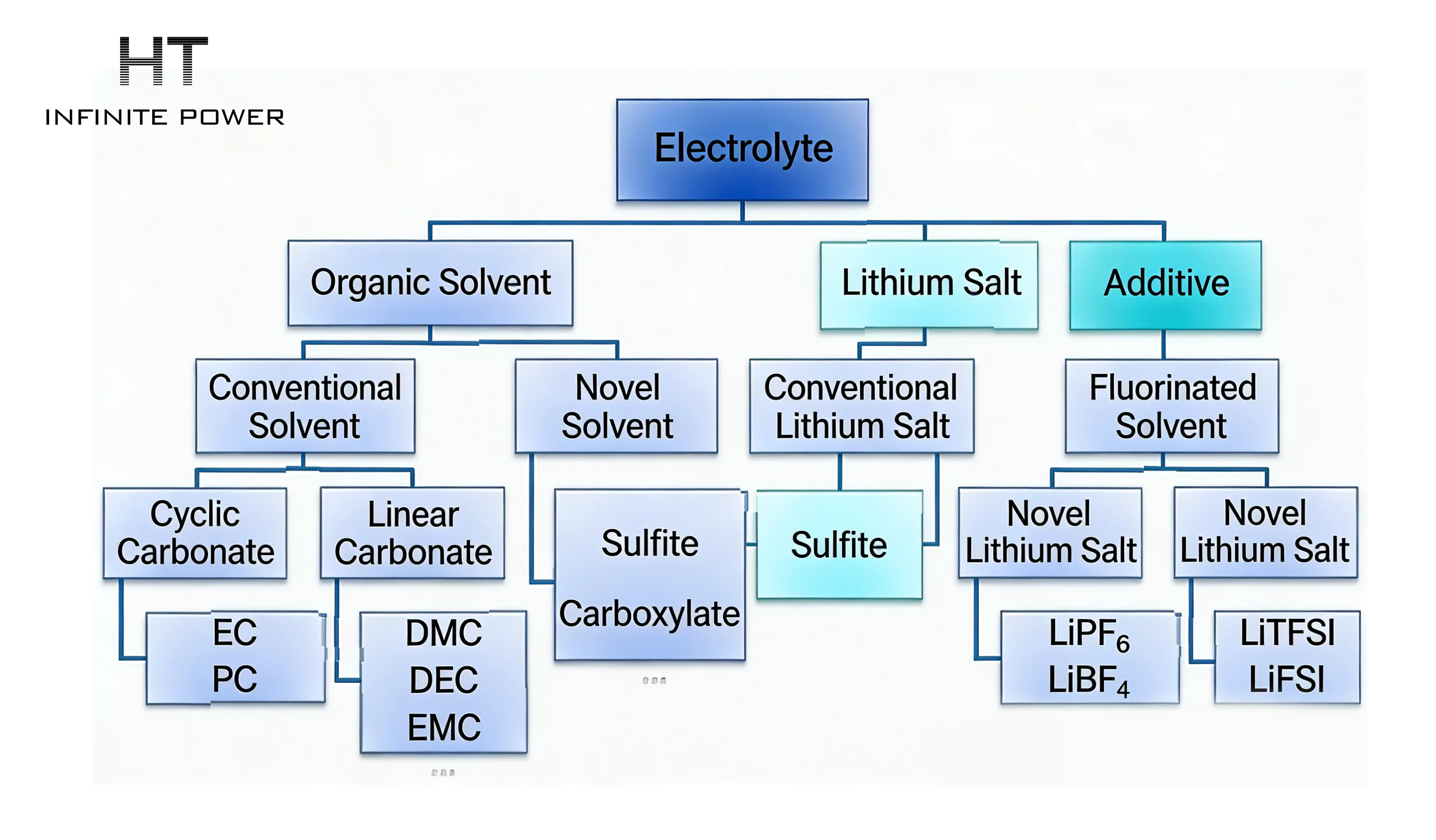
An electrolyte is not a single substance. It is a carefully formulated mixture of organic solvents, lithium salts, and functional additives, blended in precise proportions. Each component plays a distinct role, and together they ensure efficient and stable battery operation.
Organic solvents form the “structural backbone” of the electrolyte, functioning much like a “highway” for lithium-ion transport. They are mainly divided into cyclic carbonates and linear carbonates. Common examples include ethylene carbonate (EC), propylene carbonate (PC), dimethyl carbonate (DMC), diethyl carbonate (DEC), and ethyl methyl carbonate (EMC). These solvents differ significantly in their properties. Cyclic carbonates such as EC have a high dielectric constant and dissolve lithium salts effectively, but they also exhibit relatively high viscosity. Linear carbonates such as DMC and EMC have much lower viscosity, which enhances ion mobility, though their dielectric constants are lower. In practical formulations, multiple solvents are typically blended—for example, combining EC with DMC and EMC—to balance lithium salt solubility with reduced viscosity and improved ionic transport efficiency. In commercial electrolytes, solvent ratios are relatively standardized: EC typically accounts for 20–30%, DMC for 30–40%, EMC and DEC each for 10–15%, and PC for about 5–10%.
Lithium salts serve as the “ion source” of the electrolyte, effectively acting as the supply station for charge carriers. The dominant lithium salt in today’s market is lithium hexafluorophosphate (LiPF₆), which holds a leading position due to its high ionic conductivity, good electrochemical stability, and broad compatibility with existing battery systems. At the same time, next-generation lithium salts—such as lithium bis(fluorosulfonyl)imide (LiFSI), lithium bis(trifluoromethanesulfonyl)imide (LiTFSI), and lithium difluoro(oxalato)borate (LiDFOB)—are gaining traction. These alternatives offer advantages in low-temperature performance and cycle stability and are increasingly adopted in high-end battery applications.
Functional additives are the “performance enhancers” of the electrolyte. Although their dosage is small—typically less than 5%—their impact is critical. Depending on their function, additives can be classified into film-forming additives, flame-retardant additives, and low-temperature additives. Film-forming additives such as fluoroethylene carbonate (FEC) and vinylene carbonate (VC) promote the formation of a stable solid electrolyte interphase (SEI) on electrode surfaces, reducing parasitic reactions between the electrolyte and electrodes. Flame-retardant additives, often phosphate-based, improve electrolyte safety by lowering the risk of combustion. Low-temperature additives, such as DTD, enhance electrolyte fluidity under cold conditions, supporting improved battery performance in low-temperature environments.
1.2 Production Process: “Precision Manufacturing” Under Tight Control
Although electrolyte production may appear straightforward, it places extremely stringent requirements on purity and environmental control. The core process can be divided into three main stages: raw material pretreatment, formulation and mixing, and inspection and filling.
Raw material pretreatment is the foundation of electrolyte quality assurance. Organic solvents and lithium salts must undergo strict dehydration and de-alcoholization processes, with moisture content being the most critical control parameter. Excessive water leads to lithium salt hydrolysis and the formation of acidic byproducts, which can severely degrade electrolyte performance. Industrially, techniques such as distillation and thermal drying are used to reduce moisture levels to the ppm range (10⁻⁶), while high-end electrolyte products often require moisture contents below 10 ppm.
Formulation and mixing represent the core step of the process and must be carried out under strict inert gas protection—typically nitrogen—to prevent moisture and oxygen from entering the system. Dehydrated organic solvents are first charged into a mixing vessel according to the formulation ratio, and cooling systems are activated. Lithium salt is then added gradually under continuous stirring, with close temperature monitoring. Because lithium salt dissolution is exothermic, excessive temperature rise can compromise electrolyte stability. For this reason, lithium salt is introduced in small, controlled increments to keep the temperature within a safe range. Finally, functional additives are added, and the mixture is thoroughly stirred until a uniform and stable electrolyte system is obtained.
The inspection and filling stage ensures batch consistency and product reliability. After mixing, the electrolyte is sampled and tested for key parameters such as ionic conductivity, moisture content, acidity, and viscosity. Once qualified, the electrolyte is filled into stainless steel containers using pressure-filling techniques. After a controlled resting period, the product is packaged and transferred to storage. Throughout the entire production process, continuous monitoring is required to prevent contamination and to ensure stable performance across all batches.

1.3 Key Technical Indicators: the “Core Parameters” That Define Electrolyte Performance
The performance of an electrolyte is determined by a combination of technical indicators. Requirements vary significantly across application scenarios, but the core parameters generally include the following seven aspects.
Ionic conductivity
This is the primary indicator of lithium-ion transport efficiency and directly affects a battery’s high-rate charge and discharge capability. Typical electrolyte conductivity ranges from 5 to 15 mS/cm. Higher conductivity enables faster lithium-ion migration and better high-current performance. Conductivity is influenced by lithium salt concentration and solvent composition. For example, increasing lithium salt concentration can improve conductivity, but excessive concentration raises viscosity and ultimately reduces ion transport efficiency.
Moisture content
Moisture is the electrolyte’s “most critical enemy” and must generally be controlled below 20 ppm, with an ideal target below 10 ppm. Water reacts with lithium salts to generate acidic species such as HF, which corrode electrode materials, damage the SEI layer, accelerate capacity fade, shorten cycle life, and in severe cases create safety risks.
Acidity
Acidity is typically evaluated based on HF content. Excessive acidity accelerates electrode corrosion and electrolyte decomposition, triggering parasitic reactions that degrade battery performance. In most applications, acidity is required to remain below 50 ppm, while high-end batteries impose even stricter limits.
Acidity is typically evaluated based on HF content. Excessive acidity accelerates electrode corrosion and electrolyte decomposition, triggering parasitic reactions that degrade battery performance. In most applications, acidity is required to remain below 50 ppm, while high-end batteries impose even stricter limits.
Viscosity
Viscosity determines the resistance to lithium-ion migration; lower viscosity is generally preferred. It is mainly governed by solvent formulation. A higher proportion of linear carbonates results in lower viscosity, whereas higher contents of cyclic carbonates and lithium salts increase viscosity. Under low-temperature conditions, electrolyte viscosity rises sharply, which is a key reason for the poor low-temperature performance of conventional lithium batteries.
Viscosity determines the resistance to lithium-ion migration; lower viscosity is generally preferred. It is mainly governed by solvent formulation. A higher proportion of linear carbonates results in lower viscosity, whereas higher contents of cyclic carbonates and lithium salts increase viscosity. Under low-temperature conditions, electrolyte viscosity rises sharply, which is a key reason for the poor low-temperature performance of conventional lithium batteries.
Density
Density is primarily influenced by the ratio of solvents to lithium salts and typically falls in the range of 1.0–1.5 g/mL. Excessive density increases battery weight and reduces gravimetric energy density. Therefore, electrolyte formulations should aim to minimize density while maintaining performance.
Density is primarily influenced by the ratio of solvents to lithium salts and typically falls in the range of 1.0–1.5 g/mL. Excessive density increases battery weight and reduces gravimetric energy density. Therefore, electrolyte formulations should aim to minimize density while maintaining performance.
Color
A qualified electrolyte should be colorless and transparent, with acceptable color values generally below 50. Improper processing or unsuitable additive selection can lead to darkening of the electrolyte, which is usually classified as a defective product.
A qualified electrolyte should be colorless and transparent, with acceptable color values generally below 50. Improper processing or unsuitable additive selection can lead to darkening of the electrolyte, which is usually classified as a defective product.
Ionic impurities
These mainly include metal ions such as copper and iron. Such impurities can trigger side reactions within the battery, negatively affecting safety and cycle stability. High-end battery manufacturers impose strict limits, typically requiring ionic impurity levels below 1 ppm.
These mainly include metal ions such as copper and iron. Such impurities can trigger side reactions within the battery, negatively affecting safety and cycle stability. High-end battery manufacturers impose strict limits, typically requiring ionic impurity levels below 1 ppm.
In practice, an ideal electrolyte must strike a balance among high ionic conductivity, low viscosity, a wide electrochemical stability window, and long-term stability. However, these properties often conflict with one another. For example, solvents with high dielectric constants enhance lithium salt solubility but usually exhibit higher viscosity; increasing lithium salt concentration improves conductivity but raises viscosity and cost. As a result, electrolyte formulation is fundamentally an exercise in carefully balancing competing performance requirements.
II. Industry Pain Points: the “Performance Bottleneck” in Low-Temperature Environments
Although electrolyte technology has become increasingly mature, traditional electrolytes still face fundamental performance bottlenecks under extreme conditions—especially at low temperatures. This limitation has become a key factor restricting the application range of lithium batteries.
For conventional lithium batteries operating below –30 °C, capacity loss can reach 50–70%, and in some cases normal charging and discharging becomes impossible. The root cause lies in the severe degradation of electrolyte properties at low temperatures. On the one hand, low temperatures cause electrolyte viscosity to increase sharply, significantly raising the resistance to lithium-ion transport—much like blood thickening or coagulating in cold conditions—thereby drastically reducing transport efficiency. On the other hand, conventional electrolytes suffer from inherent deficiencies in their solvation structure.
In traditional carbonate-based electrolytes, different solvents exhibit substantial differences in polarity, dielectric constant, and affinity for lithium ions. Strongly polar solvents such as ethylene carbonate (EC) have very high dielectric constants and a strong tendency to bind lithium ions, forming dense, multilayer solvation shells. In contrast, weakly polar solvents such as dimethyl carbonate (DMC) and ethyl methyl carbonate (EMC) have much lower dielectric constants, interact weakly with lithium ions, and contribute little to stable coordination. More critically, the dielectric constant difference between these solvents can be as high as 86.6, leading to a highly imbalanced solvation structure. Because EC has a much higher affinity for lithium ions, more than 65% of lithium-ion coordination sites are dominated by EC molecules, resulting in most lithium ions being tightly encapsulated and poorly interacting with weakly polar solvents.
This imbalanced solvation state creates a significant barrier to lithium-ion migration. Under low-temperature conditions, lithium ions densely wrapped by EC molecules must overcome a high energy barrier to escape the solvation shell, causing a sharp reduction in ion mobility and a pronounced decline in battery performance. When temperatures drop below –40 °C, conventional electrolytes gradually lose fluidity and begin to freeze. At this point, lithium ions can no longer break free from the solvation shell or move through the frozen electrolyte medium, transport effectively ceases, and the battery completely loses its ability to operate.
This challenge severely limits the deployment of lithium batteries in cold-climate electric vehicles, polar research equipment, high-altitude drones, and low-temperature energy storage systems. As the new energy industry continues to expand, demand for low-temperature-capable electrolytes is growing rapidly. Developing electrolytes that can maintain high efficiency under extreme cold has therefore become a critical technical challenge that the industry must urgently overcome.

III. Technological Breakthrough: Breaking the Ice at –110 °C
In response to the low-temperature limitations of conventional electrolytes, a recent study published by a Chinese research team has achieved a major breakthrough. By introducing an innovative concept known as “polarity gradient engineering,” the team successfully overcame this long-standing industry challenge, enabling lithium batteries to operate efficiently even under extreme cold conditions as low as –110 °C.
3.1 Innovative Concept: From “Single-Parameter Optimization” to “Coordinated Compatibility”
Traditional approaches to low-temperature electrolyte development have largely focused on identifying single solvents with low freezing points or reducing viscosity through solvent dilution. While these methods offer incremental improvements, their effectiveness is limited and often comes at the expense of room-temperature performance. Departing from this conventional framework, the Chinese research team moved beyond single-solvent optimization and instead reconstructed the electrolyte solvation system through molecular design, establishing a coordinated, performance-balanced solvent architecture.
The core innovation lies in structural modification of solvent molecules. By replacing carbon atoms in conventional carbonate solvent backbones with larger sulfur atoms, the team synthesized two novel solvents: ethyl sulfite (ES) and dimethyl sulfoxide (DMS). This substitution led to a dramatic reduction in dielectric constant disparity between solvents—from 86.6 to just 17.1—significantly narrowing polarity differences and equalizing their affinity for lithium ions. At the same time, the larger atomic radius and unique chemical properties of sulfur smooth intermolecular interactions, effectively preventing excessive lithium-ion adsorption by any single solvent species.
Building on this foundation, methyl isobutyrate (IF) was introduced as a “coordinating component” to further lower viscosity and freezing point. The result is a new electrolyte system composed of ES, DMS, IF, and a lithium salt (LiDFOB). In this system, each component plays a complementary role, fundamentally changing the fragmented behavior of solvents in conventional electrolytes and forming a highly cooperative lithium-ion transport network.
3.2 Microscopic Mechanism: “Lightweight” Lithium-Ion Migration
Through molecular dynamics simulations and spectroscopic analysis, the researchers elucidated the microscopic working mechanism of the new electrolyte. Its key advantage lies in the reconstruction of lithium-ion solvation structures and transport pathways.
In conventional electrolytes, lithium ions are tightly wrapped by strongly polar solvent molecules, forming dense solvation shells. During migration, ions must drag multiple solvent molecules along, resulting in high energy consumption and slow transport. In the newly developed electrolyte, however, DFOB⁻, ES, DMS, and IF form a homogeneous, balanced solvation sheath. Lithium ions are no longer strongly bound to large numbers of solvent molecules; instead, they migrate in a lightweight, low-steric-hindrance coordination with DFOB⁻ and IF. This significantly reduces transport resistance under low-temperature conditions and ensures efficient ion mobility.
This partially solvated transport mechanism not only lowers the energy barrier for lithium-ion migration but also suppresses undesirable side reactions. Moreover, the homogeneous solvation structure promotes the formation of a stable interfacial protective layer on electrode surfaces—namely, a high-performance SEI film rich in LiF and B–O components. This SEI combines high ionic conductivity with structural stability, reducing the activation energy for interfacial ion transport by 45–56% and further enhancing low-temperature battery performance.
3.3 Performance Milestone: Stable Operation from –60 °C to –110 °C
In terms of physical stability, the electrolyte remains clear and liquid after standing for one hour at –110 °C, whereas conventional carbonate-based electrolytes typically freeze at around –40 °C. Even at –80 °C, its ionic conductivity reaches 1 mS·cm⁻¹, effectively maintaining “unobstructed blood flow” for lithium-ion transport under extreme cold conditions.
Battery-level performance is equally impressive. A 7.5 Ah pouch cell (energy density: 450 Wh·kg⁻¹) using this electrolyte delivers outstanding results. At –20 °C, after 400 cycles at 0.5C, capacity retention remains at 81%, far exceeding that of cells with traditional electrolytes (typically below 60%). At –60 °C, the battery can still deliver 73% of its room-temperature capacity with stable charge–discharge efficiency. Remarkably, even at –110 °C, the battery continues to operate normally, marking a breakthrough in lithium battery performance under extreme cold environments.
The significance of this technological advance goes beyond record-breaking temperature limits. More importantly, it establishes a broadly applicable electrolyte design strategy: regulating solvation structures at the atomic scale to systematically resolve the long-standing trade-off between ion conduction and desolvation. This approach provides a new direction for future electrolyte development and opens the door to lithium battery applications in a much wider range of extreme environments.

IV. Industry Trends: The “Future Direction” of Electrolyte Technology
As lithium-ion battery applications continue to expand—and as performance requirements rise across new energy vehicles, energy storage, and consumer electronics—the electrolyte industry is moving rapidly toward greater diversification, higher performance, and greener development.
4.1 Low-temperature electrolytes: from niche use cases to large-scale adoption
Breakthroughs in electrolytes for extreme cold environments are opening up new application spaces for lithium-ion batteries. In the new energy vehicle sector, low-temperature electrolytes can address winter range loss and charging difficulties in northern regions, improving the environmental adaptability of electric vehicles. In specialized equipment, they can meet the energy demands of polar research, high-altitude operations, and military equipment deployed in cold climates. In consumer electronics, they allow devices such as smartphones and laptops to function reliably at low temperatures, enhancing the user experience.
Looking ahead, low-temperature electrolytes are expected to transition gradually from specialized scenarios to large-scale commercial applications. Industry efforts will focus on maintaining low-temperature performance while optimizing room-temperature cycle life and cost control, accelerating industrialization. Over the next three to five years, the market for low-temperature electrolytes is expected to grow rapidly, becoming a key growth driver for the electrolyte sector.
4.2 High energy density orientation: continuous upgrading of formulation systems
As requirements for driving range in electric vehicles and energy density in storage systems continue to rise, high-voltage and high-energy-density electrolytes have become a major R&D focus. On one hand, the development of new lithium salts (such as LiFSI and LiTFSI) and functional additives enhances electrochemical stability, enabling compatibility with high-voltage cathode materials above 4.5 V. On the other hand, solvent formulations are being optimized to improve ionic conductivity and energy density while maintaining safety.
At the same time, the commercialization of new electrode materials—such as silicon-based anodes and high-nickel ternary cathodes—places higher demands on electrolytes. Silicon-based anodes can undergo volume expansion of up to 300% during charge–discharge cycles, requiring electrolytes that form stable SEI films to suppress performance degradation caused by expansion. High-nickel cathodes exhibit high chemical reactivity and are prone to side reactions with electrolytes, necessitating stronger oxidation resistance and overall stability. As a result, dedicated electrolytes tailored to emerging electrode materials will become a key focus of future development.
4.3 Impact of solid-state batteries: transformation and coexistence of electrolytes
All-solid-state batteries are widely regarded as an important next-generation lithium battery technology. By replacing traditional liquid electrolytes with solid electrolytes, they offer higher safety and energy density. However, solid-state batteries still face challenges such as high interfacial resistance, high costs, and difficulties in large-scale manufacturing. Full replacement of liquid lithium-ion batteries will therefore take considerable time.
In the short term, liquid electrolytes will remain dominant, while semi-solid batteries are expected to serve as a critical transitional solution. Semi-solid batteries adopt a hybrid system combining liquid electrolytes with solid electrolytes, retaining the high ionic conductivity of liquid electrolytes while improving safety and energy density. This trend will drive the electrolyte industry toward “liquid–solid hybrid” solutions and the development of new electrolyte systems compatible with semi-solid batteries.
4.4 Green development and cost reduction: core requirements for sustainable growth
Under dual-carbon goals, green development has become an inevitable trend for the electrolyte industry. On one hand, environmentally friendly solvents and additives are being developed to reduce environmental impact during production and use. On the other hand, manufacturing processes are being optimized to lower energy consumption and waste emissions, enabling cleaner production.
Meanwhile, cost control remains a core competitive factor. Lithium hexafluorophosphate, the mainstream lithium salt, is highly sensitive to price fluctuations of raw materials such as lithium and fluorine. In the future, the industry will reduce lithium salt consumption through technological innovation, develop low-cost alternative materials, and optimize formulation ratios. These efforts aim to lower electrolyte costs while maintaining performance, thereby supporting the large-scale development of the lithium-ion battery industry.
V. Conclusion: Electrolytes—the “Invisible Core” of the Lithium Battery Industry
From everyday consumer electronics to large-scale energy storage systems, and from room-temperature operation to extreme cold environments, electrolytes—often described as the “blood” of lithium batteries—remain a decisive factor governing battery performance, safety, and application scope. Advances in electrolyte technology not only drive continuous progress in the lithium battery industry, but also steadily expand the boundaries of new energy applications.
At the foundational level, electrolyte composition, production processes, and key technical parameters form the bedrock of industry development. Refined formulation design and rigorous quality control are essential prerequisites for stable and reliable battery operation. At the level of industry pain points, low-temperature performance limitations have long constrained the broader deployment of lithium batteries. The emergence of innovative approaches such as “polarity gradient engineering” has introduced new pathways to address this challenge, enabling breakthroughs from −40 °C down to −110 °C.
Looking ahead, as application demands continue to rise and technological innovation accelerates, the electrolyte industry is expected to evolve toward a more diversified development landscape. Low-temperature electrolytes, high-energy-density electrolytes, and semi-solid electrolytes will progress in parallel, with green development, cost reduction, and high performance becoming the core strategic directions. At the same time, coordinated innovation among electrolytes, electrode materials, and battery architectures will collectively propel the lithium battery industry to a new level of advancement.
What is a Solid-State Transformer (SST)?
Power Quality Compensation vs Peak Shaving in BESS
Related Article