Latest Trends in Large-Capacity Energy Storage Cells
2025-11-28
As the global energy mix accelerates toward renewables, energy storage systems play a critical role in balancing grid fluctuations and maximizing green electricity utilization. The demand for cost reduction and efficiency improvement has become increasingly urgent. In this context, the move toward large-capacity battery cells has become a key industry focus. Cell capacities have rapidly increased from 280Ah and 314Ah to over 500Ah, with some products exceeding 600Ah, significantly shortening the iteration cycle.
However, while larger cells can reduce overall system costs, they also bring a series of technical challenges and require rigorous validation by investors regarding their lifecycle safety and economic performance. This article examines the intrinsic logic and future trajectory of large-capacity cell development from multiple dimensions, including technology, market trends, and manufacturing processes.
1. Layout and Deployment of Large-Capacity Cells
As the energy storage industry increasingly pursues cost reduction and efficiency gains, battery cell technology is rapidly moving toward higher capacities. In recent years, multiple cell manufacturers have launched or planned products exceeding 500Ah, with iteration speeds accelerating noticeably. While the transition from 280–300Ah to just over 300Ah once required several years of technical validation, the leap from 300+Ah to 500Ah or even 600Ah has occurred within a significantly shorter timeframe, reflecting strong market demand for high-capacity solutions.
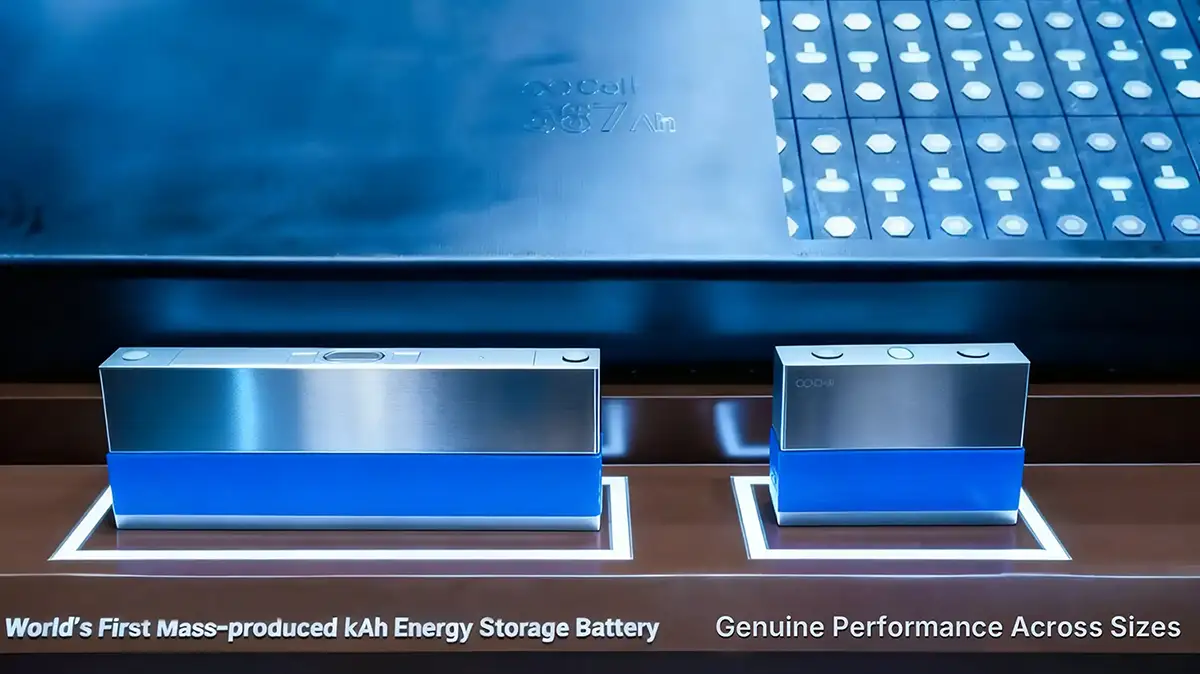
Manufacturers are showing clear differentiation in their chosen technical paths. Some aim to leverage large-capacity cells to strengthen their position in long-duration storage projects, while others emphasize “cell-to-system” co-design, seeking competitive advantage through integrated optimization. At the same time, certain teams continue to focus on medium-capacity specifications, targeting different storage applications with greater flexibility. The market, therefore, accommodates multiple strategies evolving in parallel.
Although large-capacity cells have become a widely explored industry trend, full acceptance of this technical path by project investors will require time. Only after accumulating sufficient operational data from real-world projects can the true performance of large cells—regarding reliability, thermal management, and lifecycle economics—be adequately assessed and recognized by the market.
2. Why Large-Capacity Cells Are Pursued
Battery cells represent the most valuable component of an energy storage system and are the primary arena for iterative innovation in storage integration technology, directly determining system configuration and overall integration strategy.
The fundamental rationale for large-capacity cells lies in increasing the individual cell capacity to reduce the total number of cells, components, and overall footprint required for the system, thereby lowering the total investment cost of an energy storage plant.
For example, CATL’s 587Ah cells can reduce the number of system components by 20% while improving space utilization by 30%. Fewer cells translate into significant reductions in auxiliary materials such as connectors, fuses, and BMS wiring harnesses.
From an operational perspective, for a storage system of equivalent total capacity, fewer large cells mean fewer potential failure points, reduced monitoring and maintenance complexity, and consequently lower full-lifecycle operational costs.
3. Technical Challenges of Large-Capacity Cells
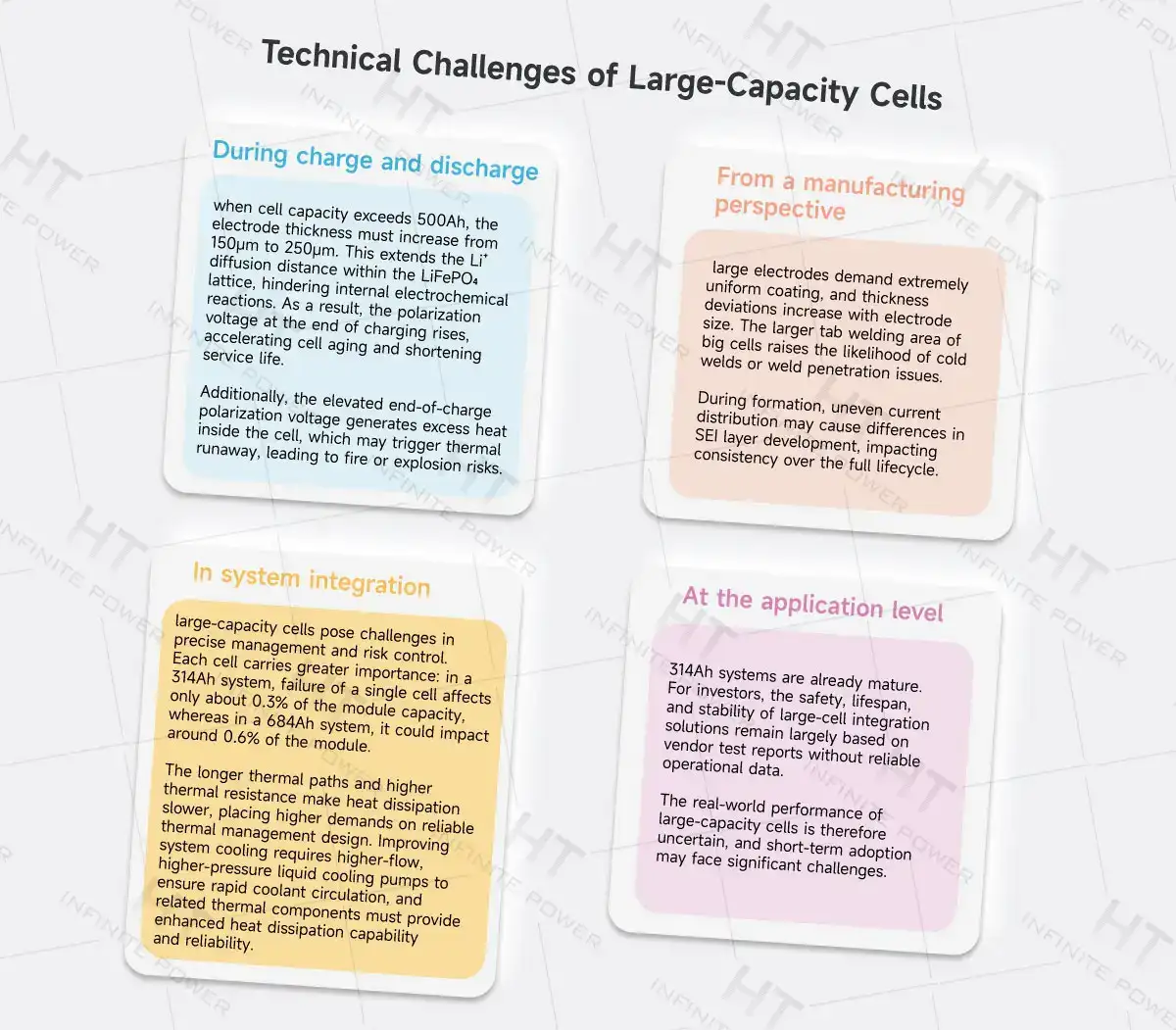
During charge and discharge, when cell capacity exceeds 500Ah, the electrode thickness must increase from 150μm to 250μm. This extends the Li⁺ diffusion distance within the LiFePO₄ lattice, hindering internal electrochemical reactions. As a result, the polarization voltage at the end of charging rises, accelerating cell aging and shortening service life. Additionally, the elevated end-of-charge polarization voltage generates excess heat inside the cell, which may trigger thermal runaway, leading to fire or explosion risks.
From a manufacturing perspective, large electrodes demand extremely uniform coating, and thickness deviations increase with electrode size. The larger tab welding area of big cells raises the likelihood of cold welds or weld penetration issues. During formation, uneven current distribution may cause differences in SEI layer development, impacting consistency over the full lifecycle.
In system integration, large-capacity cells pose challenges in precise management and risk control. Each cell carries greater importance: in a 314Ah system, failure of a single cell affects only about 0.3% of the module capacity, whereas in a 684Ah system, it could impact around 0.6% of the module. The longer thermal paths and higher thermal resistance make heat dissipation slower, placing higher demands on reliable thermal management design. Improving system cooling requires higher-flow, higher-pressure liquid cooling pumps to ensure rapid coolant circulation, and related thermal components must provide enhanced heat dissipation capability and reliability.
At the application level, 314Ah systems are already mature. For investors, the safety, lifespan, and stability of large-cell integration solutions remain largely based on vendor test reports without reliable operational data. The real-world performance of large-capacity cells is therefore uncertain, and short-term adoption may face significant challenges.
Consequently, large-capacity cells will not achieve immediate large-scale deployment. Cell manufacturers must balance process difficulty, cost, and market acceptance, while investors must consider cell safety, economic benefits, and ease of replacement.
4. Manufacturing Processes
Due to differences in research directions and technical experience among companies, approaches to large-capacity cell fabrication vary. For 500Ah+ cells, the main manufacturing methods are stacking and winding.
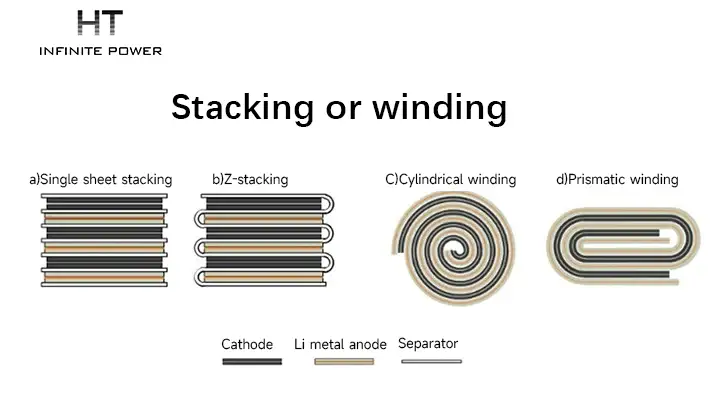
Advantages of stacking: Stacked electrodes form a layered structure without bending, making full use of the internal cell space. Compared with winding, stacking achieves higher energy density, lower internal resistance, reduced temperature rise, better rate performance, and improved safety.
Disadvantages of stacking: Electrodes must be cut before stacking, and the cut edges can produce burrs and dust, creating potential internal short-circuit risks. Precise control of burrs and alignment is required, demanding high-precision semi-automatic or fully automatic equipment, which increases both equipment and production costs.
Advantages of winding: High-speed rotation forms the rolled core, with fewer mechanical steps and shorter auxiliary time, resulting in higher production efficiency. Winding requires only two spot welds per cell, making operation simpler. Additionally, winding machines are relatively inexpensive, leading to lower capital investment.
Disadvantages of the winding process: because the wound cells have a single tab for each electrode, part of the voltage is lost to internal polarization, resulting in relatively poor charge/discharge rate performance. During winding, the tensile forces on electrodes and separators can be uneven, causing wrinkles and electrode expansion/contraction, which negatively affects cycle life.
5. Unified or Divergent Specifications
As industry standards and technical norms continue to mature, energy storage systems are evolving toward a more market-oriented, full-life-cycle approach in investment and operational assessments. Meanwhile, consensus is gradually forming around key cell parameters such as thermal runaway warning thresholds and cycle life, and communication protocols and state-monitoring parameters between the BMS and cells are becoming more compatible and standardized. As a result, cells of different sizes can more easily integrate into the same monitoring and O&M framework, making system-level adaptation feasible and more standardized.
In the short term, different markets prioritize capacity, energy density, cost, and safety differently. This divergence in demand drives differentiation in cell specifications. It is expected that 314Ah, 392Ah, and 500Ah+ cells will complement each other across different application scenarios: the smaller capacities are better suited for 2–4 hour short- to medium-duration storage, while 500Ah+ cells are more suitable for long-duration storage of 4 hours or more. Intensifying market competition also leads to strategic differences: leading manufacturers may focus on a single specification to set the next-generation standard, while small and mid-sized players may adopt multiple specifications to cover broader customer needs. In the short term, this results in a diverse and coexisting market landscape.
In the long term, as system durations increase and large-cell manufacturing processes continue to improve, specifications such as 530Ah, 587Ah, and 684Ah will undergo rigorous application-side testing. Their impact on overall station structure, thermal management strategy, and system reliability will gradually become apparent, influencing integrators’ technology choices. From a manufacturing perspective, winding processes, with their cost and yield advantages, will remain competitive in the sub-600Ah market in the near term. Stacking/lamination processes, offering more uniform internal stress distribution and lower heat generation, will be more competitive in the 600Ah+ large-cell segment.
6. Trend Outlook
The evolution of cells toward higher capacities is not simply a matter of “bigger is better.” For large-capacity cells to gain market acceptance, the technology pathway must be reconsidered at the system level: from energy storage system architecture and AC-side distribution requirements to subsequent operation and maintenance strategies, all aspects must be optimized in coordination. Only by achieving synergy in reliability, thermal management, grid compatibility, and O&M complexity can large-capacity cells reduce the levelized cost of storage (LCOS) while ensuring safety and stability, thereby earning genuine recognition from investors.
Comparative Analysis of Primary and Secondary Frequency Regulation in Energy Storage Power Stations
Analysis of the Core Factors Affecting the Operational Performance of Energy Storage Power Stations