Hybrid Storage (Li-ion + H₂ / Flow): System Integration & Dispatch Logic for Industrial Sites
2025-11-12
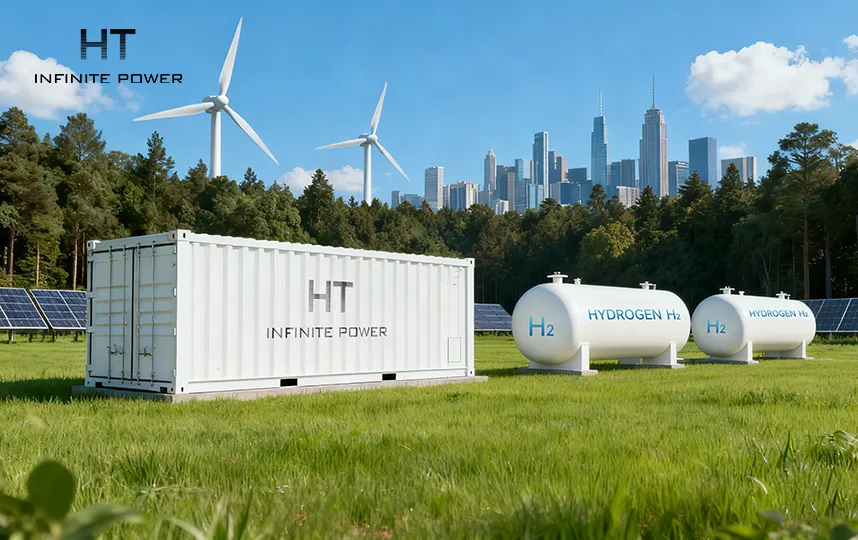
Industrial facilities today are grappling with a new paradox: the need for instantaneous power response and simultaneously storing large amounts of energy over long durations. Renewable integration, peak-demand pricing, and resilience requirements make traditional single-technology storage suboptimal. Hybrid energy storage, combining lithium-ion batteries with hydrogen or flow batteries, is emerging as a robust solution. By leveraging the complementary strengths of fast-response Li-ion cells and long-duration H₂ or flow systems, operators can achieve both agility and endurance without sacrificing equipment lifespan.
Understanding the Complementary Nature of Hybrid Storage
Lithium-ion batteries excel in rapid discharge and recharge cycles, delivering high round-trip efficiency and millisecond-level response. They are ideal for peak shaving, grid stabilization, and frequency regulation. However, repeated deep cycling reduces battery lifespan, making Li-ion less efficient for long-duration energy shifting.
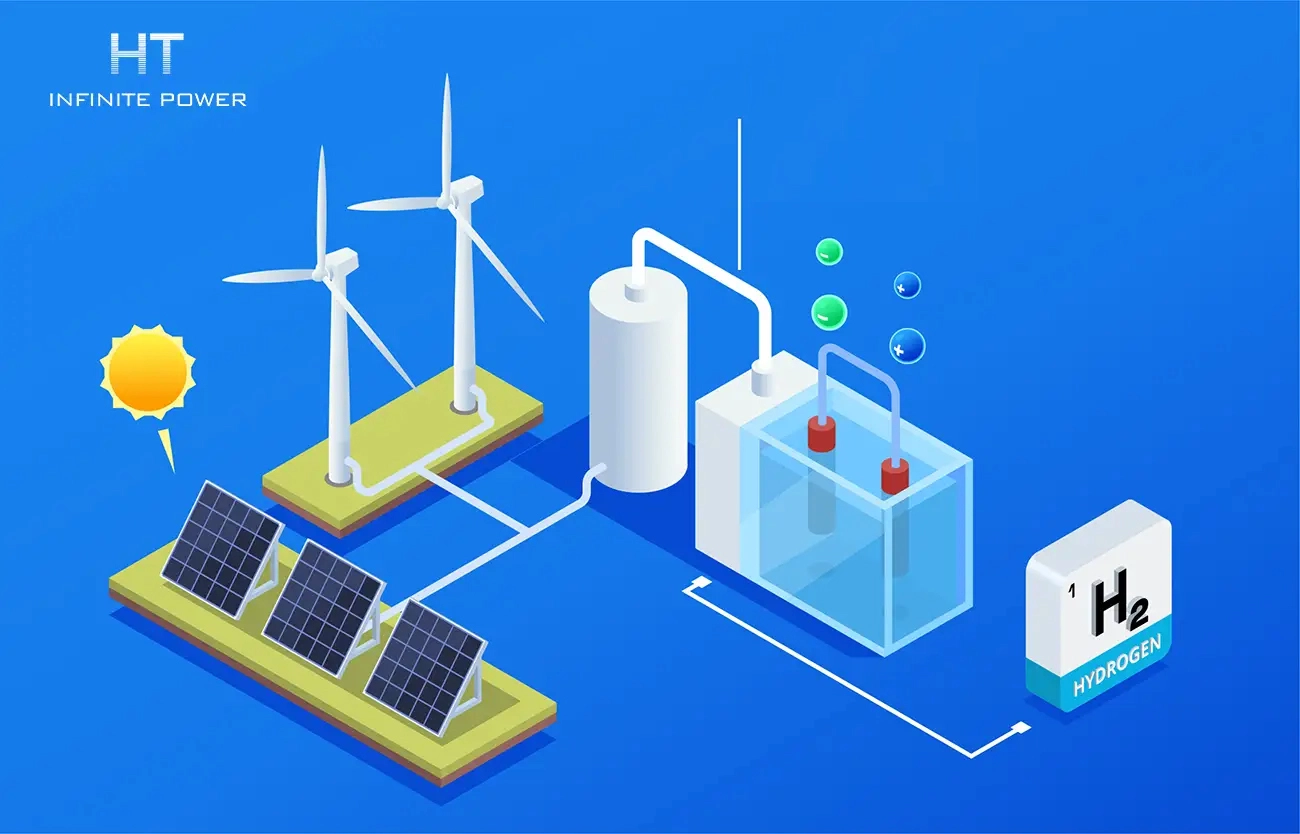
Hydrogen storage, generated via electrolysis and converted back through fuel cells, or flow batteries with their decoupled energy/power design, offer extended duration storage with minimal cycle degradation. While round-trip efficiency is lower than Li-ion (typically 20–50% for H₂ systems), these technologies can store energy for hours or days, enabling industrial sites to shift energy use or store renewable surpluses without excessive stress on fast-tier assets.

Typical Hybrid Architectures
A well-integrated hybrid system rarely relies on a single asset. Common industrial configurations include:
-
Front-end power interface: MV/LV switchgear, transformers, and a primary power conversion system that orchestrates flows between generation, loads, and storage.
-
Fast-response tier (Li-ion): Handles sub-hour operations, frequency response, and peak shaving. Battery sizing depends on C-rate, site demand, and desired contingency margins.
-
Long-duration tier (H₂ or flow): Electrolyzers, hydrogen storage tanks, fuel cells, or flow stacks store energy over multi-hour cycles. DC-coupling or coordinated AC-coupling with converters is typical.
-
Energy Management System (EMS): Manages forecasts, dispatch logic, degradation limits, and safety parameters.
-
Safety infrastructure: Thermal management, hydrogen sensors, electrolyte containment, and emergency protocols.
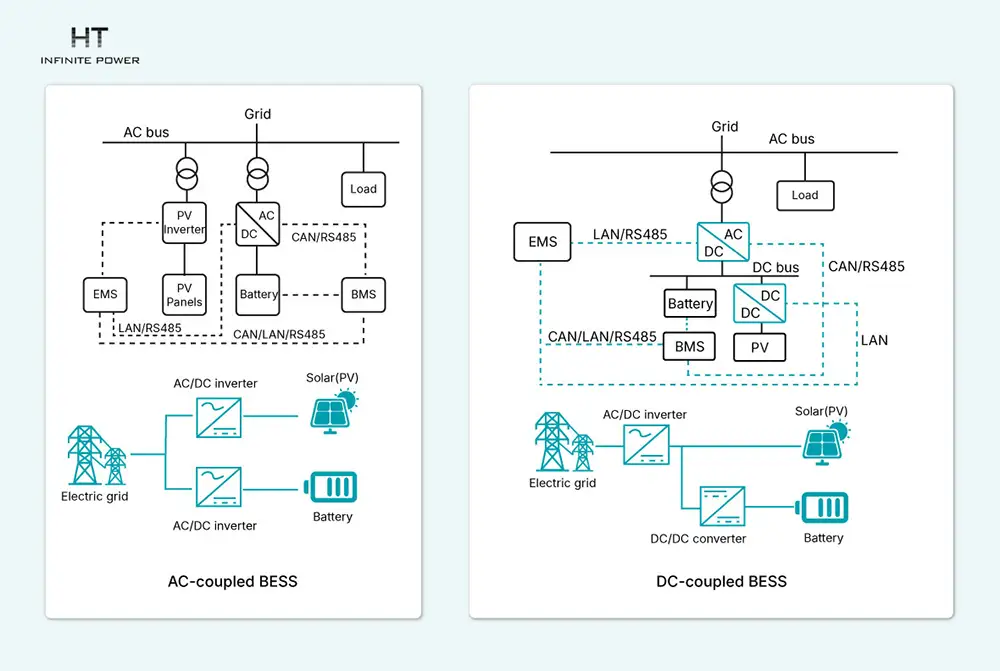
Electrical Coupling Choices
-
DC-coupled: Simplifies power flow and reduces conversion losses, but requires sophisticated bus protection.
-
AC-coupled: More flexible for retrofits and modular expansion; may incur slightly higher losses but simplifies safety compliance.
Dispatch Logic and Prioritization
Effective hybrid operation requires dispatch rules spanning multiple time horizons:
Real-Time (Seconds → Minutes)
- Battery responds to rapid load fluctuations, grid disturbances, or frequency events.
- SOC (State of Charge) margins and thermal limits are enforced to protect longevity.
Short-Term (Minutes → Hours)
- Battery executes economic dispatch: peak shaving, renewable absorption, and intra-day arbitrage.
- EMS constraints prevent deep cycling, optimize efficiency, and allocate fast-response resources.
Long-Term (Hours → Days)
- Hydrogen or flow systems provide extended storage for multi-hour or multi-day events.
- Dispatch targets minimizing energy purchase costs, preserving fast-tier SOC, and meeting reliability requirements.
Technical Formulas and Control Principles
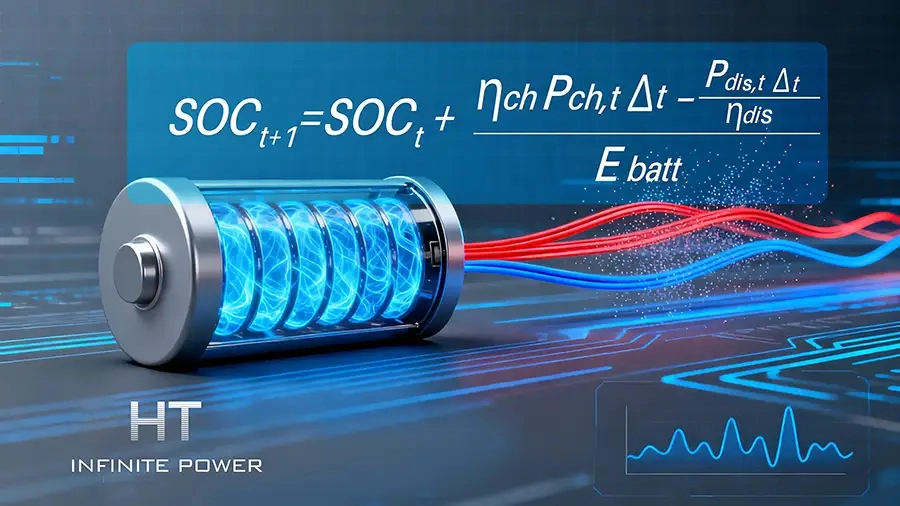
Battery SOC evolution:
SOCt+1 = SOCt + ηch·Pch,i·Δt − (Pdis,t·Δt)/ηdis Ebatt
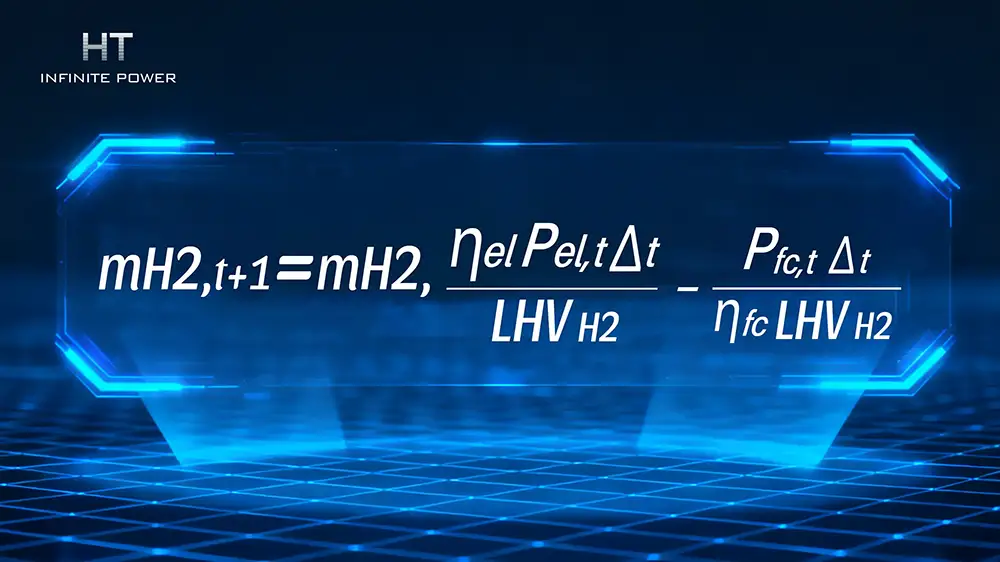
Hydrogen mass balance:
mH2,t+1 = mH2,t + ηelPel,tΔt LHVH2 − Pfc,tΔt ηfcLHVH2
H₂ round-trip efficiency: RTEH2 ≈ ηel × ηfc
Economic dispatch objective:
Minimize: Total Cost=Energy Cost+Degradation Cost+Emissions Cost
Subject to power/energy constraints and SOC limits.
Sizing Guidelines and Economic Trade-offs
-
Fast-tier Li-ion: sized for peak durations and ramp support.
-
Long-tier H₂/flow: sized for daily/seasonal shifting, reducing deep cycling on batteries.
-
Hybrid sizing optimizes lifecycle costs, balancing upfront capex with operational savings.
Rule of thumb: For industrial sites, a 1–2 hour Li-ion battery paired with a hydrogen system capable of storing multiple MWh provides balanced performance.
Safety and Regulatory Considerations
-
Hydrogen requires ventilation, explosion-proof storage, and emergency response plans.
-
Flow batteries avoid combustible gases but need electrolyte containment and monitoring.
-
Compliance with local regulations can materially affect project cost and timeline.
Illustrative Example: 1 MW Industrial Site
-
Assets: 500 kW / 2 MWh Li-ion battery, 250 kW electrolyzer + fuel cell, 2 MWh H₂ tank.
-
Dispatch:
-
Li-ion charges during PV peaks or low-tariff periods.
-
Surplus PV diverts to electrolyzer when battery SOC high.
-
Real-time battery response ±200 kW for 5 minutes, maintaining SOC ≥20%.
-
Fuel cell covers multi-hour deficits, preserving battery life.
-
Emerging Trends
-
Multi-timescale stochastic optimization for renewable integration.
-
Reinforcement learning for co-optimization of capacity and dispatch.
-
Improved flow battery chemistry enhancing efficiency and reducing maintenance.
Conclusion
Hybrid energy storage fuses the agility of Li-ion batteries with the endurance of hydrogen or flow systems. Proper integration and dispatch strategy extend asset life, reduce energy costs, and provide industrial sites with both rapid response and long-duration storage. With careful design, hybrid storage resolves the classic tradeoff between speed and scale.
FAQ
Q1: Can hydrogen fully replace Li-ion for industrial loads?
A1: No. Hydrogen excels at long-duration storage but cannot match Li-ion's millisecond response or efficiency.
A1: No. Hydrogen excels at long-duration storage but cannot match Li-ion's millisecond response or efficiency.
Q2: Is a hybrid system more cost-effective than Li-ion only?
A2: Often yes for multi-hour or seasonal shifting. For short-duration services, Li-ion only may remain cheaper.
Q3: How does hybrid dispatch protect battery life?
A3: By assigning long-duration events to H₂/flow systems and reserving Li-ion for rapid, high-power events.
Q4: AC vs DC coupling: which is better?
A4: DC reduces conversion losses but increases bus design complexity; AC offers modularity and simpler retrofits.
Q5: What safety measures are critical for hydrogen storage?
A5: Ventilation, gas sensors, explosion-proofing, and comprehensive emergency protocols.
Fast-Ramp Battery Packs: Design for High C-Rate Industrial Use
Fast-Ramp Battery Packs: Design for High C-Rate Industrial Use